Research theme
Learning-Based Locomotion Control
How can legged robots learn control policies that are fast, stable, and robust enough to run on real hardware?
Reinforcement Learning Whole-Body Control Adversarial Training
Legged robots promise mobility where wheels fail — rubble, stairs, ice, soft ground. Delivering on that promise requires controllers that handle contact-rich, underactuated dynamics in real time. Pure model-based control is precise but brittle outside its assumptions; pure learning is flexible but hard to certify on hardware. My work sits deliberately at the interface of the two.
Approach
I build layered controllers that assign each layer the tool it is best suited for:
- Model-based layers (whole-body control, trajectory optimization) handle the well-understood physics: tracking body accelerations, distributing contact forces, respecting joint limits.
- Learned layers (PPO-style policy optimization, adversarial training) handle what is hard to model: terrain uncertainty, gait selection, recovery behaviors.
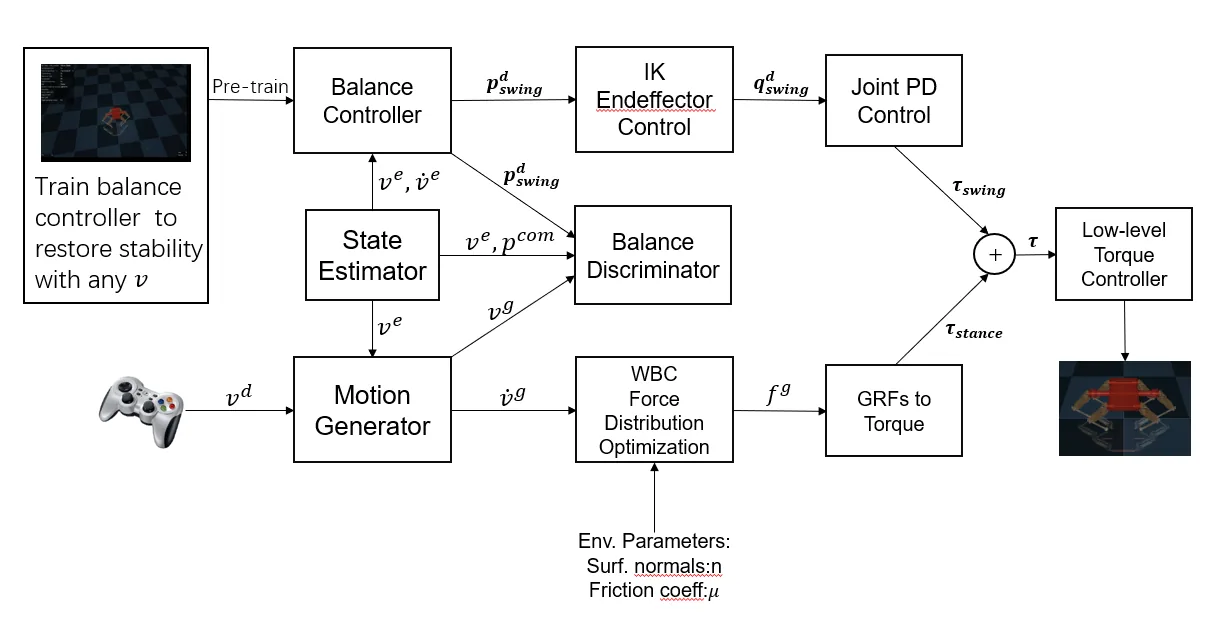
A representative example is my adversarial balancing work, which splits the control problem between two agents — stance legs driven by whole-body control to track velocity commands, and swing legs driven by a reinforcement-learning policy to keep the robot balanced. The two agents are trained adversarially, which produces faster and more stable velocity tracking than either method alone.
Representative systems
- Qingzhui, an electrically-actuated hexapod, is the primary hardware platform for locomotion experiments.
- Skating and skiing variants of the hexapod platform were deployed outdoors at real winter-sport venues for the Beijing 2022 Winter Olympics torch relay.
Open challenges
Sim-to-real transfer for contact-rich skills remains the central bottleneck. I am interested in controllers that quantify their own reliability — knowing when a learned gait will fail is as valuable as the gait itself, and it links this theme directly to my work on capability-aware planning.
Projects in this theme
Ball-Balancing Locomotion on a Quadruped
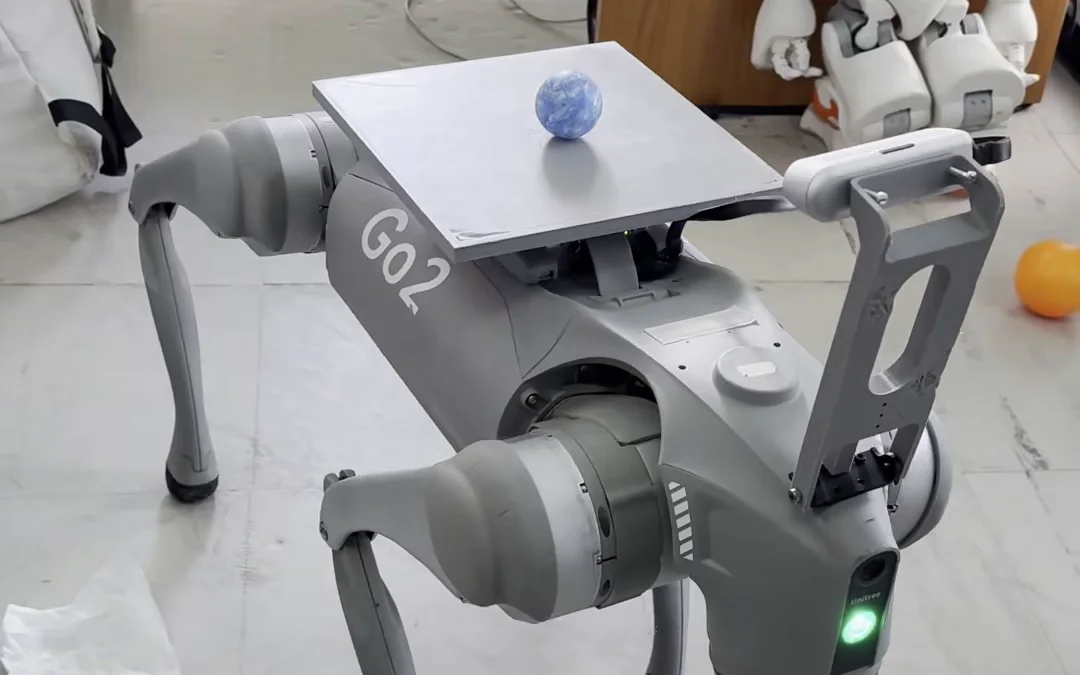
A Unitree Go2 walks while keeping a free-rolling ball balanced on a plate mounted on its back — learned in simulation, transferred to the real robot.
- Platform:
- Unitree Go2
- Methods:
- Reinforcement Learning · Sim-to-Real Transfer · Domain Randomization
Capability-Aware Locomotion for Hexapod Robots
A hierarchical learning system that teaches the Qingzhui hexapod what it can traverse — and plans long-range paths it can actually execute.
- Platform:
- Qingzhui hexapod · CoppeliaSim
- Methods:
- Reinforcement Learning · Capability Abstraction · Path Planning
Adversarial Motion Balancing for Legged Robots
Stance and swing legs as two adversarially-trained agents — whole-body control for tracking, reinforcement learning for balance.
- Platform:
- Legged robot simulation
- Methods:
- Whole-Body Control · Reinforcement Learning · Adversarial Training
Hierarchical RL Locomotion for a Six-Legged Robot
An early sim-to-real system: a reinforcement-learning planner on top of a trajectory-optimization gait controller for a hexapod.
- Platform:
- Hexapod robot · Simulation
- Methods:
- Reinforcement Learning · Trajectory Optimization · Sim-to-Real
Related publications
Role-Based Reward Decomposition for Legged Locomotion Reinforcement Learning
Changda Tian , Panos Trahanias
IEEE/RSJ International Conference on Intelligent Robots and Systems (IROS) — Accepted · 2026
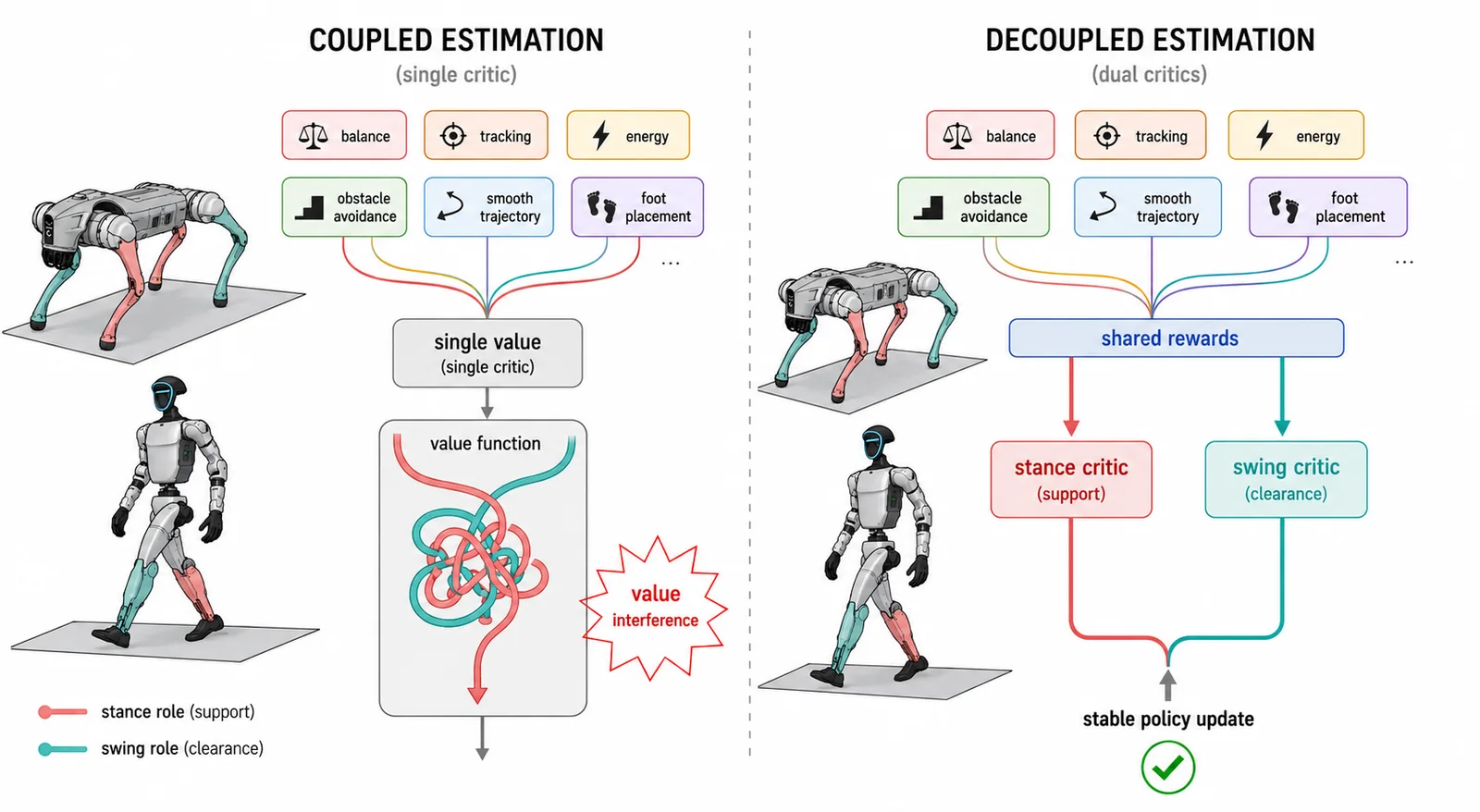
Partitioning locomotion rewards by stance and swing roles stabilizes multi-objective reinforcement learning — validated on a real Unitree Go2 and extended to the G1 biped. Accepted at IROS 2026.
Sim-to-Real Reinforcement Learning for Ball-Balancing Locomotion on Quadruped Robots
Changda Tian , Hamidreza Raei , Arash Ajoudani , Panos Trahanias
2026 IEEE/ASME International Conference on Advanced Intelligent Mechatronics (AIM) · 2026
A quadruped walks while keeping a free-rolling ball balanced on a plate on its back — learned in simulation, transferred to a real Unitree Go2. Presented at IEEE/ASME AIM 2026 in Genova.
Multimodal Assessment of Human Trust and Cognitive Load in Legged Robot Interaction
Juan Jose Garcia Cardenas , Changda Tian , Panos Trahanias , Adriana Tapus
Social Robotics + AI (ICSR+AI 2025), Lecture Notes in Computer Science · 2025
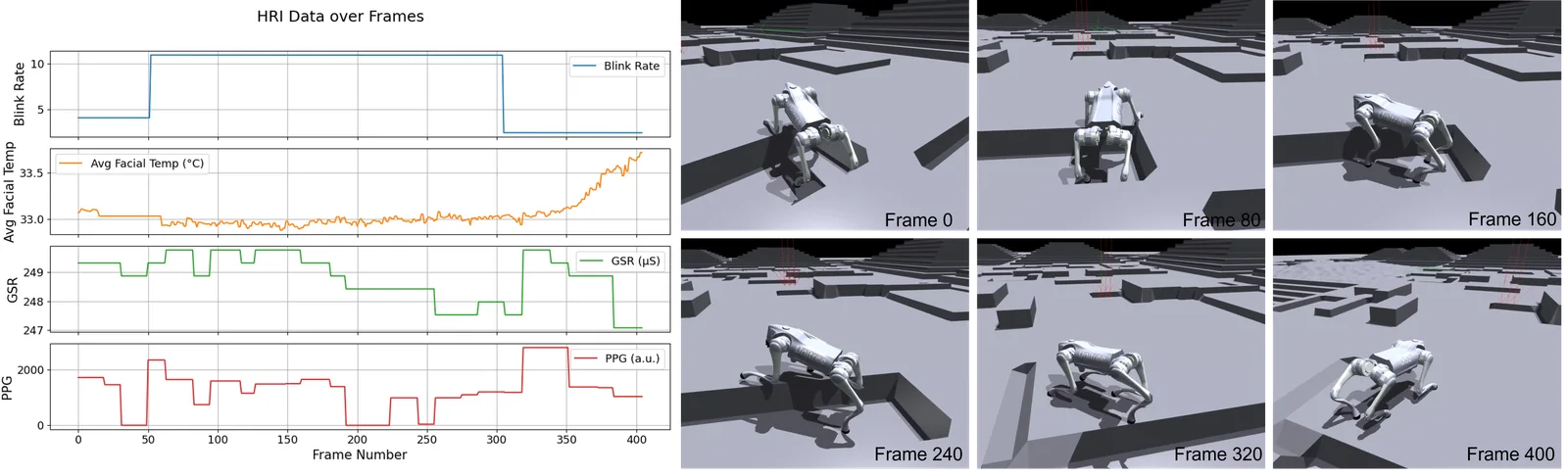
Physiological signals (skin conductance, facial temperature, blink rate) and NASA-TLX reveal how terrain difficulty and teleoperation vs. observation shape human trust and workload around a learning-based quadruped.
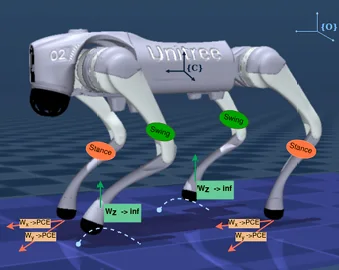
Optimal Torque Distribution via Dynamic Adaptation for Quadrupedal Locomotion on Slippery Terrains
Despina-Ekaterini Argiropoulos , Michael Maravgakis , Changda Tian , Dimitrios Papageorgiou , Panos Trahanias
2025 IEEE International Conference on Robotics and Automation (ICRA) · 2025
A real-time adaptive controller that redistributes joint torques by slippage probability, keeping quadrupeds stable on highly slippery terrain without pre-trained policies.
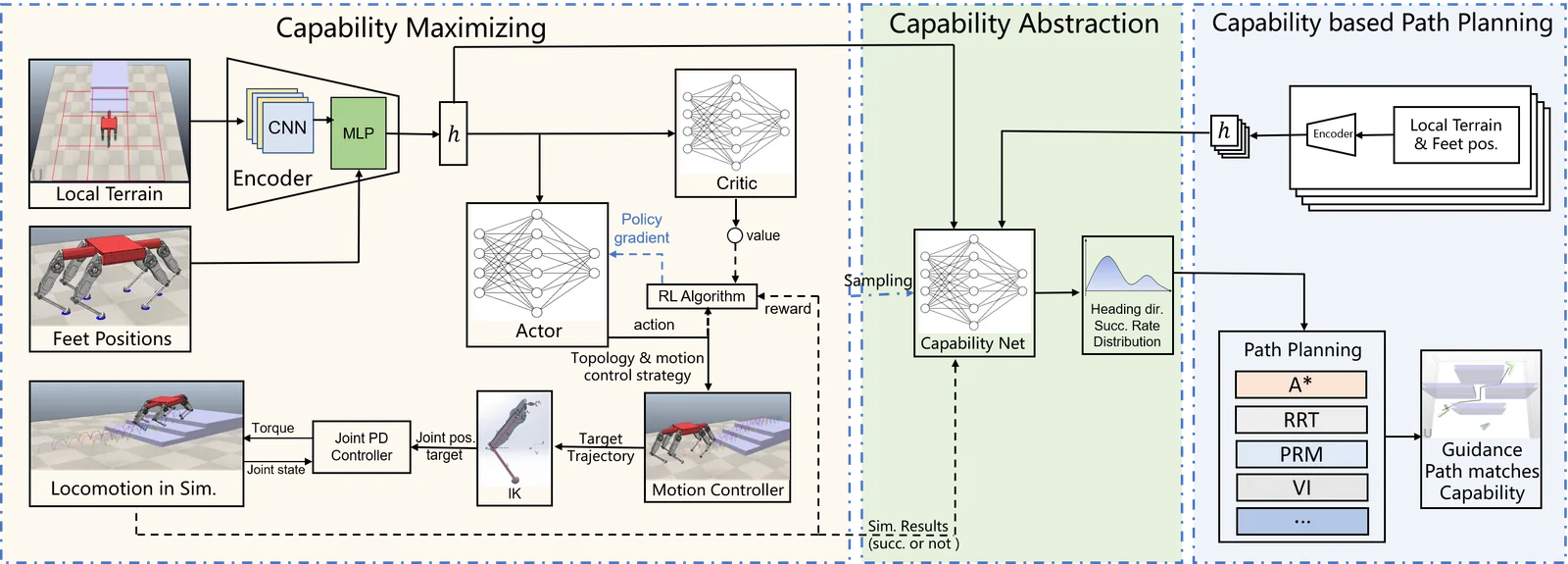
Learning Capability to Enhance Locomotion Control and Planning for Legged Robots
Yue Gao , Changda Tian , Yang Zhang
2024 IEEE International Conference on Real-time Computing and Robotics (RCAR) · 2024
Capability maximizing, capability abstraction, and capability-based path planning combined into one learning system, validated on the Qingzhui hexapod in simulation and the real world.
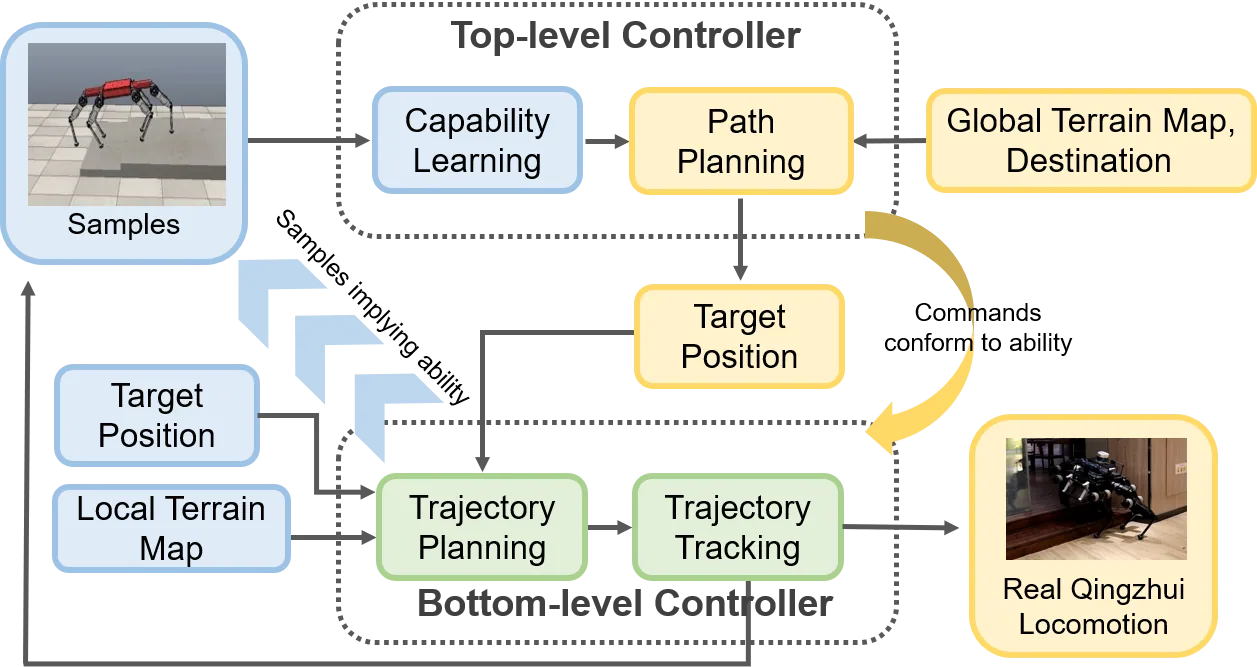
CapPlanner: Adaptable to Various Topology and Locomotion Capability for Hexapod Robots
Changda Tian , Yue Gao
2022 IEEE International Conference on Robotics and Biomimetics (ROBIO) · 2022
Best Paper in Biomimetics — Finalist
A hierarchical planner that learns a hexapod's traverse capability across body topologies, enabling reliable long-range locomotion planning.
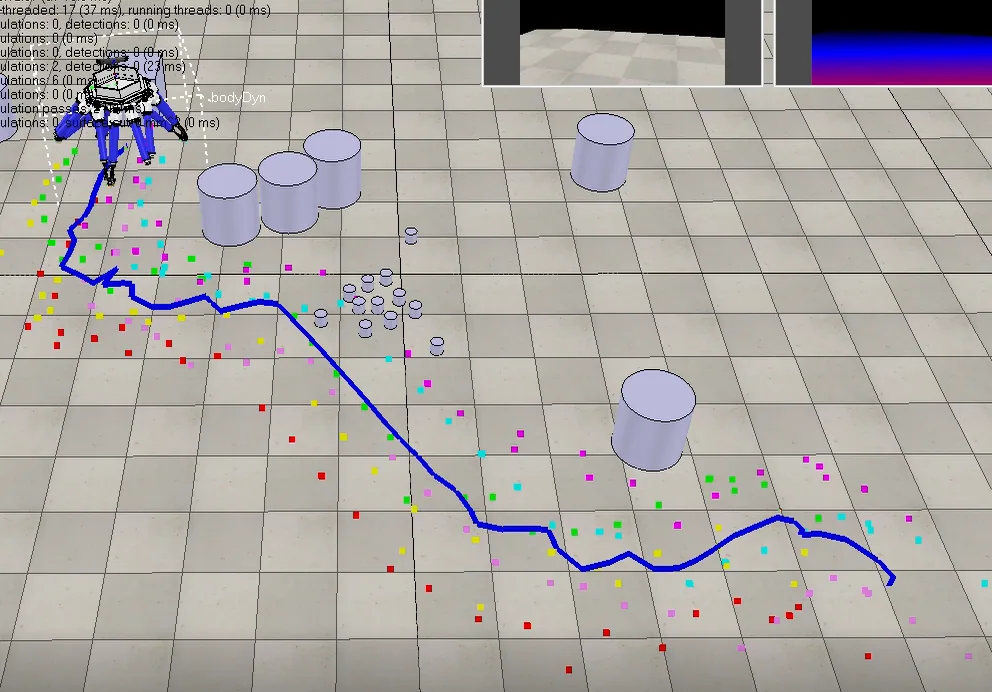
Sim-to-Real: Designing Locomotion Controller for Six-Legged Robot
Chenyu Yang , Yue Gao , Changda Tian , QingShan Yao
2019 IEEE 9th Annual International Conference on CYBER Technology in Automation, Control, and Intelligent Systems (CYBER) · 2019
An early sim-to-real hierarchical controller — RL navigation on top of per-leg foothold control — validated on a real six-legged robot.