Research theme
Capability-Aware Planning
What can this robot actually traverse — and how should a planner use that knowledge?
Capability Learning Path Planning Terrain Understanding
A path planner that ignores what its robot can physically do produces plans that fail at execution time. A quadrupled step height, a topology change from six legs to four, a different low-level controller — each changes which terrains are traversable. I formalize this as the robot’s traverse capability: the probability that a robot, with its current morphology and controller, successfully crosses a given piece of terrain.
Approach
My work turns capability into a first-class, learned quantity with three components:
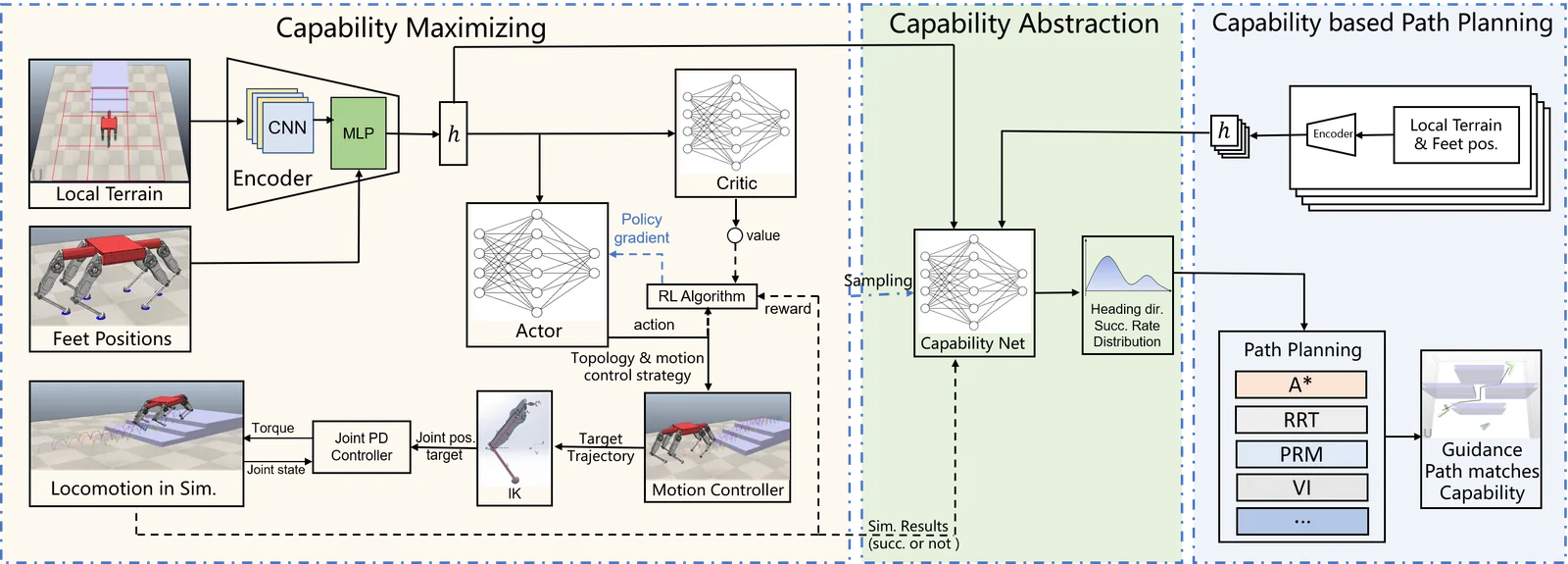
- Capability maximizing — reinforcement learning selects the control strategy and body topology that maximize traverse capability for the terrain at hand.
- Capability abstraction — a supervised network predicts the robot’s capability from terrain and foothold state, trained on large numbers of simulated locomotion trials.
- Capability-based planning — classic path planners are augmented with the learned capability model, so long-range guidance paths conform to what the robot can execute.
Evidence
The CapPlanner system (ROBIO 2022, Best Paper in Biomimetics finalist) and its journal extension demonstrate the full pipeline on the Qingzhui hexapod: long-range locomotion experiments in simulation and the real world show large improvements in global locomotion success rate compared to capability-blind planning.
Where this is going
Capability models are a natural interface between perception, control, and planning — a compact summary of “what my body can do here.” I want to extend them to dynamic skills, degraded hardware (missing legs, weak motors), and as priors for exploration in new environments.
Projects in this theme
Capability-Aware Locomotion for Hexapod Robots
A hierarchical learning system that teaches the Qingzhui hexapod what it can traverse — and plans long-range paths it can actually execute.
- Platform:
- Qingzhui hexapod · CoppeliaSim
- Methods:
- Reinforcement Learning · Capability Abstraction · Path Planning
Related publications
Learning Capability to Enhance Locomotion Control and Planning for Legged Robots
Yue Gao , Changda Tian , Yang Zhang
2024 IEEE International Conference on Real-time Computing and Robotics (RCAR) · 2024
Capability maximizing, capability abstraction, and capability-based path planning combined into one learning system, validated on the Qingzhui hexapod in simulation and the real world.
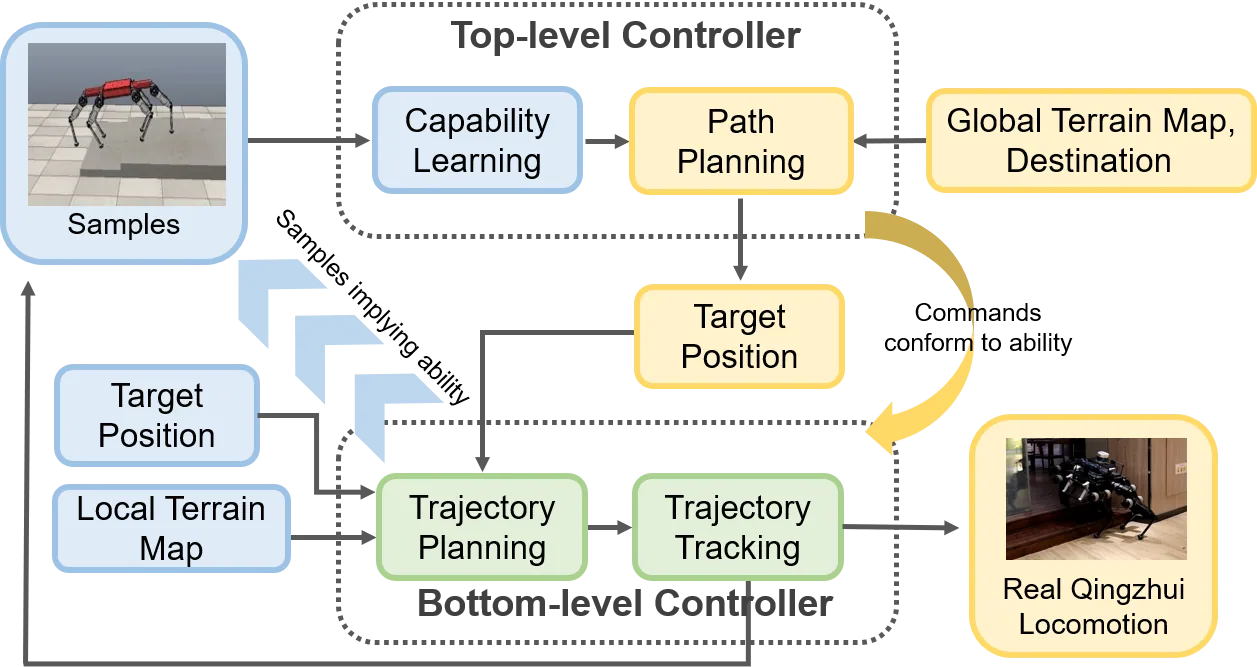
CapPlanner: Adaptable to Various Topology and Locomotion Capability for Hexapod Robots
Changda Tian , Yue Gao
2022 IEEE International Conference on Robotics and Biomimetics (ROBIO) · 2022
Best Paper in Biomimetics — Finalist
A hierarchical planner that learns a hexapod's traverse capability across body topologies, enabling reliable long-range locomotion planning.