Learning-Based Locomotion Control
Adversarial Motion Balancing for Legged Robots
Stance and swing legs as two adversarially-trained agents — whole-body control for tracking, reinforcement learning for balance.
- Period
- 2021 – 2023
- Platform
- Legged robot simulation
- Methods
- Whole-Body Control · Reinforcement Learning · Adversarial Training
- With
- Yue Gao (SJTU)
Overview
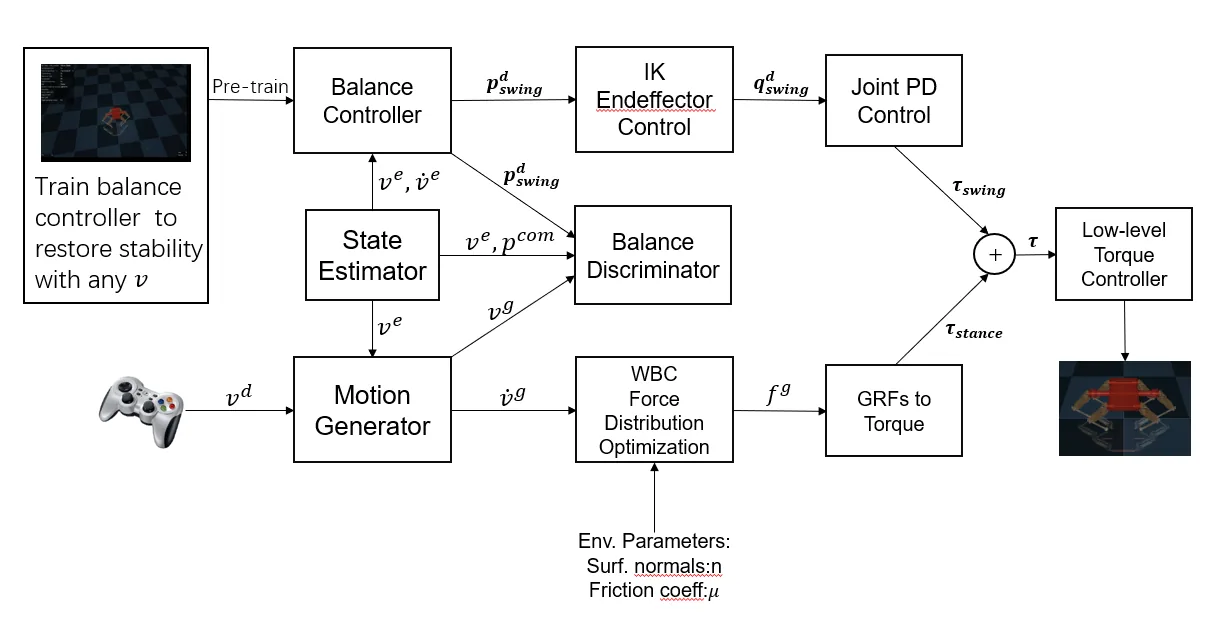
Balance control for legged robots usually treats the whole body as one control problem. This project splits it in two: stance legs and swing legs become separate agents with different jobs and different tools — and they are trained against each other.
Core idea
- The stance legs are controlled with a whole-body control (WBC) method and are responsible for generating the accelerations that track the target velocity.
- The swing legs are controlled with a reinforcement-learning policy and are responsible for keeping the robot balanced.
- Adversarial training couples the two: each agent learns in the presence of the other’s evolving behavior, which pushes the pair toward controllers that track desired velocities quickly while staying stable.
Why it matters
The decomposition assigns the well-modeled part of the problem (force distribution through stance contacts) to model-based control, and the hard-to-model part (dynamic balance through leg swing) to learning. The adversarial coupling means neither agent overfits to a frozen partner — a recurring failure mode when model-based and learned components are trained separately and only composed at deployment time.