机器人日报
机器人论文日报 — 2026-11-20
🤖 Scanned 329 papers from today’s arXiv announcement (cs.RO / eess.SY / cs.LG), picked 5 for modular & legged robotics — summarized by DeepSeek.
🤖 从今日 arXiv 新论文(cs.RO / eess.SY / cs.LG)中扫描 329 篇,围绕模块化与足式机器人精选 5 篇 — 由 DeepSeek 生成双语摘要。
1. Learning optimal gaits and styles for terrain-adaptive quadruped locomotion
面向地形自适应四足运动的最优步态与风格学习
Authors / 作者: Guillaume Bellegarda, Auke Ijspeert
arXiv: 2611.25958 · PDF
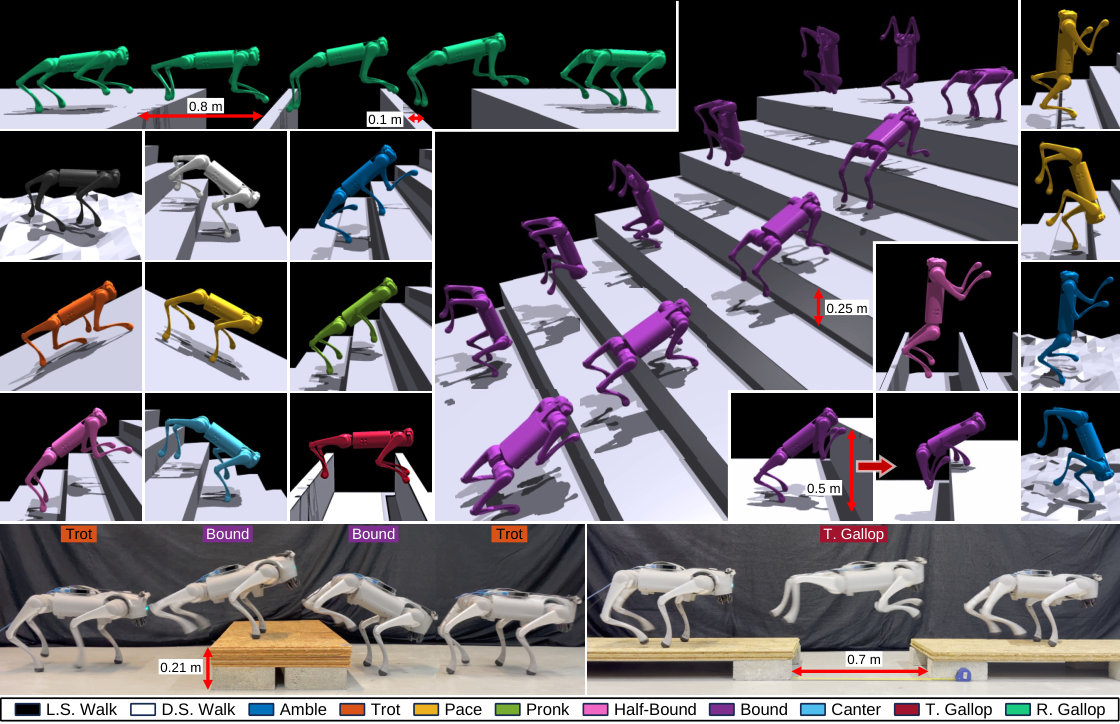
The authors train deep RL policies with networks of abstract oscillators (modeling spinal CPGs) to learn 11 quadrupedal gaits and their associated locomotion styles (base height, foot clearance, foot offsets) across challenging terrains. A second policy selects among gaits to optimize a user-specified criterion such as cost of transport, base stability, or joint smoothness. The framework generalizes zero-shot to unseen gait couplings and styles, terrains beyond the training distribution, and 5x larger robots, and with one pitch-tracking reward also supports bipedal locomotion.
中文摘要: 本文利用深度强化学习与模拟脊髓中枢模式发生器(CPG)的抽象振子网络,在多种复杂地形上学习11种四足步态及其对应的运动风格(机身高度、抬腿高度、足端偏移)。随后由第二个策略根据用户指定准则(运输成本、机身稳定性或关节平滑度)选择步态。结果表明,每种步态都至少在某一种地形-指标-速度组合下最优;框架能零样本泛化到训练中未见过的步态耦合与风格、远超训练分布的地形以及质量为训练五倍的大型四足机器人;仅增加一个俯仰跟踪奖励项即可支持双足模式运动。
💬 A clean demonstration that gait optimality is terrain- and criterion-dependent, with a CPG-inspired RL architecture that yields a rich gait repertoire for quadruped design and control.
💬 该工作清晰证明了步态最优性依赖于地形与优化准则,其CPG启发的强化学习架构为四足设计与控制提供了丰富的步态库。
Why read it / 推荐理由: Directly relevant to modular legged gait generation: it gives a systematic learnable gait repertoire and style-selection mechanism you could adapt for reconfigurable multi-legged platforms. 与模块化腿式步态生成直接相关:它提供了系统化的可学习步态库与风格选择机制,可适配于可重构多足平台。
2. LocoMuJoCo: A Comprehensive Imitation Learning Benchmark for Whole-Body Control
LocoMuJoCo:面向全身控制的综合模仿学习基准
Authors / 作者: Firas Al-Hafez, Davide Tateo, Oleg Kaidanov, Aditya Bhatt, Artur Zelik, Zhengyi Luo et al.
arXiv: 2611.26293 · PDF
LocoMuJoCo is an open-source benchmark coupling MuJoCo (CPU) with MJX/MjWarp (GPU) under one API, exposing 9 humanoid, 3 musculoskeletal, and 4 quadruped embodiments with native motion-capture data and AMASS/LAFAN1 retargeting. A modular plug-in architecture makes observations, rewards, control modes, terrains, and domain randomization interchangeable, with JAX implementations of RL/IL algorithms for JIT-compiled training and a companion sim-to-real repository.
中文摘要: LocoMuJoCo 是一个开源基准,在统一 API 下将 CPU 版 MuJoCo 与 GPU 版 MJX/MjWarp 后端耦合,提供 9 种人形、3 种(肌肉)骨骼和 4 种四足机器人实施例,并为每个人形配备原生动捕数据集,还支持 AMASS 与 LAFAN1 重定向。其模块化插件架构使观测、奖励、控制模式、地形与域随机化完全可互换,并包含多个 RL/IL 算法的紧凑 JAX 实现以支持 JIT 端到端训练,配套仓库提供 sim-to-real 部署。
💬 A well-engineered, quadrupeds-included WBC benchmark with interchangeable terrain and domain randomization, valuable infrastructure for reproducible sim-to-real locomotion research.
💬 一个工程完善的全身控制基准,包含四足实施例,地形与域随机化可互换,是可复现 sim-to-real 运动研究的宝贵基础设施。
Why read it / 推荐理由: Provides ready-made quadruped embodiments and modular terrain/domain-randomization hooks, useful for benchmarking your RL-based locomotion and sim-to-real pipelines. 提供现成的四足实施例及可插拔的地形/域随机化接口,适合用于评测你的强化学习运动控制与 sim-to-real 流程。
3. Bridging vision-language reasoning and learned control for legged navigation in the wild
连接视觉-语言推理与学习控制:野外腿式机器人导航
Authors / 作者: Takahiro Miki, Robin Schmid, Manthan Patel, Turcan Tuna, Julia Richter, Julian Nubert et al.
arXiv: 2611.25215 · PDF
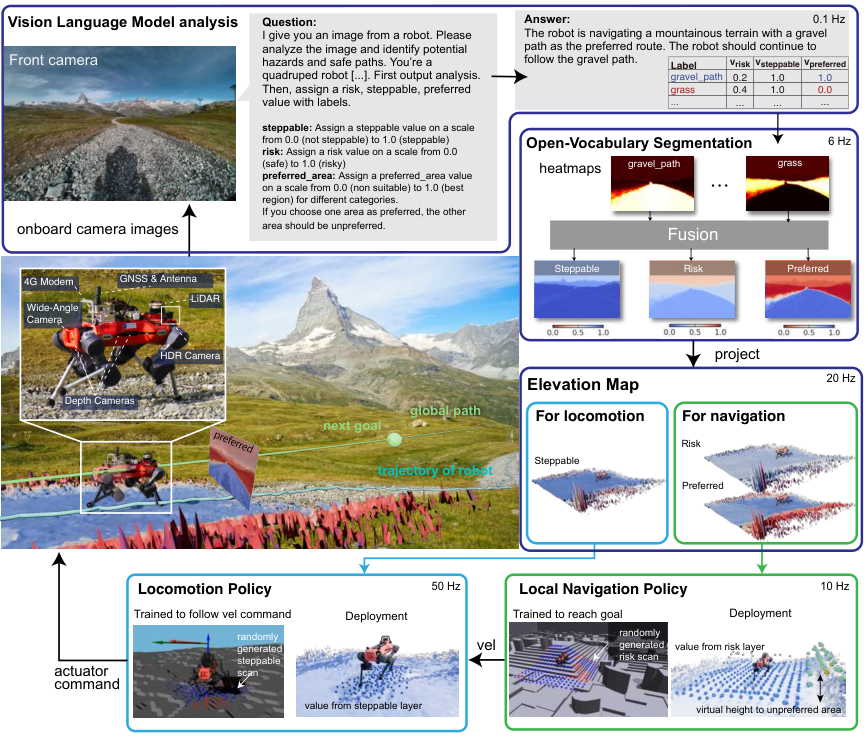
ROAM combines a vision-language model’s common-sense reasoning and semantic scene interpretation with RL-trained agile locomotion and local navigation policies. An open-vocabulary segmentation module converts VLM labels into a dense real-time risk map that conditions the two pre-trained RL policies. Real-world experiments show kilometer-scale autonomous navigation in alpine and urban settings, with sign interpretation and safe foothold selection.
中文摘要: ROAM 将视觉-语言模型(VLM)的常识推理与语义场景理解同强化学习训练得到的敏捷运动与局部导航策略相结合。开放词汇分割模块把 VLM 生成的风险标签转换为实时稠密风险图,用以调节两个预训练 RL 策略。真实机器人实验表明,系统能在高山与城市场景中完成公里级自主导航,可解读路标以规避危险,并评估环境以选择安全落脚点。
💬 A convincing real-world integration of high-level VLM semantics with low-level learned legged control, showing kilometer-scale traverses and semantic risk-aware foothold selection.
💬 令人信服地将高层 VLM 语义与底层学习式腿式控制结合,展示公里级穿越与语义风险感知的落脚点选择。
Why read it / 推荐理由: Relevant to traverse-capability-aware path planning: it shows how semantic risk maps can condition locomotion policies for long-horizon terrain navigation. 与穿越能力感知路径规划相关:展示了语义风险图如何调节运动策略以完成长时程地形导航。
4. ECHO: In-Context Behavior foundation model for Humanoid Whole-Body Control
ECHO:面向人形全身控制的上下文行为基础模型
Authors / 作者: Xingyi Wang, Bin Li, Jiyuan Shi, Chenyun Zhang, Weiji Xie, Xiangyu Miao et al.
arXiv: 2611.25778 · PDF
ECHO is an in-context behavior foundation model that separates general behavioral capability from dynamics-specific execution. Mixed and Annealed Sampling builds a behavior prior via large-scale motion imitation, then a Context Representation and Residual Adaptation module learns structured dynamics representations from interaction history to guide residual corrections to the frozen prior, enabling test-time adaptation without parameter updates. It outperforms baselines across motions and physical conditions and is deployed on the Unitree G1 for acrobatic teleoperation, terrain interaction, and payload adaptation.
中文摘要: ECHO 是一种上下文行为基础模型,将通用行为能力与特定动力学执行分离。混合与退火采样通过大规模运动模仿建立行为先验,随后上下文表示与残差自适应模块从交互历史中学习结构化动力学表示,引导对冻结先验的残差修正,实现无需测试时参数更新的自适应。实验表明其在多种运动与物理条件下优于基线,并在 Unitree G1 上实现极限特技遥操作、地形交互与负载自适应。
💬 A principled in-context adaptation scheme for WBC foundation models that cleanly separates behavior priors from dynamics-specific residual correction.
💬 一种有原则的全身控制基础模型上下文自适应方案,清晰分离行为先验与动力学特定的残差修正。
Why read it / 推荐理由: Its residual-adaptation-on-frozen-prior idea is transferable to modular legged robots facing changing limb configurations and payloads. 其在冻结先验上做残差自适应的思路可迁移到面临腿部构型与负载变化的模块化腿式机器人。
5. Collision-Free Is Not Enough: Passage-Conditioned Navigation for Wheeled-Legged Robots
无碰撞还不够:面向轮腿机器人的通道条件导航
Authors / 作者: Wai Ka Sun, Waiyiu Pong, Bowen Wang
arXiv: 2611.25788 · PDF
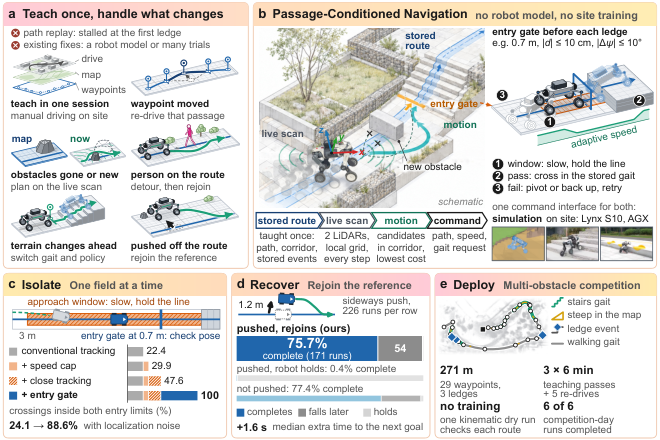
The authors show that collision-free paths can still misalign a legged robot’s entry into stairs or ledges, causing a fixed locomotion skill to stall or fall. Passage-conditioned navigation stores each taught crossing as an event and, without training or a robot model, enforces an entry gate after every local replan, retrying if more than 10 cm or 10 degrees off the taught crossing. This raises disturbed ledge-crossing success within limits from 24.1% to 88.6% and eliminates falls in 180 stair climbs under contact simulation.
中文摘要: 作者指出无碰撞路径仍可能导致腿式机器人进入台阶或边缘时姿态失准,使固定的运动技能停滞或跌倒。通道条件导航将每次示教的跨越记录为事件,无需训练或机器人模型,在每次局部重规划后施加进入门控:若偏离示教跨越超过 10 cm 或 10 度则转向或后退重试。结果使受扰动边缘跨越在限差内的成功率从 24.1% 提升至 88.6%,在接触仿真中 180 次爬梯无一跌倒。
💬 Addresses an underappreciated coupling between path planning and locomotion-skill entry conditions, with a lightweight training-free gate that yields large robustness gains for wheeled-legged robots.
💬 关注路径规划与运动技能进入条件之间被低估的耦合,其轻量免训练门控为轮腿机器人带来显著鲁棒性提升。
Why read it / 推荐理由: Highly relevant to traverse-capability-aware planning and gait-skill interfaces: it formalizes transition-entry constraints that modular legged platforms also face. 与穿越能力感知规划及步态技能接口高度相关:它将模块化腿式平台同样面临的过渡进入约束形式化。