机器人日报
机器人论文日报 — 2026-11-16
🤖 Scanned 229 papers from today’s arXiv announcement (cs.RO / eess.SY / cs.LG), picked 5 for modular & legged robotics — summarized by DeepSeek.
🤖 从今日 arXiv 新论文(cs.RO / eess.SY / cs.LG)中扫描 229 篇,围绕模块化与足式机器人精选 5 篇 — 由 DeepSeek 生成双语摘要。
1. PROOF: Perceptive Robustness via Out-of-Distribution Fallback for Legged Locomotion
PROOF:基于分布外回退的腿足机器人感知鲁棒运动
Authors / 作者: Siyuan Wang, Dongjie Zhu, Jinxuan Lu, Wenjun Xu, Jiankun Wang
arXiv: 2611.18305 · PDF
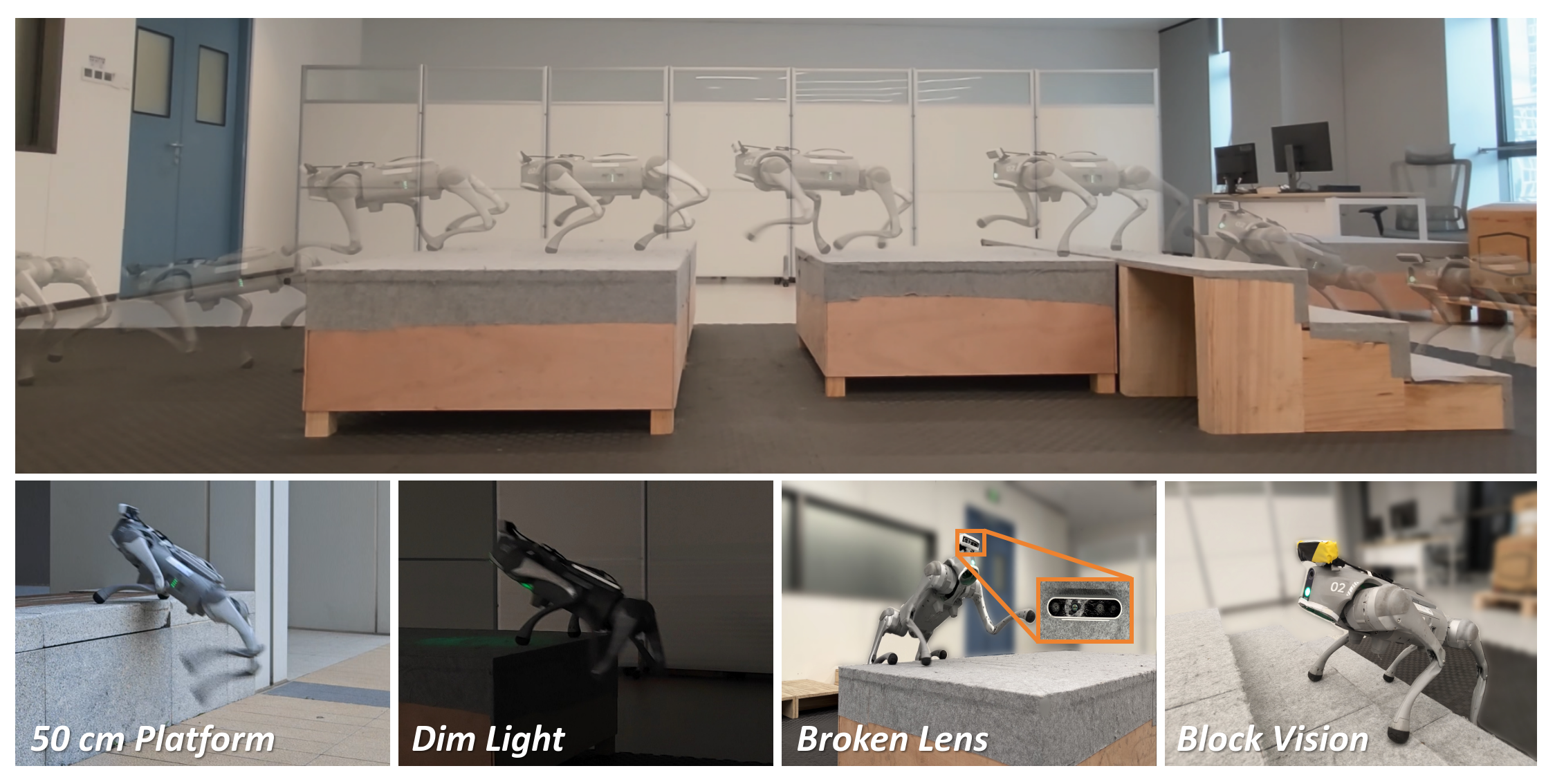
PROOF proposes a two-stage teacher-student framework for vision-based legged locomotion that explicitly models perception reliability: the teacher learns both perception-driven and proprioceptive fallback behaviors, and the student estimates exteroceptive feature uncertainty and suppresses degraded features under out-of-distribution inputs. On a Unitree Go2 with a RealSense D435, it achieves high-dynamic parkour (gaps, platforms, narrow beams) and maintains stable locomotion under heavy occlusion and strong illumination changes.
中文摘要: 本文提出PROOF框架,用于严重视觉干扰下的腿足机器人鲁棒运动控制。方法采用两阶段教师—学生学习范式并显式建模感知可靠性:教师策略同时学习基于感知的运动行为和基于本体感受的回退行为,学生网络则预测外感受特征的置信度/不确定性,并在分布外输入时抑制不可靠的视觉特征。在配备RealSense D435深度相机的Unitree Go2四足机器人上进行了真实环境验证:正常视觉条件下可完成大间隙跨越、高台和窄梁等高动态跑酷动作;在严重遮挡和强光照变化等视觉退化条件下,机器人仍能保持稳定鲁棒的行走。该方法将感知失效检测与回退策略结合,对sim-to-real部署中的感知鲁棒性具有参考价值。
💬 A clean teacher-student formulation that treats perception failure as an uncertainty-driven fallback problem, with convincing real-robot parkour and degradation tests.
💬 该工作以不确定性驱动的回退机制处理感知失效,教师—学生结构清晰,并在真实机器人上完成了跑酷与视觉退化实验,结果有说服力。
Why read it / 推荐理由: Directly relevant to sim-to-real perceptive locomotion and proprioceptive fallback for legged robots under degraded sensing. 与腿足机器人感知运动、sim-to-real以及感知退化下的本体感受回退直接相关,值得细读。
2. Reusing Locomotion Training Recipes Across Humanoids via Body-Aligned Virtual Joints
通过身体对齐虚拟关节在多种人形机器人间复用运动训练配方
Authors / 作者: Sol Choi, Mingon Kim, Seokin Seo, Jongeun Choi, Donghyeon Kim, Yisoo Lee
arXiv: 2611.18003 · PDF
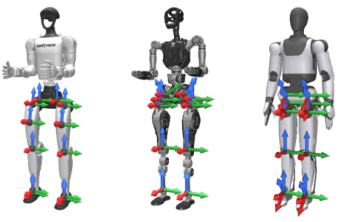
The paper introduces a body-aligned virtual joint space upstream of the actuator transmission mapping, so that policy actions and observations follow a common anatomical convention regardless of each robot’s native joint coordinates, while the existing low-level control stack stays unchanged. Using a single unmodified RL training recipe, it is the only interface that tracks accurately, keeps feet aligned with travel direction, and trains stably on three humanoids with different leg-axis layouts, and on a Unitree G1 it reduces heading drift by nearly 6x.
中文摘要: 针对强化学习人形机器人运动控制中训练配方(奖励、网络结构、超参数)难以跨机器人复用的问题,本文提出在底层传动映射之前引入“身体对齐虚拟关节空间”:策略的动作与观测遵循统一的解剖学约定,再由确定性运动学层将虚拟目标映射为各机器人原生关节目标,从而不改变原有传动与底层控制栈。在三种腿部轴向布局不同的人形机器人上使用同一套未修改的训练配方,该接口是唯一能准确跟踪、保持足端与行进方向对齐并稳定训练的接口;在Unitree G1实机上将航向漂移降低近6倍。该方法对模块化异构腿足平台的统一控制接口设计具有启发意义。
💬 Addresses the under-discussed problem of coordinate-interface heterogeneity across legged platforms, yielding recipe portability and a measurable real-robot heading-drift gain.
💬 该文针对腿足平台间坐标接口异构这一较少讨论的问题,实现了训练配方的可移植性,并在实机上获得可量化的航向漂移改善。
Why read it / 推荐理由: Highly relevant to reconfigurable/modular legged platforms where a unified action-joint abstraction is needed across heterogeneous morphologies. 对需要跨异构构型统一动作—关节抽象的模块化可重构腿足平台高度相关,值得借鉴。
3. PoliMop: Policy-in-the-Loop Motion Planning in 3D Spaces for Mobile Robots
PoliMop:面向移动机器人的三维空间策略在环运动规划
Authors / 作者: Yael Fassbind, Valentin N. Hartmann, Huang Su, Yijiang Huang, Stelian Coros
arXiv: 2611.18110 · PDF
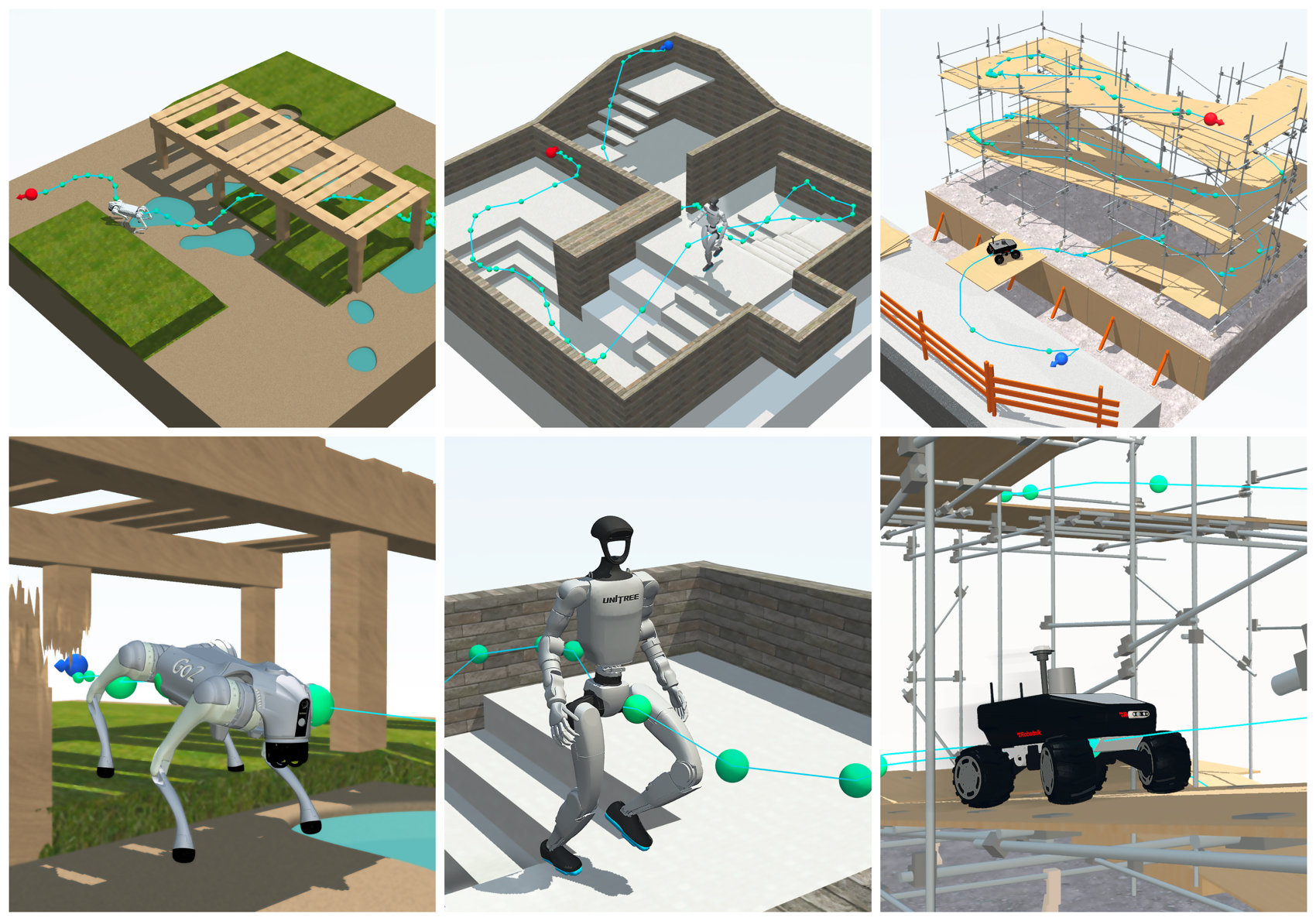
PoliMop presents a kinodynamic RRT planner that uses physics simulation to evaluate policy rollouts, so paths are found with respect to the robot’s actual physical design and control policy rather than a simplified model. Sampling in a reduced 3D state space is guided by a preplanned mass-point path, cutting planning time by up to 63%, and experiments with quadrupeds, humanoids, and wheeled robots show drop-in integration across robots and policies, including automatic exploitation of environmental modifications such as a plank bridging a gap.
中文摘要: 本文提出PoliMop,一种将控制策略纳入规划闭环的运动学动力学RRT规划器。规划器在场景周围降维的三维状态空间中采样,并用物理仿真执行策略 rollout 来扩展树,从而依据机器人真实构型与控制策略能力判断可通行性;同时利用简单质点模型预规划路径引导采样,将规划时间最多减少63%。在四足、人形与轮式机器人上的仿真实验表明,该方法可即插即用地适配不同机器人与控制策略,并能自动利用环境改造(如架板跨沟)扩展可达空间。该工作体现了“可通行性感知”与策略能力建模相结合的规划思路,对多足平台越障路径规划有直接参考价值。
💬 Couples the locomotion policy directly into kinodynamic planning, making reachability depend on the actual controller rather than an idealized abstraction.
💬 该文将运动控制策略直接嵌入动力学规划,使可达性取决于真实控制器而非理想化模型,思路具有启发性。
Why read it / 推荐理由: Directly targets traverse-capability-aware path planning where policy capability determines traversability, a core interest for multi-legged platforms. 直接面向以策略能力决定可通行性的越障路径规划,是多足平台研究的核心关切。
4. Heavy Metal Acrobatics: Learning Dynamic Control for Skid-Steer Loaders
重金属特技:滑移转向装载机的动态控制学习
Authors / 作者: Pierre-Jean Lorentz, Pascal Egli, Edo Jelavic, Cliff Li, Ramitha Sundar, Harikrishnan Suresh et al.
arXiv: 2611.18365 · PDF
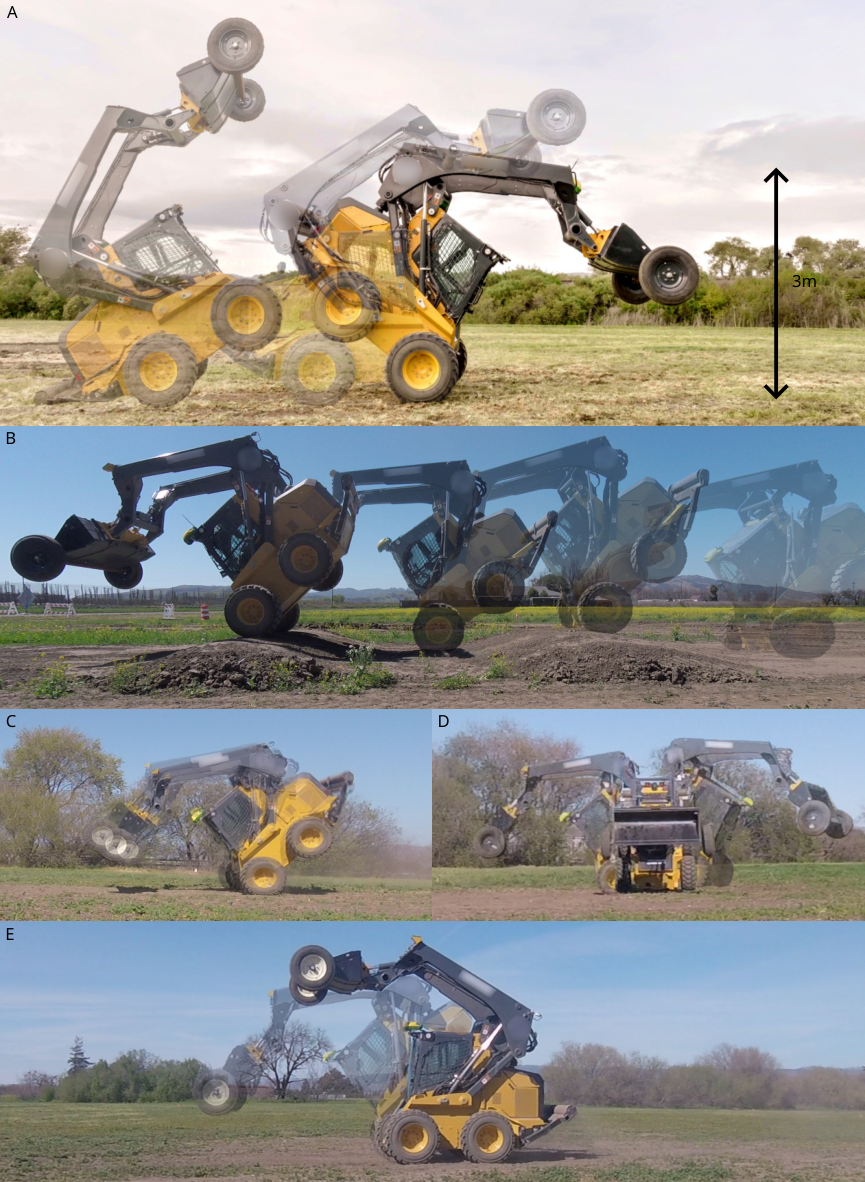
The authors train RL policies in simulation and transfer them to a real 5-tonne John Deere 332G skid-steer loader with hydraulic actuation, achieving autonomous acrobatic maneuvers previously performed only by elite human operators. The policies swing the machine onto two wheels and, while balancing, drive over rough terrain, follow specified trajectories, spin, and swing the bucket before landing safely, demonstrating RL plus sim-to-real for dynamic control of heavy machinery.
中文摘要: 本文研究重型工程机械的自主动态控制。作者在仿真中训练强化学习策略,并迁移到真实的5吨级John Deere 332G滑移转向装载机上,该机具有液压驱动带来的流体、柔性元件与非线性延迟等复杂动力学。所学习的策略能够自主将机器摆上两轮,并在两轮平衡状态下通过崎岖地形、沿指定轨迹行驶、原地旋转、摆动铲斗后再安全落回四轮,完成了此前仅有少数顶尖操作员在世界纪录表演中实现的特技动作。该工作展示了RL与sim-to-real在重载液压机械动态控制上的可行性,对高动态腿足控制与sim-to-real迁移同样有方法论借鉴意义。
💬 A striking sim-to-real demonstration on a 5-tonne hydraulic machine, showing that RL can push actuation limits with real hardware safety.
💬 该文在5吨级液压机械上完成了令人印象深刻的sim-to-real演示,表明强化学习可在真实硬件上逼近执行机构极限。
Why read it / 推荐理由: Strong evidence for RL-based dynamic control and sim-to-real transfer on real heavy hardware, with transferable lessons for high-dynamic legged control. 为基于强化学习的高动态控制与真实硬件sim-to-real迁移提供了有力证据,对腿足高动态控制有可借鉴之处。
5. CS-MPC: Contraction-Certified Sampling-Based MPC for Nonlinear Systems Under Uncertainty
CS-MPC:不确定性下非线性系统的收缩认证采样模型预测控制
Authors / 作者: Yashwanth Kumar Nakka
arXiv: 2611.18390 · PDF
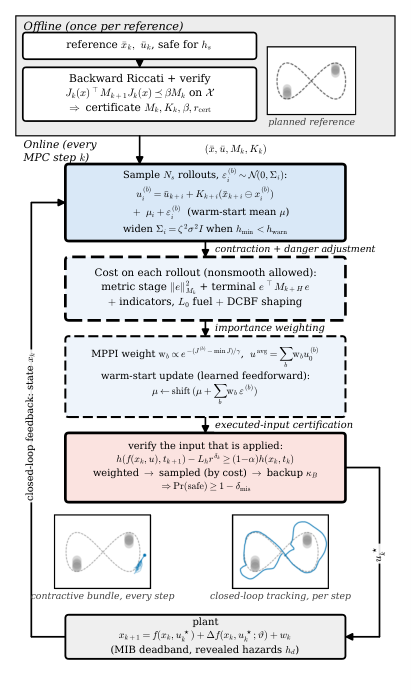
CS-MPC embeds a contraction-certified tracking feedback inside every sampled rollout to concentrate samples around the reference, and adds an execution layer that verifies inputs via a quantile-tightened discrete-time control barrier function. The authors derive a nonlinear contraction verification procedure and prove finite-sample stochastic stability and mission-level probabilistic safety; compared with MPPI, it matches tracking error with 7-20x fewer rollouts on a rover and cuts quadrotor error 2-4x with no safety violations in 200 Monte Carlo missions.
中文摘要: 本文提出收缩认证采样模型预测控制(CS-MPC),用于参数不确定性、扰动和在线揭示的安全约束下的非线性机器人跟踪与安全控制。方法在每次采样 rollout 中嵌入收缩认证的跟踪反馈,使采样集中于参考轨迹附近,并增加执行层,用量化分收紧的离散时间控制屏障函数条件验证实际施加的输入。作者给出闭环动力学非线性收缩的验证流程,并证明有限样本随机稳定性与任务级概率安全保证。在漫游车、四旋翼和小行星着陆仿真中,相比标准MPPI,漫游车以7至20倍更少的rollout达到相同跟踪误差,四旋翼跟踪误差降低2至4倍,200次蒙特卡洛任务无安全违规。该采样型MPC效率与安全认证思路对腿足MPC控制有参考价值。
💬 Combines contraction-based rollout shaping with CBF-based certified execution, giving sample-efficiency and safety guarantees that sampling MPC usually lacks.
💬 该文将基于收缩的采样整形与基于CBF的认证执行相结合,弥补了采样MPC通常缺乏的样本效率与安全保证。
Why read it / 推荐理由: Relevant to MPC for legged locomotion where sample efficiency and safety certification under uncertainty are key practical concerns. 对腿足运动MPC而言,不确定下的采样效率与安全认证是关键实际问题,本文方法值得参考。