机器人日报
机器人论文日报 — 2026-11-12
🤖 Scanned 40 papers from the last 3 days of arXiv announcements (cs.RO / eess.SY / cs.LG), picked 5 for modular & legged robotics — summarized by DeepSeek.
🤖 从近 3 天的 arXiv 新论文(cs.RO / eess.SY / cs.LG)中扫描 40 篇,围绕模块化与足式机器人精选 5 篇 — 由 DeepSeek 生成双语摘要。
1. ReACT: Reflection-Consistent Modulation and Cross-Load Consistency for Humanoid Velocity Tracking Under Asymmetric Loads
ReACT:面向人形机器人在非对称负载下速度跟踪的反射一致调制与跨负载一致性
Authors / 作者: Xianghui Wang, Aoran Fu, Liyou Luo, Shanze Wang, Xiaoyu Shen, Dan Zhang et al.
arXiv: 2611.13929 · PDF
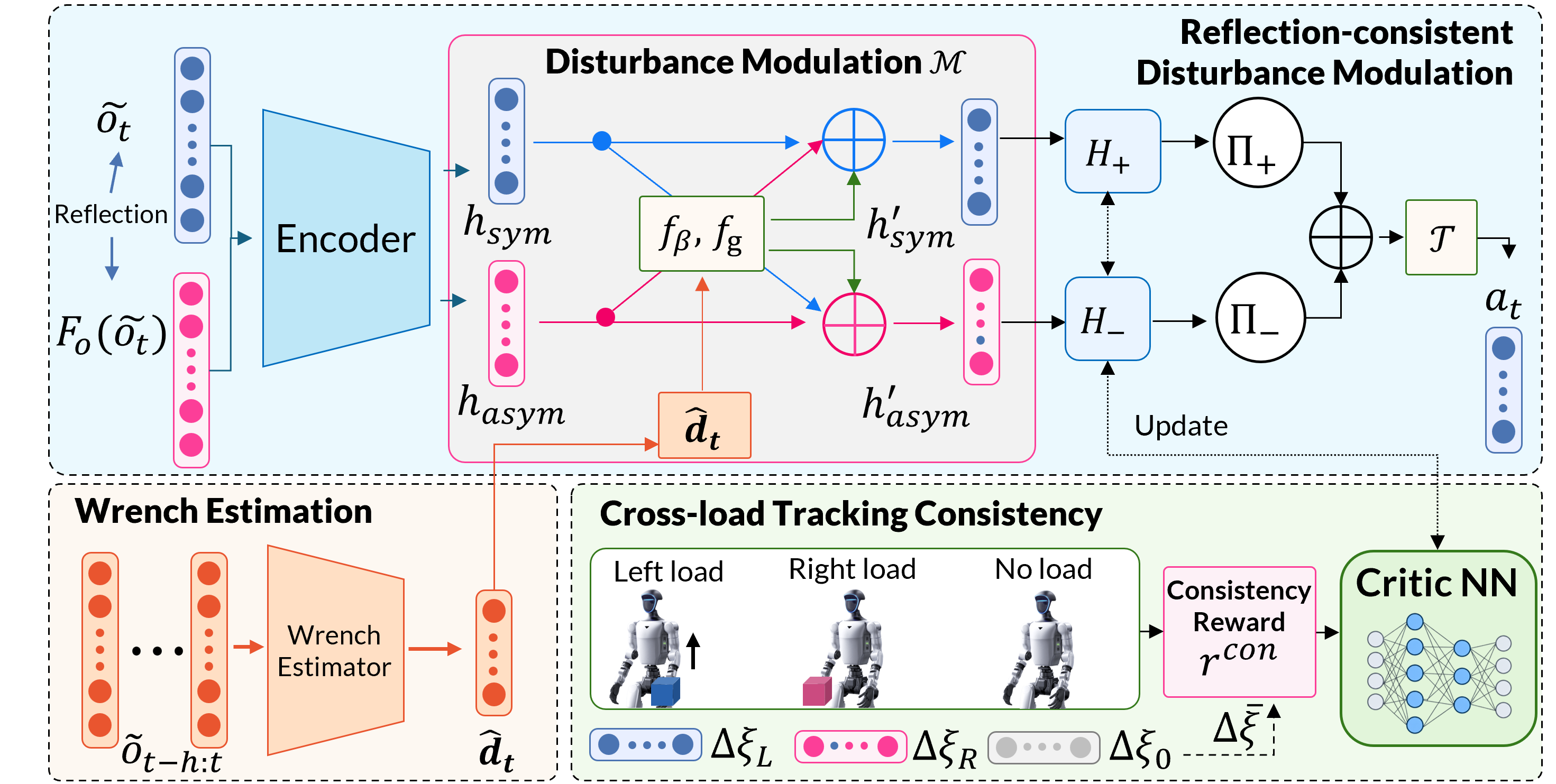
ReACT addresses velocity-tracking degradation in humanoid loco-manipulation caused by persistent asymmetric upper-body loads. It uses estimated wrenches to modulate actor features for load compensation (reflection-consistent disturbance modulation) and trains with cross-load tracking consistency between loaded and unloaded conditions under identical velocity commands. On a Unitree G1, simulation shows reduced directional bias and improved tracking, and all 40 real-world navigation trials reached goals collision-free under unilateral hand loads.
中文摘要: 该文针对人形机器人单手持物导致上半身持续非对称负载、进而使速度跟踪偏差累积并引发位置与航向漂移的问题,提出ReACT框架。方法包含两部分:一是反射一致的扰动调制,利用估计的外力旋量调制actor特征以补偿负载,同时在观测镜像反射下保持动作对应关系;二是跨负载跟踪一致性训练,在相同速度指令下对比有载与无载条件,促使不同负载下的速度跟踪一致。在Unitree G1仿真中速度跟踪改善、方向偏差减小,实物40次无地图导航试验在单侧手持负载下全部无碰撞到达目标。
💬 A clean RL-based whole-body locomotion approach that explicitly models carried-load wrenches and reflection symmetry, validated on real humanoid hardware and directly transferable to modular payload-carrying legged platforms.
💬 这是一种清晰的基于强化学习的全身运动控制方法,显式建模携带负载的外力旋量与反射对称性,并在真实人形硬件上验证,可直接迁移到模块化承载足式平台。
Why read it / 推荐理由: If you extend modular legged robots with payload or arm modules, its load-aware feature modulation and consistency training offer a concrete recipe for robust velocity tracking. 若你为模块化足式机器人增加负载或机械臂模块,其负载感知特征调制与一致性训练为鲁棒速度跟踪提供了具体方案。
2. Distributionally Robust Indirect-Feedback Stochastic MPC with Gelbrich Ambiguity Sets
基于Gelbrich模糊集的分布鲁棒间接反馈随机模型预测控制
Authors / 作者: Jiaxun Sun, Riccardo Cescon, Marcell Bartos, Melanie N. Zeilinger
arXiv: 2611.13986 · PDF
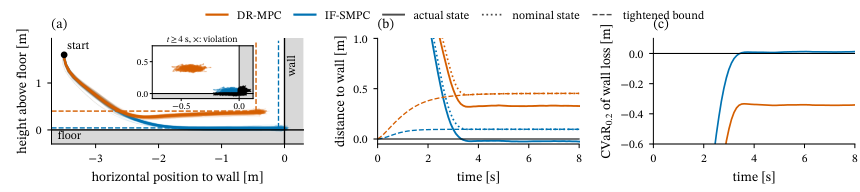
The paper handles stochastic MPC when disturbance mean and covariance are themselves uncertain, representing them with a Gelbrich ambiguity set that admits distributions of any shape and unbounded support. Building on the indirect-feedback paradigm for LTI systems with additive disturbances, it propagates moment uncertainty along error dynamics to yield a closed-form, offline-computed constraint tightening, keeping the online problem a QP. Recursive feasibility and closed-loop CVaR constraint satisfaction hold for every distribution in the set, illustrated on a linearized planar quadrotor.
中文摘要: 针对随机MPC中扰动统计量(均值与协方差)估计误差会破坏安全保证的问题,本文用Gelbrich模糊集刻画矩不确定性,该集合涵盖任意形状乃至无界支撑的分布。在线性时不变加性扰动系统上,基于间接反馈范式沿误差动力学传播矩不确定性,得到可离线计算的闭式约束收紧量,使在线问题仍为二次规划。方法保证递归可行性与闭环CVaR约束对集合内任意分布成立,在线性化平面四旋翼上进行了演示。
💬 A rigorous DRO-MPC formulation that turns moment-estimation error into a single additive tightening term, trading a bit of conservatism for statistical soundness while preserving QP-structured online computation.
💬 该分布鲁棒MPC将矩估计误差转化为单一加性收紧项,以少量保守性换取统计严谨性,同时保持在线计算的二次规划结构。
Why read it / 推荐理由: Its closed-form constraint tightening for uncertain disturbance statistics is directly reusable when your MPC must stay safe under contact and terrain-model uncertainty. 其针对不确定扰动统计量的闭式约束收紧方法可直接用于你的MPC在接触与地形模型不确定性下保持安全。
3. Recurrent Modular Structure in Spiking Neural Network Reinforcement Learning
脉冲神经网络强化学习中的循环模块化结构
Authors / 作者: Vikram Ramavarapu, Himanshu Udupi, Ashish Gautam
arXiv: 2611.14262 · PDF
The authors introduce Community Recurrent SNNs (CoRe SNNs), recurrent spiking networks partitioned into communities with fixed roles, where spiking activity is a walk between communities and actions correspond to terminal communities. Learning is fully local and three-factor, with a new Map-STDP rule encouraging modular structure during learning, compared against stochastic-block-model partial modularity and sealed full modularity. On CartPole across three neuron models, Map-STDP improves learning over the unstructured baseline, matches sealed modularity on two of three models, and yields more compressible spike walks.
中文摘要: 本文提出社区循环脉冲神经网络(CoRe SNN),将循环网络划分为具有固定角色的社区:控制社区接收刺激,每个动作对应一个社区,潜在社区承载内部状态,脉冲活动即在社区间游走、到达的社区即动作。学习完全局部且为三因子规则,作者提出Map-STDP在学习中促进模块化,并与随机块模型部分模块化和封闭全模块化对比。在CartPole上跨三种脉冲神经元模型,Map-STDP优于无结构基线、在其中两种模型上匹敌封闭模块化,并使脉冲游走更可压缩。
💬 A neurally motivated alternative to monolithic RL policies where modularity emerges via local plasticity, though validation is currently limited to the CartPole benchmark rather than robot control.
💬 这是一种以神经科学为动机的替代单体强化学习策略的方法,模块性通过局部可塑性涌现,但目前验证仅限CartPole基准而非机器人控制。
Why read it / 推荐理由: If you are exploring structured/modular controllers for reconfigurable leg modules, this offers a local-learning recipe for inducing functional modules, though evidence is still toy-scale. 若你在探索面向可重构腿模块的结构化/模块化控制器,该方法提供了诱导功能模块的局部学习方案,但证据仍停留在玩具级任务。
4. FaST: Factored Synthesis of Transitions for Offline Reinforcement Learning
FaST:面向离线强化学习的分因子转移合成
Authors / 作者: Daniel Campa, Spandan Das, Srinjoy Das
arXiv: 2611.13013 · PDF
FaST addresses monolithic diffusion-based transition generators in offline RL by factoring transitions through the chain rule into state, action, dynamics, reward, and terminal stages, each fit with a matched estimator. On twelve D4RL locomotion and maze benchmarks, TD3+BC and IQL trained on FaST transitions match SynthER while generating over 90x faster, and its re-queryable action conditional enables best-of-N advantage-based action synthesis that beats real-data training on 11 of 12 medium settings.
中文摘要: 针对离线强化学习中扩散式生成器将转移元组(状态、动作、下一状态、奖励、终止)作为整体建模、无法单独重绘单一因子的问题,FaST按链式法则将转移分解为状态、动作、动力学、奖励与终止各阶段,并为每阶段匹配相应估计器。在12个D4RL运动与迷宫基准上,用FaST合成数据训练的TD3+BC与IQL达到SynthER水平而生成速度快90倍以上;其可重查询的动作条件支持按优势值做best-of-N动作合成,在12个medium设置中11个超过真实数据训练。
💬 Factorizing the transition distribution and re-querying the action conditional for advantage-guided synthesis is a neat, computationally cheap idea for locomotion-style offline RL pipelines.
💬 将转移分布分解并重查询动作条件以进行优势引导合成,是面向运动类离线强化学习流程的一个简洁且计算廉价的想法。
Why read it / 推荐理由: Sample-efficient offline RL data synthesis can accelerate training of locomotion policies for your modular legged prototypes where real-robot data is scarce. 样本高效的离线强化学习数据合成可加速在真实数据稀缺时训练模块化足式原型的运动策略。
5. ExRL: Sample-Efficient Online Adaptation of Long-Chunk Policies via Execution Length Control
ExRL:通过执行长度控制实现长动作块策略的样本高效在线自适应
Authors / 作者: Xu Luo, Jiaying Yang, Hao Wu, Junlin Xie, Zijin Hong, Ji Zhang et al.
arXiv: 2611.13482 · PDF
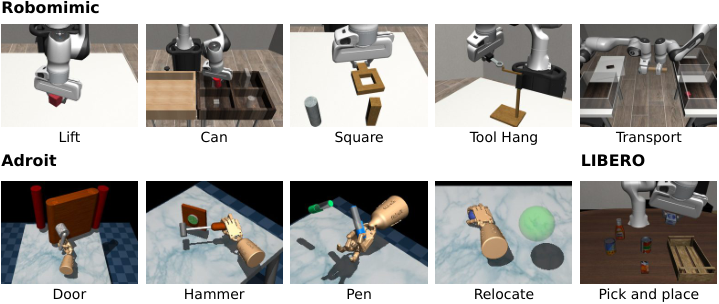
ExRL observes that online RL adaptation of long-chunk robot policies is sample-inefficient because the full high-dimensional action chunk must be optimized. Instead it adapts only how long each predicted chunk is executed, adding a lightweight adapter trained with off-policy RL, keeping the adaptation space low-dimensional while expressivity grows with chunk size. Across simulation benchmarks and real-world robotic tasks, ExRL enables sample-efficient adaptation of diverse long-chunk policies with minimal task-specific tuning.
中文摘要: 本文发现长动作块(可达数十步)策略用现有强化学习在线自适应时,因需优化高维动作块而样本效率低下、难以实机应用。ExRL将自适应从优化动作转移到优化每个预测块的执行时长:在基础策略上增加轻量适配器预测块执行长度,并用离策略强化学习训练,从而保持低维自适应空间且表达能力随块长增长。在多个仿真基准与真实机器人任务上,ExRL以极少任务特定调参实现多种长动作块策略的样本高效自适应。
💬 Reducing online adaptation to a 1D execution-length decision is a pragmatic trick that sidesteps the sample cost of fine-tuning high-dimensional action-chunk policies on hardware.
💬 将在线自适应降维为一维执行长度决策,是一种务实的技巧,可规避在硬件上微调高维动作块策略的样本开销。
Why read it / 推荐理由: A practical, low-sample path to adapting chunk-based motion policies on real robots, useful when transferring learned gaits to your modular platform with limited hardware time. 一种在真实机器人上以低样本量自适应块式运动策略的实用途径,适用于在有限硬件时间内将学习步态迁移到模块化平台。