机器人日报
机器人论文日报 — 2026-11-11
🤖 Scanned 338 papers from today’s arXiv announcement (cs.RO / eess.SY / cs.LG), picked 5 for modular & legged robotics — summarized by DeepSeek.
🤖 从今日 arXiv 新论文(cs.RO / eess.SY / cs.LG)中扫描 338 篇,围绕模块化与足式机器人精选 5 篇 — 由 DeepSeek 生成双语摘要。
1. Koopman Model-Based Reinforcement Learning
基于Koopman算子的模型强化学习
Authors / 作者: Wenjian Hao, Paulo C. Heredia, Shaoshuai Mou
arXiv: 2611.14186 · PDF
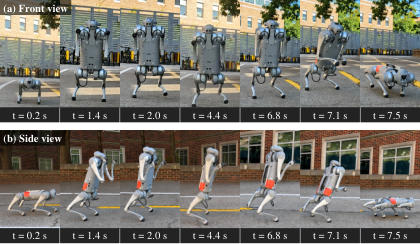
K-MBRL learns a control policy for nonlinear robotic systems with unknown dynamics by combining a stochastic Koopman operator that linearizes the dynamics with a critic estimating the remaining future cost. The linear representation reduces the model-dependent policy gradient to a constant matrix product, and one-step propagation avoids long-horizon prediction error accumulation. Simulations on HalfCheetah and quadruped locomotion show strong sample efficiency and real-time feedforward control, with convergence guarantees.
中文摘要: 本文提出基于Koopman算子的模型强化学习算法K-MBRL,用于未知动力学的非线性机器人控制。该方法利用随机Koopman算子将未知非线性动力学近似为线性表征,策略目标由解析即时代价与critic估计的未来代价组成;线性动力学使依赖模型的策略梯度计算简化为常数矩阵乘积,而单步模型前推避免了长时域预测误差累积。算法在标准随机逼近假设下给出策略学习收敛性保证;在HalfCheetah与四足机器人运动任务上的仿真表明其样本效率和性能优于无模型及传统基于模型的强化学习基线,学习到的策略可前馈实时执行而无需在线优化。
💬 Elegant combination of Koopman linearization and model-based policy gradient that yields closed-form policy improvement and real-time quadruped control without online optimization.
💬 将Koopman线性化与基于模型的策略梯度优雅结合,得到闭式策略改进与无需在线优化的四足实时控制。
Why read it / 推荐理由: It offers a principled, sample-efficient MBRL route to feedforward real-time locomotion policies, relevant to RL-based motion control and sim-to-real deployment. 它提供了一条有理论保障、高样本效率的MBRL路径来生成可前馈实时执行的运动策略,与基于RL的运动控制和sim-to-real部署密切相关。
2. FAME-QP: A GPU-Accelerated Quadratic-Programming Solver for Real-Time Model Predictive Control
FAME-QP:面向实时模型预测控制的GPU加速二次规划求解器
Authors / 作者: Santosh Mohan Rajkumar, Debdipta Goswami, Stephanie Stockar
arXiv: 2611.13766 · PDF
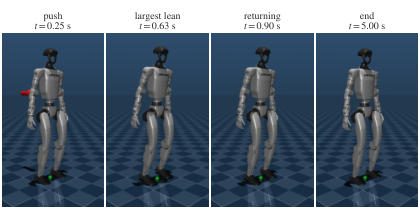
FAME-QP is a GPU solver for dense QPs from linear MPC that combines constraint-dependent operator representations with fused one- and two-kernel iterations replayed via CUDA graphs, selecting execution configurations automatically through device calibration. It uses a cached operator bank for initial penalties and lazy operator updates when matrices change. Benchmarks and simulated humanoid and quadrotor control show lower latency than competing GPU solvers while preserving accuracy and control performance.
中文摘要: 本文提出FAME-QP,一种用于线性模型预测控制中稠密二次规划的GPU加速求解器。其核心是将依赖约束的算子表示与经CUDA图回放融合的单核/双核迭代相结合,并通过设备校准与问题相关计时自动选择执行配置;求解器利用缓存算子库选择初始惩罚参数,在问题矩阵变化时惰性更新算子。数值基准以及仿真人形机器人与四旋翼控制实验表明,其在保持解精度和控制性能的同时,延迟低于现有GPU求解器。
💬 A practical, well-engineered GPU QP solver whose sub-millisecond-class latency directly targets the real-time MPC bottleneck in legged and humanoid whole-body control.
💬 一个工程实现扎实的GPU QP求解器,其低延迟直接针对腿足与人形全身控制中实时MPC的瓶颈。
Why read it / 推荐理由: Real-time MPC for legged robots is solver-bound at kHz rates, so a faster GPU QP backend can directly enable higher-rate whole-body predictive control. 腿足机器人实时MPC受限于求解器速度,更快的GPU QP后端可直接支持更高频率的全身预测控制。
3. Ground Reaction Force-Aware Model Predictive Control for Underactuated Upright Physical Assistance
面向欠驱动直立辅助的地面反力感知模型预测控制
Authors / 作者: Darren Biskup, Jeonghan Yu, Zibo Yu, Sunil K. Agrawal
arXiv: 2611.13204 · PDF
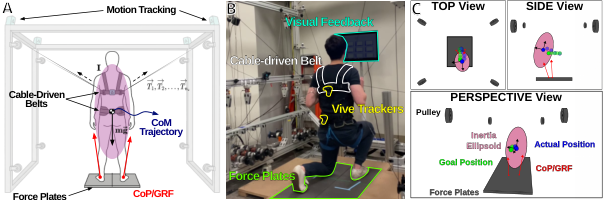
GRF-MPC integrates live ground reaction force and center-of-pressure measurements into a human centroidal dynamics model and solves a receding-horizon QP that optimizes assistive forces and moments. Deployed on the 4-cable underactuated RobUST trainer against an 8-cable impedance baseline across ~300 trials, it cut peak CoM error by 19.6%, tracking error by 24.1%, and mechanical work by 28.7%, while QP solves stay under 1 ms at 100 Hz.
中文摘要: 本文提出地面反力感知模型预测控制(GRF-MPC),将实时地面反力与压力中心测量直接融入人体质心动力学模型,以滚动时域二次规划在线优化辅助力与力矩。作者在欠驱动四索配置的RobUST直立训练平台上部署该控制器,并与全驱动八索笛卡尔阻抗基线在六名健康受试者上开展近300次试验对比:在脉冲扰动下峰值质心误差降低19.6%,轨迹跟踪误差降低24.1%,净机械功减少28.7%,自主稳定极限区域扩大45.9%。QP求解时间小于1ms,可支持100Hz重规划。
💬 Shows how embedding measured contact forces and CoP as feedback in an MPC QP dramatically improves assistive performance with half the actuators — a useful template for contact-aware legged control.
💬 表明将实测接触力与压力中心作为反馈嵌入MPC的QP中,可用一半的驱动器显著提升辅助性能,对接触感知的腿足控制有借鉴价值。
Why read it / 推荐理由: It demonstrates a fast, contact-force-aware MPC formulation with strong hardware results, directly transferable to legged robots that must exploit ground reaction forces. 它给出了一个快速、接触力感知的MPC形式并在硬件上取得显著效果,可直接迁移到需利用地面反力的腿足机器人。
4. RedirectMimic: Local Motion Content Redaction for Humanoid Whole-Body Control
RedirectMimic:面向人形机器人全身控制的局部运动内容重定向
Authors / 作者: Zepeng Wang, Xiaochuan Shi
arXiv: 2611.14049 · PDF
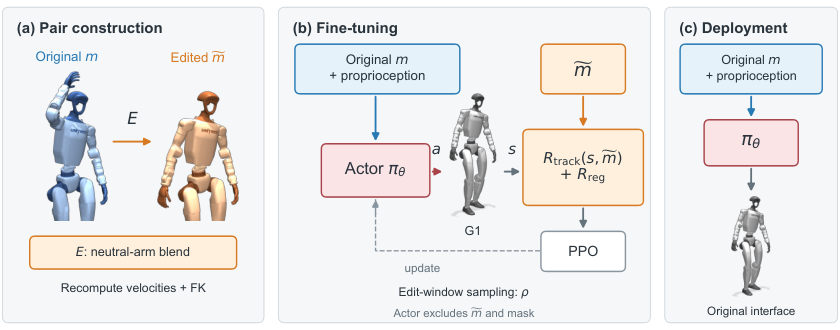
RedirectMimic decouples the reference observed by the RL actor from the edited target used to train execution: a rule-generated edited reference shapes PPO tracking rewards while deployed observation and action interfaces remain unchanged. On a pretrained Unitree G1 tracker, it suppresses unwanted overhead-arm content to 2.7% occurrence with 94.2% core-window joint success, versus 58.9% for reward zeroing and 32.8% for anti-tracking, and retains tracking accuracy on unedited motions.
中文摘要: RedirectMimic针对人形机器人全身控制提出局部运动内容遮蔽方法:将actor观测到的参考与训练执行所用的目标解耦,由规则生成的编辑参考在PPO中引导跟踪奖励,而部署时的观测与动作接口保持不变。作者在基于7509段运动预训练的Unitree G1跟踪器上评测:在过头手臂任务中,该方法将核心窗口内容出现率降至2.7%,核心窗口关节成功率达94.2%,显著优于奖励置零(58.9%)与反跟踪(32.8%);在速度定义任务中其替换误差最低,且对未编辑运动的跟踪精度与预训练控制器相当。
💬 A clean observation-target decoupling trick that edits whole-body motion content at training time without touching the deployed policy interface — practically valuable for modular behavior composition.
💬 一种简洁的观测—目标解耦技巧,可在训练时编辑全身运动内容而不改动部署策略接口,对行为模块化组合有实用价值。
Why read it / 推荐理由: For modular legged/humanoid control, it shows how to selectively reshape parts of a whole-body tracking policy at training time while keeping the deployed interface intact. 对于模块化腿足/人形控制,它展示了如何在训练时选择性重塑全身跟踪策略的局部行为,同时保持部署接口不变。
5. Online Adaptive Clustering in Robust Distributed Model Predictive Control
鲁棒分布式模型预测控制中的在线自适应聚类
Authors / 作者: Stefan van Dijk, W. P. M. H. Heemels, Paula Chanfreut Palacio
arXiv: 2611.13923 · PDF
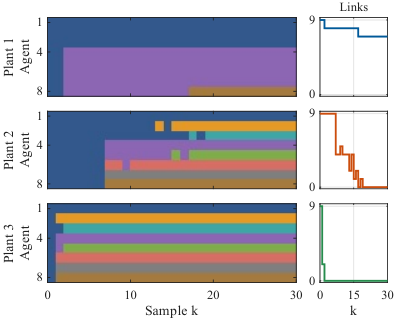
The paper proposes a dynamic clustering framework for tube-based MPC of coupled multi-agent systems, treating out-of-cluster couplings as bounded disturbances and building a state-dependent mismatch measure from a robust upper bound on closed-loop cost and a partition-independent optimistic lower bound. Combined with a communication penalty, this enables online selection of centralized-to-decentralized topologies while preserving recursive feasibility and practical asymptotic stability, with mismatch bounding the finite-horizon gap to centralized MPC.
中文摘要: 本文针对耦合多智能体系统提出一种用于管式模型预测控制的动态聚类框架:簇内智能体显式协调动力学,簇外耦合视为有界扰动。作者对每个可行簇,基于预测闭环代价的鲁棒上界与与划分无关的乐观下界构造状态相关的失配度量,并结合通信惩罚实现在线选择从集中式到完全分布式的聚类拓扑。所得切换控制器保持递归可行性与约束满足,并实现闭环实际渐近稳定;失配量还给出相对集中式MPC有限时域性能差的上界。八智能体弹簧—阻尼示例验证了其在降低通信的同时接近集中式MPC的性能。
💬 A theoretically rigorous approach to online topology switching in distributed MPC, conceptually aligned with selecting coordination patterns in modular multi-limb robots.
💬 一种在分布式MPC中在线切换拓扑的严谨方法,在概念上与模块化多足机器人协调模式的选择相通。
Why read it / 推荐理由: Its mismatch-metric-based online coordination selection offers a formal viewpoint on when modular units should coordinate tightly versus act independently. 其基于失配度量的在线协调选择,为模块化单元何时紧密协调、何时独立行动提供了形式化视角。