机器人日报
机器人论文日报 — 2026-11-09
🤖 Scanned 289 papers from today’s arXiv announcement (cs.RO / eess.SY / cs.LG), picked 5 for modular & legged robotics — summarized by DeepSeek.
🤖 从今日 arXiv 新论文(cs.RO / eess.SY / cs.LG)中扫描 289 篇,围绕模块化与足式机器人精选 5 篇 — 由 DeepSeek 生成双语摘要。
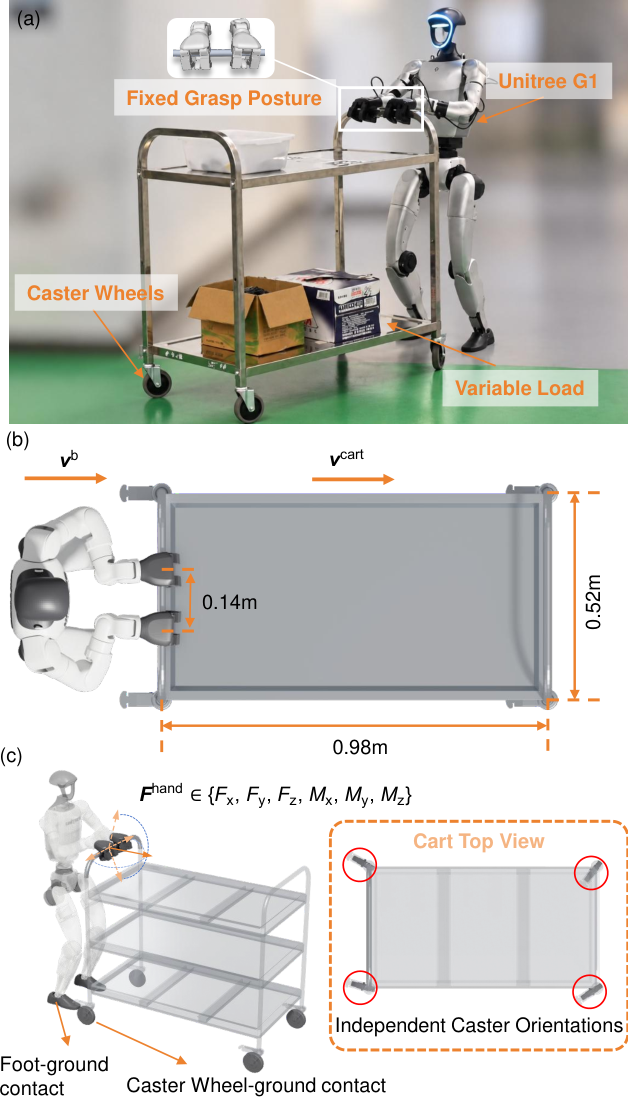
1. ForPC: Force-Aware Whole-Body Control for Precise Humanoid Cart Pushing
ForPC:面向精确人形机器人推车的力感知全身控制
Authors / 作者: ZhenYu Zou, Xing Liu, ShiChuang Wang, YunLong Dong, LiNan Deng, Feng Hua et al.
arXiv: 2611.08664 · PDF
Proposes a two-stage reinforcement learning framework for humanoid cart pushing that first trains a locomotion prior, then infers force and state latents from onboard observations without external force sensors to drive a residual policy coordinating arms, waist, and legs. Reduces cart-velocity RMSE by up to 68.2% and cross-track RMSE by up to 74.2% in sim-to-sim, and transfers to a physical Unitree G1.
中文摘要: 针对人形机器人推轮式推车时双臂抓握形成力耦合闭环、载荷变化扰动平衡的问题,提出 ForPC 力感知全身控制框架。采用两阶段强化学习:先在变化手部载荷与上身姿态下训练运动先验以提供平衡支撑,再从机载观测(无需外力传感器)推断力隐变量与状态隐变量,输入残差策略,协调受限的手臂、腰部与腿部调整及基座速度指令。多目标奖励惩罚双臂内对抗、抓握滑移与执行器饱和,无需人工示教即可按需施加接触力。仿真实验相对仅运动基线降低推车速度 RMSE 达 68.2%,多弯路径横向误差降低 74.2%,并零样本迁移至 Unitree G1 实物。
💬 A clean residual-WBC architecture with sensorless force-latent inference that demonstrates whole-body contact control of a coupled robot-object loop with real-robot transfer.
💬 一种简洁的残差式全身控制架构,借助无传感器力隐变量推断实现对机器人-物体耦合闭环的全身接触控制,并完成实物迁移。
Why read it / 推荐理由: Directly relevant to whole-body control under coupled contact forces and shows a practical force-estimation pathway without external sensors. 与耦合接触力下的全身控制直接相关,并给出无需外力传感器的实用力估计途径。
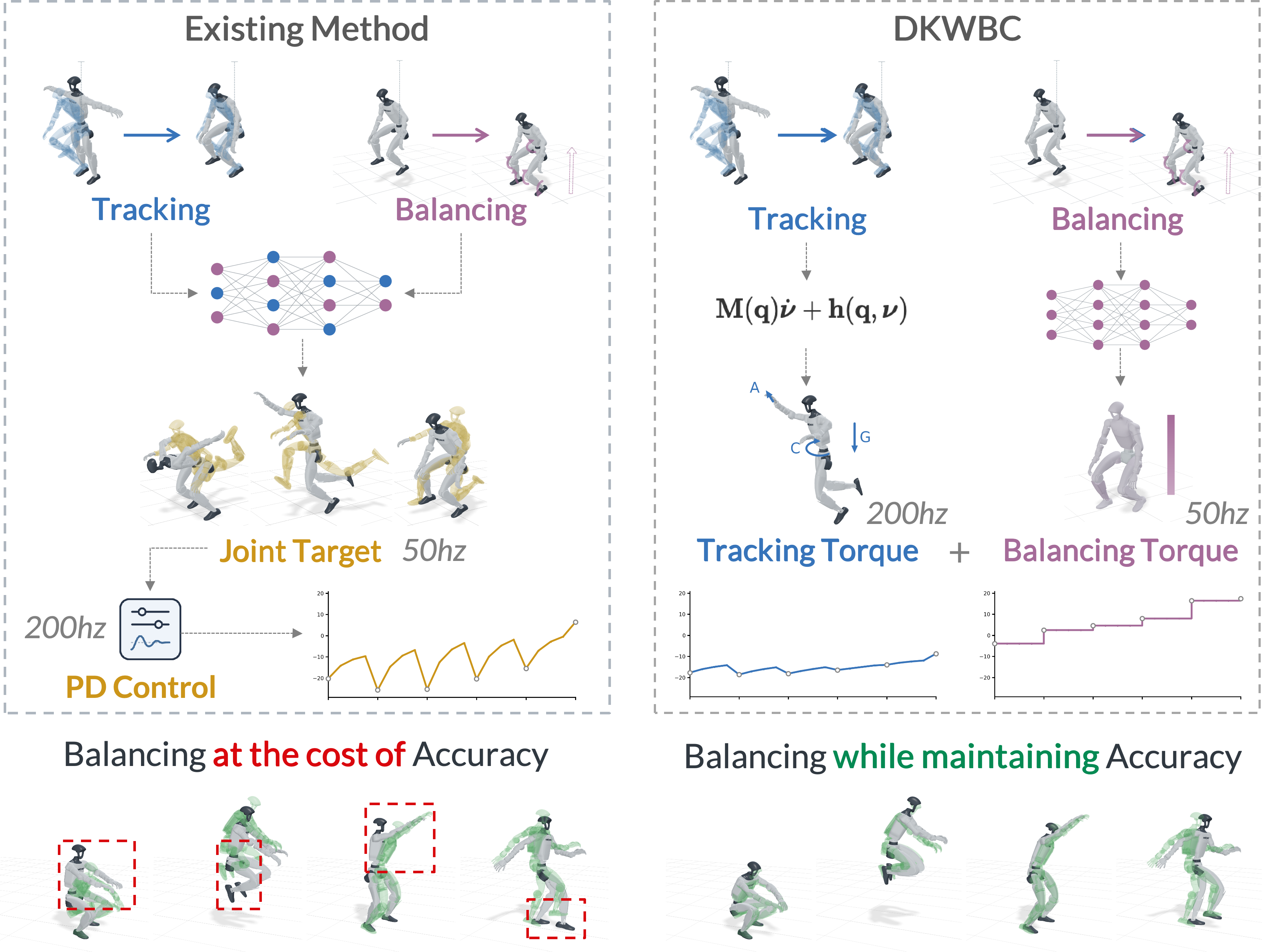
2. DKWBC: Decoupling Motion Tracking and Balancing for Humanoid Whole-Body Control
DKWBC:解耦运动跟踪与平衡的人形全身控制
Authors / 作者: Dingkun Wei, Zehong Shen, Huaijin Pi, Xueyang Wang, Xing Zhu, Hujun Bao et al.
arXiv: 2611.09605 · PDF
Proposes a dynamics-informed whole-body control framework that uses inverse-dynamics feedforward plus joint PD feedback for tracking torque, with a learned residual policy supplying only balancing corrections. A single balancing policy generalizes across motion datasets in simulation and on real hardware, including payloads and physical interactions.
中文摘要: 针对现有强化学习跟踪器将运动跟踪与平衡耦合学习导致学习困难和控制高频抖动的问题,提出 DKWBC 动力学感知全身控制框架。借鉴浮基动力学中模型项与环境力矩对关节力矩的贡献,采用逆动力学前馈加关节 PD 反馈生成跟踪力矩,仅由残差策略学习平衡所需的关节力矩修正,从而显式分离运动相关力矩需求,简化策略学习。仿真与实物实验表明,单一平衡策略可跨多个运动数据集泛化,在地面支撑、附加载荷与物理交互下均保持精确跟踪与平衡。
💬 An elegant model-based-plus-residual decomposition that cleanly separates tracking from balancing and generalizes across motions on real hardware.
💬 一种优雅的模型加残差分解方法,清晰分离跟踪与平衡,并在实物上跨运动泛化。
Why read it / 推荐理由: Offers a principled structural template for separating nominal model control from learned corrections, directly transferable to modular legged platforms. 提供了将标称模型控制与学习修正分离的结构化模板,可直接迁移至模块化足式平台。
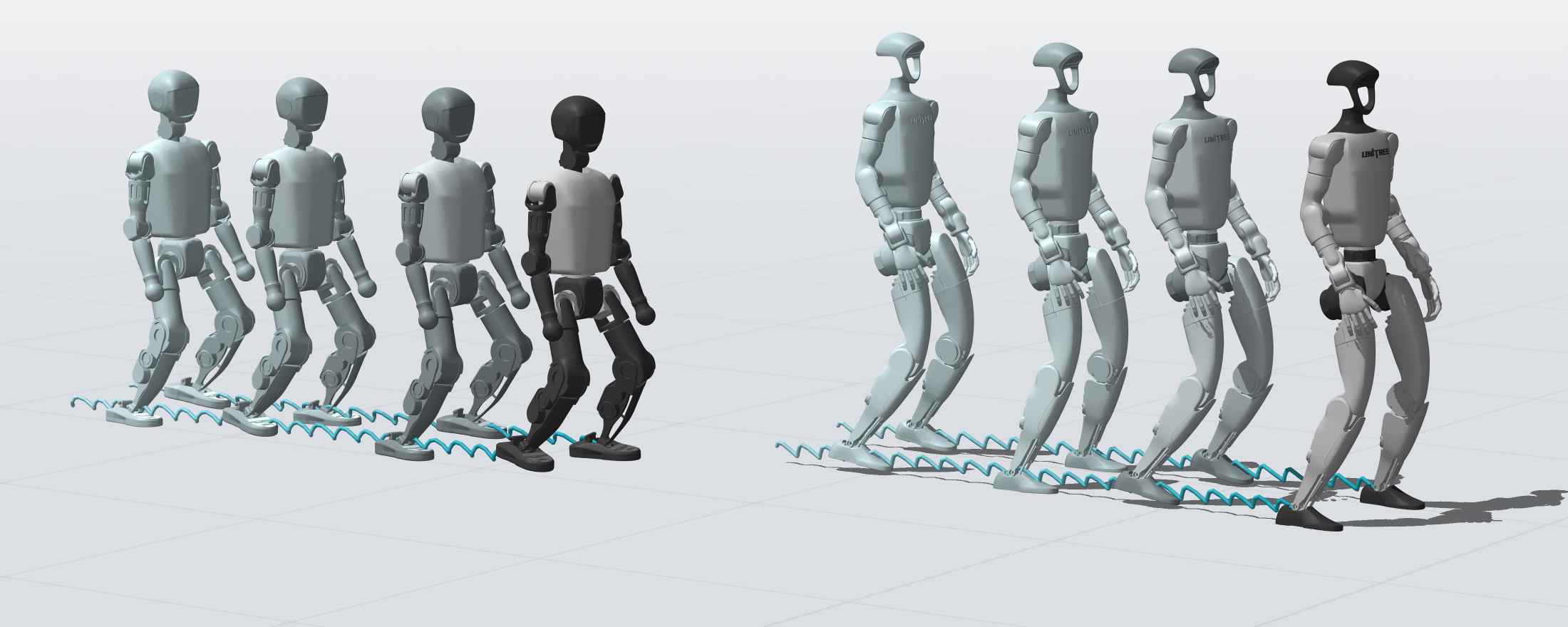
3. STRIDE: Learning Humanoid Locomotion in Minutes with Acceleration-Based Rewards
STRIDE:基于加速度奖励在数分钟内学习人形机器人运动
Authors / 作者: Nico Bohlinger, Jan Peters
arXiv: 2611.08857 · PDF
Introduces an RL locomotion reward that tracks a commanded acceleration profile instead of base velocity, requiring only the onboard IMU. Combined with the off-policy XQC algorithm, high-gain joint position control, and symmetry augmentation, it learns walking on Unitree G1 and Booster T1 within 14 minutes of samples and cuts training falls by 81%.
中文摘要: 针对强化学习运动奖励通常跟踪基座速度、而该速度在机载条件下难以测量的问题,提出 STRIDE:改以跟踪指令加速度剖面作为奖励,仅需机载 IMU。为高效利用该奖励,采用离策略算法 XQC,结合高增益关节位置控制与左右对称数据增强。仿真中在 Unitree G1 与 Booster T1 上仅用约 14 分钟样本即学会行走,相比缺少上述两组件的情况训练摔倒减少 81%,而后者需一个多小时才学会。
💬 A practical on-board-only reward formulation with strong sample efficiency, though validation remains simulation-only.
💬 一种仅依赖机载传感的实用奖励设计,样本效率高,但目前仅在仿真中验证。
Why read it / 推荐理由: Offers a sensor-lean reward signal that could simplify sim-to-real pipelines for modular legged robots lacking motion capture. 提出低传感依赖的奖励信号,有望简化缺少动捕的模块化足式机器人的 sim-to-real 流程。
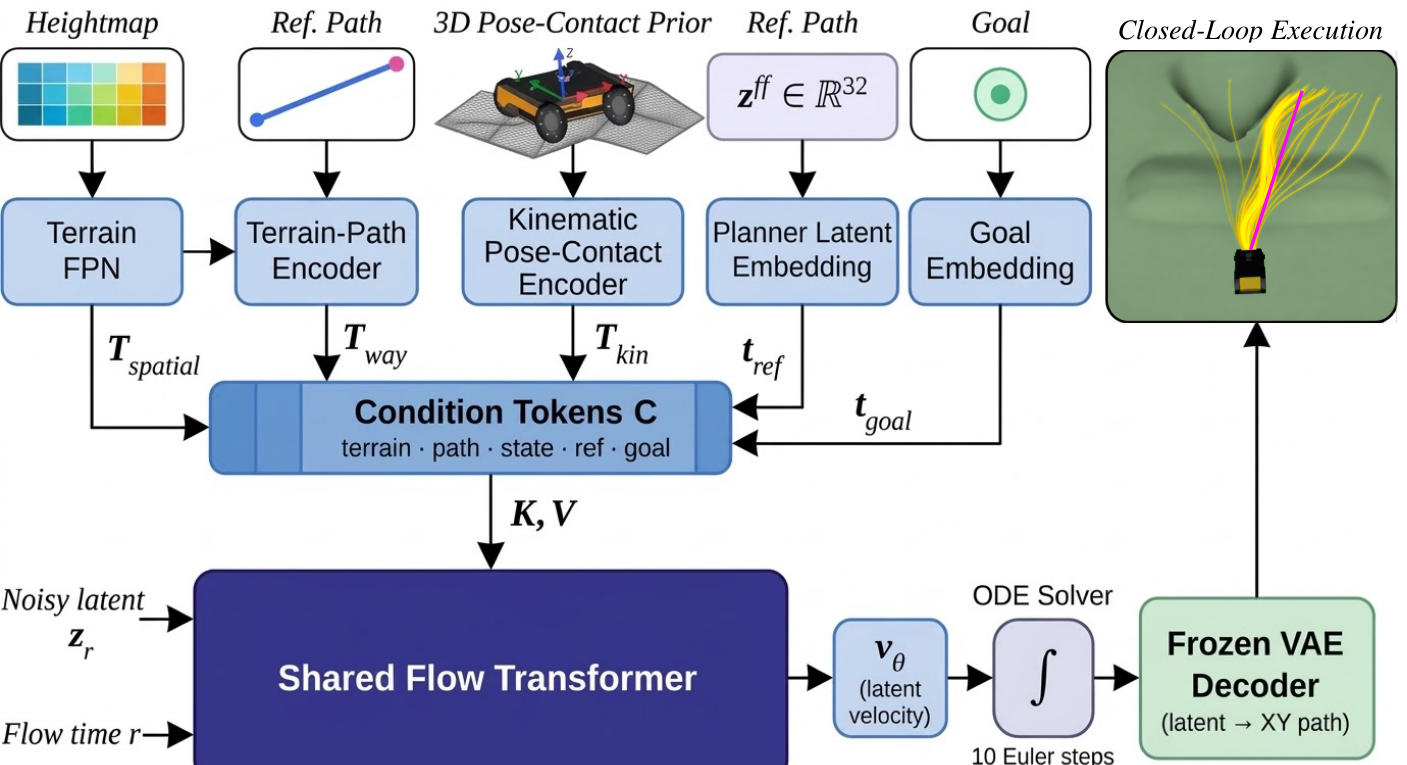
4. EGT: Execution-Grounded Traversability through Learned Closed-Loop Trajectory Distributions
EGT:基于学习闭环轨迹分布的执行接地可通行性
Authors / 作者: Chinmay Mundane, Amith Manoharan, Arun Kumar Singh
arXiv: 2611.09270 · PDF
Defines traversability as the probability a vehicle-controller pair can execute a path, estimated via latent-space flow matching that predicts closed-loop trajectory distributions conditioned on terrain features and vehicle attitude. Reduces safe-path rejection to 2.2% and navigation failures substantially, with zero-shot transfer to real outdoor experiments.
中文摘要: 针对点式滚转、俯仰或力角裕度忽略地形扰动与底层控制器修正、导致过于保守的问题,提出执行接地可通行性(EGT),定义为车辆-控制器对执行候选路径并满足轨迹级跟踪与进度要求的概率。采用潜空间流匹配模型,以多分辨率地形特征及三维车辆姿态与轮地接触点为条件,预测闭环轨迹分布。650 次未见地形仿真试验中,安全路径误拒率降至 2.2%(基线为 11.4%–39.5%),不安全接受率 7.7%;集成到滚动时域采样规划器后导航失败率显著降低并缩短到达时间,仿真训练模型零样本迁移至真实户外实验。
💬 Reframes traversability in controller-execution terms with a learned stochastic predictor, well matched to traverse-capability-aware planning.
💬 以控制器实际执行能力重新定义可通行性并采用学习式随机预测器,契合可通行能力感知的路径规划。
Why read it / 推荐理由: Directly advances traverse-capability-aware path planning with a controller-coupled, probabilistic formulation and real-world zero-shot transfer. 以控制器耦合的概率化建模推动可通行能力感知路径规划,并实现真实环境零样本迁移。
5. SUGARv2: Learning Diverse Visual Humanoid Loco-Manipulation Skills from Synthesized Interaction References
SUGARv2:从合成交互参考学习多样化视觉人形移动操作技能
Authors / 作者: Tianshu Wu, Tianxiang Gui, Yue Chen, Tingxu Liu, Ziye Peng, Guangjie Yang et al.
arXiv: 2611.09266 · PDF
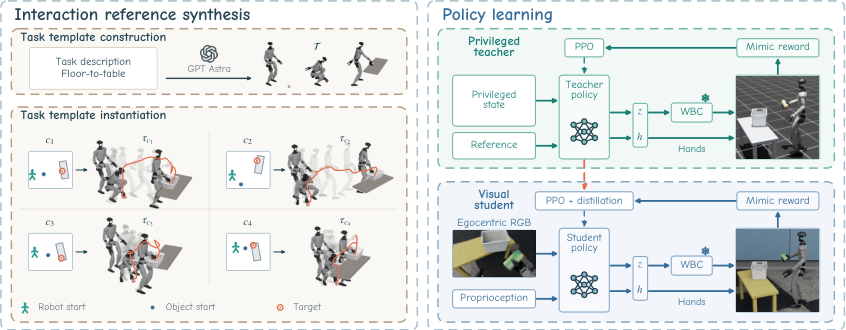
Presents a unified framework that synthesizes robot-object interaction references from reusable task templates and trains privileged teachers plus visual student policies via reference-based imitation and RL with domain randomization. Achieves 91.0% mean success across five loco-manipulation tasks in simulation and demonstrates sim-to-real whole-body manipulation on a real humanoid.
中文摘要: 为降低人形移动操作技能扩展中示教采集与任务专用训练设计的成本,提出 SUGARv2 统一框架。通过将可复用任务模板适配到不同空间布局,合成协调的机器人-物体交互参考;以基于参考的模仿作为跨任务统一学习目标,先训练特权教师执行参考,再经教师蒸馏与强化学习训练视觉策略,并结合多样物体实例与视觉域随机化以支持视觉泛化与 sim-to-real 迁移。五个任务上仿真平均成功率 91.0%,并在真实人形上完成全身操作迁移。
💬 A scalable template-driven reference synthesis pipeline that reduces per-task reward engineering while achieving real-robot whole-body manipulation.
💬 一种可扩展的模板驱动参考合成流程,减少逐任务奖励工程,并在实物上实现全身操作。
Why read it / 推荐理由: Useful for scaling diverse whole-body motion skills with minimal human effort, applicable to modular multi-legged platforms. 有助于以最少人工投入扩展多样化全身运动技能,可应用于模块化多足平台。