机器人日报
机器人论文日报 — 2026-11-08
🤖 Scanned 38 papers from the last 3 days of arXiv announcements (cs.RO / eess.SY / cs.LG), picked 5 for modular & legged robotics — summarized by DeepSeek.
🤖 从近 3 天的 arXiv 新论文(cs.RO / eess.SY / cs.LG)中扫描 38 篇,围绕模块化与足式机器人精选 5 篇 — 由 DeepSeek 生成双语摘要。
1. LMGN: A Unified Policy Learning Model for Last-Mile Grasp-Navigation
LMGN:最后一英里抓取-导航的统一策略学习模型
Authors / 作者: Xuenmin Hu, Qingxue Qian, Wei Luo, Benyi Ma, Bo Tang, Long Chen
arXiv: 2611.07515 · PDF
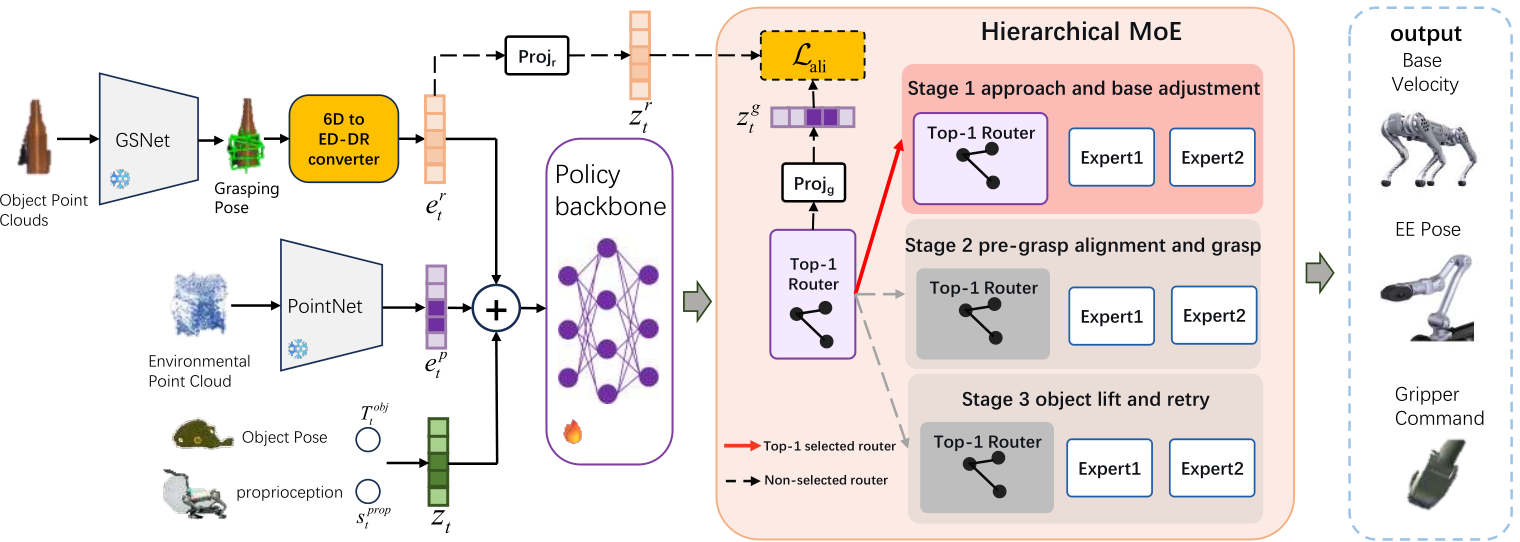
LMGN addresses the last-mile grasp-navigation problem for quadruped loco-manipulation by introducing an Explicit Distance and Directional Reachability (ED-DR) representation to encode grasp-compatible base placement and approach direction, and a semantically aligned Hierarchical Mixture-of-Experts (HMoE) policy that models stage-aware behaviors (base adjustment, pre-grasp alignment, grasp execution, object lift). A joint optimization method aligns navigation and manipulation, and experiments in Habitat and Isaac Gym show consistent outperformance over state-of-the-art.
中文摘要: LMGN针对四足机器人移动操作中的最后一英里抓取-导航问题,提出显式距离与方向可达性(ED-DR)表示,明确编码适合抓取的基座放置和接近方向;并设计语义对齐的分层混合专家(HMoE)策略,对基座调整、预抓取对齐、抓取执行和抬升等阶段行为建模。通过联合对齐导航与操作、阶段依赖专家路由和动作级一致性的优化方法训练该策略。在Habitat和Isaac Gym上的大量实验表明,LMGN持续优于现有最先进方法,证明了整合抓取感知的移动操作的有效性。
💬 The hierarchical mixture-of-experts policy with explicit reachability representation is a promising approach for stage-aware loco-manipulation, though validation is limited to simulation.
💬 分层混合专家策略与显式可达性表示相结合,为阶段感知的移动操作提供了有前景的方法,但验证仅限于仿真。
Why read it / 推荐理由: It offers a modular policy architecture and explicit reachability encoding that could inspire stage-based control for modular legged platforms. 它提供了模块化策略架构和显式可达性编码,可为模块化腿式平台的阶段式控制提供启发。
2. Distributed Robust Model Predictive Control for Optimal Consensus of Unknown Multiagent Systems with Event-Triggered Communication
未知多智能体系统最优一致性的分布式鲁棒模型预测控制与事件触发通信
Authors / 作者: Shiyue Jia, Nan Bai, Dawei Shi, Ling Shi
arXiv: 2611.07383 · PDF
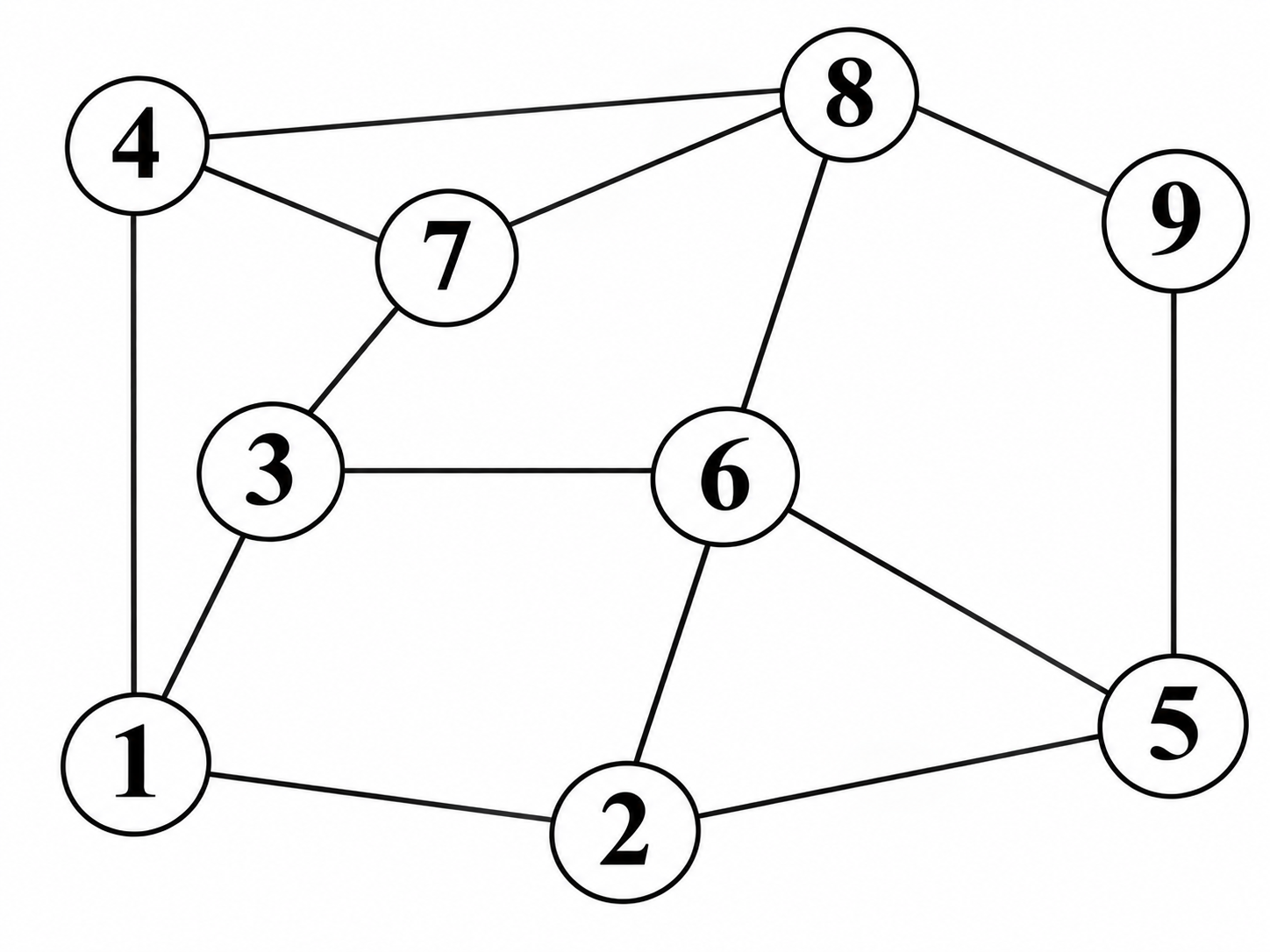
The paper proposes a robust MPC framework for optimal consensus of multiagent systems with unknown dynamics, using noisy offline data to construct nominal models and quantify uncertainty. A distributed gradient-projection ADMM algorithm with event-triggered communication solves the optimization, and sufficient conditions guarantee robust constraint satisfaction and practical consensus. Numerical simulations validate the approach.
中文摘要: 本文针对未知动态的多智能体系统最优一致性问题,提出鲁棒模型预测控制框架,利用含噪离线数据构建名义预测模型并量化不确定性,将其显式纳入鲁棒MPC设计。为减少智能体间通信,开发了带有事件触发信息交换机制的分布式梯度投影ADMM算法,并证明其收敛性。进一步建立保证闭环系统鲁棒约束满足和实用一致的充分条件。数值仿真验证了框架的有效性。
💬 A rigorous distributed robust MPC method with event-triggered communication, though demonstrated only in simulation and not on robotic systems.
💬 一种严谨的分布式鲁棒MPC方法,具有事件触发通信机制,但仅在仿真中验证,未应用于机器人系统。
Why read it / 推荐理由: The distributed robust MPC with event-triggered communication is directly relevant to controlling modular multi-legged robots as multiagent systems. 具有事件触发通信的分布式鲁棒MPC与将模块化多足机器人作为多智能体系统控制直接相关。
3. AffectiveVLA: Safe and Intent-Aware VLA Control for Human-Humanoid Social Interaction
AffectiveVLA:面向人-人形社交互动的安全意图感知VLA控制
Authors / 作者: Nikita Kuzmin, Georgii Demianchuk, Mariya Lezina, Yara Mahmoud, Iana Zhura, Miguel Altamirano Cabrera et al.
arXiv: 2611.07712 · PDF
AffectiveVLA is an intent-gated Vision-Language-Action pipeline deployed on a Unitree G1 humanoid with dexterous hands for social touch interactions. A lightweight RGB model recognizes interaction intent and converts it into a language prompt, with low-confidence predictions suppressing motion; interaction-specific compliance profiles adjust arm impedance during contact, and a voice-triggered safe-stop is included. Fine-tuning four VLA models on 1,300 multimodal episodes showed GR00T’s macro-F1 improved from 0.75 to 0.90 with intent gating.
中文摘要: AffectiveVLA是一种意图门控的视觉-语言-动作管道,部署在带灵巧手的Unitree G1人形机器人上,用于社交触摸互动。轻量级RGB模型从两个机载相机识别交互意图并转换为语言提示,低置信度预测抑制运动执行;接触时根据交互类型调整手臂阻抗,并设有语音触发的安全停止机制。通过VR遥操作收集约1300个多模态交互片段,微调了四种VLA模型。实验表明,意图识别将GR00T的宏F1从0.75提升至0.90,意图模型p95推理延迟为6.27毫秒。
💬 The intent-gating and compliance adaptation mechanisms enhance safety in human-robot interaction, but the work focuses on social touch rather than locomotion.
💬 意图门控和顺应性自适应机制增强了人机交互安全性,但工作侧重于社交触摸而非运动控制。
Why read it / 推荐理由: It demonstrates a practical integration of intent recognition with whole-body control on a humanoid, offering safety concepts transferable to legged robots. 它展示了意图识别与全身控制在人形机器人上的实际集成,其安全概念可迁移至腿式机器人。
4. An Empirical Study of Reinforcement Learning for Keypoint Positioning of Deformable Linear Objects
可变形线性物体关键点定位的强化学习实证研究
Authors / 作者: Vinay Rodrigues, Sara Zeynalpour, Gokhan Solak, Sebastian Hjorth, Arash Ajoudani
arXiv: 2611.07261 · PDF
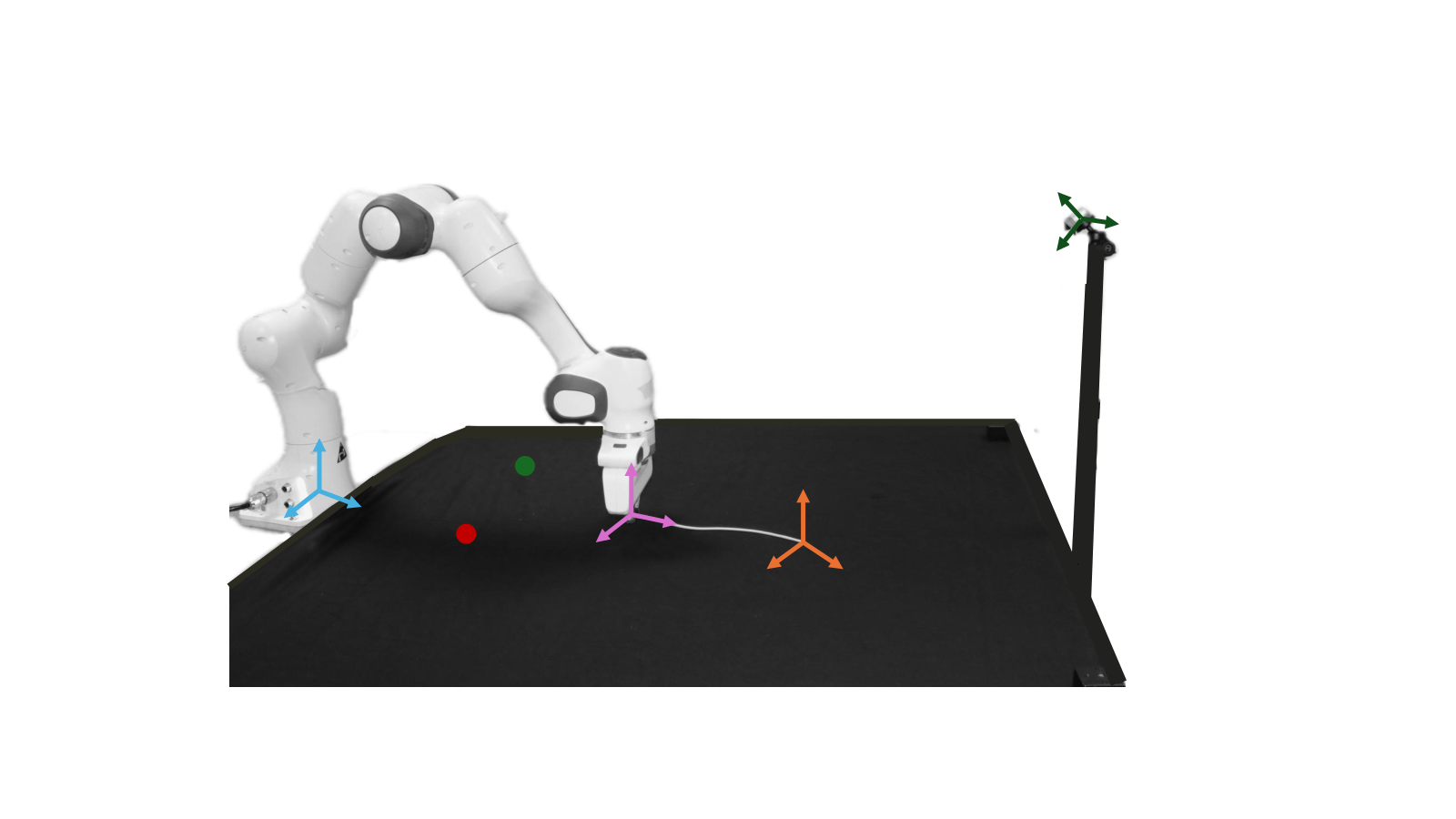
This empirical study investigates RL for planar manipulation of a one-end-grasped deformable linear object, comparing three PPO training stacks and finding that a GPU-parallel MuJoCo Playground stack converges faster. Relative keypoint observations and an asymmetric actor-critic improve learning efficiency, and policies trained with noise, delay, domain randomization, and disturbances achieve high simulation success (96.4%, 98.0%, 88.8%) and transfer zero-shot to real robot with markerless RGB-D keypoint estimation (9/10, 10/10, 8/10 success).
中文摘要: 本文针对一端抓取的可变形线性物体平面操作,实证研究强化学习方法,比较三种PPO训练栈,发现GPU并行的MuJoCo Playground栈收敛更快。相对关键点观测和非对称actor-critic进一步提升学习效率。通过观测噪声、延迟、域随机化和扰动训练的策略在仿真中达到96.4%(单点跟踪)、98.0%(扰动恢复)和88.8%(两点跟踪)的成功率,并利用无标记RGB-D关键点估计实现零样本真机迁移,物理试验成功率分别为9/10、10/10和8/10。
💬 Provides valuable empirical insights into RL training stacks and sim-to-real transfer for deformable object manipulation, with a thorough ablation.
💬 为可变形物体操作的强化学习训练栈和 sim-to-real 迁移提供了宝贵的实证见解,并进行了全面的消融研究。
Why read it / 推荐理由: The systematic comparison of RL training stacks and successful zero-shot sim-to-real transfer are instructive for locomotion sim-to-real as well. 对强化学习训练栈的系统比较和成功的零样本 sim-to-real 迁移对运动控制的 sim-to-real 同样具有指导意义。
5. HITCH: Teaching a Vision-Language Model to Operate a Humanoid through a Whole-Body Harness
HITCH:通过全身束具教视觉语言模型操作人形机器人
Authors / 作者: Qingzhou Lu, Chenxin Liu, Xinming Wang, Liu Cao, Yanjiang Guo, Mengdi Xu et al.
arXiv: 2611.08039 · PDF
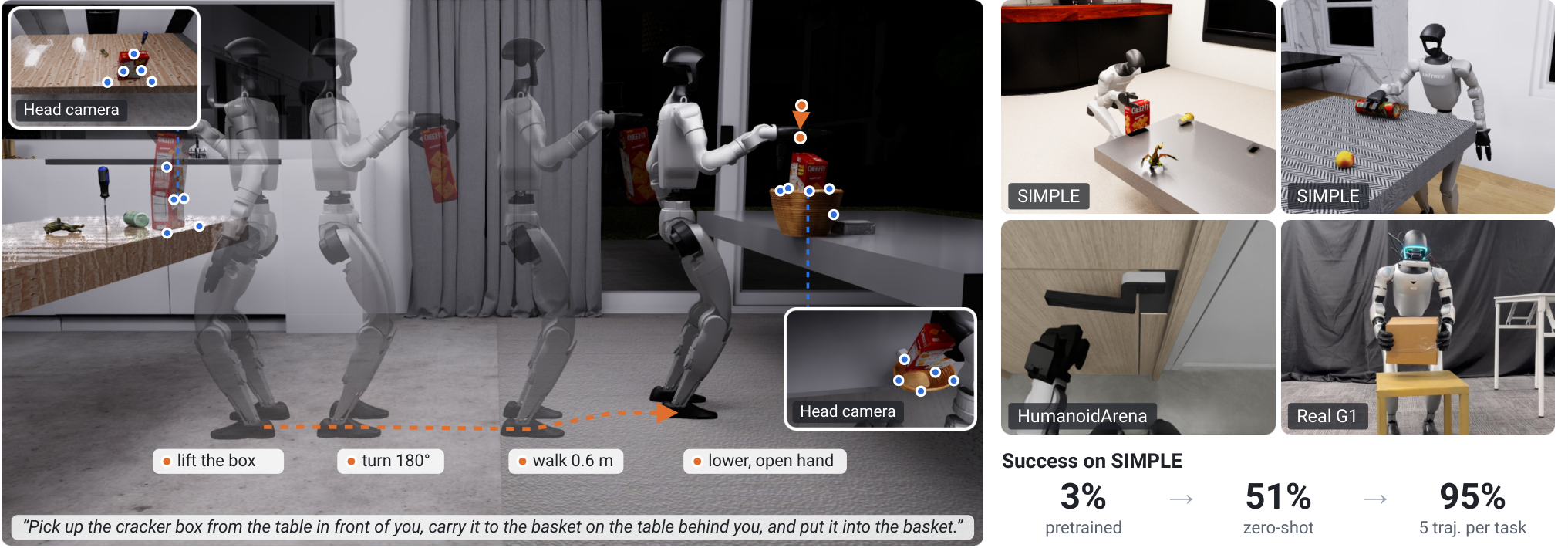
HITCH is a harness that enables a VLM to control a humanoid by mapping selected image points to 3D positions and executing whole-body commands (pelvis, torso, hands, walking, gaze) via a learned tracker. Fine-tuning the VLM on trajectories from teacher policies solving five base tasks through HITCH yields 51% success on SIMPLE and 42.5% on HumanoidArena without task-specific trajectories, rising to 95% with five trajectories per task. The model transfers to a real G1 robot for carrying a box and walking to a goal without real training data.
中文摘要: HITCH是一个使视觉语言模型能够控制人形机器人的框架,通过将图像中选择的点映射为3D位置,并利用学习到的跟踪器将骨盆、躯干、手、行走和注视命令转化为全身运动。在教师策略通过HITCH解决五个基础任务的轨迹上微调VLM,无需任务特定轨迹时在SIMPLE和HumanoidArena上分别达到51%和42.5%的成功率,每任务增加五条轨迹后SIMPLE成功率提升至95%。在真实G1机器人上,无需真实训练数据即可执行搬箱并走到目标点的任务。
💬 The whole-body harness abstracting low-level control and enabling VLM-based task execution is a novel direction for humanoid control, though not specifically legged modular design.
💬 全身束具抽象了低级控制并支持基于VLM的任务执行,是人形机器人控制的新颖方向,但并非专门针对腿式模块化设计。
Why read it / 推荐理由: It presents a generalizable whole-body interface for VLMs that could be adapted to modular legged robots for high-level task specification. 它提出了一种可推广的全身接口,供VLM使用,可适配模块化腿式机器人以进行高级任务规范。