机器人日报
机器人论文日报 — 2026-11-02
🤖 Scanned 299 papers from today’s arXiv announcement (cs.RO / eess.SY / cs.LG), picked 5 for modular & legged robotics — summarized by DeepSeek.
🤖 从今日 arXiv 新论文(cs.RO / eess.SY / cs.LG)中扫描 299 篇,围绕模块化与足式机器人精选 5 篇 — 由 DeepSeek 生成双语摘要。
1. Online Learning of Heterogeneous Locomotion Dynamics under Reinforcement Learning Policies for Precise Loco-Manipulation
面向精确移动操作的强化学习策略下异构运动动力学在线学习
Authors / 作者: Tianlin Zhang, Weipeng Xia, Lingwei Zhang, Yiyang Shao, Zhongyu Li, Yun-Hui Liu
arXiv: 2610.41892 · PDF
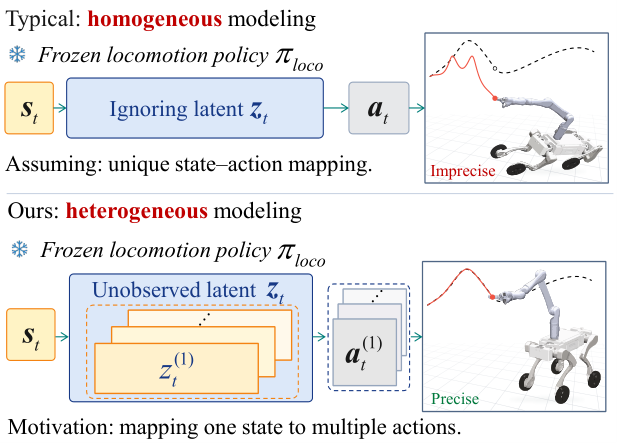
The paper learns the closed-loop floating-base dynamics beneath a frozen RL locomotion policy using a contaminated Gaussian model with two components (predictable and unpredictable latent-condition responses), combined with a Gaussian process over random Fourier features for online updates. The learned model feeds an MPC that predicts base motion and improves end-effector tracking accuracy in loco-manipulation.
中文摘要: 本文研究如何复用预训练的强化学习运动策略以实现精确移动操作,提出在线学习冻结策略下的闭环浮动基座动力学。由于策略的未观测潜变量导致同一观测状态产生异构响应,直接学习会引入偏差与波动;作者用由两个高斯分量组成的污染高斯模型分别近似可预测与不可预测响应,并结合随机傅里叶特征的高斯过程构建在线学习器,按样本属于可预测分量的概率加权更新。由此得到一致且无偏的动力学估计,使模型预测控制能够准确预测浮动基座运动并提升末端跟踪精度。
💬 A neat latent-heterogeneity treatment that turns a frozen locomotion policy into a model usable by MPC for manipulation—directly relevant to WBC/MPC-plus-learning pipelines.
💬 对潜变量异构性的建模很巧妙,将冻结运动策略转化为可供MPC使用的模型以支持操作任务,与‘WBC/MPC+学习’的组合流程直接相关。
Why read it / 推荐理由: It offers a concrete recipe for online system identification under learned policies, useful if you plan to attach an MPC or planner on top of an RL gait controller. 它给出了在学习策略之上做在线系统辨识的具体方案,若你打算在RL步态控制器之上叠加MPC或规划器会很有参考价值。
2. Joint-Health-Aware Reinforcement Learning for Robust Robot Control Under Actuator Degradation
关节健康感知的强化学习:执行器退化下的鲁棒机器人控制
Authors / 作者: Haifa Zhang, Yijing Wang, Zhiqiang Zuo
arXiv: 2610.41348 · PDF
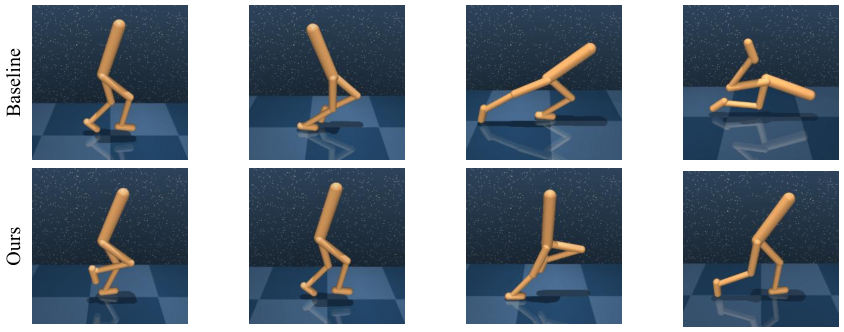
The authors encode per-joint actuation capability as a continuous health vector, model degradation as multiplicative attenuation of executed actions, and use a HealthNet estimator to infer joint health from recent observations for policy redistribution of effort. Evaluated on Walker, Go2, Cassie and Panda manipulation, it improves locomotion returns by up to 250% and manipulation success by up to 15.2 points under degradation.
中文摘要: 针对执行器权限退化导致强化学习策略失效的问题,本文提出关节健康感知的强化学习框架:以连续关节健康向量编码执行器状态,将退化建模为实际执行动作的乘性衰减,并用HealthNet从近期观测与动作中估计各关节健康度,使策略能在健康与退化关节间重新分配控制力矩。在Walker、Go2、Cassie及Panda操作任务上的多种退化掩码与严重程度测试中,该方法优于标称与退化训练基线,运动回报最高提升250.1%,操作成功率提升最多15.2个百分点。
💬 Per-joint continuous health estimation is a more informative robustness signal than fault labels or global latents, and the multi-platform evaluation is convincing.
💬 逐关节连续健康估计比故障标签或全局潜变量提供更丰富的鲁棒性信号,多平台评测也较有说服力。
Why read it / 推荐理由: Modular leg platforms can lose individual actuator authority, so the health-vector conditioning idea maps naturally onto module-aware gait policies. 模块化腿部平台可能出现单个执行器失能,健康向量条件化的思路可自然迁移到模块感知的步态策略中。
3. CuPIQP: A Batched and Differentiable QP Solver on GPUs for Robot Learning and Control
CuPIQP:面向机器人学习与控制的可批处理可微GPU二次规划求解器
Authors / 作者: Fenglong Song, Roland Schwan, Yuwen Chen, Yuning Jiang, Colin N. Jones
arXiv: 2610.41021 · PDF
cuPIQP implements a batched, differentiable proximal interior-point QP solver on GPUs with unified support for dense, sparse and multistage problems, exploiting parallelism across problems while keeping per-problem numerical updates intact. Benchmarks up to 16384 QPs per batch show up to 18.8x speedup over Moreau and 4.26x over eight-core PIQP, and end-to-end learning training is accelerated 4.6x over QPAX and 7.8x over Moreau.
中文摘要: 二次规划是逆运动学、全身控制与模型预测控制的核心模块。本文提出cuPIQP,一个基于近端内点法的GPU可批处理、可微QP求解器,统一支持稠密、稀疏与多阶段问题,在并行求解大量独立问题的同时保持每个问题的数值更新与终止判定。批量规模达16384时,求解时间较Moreau最高加速18.8倍、较八核PIQP加速4.26倍;端到端学习训练较QPAX加速4.6倍、较Moreau加速7.8倍。
💬 Batched differentiable QP infrastructure is exactly what scalable MPC/WBC and learned-optimization pipelines need, though it is an enabler rather than a robot result.
💬 批处理可微QP正是可扩展MPC/WBC与学习优化流程所需的基础设施,但它是使能工具而非机器人实证成果。
Why read it / 推荐理由: If you plan to differentiate through whole-body or MPC layers on GPU, this solver offers a reusable and well-benchmarked building block. 若你计划在GPU上对全身控制或MPC层做端到端求导,该求解器提供了可复用且基准充分的构件。
4. AC-SMPC: Differentiable Actor—Critic MPC with State Constraints for Safe and Fast Robot Navigation
AC-SMPC:带状态约束的可微Actor-Critic模型预测控制用于安全快速机器人导航
Authors / 作者: Chaoran Wu, Jiayu Fan, Qichen Tan, Yuyi Liu, Jin Wang
arXiv: 2610.41477 · PDF
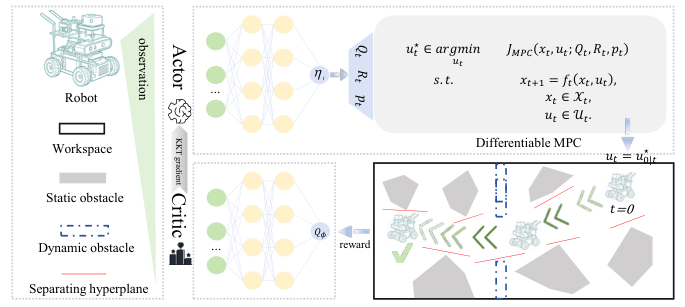
The paper embeds hyperplane collision-avoidance constraints, convexified from vertex/half-space robot and obstacle representations, into a differentiable MPC layer within an actor-critic architecture; slack variables with bounded penalties relax the QP for infeasible local approximations. Simulation and multi-robot narrow-corridor experiments show adaptive objective tuning improving navigation safety and efficiency.
中文摘要: 针对现有可微MPC层难以纳入显式状态约束、从而无法在学习型规划中处理避障的问题,本文以顶点表示机器人与障碍物、半空间表示工作空间,对非线性动力学局部线性化并将超平面避碰约束凸化后嵌入可微MPC层;actor通过闭环反馈调整MPC目标参数塑造局部行为,critic评估长期性能。作者进一步引入有界惩罚松弛变量构成弹性QP以处理约束不可同时满足的情形。仿真与狭窄场景多机器人动态避碰实验验证了其自适应调节与导航性能优势。
💬 Explicit constrained differentiable MPC is a welcome step beyond unconstrained differentiable layers, and the elastic QP relaxation handles local infeasibility sensibly.
💬 带显式约束的可微MPC较无约束可微层是一大进步,弹性QP松弛对局部不可行的处理也较为合理。
Why read it / 推荐理由: Relevant if you want constrained MPC layers that remain differentiable for learned objective tuning in legged navigation. 若你希望获得在腿部导航中既保持约束又可供学习目标调参的可微MPC层,此文值得一读。
5. DiffWBC: Unlocking Steerable General Humanoid Motion Tracking via One-Step Diffusion Whole-Body Control
DiffWBC:基于单步扩散全身控制的可操控通用人形运动跟踪
Authors / 作者: Yifei Huang, Yazhao Yang, Weijia Li, Zhiheng Ma, Dian Shen
arXiv: 2610.41354 · PDF
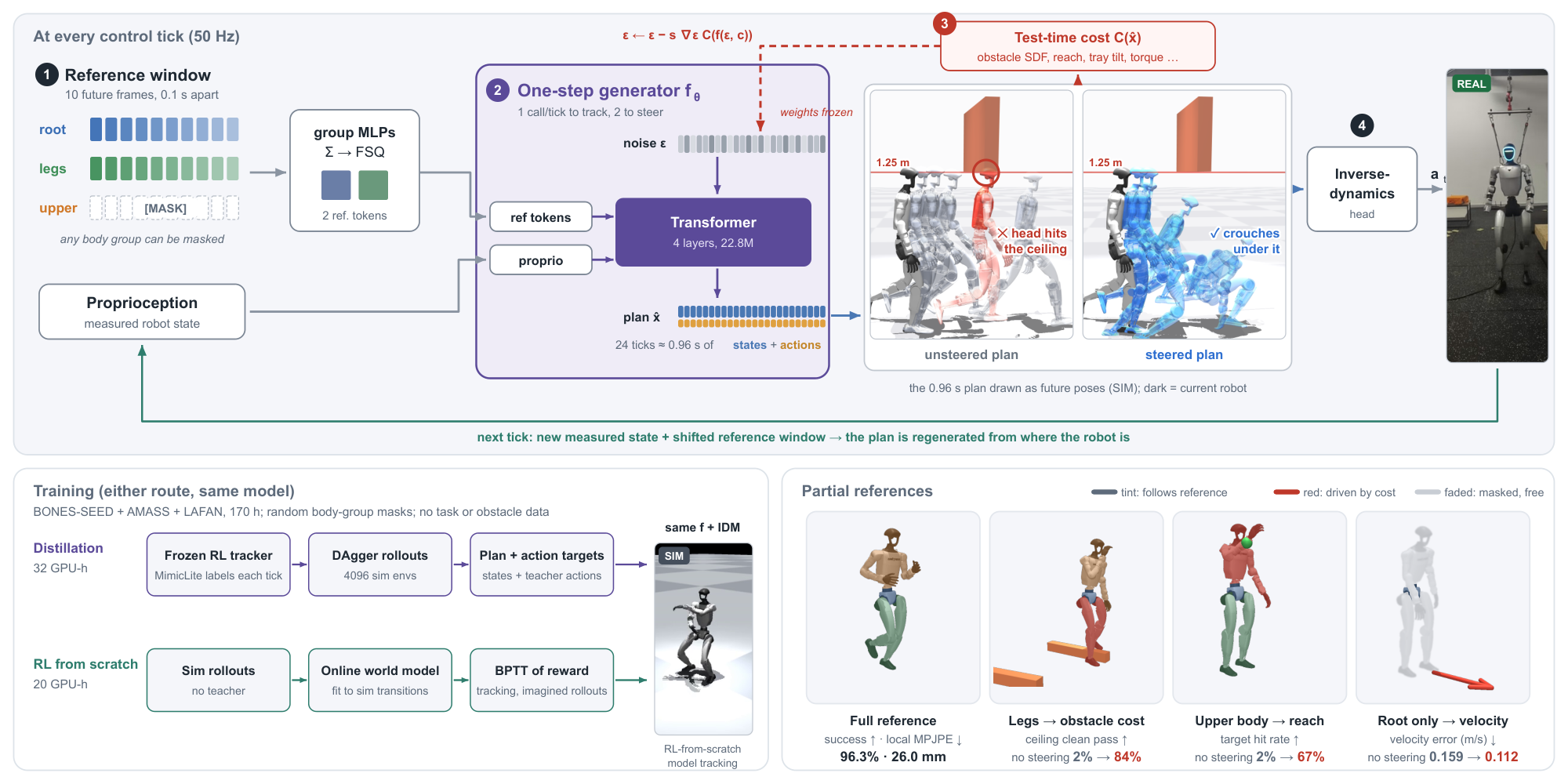
DiffWBC replaces deterministic whole-body trackers with a one-step diffusion policy over future trajectories, requiring one forward pass per 50 Hz control step and achieving 20.1 mm tracking error on BONES while deploying on a Unitree G1. Differentiable cost gradients and body-group masks enable zero-shot test-time steering, and generation-noise plan dispersion flags physical failures with 91% precision.
中文摘要: DiffWBC将全身控制转向生成式范式,用单步扩散模型建模未来轨迹分布,每个50Hz控制步仅需一次前向,可由RL教师蒸馏或经基于模型的RL从头训练。在留出基准上取得六种通用跟踪器中最低的局部跟踪误差(BONES上20.1mm),并部署于Unitree G1实机。借助可微代价梯度与身体分组掩码,可在冻结控制器上零样本测试时操控,显著优于运动学参考编辑;生成噪声下的规划离散度还能免仿真地识别跟踪失败,精度达91%。
💬 Generative WBC with test-time steering is a fresh angle, but humanoid-specific and further from modular multi-legged design than the top entries.
💬 生成式全身控制加测试时操控思路新颖,但面向人形且与模块化多足设计距离较远。
Why read it / 推荐理由: Worth skimming for the test-time steering and failure-detection mechanisms, which could transfer to steerable learned gait controllers. 其测试时操控与失败检测机制或可迁移到可操控的学习型步态控制器,值得快速浏览。