机器人日报
机器人论文日报 — 2026-10-30
🤖 Scanned 37 papers from the last 3 days of arXiv announcements (cs.RO / eess.SY / cs.LG), picked 5 for modular & legged robotics — summarized by DeepSeek.
🤖 从近 3 天的 arXiv 新论文(cs.RO / eess.SY / cs.LG)中扫描 37 篇,围绕模块化与足式机器人精选 5 篇 — 由 DeepSeek 生成双语摘要。
1. GRAFT: Geometry-Aware Residual Adaptation for Foundation Trackers
GRAFT:面向基础跟踪器的几何感知残差自适应
Authors / 作者: Liang Li, Guoyao Zhang, Xingyu Chen, Sikai Wu, Qianyang Wu, Yuhang Lin et al.
arXiv: 2610.36507 · PDF
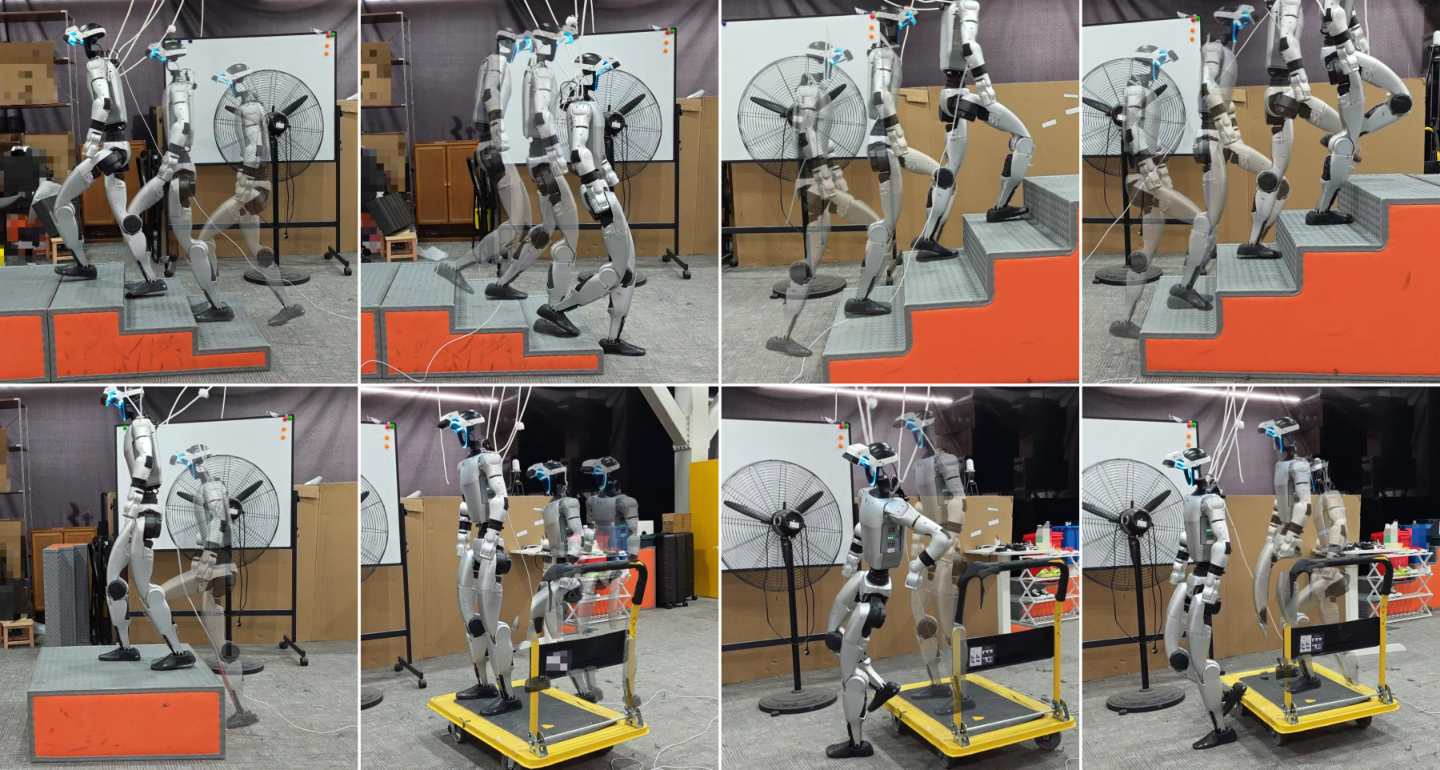
GRAFT freezes a humanoid whole-body behavior foundation model (BFM) tracker and adds a lightweight terrain-conditioned residual adapter only on lower-body execution targets, trained with task and foot-geometry rewards and regularized to stay neutral on flat ground. The adapter is distilled from privileged terrain observations to onboard depth. Evaluated on four frozen trackers over stairs, gaps and platforms in simulation plus real-world deployment, it improves terrain-aware foot placement/clearance without retraining the tracker.
中文摘要: 本文提出GRAFT,一种面向冻结人体行为基础模型(BFM)跟踪器的几何感知残差自适应框架。BFM主要基于平地运动训练,缺乏对局部地形的足端落点、摆动高度和接触时序的显式适应能力。GRAFT保留BFM参数与运动参考接口,仅在下肢执行目标上叠加轻量级地形条件残差适配器,以任务奖励和足部几何奖励训练,并正则化以抑制平地上的多余修正,同时从特权地形观测蒸馏到机载深度。在四个冻结跟踪器上于仿真中评估楼梯、跨沟和平台地形,并开展真实世界部署验证。
💬 A clean decoupling of terrain adaptation from whole-body tracking that avoids costly retraining of foundation trackers, with real-robot validation.
💬 该工作将地形适应与全身跟踪清晰解耦,避免了对基础跟踪器的高成本重训练,并具备真机验证。
Why read it / 推荐理由: Directly relevant to whole-body control and terrain-aware locomotion: shows how to add geometry-aware foot-placement adaptation on top of a frozen locomotion prior, echoing modular plug-in design. 与全身控制和地形感知运动直接相关:展示了如何在冻结的运动先验之上叠加几何感知的落足自适应,契合模块化即插即用设计思想。
2. When Black-Box Robot Policies Fail: Online Sensor Diagnosis and Repair with a Transparent Surrogate
当黑盒机器人策略失效时:基于透明代理模型的在线传感器诊断与修复
Authors / 作者: Marc Ziegler, Batu Özen, Sami Mentes, Thomas Waschulzik, Alois Knoll
arXiv: 2610.36852 · PDF
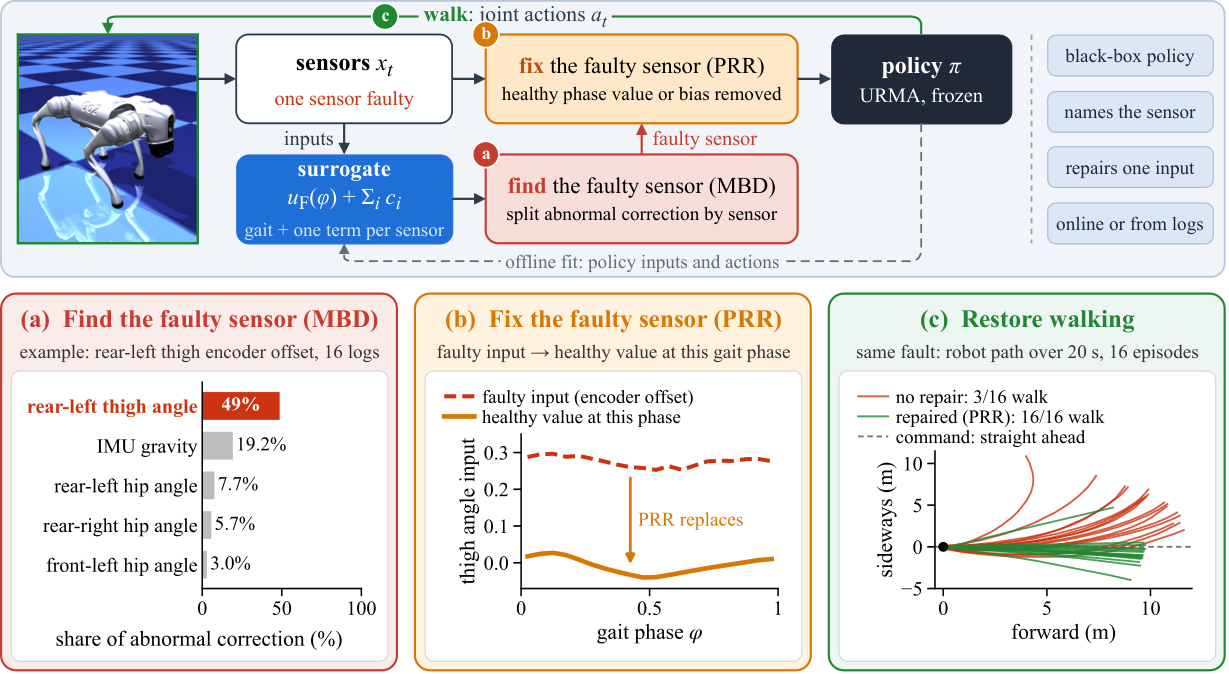
The paper builds a structured surrogate around a frozen locomotion policy that separates periodic gait from sensor-dependent corrections, then uses it to diagnose and repair corrupted sensor inputs without access to policy internals. On simulated Go2, offline diagnosis raises walking success from 259/640 to 429/640 episodes and online repair to 382/640 with no false triggers on fault-free episodes; Go1 and ANYmal C transfer also improves. A matched boosted-tree surrogate predicts actions similarly but yields no repair gain.
中文摘要: 本文针对冻结或不可访问的机器人运动策略,提出一种透明的结构化代理模型:将周期性步态与依赖传感器的修正项分离,从而在无策略内部信息的情况下诊断并在线修复被污染的传感器输入以维持行走。在仿真Go2上,离线诊断将行走成功率从259/640提升至429/640,在线修复达到382/640,且在64个无故障回合中未误触发。在Go1和ANYmal C上的独立拟合同样带来改善,但相位感知梯度效果更佳。对照的提升树代理虽预测精度相近,却无修复增益,说明结构化分解是关键。
💬 A rare study of runtime robustness of frozen locomotion policies for legged robots, with an interpretable surrogate structure that exposes gait-phase versus sensor contributions.
💬 少见的针对足式机器人冻结运动策略的运行时鲁棒性研究,通过可解释代理结构分离步态相位与传感器贡献。
Why read it / 推荐理由: Useful for modular legged platforms where policies are fixed per module and sensor faults under deployment must be handled without retraining. 对模块化足式平台有参考价值:各模块策略固定时,部署中的传感器故障需要在不重训练的情况下处理。
3. RESPLE2: Inertial-Informed Recursive Non-Uniform Spline Estimation for Multi-Sensor Odometry with Global Refinement
RESPLE2:惯性引导的递归非均匀样条多传感器里程计估计与全局优化
Authors / 作者: Ziyu Cao, William Talbot, Song Li, Pakpong Chirarattananon, Fredrik Gustafsson, Marco Hutter et al.
arXiv: 2610.37602 · PDF
RESPLE2 represents 6-DoF motion with recursive non-uniform B-splines, exploiting the knot-clamping boundary property for exact control-point prediction from inertial kinematics, with knot placement adapted to motion and measurement availability inside an iterated EKF. Continuous-time observation models fuse LiDAR, camera, IMU and leg kinematics at native timestamps, and a lightweight global optimizer refines control points with LiDAR-visual loop closures. It achieves competitive or superior accuracy on handheld, tracked, legged and hybrid aerial-legged datasets including highly dynamic maneuvers.
中文摘要: 本文提出RESPLE2,一种基于递归非均匀B样条表示6自由度运动的连续时间多传感器状态估计框架。利用样条节点夹持边界性质,提出由惯性运动学直接精确预测控制点的机制,并根据运动与测量可用性自适应放置节点;在迭代扩展卡尔曼滤波中完成该预测,并通过重置步骤在节点扩展时保持轨迹一致性。更新步骤以连续时间观测模型在各传感器原生时间戳融合LiDAR、相机、IMU与腿部运动学。此外,轻量级全局优化模块利用LiDAR-视觉闭环约束直接精化样条控制点。在手持、履带、足式及空足混合平台的公开与自测数据集(含高动态大加速度机动)上,估计精度与鲁棒性达到与现有最优多传感器里程计相当或更优的水平。
💬 Strong continuous-time multi-sensor state estimation that explicitly exploits leg kinematics, with results on highly dynamic legged-platform maneuvers that stress-test state estimation.
💬 扎实的连续时间多传感器状态估计工作,显式利用腿部运动学,并在足式平台高动态机动上进行了压力测试。
Why read it / 推荐理由: State estimation is the backbone of WBC and MPC on legged robots; leg-kinematics-aware spline odometry with inertial-informed prediction is directly usable on modular multi-legged platforms. 状态估计是足式机器人全身控制与MPC的基础;该工作融合腿部运动学与惯性引导样条预测,可直接用于模块化多足平台。
4. Camera-to-Quadruped Robot Pose Estimation from Sequential Images
基于序列图像的四足机器人位姿估计
Authors / 作者: Seobin Hwang, Ji-Seong Beom, Yeong-Jun Cho
arXiv: 2610.36599 · PDF
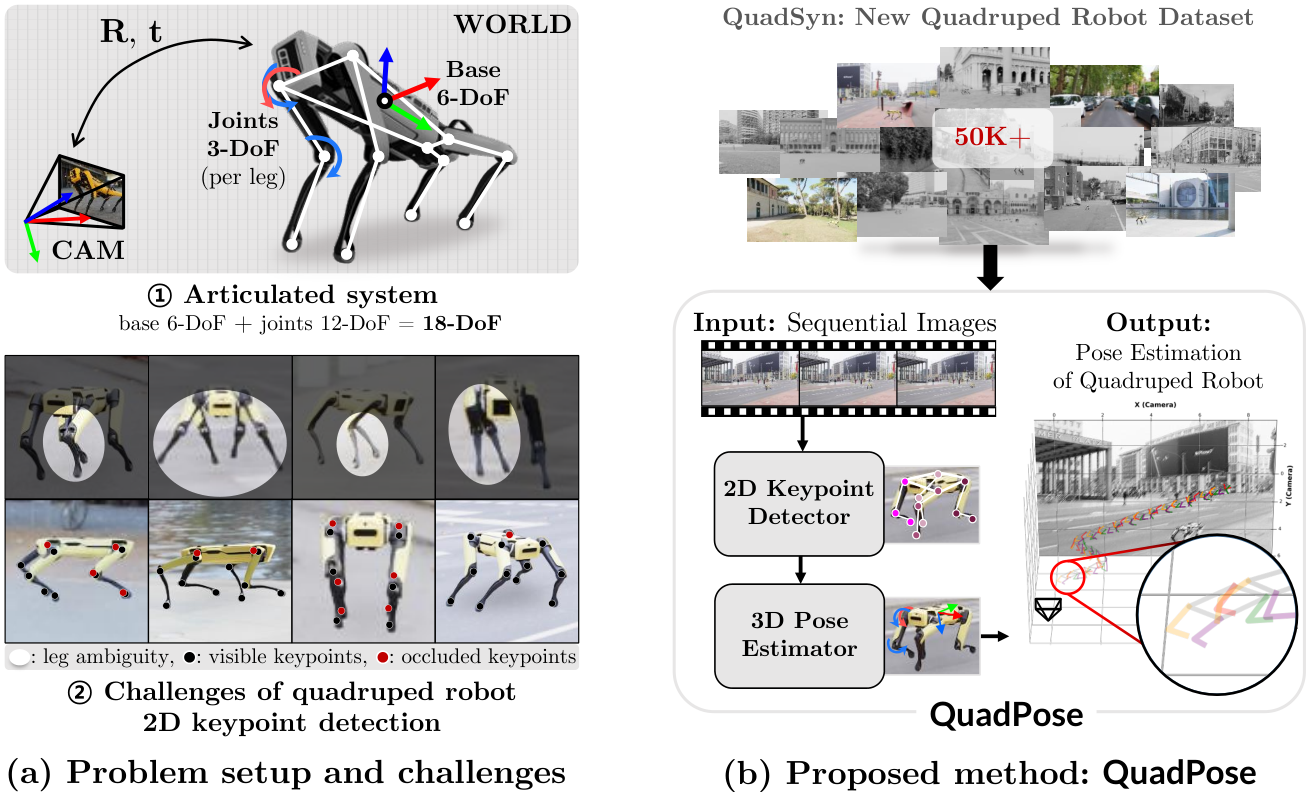
QuadPose estimates the full 18-DoF quadruped pose (6-DoF base pose plus 12 joint angles) from monocular video sequences and introduces QuadSyn, the first camera-to-quadruped pose benchmark addressing leg symmetry and self-occlusion ambiguity. On QuadSyn it reaches 92.18% PCK@2.5px, 85.94% ADD@20cm, and 3.65° mean joint-angle error at about 33 FPS.
中文摘要: 本文提出QuadPose,从单目视频序列估计四足机器人全身18自由度位姿,即6自由度基座位姿加12个关节角,并构建首个外部相机到四足机器人位姿估计基准QuadSyn。该问题难点在于四足为关节式系统、腿关节随时间变化、腿部对称性以及频繁自遮挡导致关键点对应模糊。方法通过序列信息缓解这些歧义。在QuadSyn上达到92.18%的PCK@2.5px、95.54%的PCK-AUC、85.94%的ADD@20cm、66.98%的ADD-AUC,平均关节角误差3.65度,速度约33帧每秒。
💬 Provides the first public benchmark and a sequence-based baseline for external-camera full-body quadruped pose estimation, an under-addressed problem for legged-robot monitoring.
💬 为外部相机下的四足机器人全身位姿估计提供了首个公开基准与基于序列的基线,填补了足式机器人外部监测的空白。
Why read it / 推荐理由: Useful for experimental validation and monitoring of modular legged platforms, where external-camera pose tracking complements onboard proprioception and enables sim-to-real evaluation. 对模块化足式平台的实验验证与监测有用:外部相机位姿跟踪可补充机载本体感知,并支撑仿真到现实的评估。
5. From Biological Curves to Soft Modular Robots: Learning-Based Inverse Design with Uncertainty-Guided Refinement
从生物曲线到软体模块化机器人:不确定性引导精化的学习式逆向设计
Authors / 作者: Dixiang Wang, Minghao Zha, Arifur Rahman, Yinhong Qin, Yitao Jiang, Shiyang Lu et al.
arXiv: 2610.36681 · PDF
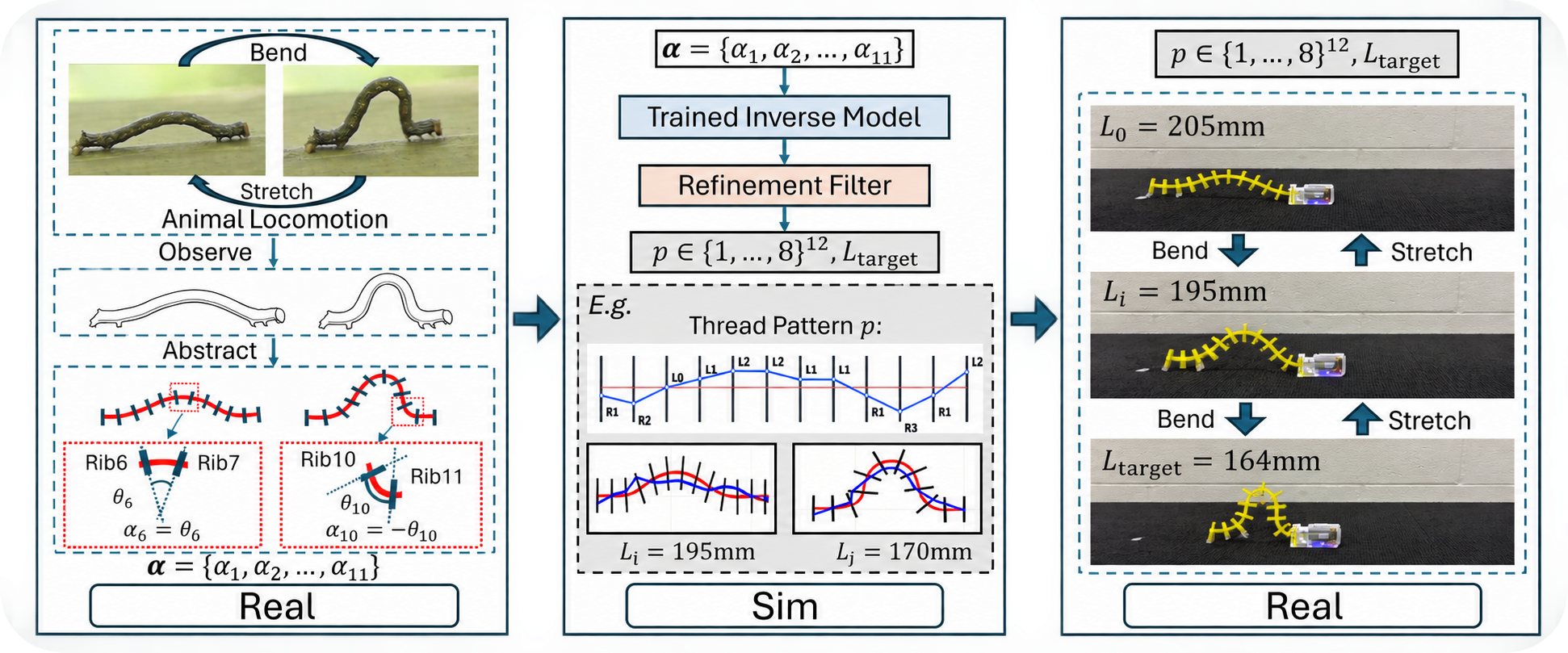
The paper presents a learning-based real-to-sim-to-real framework that maps target biological shape curves to cable-driven modular soft robot configurations via surrogate-assisted inverse design, combining learned inverse prediction with uncertainty-guided candidate exploration and a fast forward surrogate for evaluation and selection. The forward surrogate cuts deformation prediction time from 1.53e5 ms to 0.0008 ms, inverse design time from 1.99e6 ms to 4.18 ms, and achieves 93% shape reconstruction success on 5,000 unseen threading patterns.
中文摘要: 本文将生物形态(如鳗鱼波动、尺蠖拱起等形状变化)映射为可实现的软体模块化机器人构型,提出基于学习的real-to-sim-to-real框架。现有缆驱动模块化软体机器人逆向设计依赖昂贵的物理建模与组合搜索。方法将学习式逆预测与不确定性引导的候选探索相结合,并用快速正演代理模型评估和筛选候选设计。正演代理将形变预测时间从1.53e5毫秒降至0.0008毫秒(约1.9e8倍加速),逆向设计时间从1.99e6毫秒降至4.18毫秒。在5000个未见过的穿线模式测试样本上,基于代理评估的形状重构成功率达93%。
💬 Offers a transferable surrogate-plus-uncertainty recipe for inverse design of modular robots, though the domain is soft-body shaping rather than legged locomotion.
💬 为模块化机器人逆向设计提供可迁移的代理模型加不确定性方法,但应用领域是软体形变而非足式运动。
Why read it / 推荐理由: The modular reconfiguration and surrogate-assisted design methodology resonates with reconfigurable leg-module design, even though the target morphology is soft-bodied rather than legged. 其模块化重构与代理辅助设计方法可与可重构腿模块设计相互借鉴,尽管目标形态为软体而非足式。