机器人日报
机器人论文日报 — 2026-10-29
🤖 Scanned 80 papers from the last 3 days of arXiv announcements (cs.RO / eess.SY / cs.LG), picked 5 for modular & legged robotics — summarized by DeepSeek.
🤖 从近 3 天的 arXiv 新论文(cs.RO / eess.SY / cs.LG)中扫描 80 篇,围绕模块化与足式机器人精选 5 篇 — 由 DeepSeek 生成双语摘要。
1. Learning Multi-Phase Robot Loco-Manipulation via Phase-Conditioned Policy Optimization
基于阶段条件策略优化的多阶段机器人移动操作学习
Authors / 作者: Simone Manni, Annika Wollschläger, Dario Bellicoso, Abel Gawel, Marco Hutter, Simon Le Cleac’h et al.
arXiv: 2610.36270 · PDF
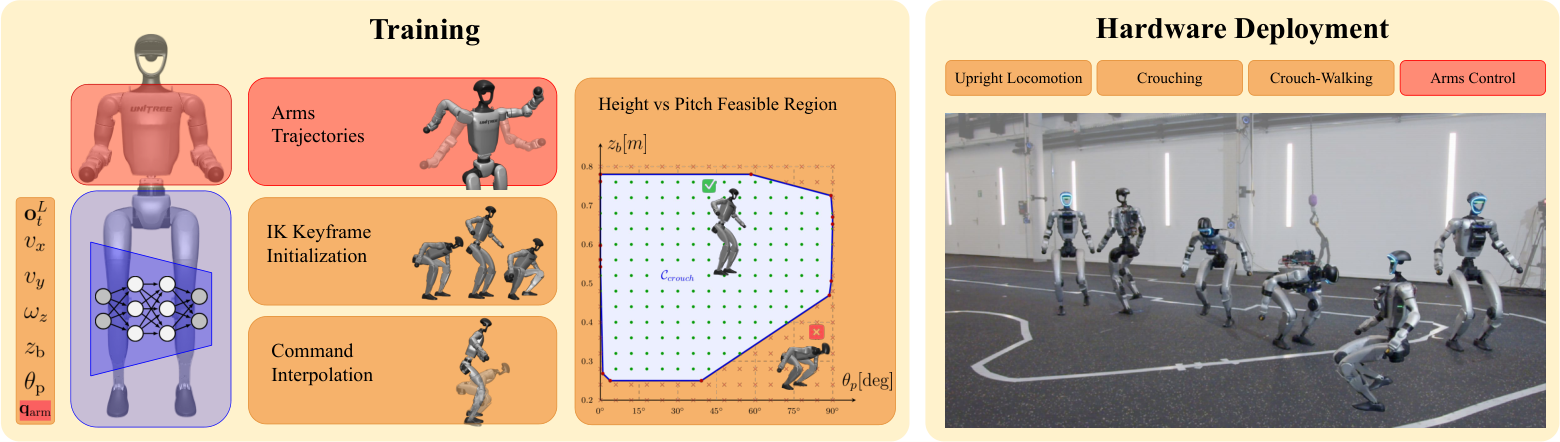
The authors extend PPO to train a single policy for long-horizon multi-phase loco-manipulation tasks using a phase-conditioned critic, phase-gated rewards, and a multi-phase reset curriculum, combined with a decoupled hierarchical controller that separates low-level balancing from high-level phase execution. The method is validated on hardware with a Unitree G1 and a Boston Dynamics Spot equipped with a manipulator arm, and shows that complex behaviors can be acquired purely through environment interaction without human motion data.
中文摘要: 针对长时程全身移动操作任务中多阶段行为(蹲伏、抓取、行走)难以用单一策略学习的问题,作者提出阶段条件策略优化方法,将PPO扩展为带阶段条件评论家、阶段门控奖励函数与多阶段重置课程的单策略训练框架,并采用解耦的分层控制架构,将底层平衡动力学与高层阶段执行分离,从而支持异构机器人平台。在Unitree G1与人形与搭载机械臂的Boston Dynamics Spot真机上验证了多阶段移动操作技能,并通过消融实验验证设计选择,表明无需人类运动数据即可仅通过环境交互获得复杂行为。
💬 A clean, data-free PPO extension that injects high-level task phase structure directly into policy learning and transfers across two very different legged platforms.
💬 该工作将高层任务阶段结构直接注入策略学习,是一种无需人类数据的简洁PPO扩展,并在两种差异很大的足式平台上完成了迁移。
Why read it / 推荐理由: Directly relevant to RL-based whole-body motion control for legged robots and shows a practical hierarchical structure that generalizes across quadruped and humanoid hardware. 该文与足式机器人强化学习全身运动控制直接相关,并展示了可跨四足与人形硬件泛化的实用分层结构。
2. Learning Force-Reactive Humanoid Loco-Manipulation
学习力反应式人形机器人移动操作
Authors / 作者: Sihang Li, Xiaofeng Guo, Jinkun Cao, Charlie Cheng, Ruihan Yang, Chen Feng et al.
arXiv: 2610.35862 · PDF
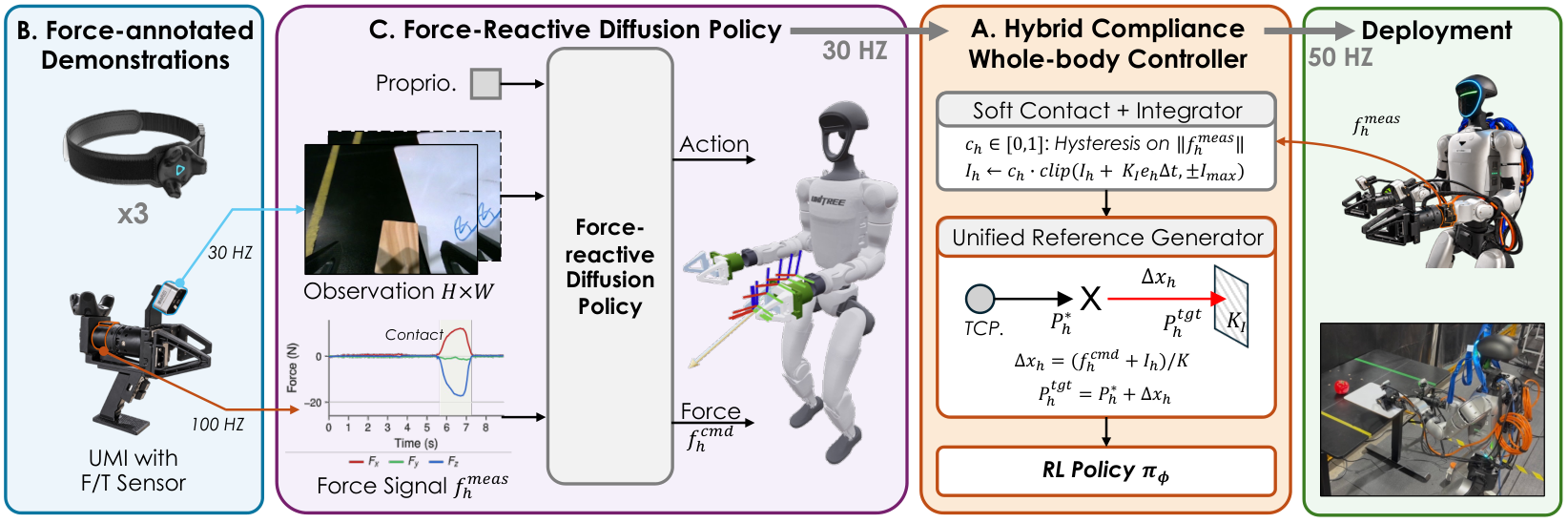
FLORE learns force-reactive humanoid loco-manipulation from robot-free demonstrations collected with two force-sensing UMI-style grippers and wearable trackers. A force-reactive diffusion policy outputs actions plus per-hand force commands, executed by a hybrid compliance whole-body controller with F/T-based integral force tracking, achieving 80% rollout success on three contact-rich tasks versus 26.7% for a position-only baseline.
中文摘要: 针对人形机器人接触丰富任务中需协调双手与全身接触力的问题,FLORE利用两只带力感知的UMI式手持夹爪和穿戴式追踪器采集无机器人演示,训练以视觉、本体感知与测量力旋量为输入的力反应扩散策略,输出动作及每只手的目标力指令;执行端采用混合柔顺全身控制器,借助真实力/力矩传感器的力误差积分实现沿指令方向的精确力跟踪与其余方向柔顺。仿真中控制器能以较小全身运动精度损失跟踪不同幅值与方向的力指令,真机三项接触任务成功率达80%,而仅位置策略为26.7%。
💬 Couples a force-command-predicting diffusion policy with a compliance-aware WBC, giving a strong real-robot demonstration that force feedback, not just kinematics, is essential for contact-rich legged manipulation.
💬 该文将预测力指令的扩散策略与柔顺全身控制器结合,在真机上有力证明接触丰富的足式操作不仅依赖运动学,更需力反馈。
Why read it / 推荐理由: Shows how a whole-body controller with force tracking can be paired with a learned policy to handle contact-rich tasks, a key ingredient for extending modular legged platforms to manipulation. 该文展示了如何将带力跟踪的全身控制器与学习策略结合以处理接触丰富任务,这是模块化足式平台拓展到操作任务的关键要素。
3. A Bi-level Co-design Framework for Lunar Monoped with 2D Jump and Landing Control
面向月面单腿机器人的双层协同设计框架及二维跳跃与着陆控制
Authors / 作者: Sanjay Ramkumar, Suraj Kumar
arXiv: 2610.37199 · PDF
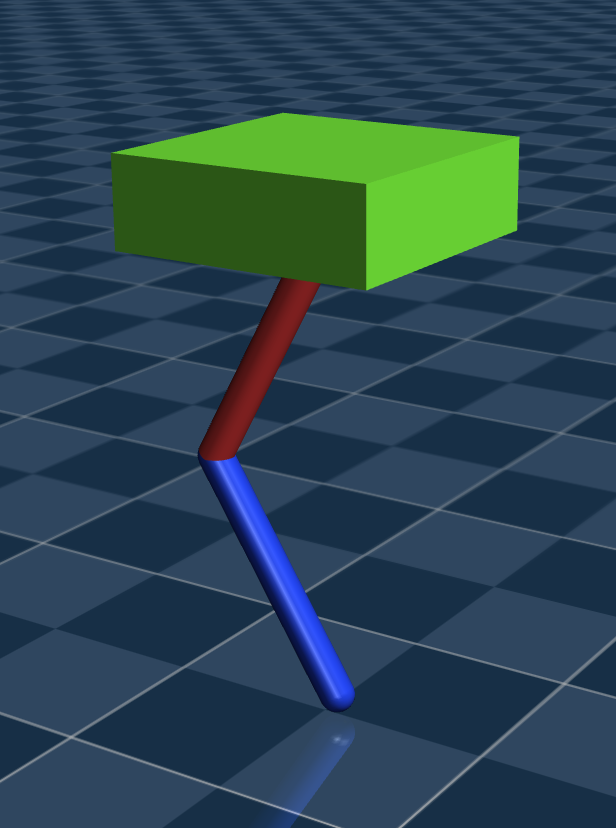
The paper studies a planar monoped in lunar gravity using a bi-level co-design framework: differential evolution searches link lengths in the outer loop while each candidate is evaluated by either a QP-based task-space controller or direct-collocation trajectory optimization. Trajectory optimization yields 17% lower cost of transport at its optimum, and a 2D jump with centroidal angular momentum regulation plus an LQR landing controller produces stable in-place and forward jumps.
中文摘要: 针对月面低重力环境(1.625 m/s²)下腿型形态与控制器相互耦合的问题,作者研究平面单腿机器人并提出双层协同设计框架:外层用差分进化搜索连杆长度,内层用基于二次规划的任务空间控制器或直接配点轨迹优化评估竖直跳跃性能。两种控制器给出不同的最优连杆长度,轨迹优化在多数设计空间内更优,在其各自最优点处能耗低17%。进一步扩展到二维跳跃,结合质心角动量调节的轨迹优化实现稳定的原地与向前跳跃,并用LQR控制器吸收落地冲击,在双连杆均为0.3 m的基准形态上演示。
💬 A rare explicit morphology-controller co-design study for a legged robot, with quantitative evidence that trajectory optimization and QP task-space control favor different leg designs.
💬 这是足式机器人中少见的形态与控制器显式协同设计研究,定量表明轨迹优化与QP任务空间控制偏好不同的腿部构型。
Why read it / 推荐理由: Highly relevant to reconfigurable leg module design, showing how optimizer choice shapes optimal leg morphology and how landing can be stabilized with LQR. 该文与可重构腿部模块设计高度相关,揭示了优化器选择如何影响最优腿型,以及如何用LQR稳定着陆。
4. MimicAll: Structured Embodiment Conditioning for Cross-Humanoid Whole-Body Motion Tracking
MimicAll:面向跨人形全身运动跟踪的结构化具身条件化
Authors / 作者: Jia Li, Lingyun Xu, Yitang Li, Hao Zhao
arXiv: 2610.33508 · PDF
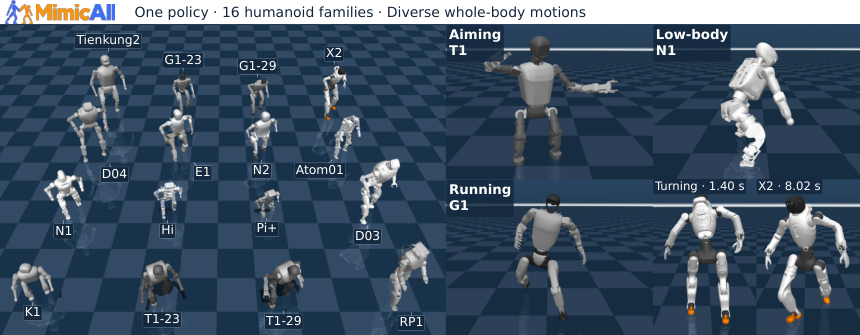
MimicAll is a reinforcement-learning framework for shared whole-body motion tracking across heterogeneous humanoids, encoding a structured embodiment descriptor into global and joint-aligned conditions that are combined with observation history and body-matched motion references to predict joint-target offsets. Trained over 4,096 variants from 16 humanoid families and evaluated on a 464-body benchmark, shared training reaches 99.4% 30-second success on randomized G1 bodies versus 42.9% for a single-body specialist.
中文摘要: 为在异构人形机器人间共享全身运动跟踪策略,MimicAll将结构化具身描述符编码为全局与关节对齐的条件,与观测历史及身体匹配的运动参考结合,预测关节目标偏移;配合物理一致的具身随机化、身体校准重定向与异构仿真,在16个人形家族的4096种变体上训练,并构建涵盖五个分布层的464个身体基准。受控消融表明具身信息以简单拼接即可提升运动完成度,自注意力编码获得最低全局位置误差;同等训练量下共享训练在随机化G1上30秒成功率99.4%,而单身体专用策略仅42.9%,并分析了未见家族的迁移表现。
💬 Systematically quantifies how embodiment conditioning enables one motion-tracking policy to span thousands of morphologies, with a useful benchmark for morphological generalization.
💬 该文系统量化了具身条件化如何让单一运动跟踪策略覆盖数千种形态,并提供形态泛化评测基准。
Why read it / 推荐理由: Directly informs modular reconfigurable legged robots, where a single controller must cope with changing link lengths and body configurations. 该文可直接启发模块化可重构足式机器人研究,即单一控制器需适应变化的连杆长度与机体构型。
5. Learning to Exploit Passive Dynamics for Energy-Efficient Target Hopping of a Spring-Legged Quadcopter
学习利用被动动力学实现弹簧腿四旋翼能量高效定点跳跃
Authors / 作者: Ruigang Chen, Qi Zhang, Zhicheng Zhong, Zhuorui Yun, Yizhar Or, Mingyi Liu
arXiv: 2609.15447 · PDF
The authors replace heuristic PID tuning with a direct estimated-state-to-motor PPO policy that commands four motors without an explicit hopping state machine or low-level attitude PID. Its reward combines energy-manifold shaping with a history-aware power estimator, and on hardware it reduces cycle-averaged electrical power by 30.7% and mean normalized thrust by 49.8% while retaining repeatable commanded-height hopping.
中文摘要: 针对单腿弹簧四旋翼中主动推力与被动接触动力学协调受限于启发式PID整定的问题,作者提出直接由估计状态到电机的PPO策略,无显式跳跃状态机与底层姿态PID,四个电机直接受控。奖励函数融合质量归一化竖直能量跟踪与顶点状态锚定的能量流形塑形,以及基于历史感知功率估计器的效率塑形,惩罚一般功耗、附加空中功耗与空中近静止。真机实验中相比整定PID控制栈,循环平均电功耗降低30.7%,平均归一化总推力降低49.8%,同时保持可重复的指令高度跳跃与更集中的着陆。
💬 An elegant demonstration that RL can exploit passive leg dynamics better than hand-tuned PID, with energy-based reward shaping that is transferable to legged hopping gaits.
💬 该文优雅地证明强化学习比手工整定PID更能利用腿部被动动力学,其能量型奖励塑形可迁移到足式跳跃步态。
Why read it / 推荐理由: Relevant to leg-module actuation and energy-efficient gait design, showing how reward shaping around passive dynamics yields large real-robot power savings. 该文与腿部模块驱动及高能效步态设计相关,展示了围绕被动动力学的奖励塑形可在真机上大幅节能。