机器人日报
机器人论文日报 — 2026-10-28
🤖 Scanned 333 papers from today’s arXiv announcement (cs.RO / eess.SY / cs.LG), picked 5 for modular & legged robotics — summarized by DeepSeek.
🤖 从今日 arXiv 新论文(cs.RO / eess.SY / cs.LG)中扫描 333 篇,围绕模块化与足式机器人精选 5 篇 — 由 DeepSeek 生成双语摘要。
1. A Trainable CPG Framework for Quadruped Locomotion
一种可训练的四足运动CPG框架
Authors / 作者: Xiyan Liu, Yide Liu, Guoyong Mao, Shaoxing Qu
arXiv: 2610.36537 · PDF
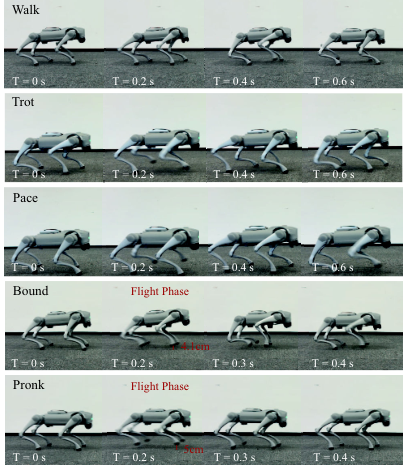
CPG-ENN combines a symmetry-based eight-neuron central pattern generator with a pretrained leg-shared execution network to map gait rhythms and trajectory parameters to joint references without online IK. A single feedback policy modulates six interpretable trajectory variables, tracking velocity and yaw commands across five gaits and all 20 directed gait transitions in simulation (99.39% success), validated on a Unitree Go2.
中文摘要: CPG-ENN提出一种可训练的四足运动框架,将显式神经协调与学习到的运动实现相结合。基于对称性的八神经元中枢模式发生器(CPG)产生步态节律,预训练的腿部共享执行神经网络(ENN)将节律信号和轨迹参数映射为关节角参考,无需在线逆运动学。单一反馈策略调制六个物理可解释的轨迹变量,可在行走、小跑、溜蹄、奔跑和弹跳五种步态间跟踪平面速度和偏航角指令,无需步态专用控制器或过渡专用奖励。仿真中20个有向步态对及所有速度组合的过渡成功率达99.39%,消融表明无需过渡曝光即可实现跨步态过渡可行性,曝光主要精化步态获取和速度瞬态。与AllGaits和Walk These Ways相比具有更准确的步态-速度调节,Unitree Go2实验验证了五种步态及其过渡。
💬 A clean, interpretable CPG-plus-RL architecture that achieves all-gait transitions with a single policy—highly relevant to modular legged gait generation.
💬 一种清晰可解释的CPG加RL架构,用单一策略实现全步态过渡,与模块化腿式步态生成高度相关。
Why read it / 推荐理由: It offers a principled recipe for gait-generic locomotion control and cross-gait transitions that could directly inform reconfigurable modular leg platforms. 它提供了步态通用运动控制和跨步态过渡的原则性方案,可直接启发可重构模块化腿平台。
2. Whole-Body Humanoid Control via Stochastic Motion Tokenization
基于随机运动令牌化的全身人形机器人控制
Authors / 作者: Michael Drolet, Oleg Arenz, Jan Peters
arXiv: 2610.36452 · PDF
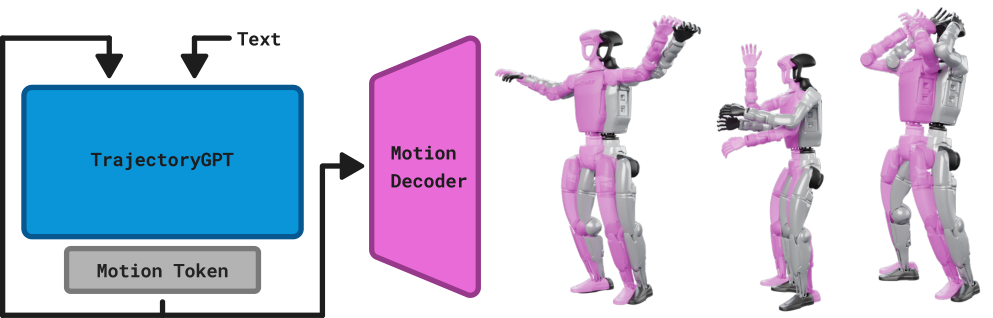
The authors introduce a stochastic motion tokenizer that compresses whole-body motion into concise discrete tokens fed as references to a tracking policy, conditioned by behavior labels or text. The tokenizer outperforms FSQ and VQ-VAE at matched capacity, and the resulting interface drives a physical Unitree G1 through 16.8 s dance, fight, and walk motions plus a 35 s fight-to-dance sequence.
中文摘要: 本文提出随机运动令牌化器,将全身运动压缩为简洁的离散令牌,作为跟踪策略的详细运动参考,并可由行为标签或文本命令条件生成。在相同容量下,该随机令牌化器的运动重建质量超过有限标量量化(FSQ)和矢量量化自编码器(VQ-VAE)。所形成的高层可生成离散接口可条件化全身跟踪策略,在真实Unitree G1上执行了各16.8秒的舞蹈、格斗和行走动作,以及35秒的格斗到舞蹈过渡序列,展示了基于条件信息执行复杂全身运动的灵活性。
💬 A novel discrete motion interface that bridges high-level behavior commands and whole-body tracking, relevant to whole-body control with transition-aware references.
💬 一种新颖的离散运动接口,衔接高层行为命令与全身跟踪,与具有过渡感知参考的全身控制相关。
Why read it / 推荐理由: Its tokenized motion reference interface could be adapted to coordinate modular whole-body behaviors and behavior transitions on multi-legged platforms. 其令牌化运动参考接口可适配于协调多腿平台的模块化全身行为与行为过渡。
3. REACH: An RL-based Hierarchical Humanoid Crawling Framework for Adaptable Confined Space Traversal
REACH:一种基于强化学习的层次化人形机器人爬行框架,用于受限空间自适应穿越
Authors / 作者: Shengzhang Xu, Yuning Guo, Weiyi Hu, Yifeng Xu, Zhongyu Li, He Kong
arXiv: 2610.36546 · PDF
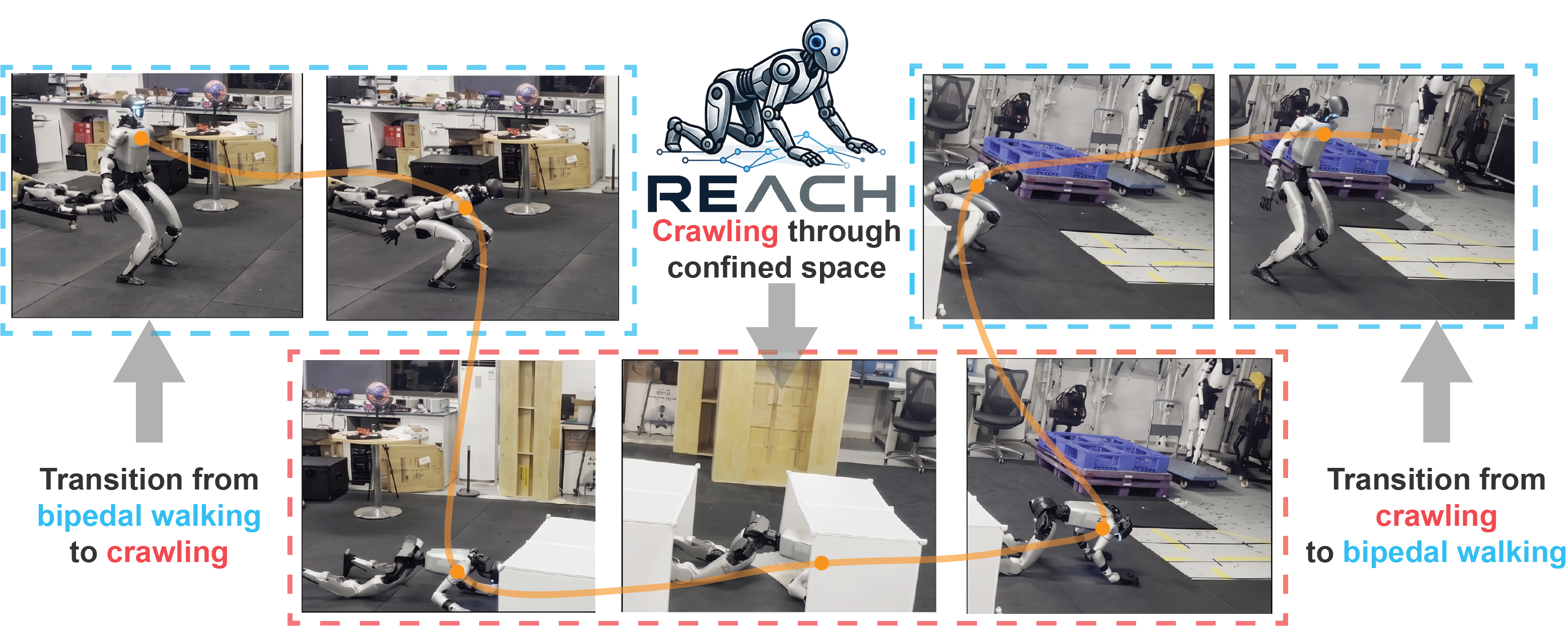
REACH is an RL-based hierarchical framework enabling a Unitree G1 humanoid to switch between variable-height bipedal walking (1.27–0.50 m) and crawling (0.50–0.20 m), using a history-conditioned latent representation and a bidirectional transition policy. Integrated with a LiDAR-based planner, it achieves accurate height/velocity tracking, robust terrain traversal, and confined-space navigation in real-world experiments.
中文摘要: REACH是一种基于强化学习的层次化框架,使Unitree G1人形机器人能够在可变高度双足行走(身高1.27至0.50米)和爬行(0.50至0.20米)之间切换,从而穿越高度受限环境。针对接触丰富的爬行动力学,采用历史条件化的潜在表示从本体感知中捕捉地形与交互上下文;双向过渡策略连接存在大运动学和接触不连续性的蹲伏行走与爬行模式。技能与基于LiDAR的规划器集成,将点云转换为无碰撞三维路径及含主动高度目标的运动指令。真实实验验证了高度与速度跟踪精度、鲁棒地形穿越、可靠模式切换及受限空间穿越。
💬 A strong hierarchical RL system demonstrating multi-mode, height-adaptive locomotion with real-robot confined-space traversal and a planner in the loop.
💬 一个强大的层次化RL系统,展示多模式高度自适应运动,并在真实机器人上实现受限空间穿越且规划器在回路中。
Why read it / 推荐理由: It shows how learned mode transitions and height adaptation can be integrated with planning—an informative analogue for reconfigurable legged robots changing posture or gait. 它展示了如何将学习到的模式过渡与高度自适应同规划集成,为可重构腿式机器人改变姿态或步态提供了有益类比。
4. HC2Robot: Hyper-Connection Transformers with Predicted Foresight for Multi-Terrain Humanoid Parkour
HC2Robot:面向多地形人形机器人跑酷的超连接Transformer与预测前瞻
Authors / 作者: Wenhao Xu, Yanheng Mai, Yifei Fu, Nan Zheng, Yanbo Zhou, Zirui Huang et al.
arXiv: 2610.36825 · PDF
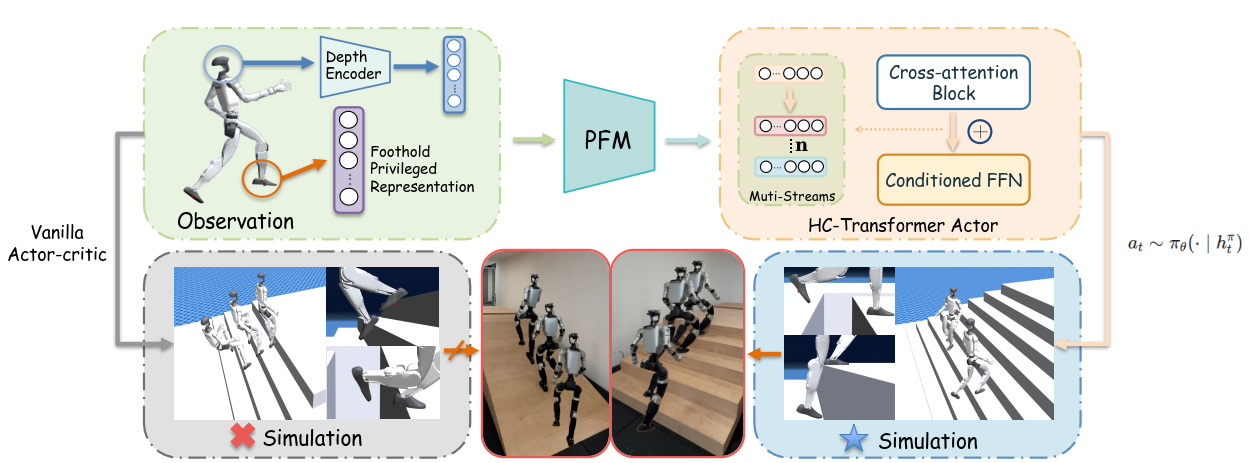
HC2Robot narrows the privileged-information gap in asymmetric actor-critic learning by having a Predicted Foresight Module infer future touchdown timing, location, and support quality from deployable observations, plus a Hyper-Connection Transformer for temporal reasoning. Across stairs, gaps, platforms, and slopes it reaches 97.60% simulated traversal success with higher safe-foothold rates than strong perceptive baselines.
中文摘要: HC2Robot重新审视感知人形运动中的非对称actor-critic信息不对称问题,提出可部署的感知人形跑酷框架。预测前瞻模块(PFM)从可部署观测中预测每只脚下一次触地事件的时间、位置和支持质量,将特权监督转化为可部署的潜在表示,使actor无需特权运行时传感即可获得预测触地信息;超连接(HC)Transformer通过可学习多流路由增强时序推理,未来运动预测头提供短时运动先验用于正则化。在楼梯、间隙、高台和斜坡上,HC2Robot实现97.60%的平均仿真穿越成功率,安全落脚率持续高于强感知基线。
💬 A thoughtful treatment of asymmetric learning that converts privileged foothold supervision into deployable foresight, directly relevant to traverse-capability-aware locomotion.
💬 对非对称学习进行了细致处理,将特权落脚监督转化为可部署前瞻,与穿越能力感知运动直接相关。
Why read it / 推荐理由: Its deployable touchdown-foresight formulation is a useful pattern for traverse-capability-aware control and sim-to-real transfer of foothold reasoning. 其可部署触地前瞻形式为穿越能力感知控制和落脚推理的sim-to-real迁移提供了有用范式。
5. Remember Where You Walk: Learning Spatial Memory for End-to-End Legged Robot Exploration
记住你走过的地方:面向端到端腿式机器人探索的空间记忆学习
Authors / 作者: Leon Magnus, Nico Bohlinger, Jan Peters, Oleg Arenz
arXiv: 2610.37203 · PDF
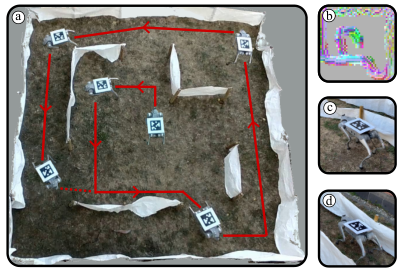
The authors propose a Local Spatial Matrix Memory (LSMM) based on Hadamard memory that stores task-relevant information in position-based memory cells, addressing the long-horizon memory limitations of LSTM-based RL policies. On autonomous maze exploration, LSMM matches strong recurrent and finite-history baselines in coverage while being the only architecture to remember the maze layout, reducing reconstruction error threefold.
中文摘要: 本文提出基于Hadamard记忆的局部空间矩阵记忆(LSMM)网络架构,面向腿式机器人导航,使强化学习智能体能够在特定位置基元中存储通用任务相关信息,实现灵活且空间接地的记忆。针对LSTM等记忆网络在长时程上信息保持不足的问题,LSMM在自主迷宫探索任务中匹配强循环和有限历史基线的迷宫覆盖率,同时是唯一能记住迷宫布局的架构,将重建误差降低三倍。该工作为端到端腿式机器人探索提供了一种空间记忆机制。
💬 A spatially grounded memory architecture that tackles long-horizon forgetting in legged exploration RL, though evaluated only in simulated mazes.
💬 一种空间接地的记忆架构,解决腿式探索RL中的长时程遗忘问题,但仅在仿真迷宫中评估。
Why read it / 推荐理由: Spatial memory is key for traverse-capability-aware path planning; this offers a lightweight, position-indexed memory design worth considering for modular legged explorers. 空间记忆是穿越能力感知路径规划的关键;本文提供了一种轻量、按位置索引的记忆设计,值得模块化腿式探索机器人借鉴。