机器人日报
机器人论文日报 — 2026-10-25
🤖 Scanned 38 papers from the last 3 days of arXiv announcements (cs.RO / eess.SY / cs.LG), picked 5 for modular & legged robotics — summarized by DeepSeek.
🤖 从近 3 天的 arXiv 新论文(cs.RO / eess.SY / cs.LG)中扫描 38 篇,围绕模块化与足式机器人精选 5 篇 — 由 DeepSeek 生成双语摘要。
1. LocoManiLab: A Unified Testbed for Data, Policies, Controllers, and Deployment in Humanoid Loco-Manipulation
LocoManiLab:面向人形机器人移动操作的数据、策略、控制器与部署统一测试平台

Authors / 作者: Dewei Wang, Jinrui Han, Jiyuan Shi, Chenyun Zhang, Xianbo Lu, Jiabao Wu et al.
arXiv: 2610.30876 · PDF
LocoManiLab provides an integrated testbed combining data collection/generation, policy training, evaluation and physical deployment for humanoid loco-manipulation, covering 234 atomic and compositional household tasks with 51.5 hours of simulated teleoperation. It benchmarks twelve policies under a shared controller across task/scene splits and perturbations, and shows that simulated rankings transfer to three real-world-matched tasks, supporting sim-based evaluation reliability.
中文摘要: 本文提出LocoManiLab,一个面向人形机器人移动操作的一体化测试平台,涵盖数据采集与生成、策略训练、评估与实体部署四个环节。其任务库包含五大类家庭场景下的234个原子与组合任务,并提供51.5小时仿真遥操作数据。评估部分在统一控制器下测试了12种策略在不同任务与场景划分及扰动水平下的表现,另对2种策略跨5种控制器进行比较,并研究示范规模与数据来源混合的影响。结果显示,策略在未见任务与场景上的成功率下降,且随视觉扰动增强而普遍降低,不同策略的泛化与鲁棒性存在差异。此外,作者将人形运动生成模型微调用于移动操作,以研究其输出与任务执行需求的对齐及其在数据生成管线中的集成。最后,三个与真实设置高度一致的仿真任务使三种策略可在仿真与真实域同时评估,且策略排序相似,说明基于仿真的评估具有可靠性。
💬 A well-scoped benchmark that explicitly couples learned policies with shared low-level controllers and validates sim rankings on real hardware, directly relevant to how one should evaluate RL motion controllers for legged platforms.
💬 该基准明确将学习策略与共享底层控制器耦合,并在真实硬件上验证仿真排序,对足式平台强化学习运动控制器的评估方式具有直接参考价值。
Why read it / 推荐理由: Useful as a template for structuring sim-to-real evaluation of loco-manipulation policies, and its controller-sharing and perturbation-axis analysis can be adapted to modular legged platforms. 可作为组织移动操作策略sim-to-real评估的模板,其共享控制器与扰动轴分析可迁移到模块化足式平台。
2. Continuous-Time Motion Planning and Steering with Global Convergence
具有全局收敛性的连续时间运动规划与引导
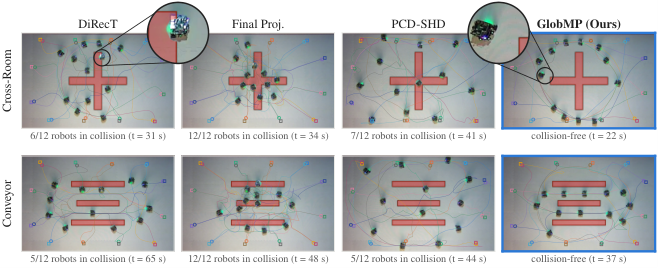
Authors / 作者: Mohsen Amiri, Sima Didari, Davoud Ataee Tarzanagh, Hankyu Moon, Yeongdae Kwon
arXiv: 2610.30607 · PDF
The paper casts multi-robot motion planning and steering of learned proposals as a single continuous-time program over piecewise-polynomial curves, where each constraint is one polynomial per piece that must stay nonnegative over the whole motion, and proposes GlobMP, a gradient projection method alternating cost reduction with feasibility restoration. Under mild assumptions it proves the cost approaches the global optimum as pieces grow, with constraints met to any tolerance or exactly on stable instances, and demonstrates results on up to 200 robots, the Robotarium, mazes, and steering tactile-reactive policies on a bimanual humanoid.
中文摘要: 本文研究同时满足连续时间约束(而非仅在采样时刻成立)的运动规划问题,并将运动规划与对学习型策略输出的引导统一为一个连续时间优化程序:机器人之间及与静态/移动障碍之间避碰,同时使运动尽量接近学习给出的提议。该程序形式简洁但非凸。作者提出GlobMP,一种在分段多项式曲线上运行的梯度投影方法,将每条约束表示为每段上的一个多项式并要求其在整段运动上非负,算法在代价下降与可行性恢复之间交替。在温和假设下,作者证明随着多项式段数增加,从细网格初值出发的代价趋近全局最优,约束可满足任意指定容差,在稳定实例上可精确满足。实验在真实与合成场景中展示了优于强基线的性能,包括多达200个机器人的团队、Robotarium平台多机规划、迷宫导航,以及对双臂人形机器人触觉反应式策略的引导。
💬 Provably convergent continuous-time constrained planning that can act as a safety/correction layer over learned locomotion policies is a valuable complement to RL-based motion control.
💬 该工作提供可证明收敛的连续时间约束规划,可作为学习型运动策略之上的安全与修正层,是强化学习运动控制的有益补充。
Why read it / 推荐理由: Its constraint-over-whole-trajectory formulation and steering of learned policies map naturally onto correcting MPC/RL gait outputs on modular legged robots under continuous contact and collision constraints. 其全程连续约束表述与对学习策略的引导机制,可自然用于在连续接触与碰撞约束下修正模块化足式机器人的MPC/RL步态输出。
3. Robot Motion Transition with Human Motion Prior
基于人体运动先验的机器人运动过渡
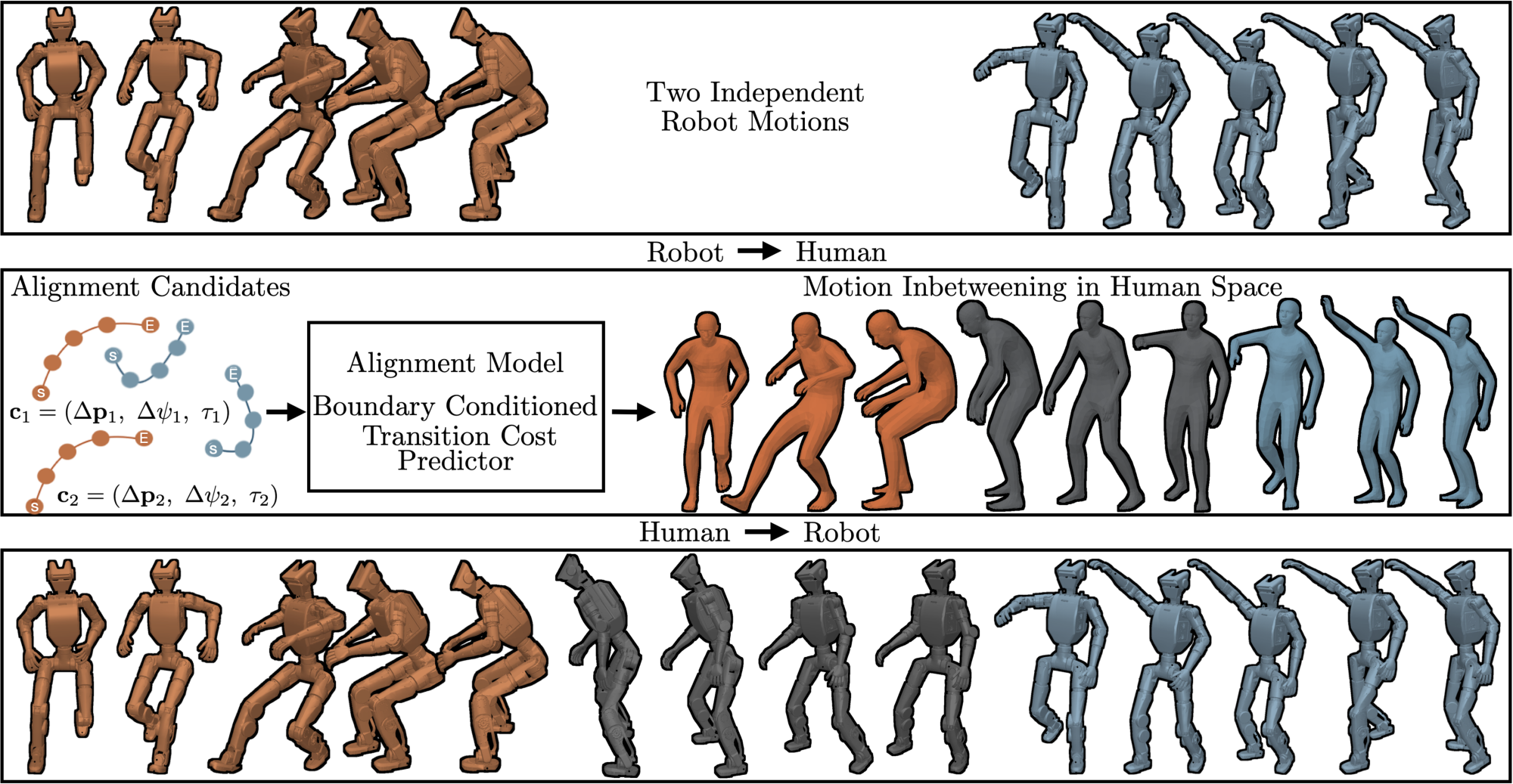
Authors / 作者: Taehyun Byun, Taemoon Jeong, Yoonbyung Chai, Woojin Wie, Insu Park, Kyungjae Lee et al.
arXiv: 2610.30817 · PDF
STAMP addresses connecting independently acquired humanoid motion-tracking policies into continuous sequences through a Robot-to-Human-to-Robot process: motions are retargeted to a human rig, a learned alignment model ranks candidate positions, headings and transition durations, a human motion prior generates the in-between motion, and the completed sequence is retargeted back and used to train a tracking policy. It is evaluated on Unitree G1 and ROBOTIS K1 with physical demonstrations.
中文摘要: 人形机器人运动跟踪策略已能复现多样行为,但将独立获取的动作片段拼接为连续序列仍具挑战:简单插值仅连接边界位姿,未考虑相对位置、朝向与时长是否适合过渡;而生成式运动先验在边界安排不当时会生成过多行走、转向或非预期动作。本文提出STAMP框架,通过“机器人—人体—机器人”流程利用人体运动空间中的丰富先验并跨形态复用过渡知识。其核心是学习型对齐模型:将两段动作重定向到人体骨架后,该模型对后续动作的候选位置、朝向与过渡时长进行排序;随后由人体运动先验在选定对齐条件下生成过渡片段,再将完整序列重定向回机器人并作为参考训练运动跟踪策略。作者在Unitree G1与ROBOTIS K1上评估生成过渡的跟踪成功率,并通过实体机器人演示验证STAMP可连接独立动作片段。
💬 A clean human-motion-prior pipeline for chaining motion-tracking policies, with tangible real-robot validation on two humanoid platforms.
💬 该文给出清晰的人体运动先验流程用于串联运动跟踪策略,并在两种人形平台上完成了实机验证。
Why read it / 推荐理由: The alignment-plus-prior recipe for stitching motion segments is transferable to gait/module transition scheduling in reconfigurable legged robots. 其“对齐+先验”的动作片段拼接方案可迁移到可重构足式机器人的步态与模块切换调度中。
4. Model Predictive Control of Wind Turbines: A Model-Oriented Review of Prediction Models, Control Objectives, and Nonlinear Aerodynamic Formulations
风力发电机模型预测控制:面向模型的预测模型、控制目标与非线性气动表述综述
Authors / 作者: Roya Khalili-Amirabadi, Mohsen Jalaeian-Farimani, Mahdi Ghane
arXiv: 2610.31295 · PDF
This review organizes wind-turbine MPC literature by the prediction model propagated inside the controller, treating model order, predictor representation, MPC formulation, objective and validation plant as separate descriptors. It finds low-order linear/piecewise-affine predictors suit constrained power and speed regulation while flexible drivetrain, structural and floating models are needed when those dynamics are explicit control quantities, and warns that the label NMPC alone does not prove the original nonlinear pitch map is retained in the optimizer, adopting a conservative equation-based classification.
中文摘要: 本文综述风力发电机模型预测控制(MPC)研究,核心组织维度是控制器内部传播的预测模型,并将模型阶次、预测器表示、MPC形式、控制目标与验证对象作为相互独立的描述符。综述表明:低阶线性或分段仿射预测器适合带约束的功率与转速调节;当传动链扭转、塔架运动、叶片载荷或浮式平台动力学作为显式控制量时,则需要柔性传动链、结构或浮式模型。非线性MPC与经济型MPC研究进一步展示了跨宽运行区的桨距/转矩协调控制,而预测型、重复型与数据驱动型形式分别应对风速预测、周期载荷与模型失配。作者特别关注气动桨距依赖:变桨风机动力学对施加桨距可能是非仿射的,仅称“NMPC”并不能证明优化器内部保留了原始非线性桨距映射,因此采用基于方程的保守分类来判定是否直接传播非线性施加桨距。
💬 Not legged robotics, but a rigorous model-centric MPC taxonomy with a caution about nonlinear formulations that transfers well to contact-rich legged MPC design.
💬 虽非足式机器人,但其以模型为中心的MPC分类体系及对非线性形式的辨析,对富接触足式MPC设计有良好借鉴意义。
Why read it / 推荐理由: Offers a disciplined way to reason about predictor fidelity in nonlinear MPC, useful when weighing simplified centroidal/contact models against full nonlinear dynamics in legged locomotion. 提供了在非线性MPC中审视预测模型保真度的严谨方法,有助于在足式运动中权衡简化质心/接触模型与完整非线性动力学。
5. PhysibleMDM: Enforcing Inference-Time Physical Feasibility Constraints on Motion Diffusion Models via Noise Optimization
PhysibleMDM:通过噪声优化在推理时为运动扩散模型施加物理可行性约束
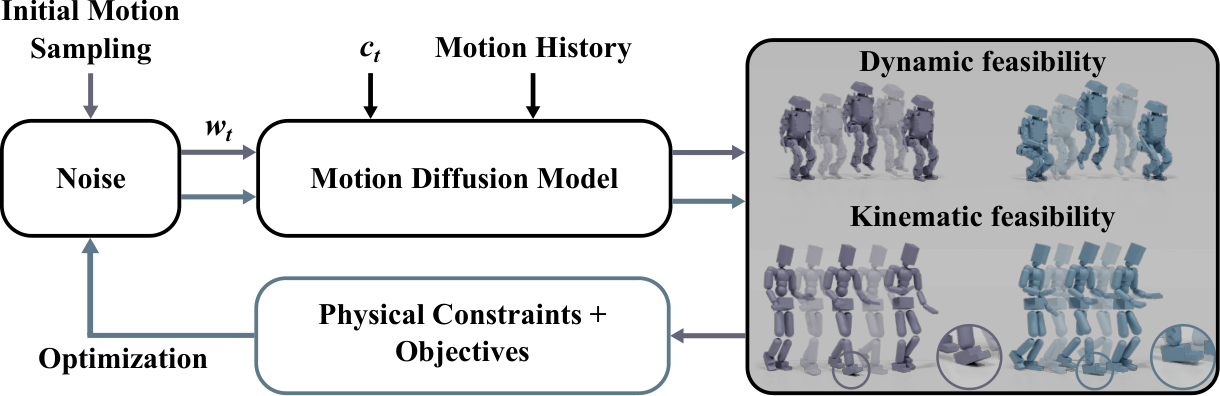
Authors / 作者: Maximilian Stölzle, David Müller, Agon Serifi, Ruben Grandia, Espen Knoop, Moritz Bächer
arXiv: 2610.30500 · PDF
PhysibleMDM improves physical feasibility of motion diffusion model outputs at inference time by optimizing the diffusion noise without retraining, using surrogate kinematic checks (ground penetration, slip, self-collision) plus inverse-dynamics feasibility computed via a cone program, solved by Sep-CMA-ES in a black-box manner. An autoregressive scheme chains optimized segments, reducing ground penetration, self-collision and slip by 75%, 92% and 74% on 100 SMPL styles and achieving large acceleration-reconstruction error reductions on 11 sequences for a custom bipedal robot.
中文摘要: 运动扩散模型(MDM)能生成多样且视觉自然的运动,但其轨迹常违反物理约束,限制了在仿真与控制中的下游使用。本文提出PhysibleMDM,在不重新训练生成模型的前提下,于推理阶段优化扩散噪声以提升输出物理可行性。作者设计了一组无需完整轨迹仿真即可评估的代理可行性约束:运动学检查(地面穿透、滑移、自碰撞)与通过内层锥规划求解逆动力学得到的动力学可行性测试相结合。由于该黑箱噪声优化问题梯度代价高且不连续,作者采用可分离协方差矩阵自适应进化策略(Sep-CMA-ES)求解,并用自回归方式串联优化后的片段以合成长时间运动。在SMPL人形模型的100种运动风格上,相比未优化输出,地面穿透、自碰撞穿透与地面滑移分别降低75%、92%与74%;在自研双足机器人的11段序列上,单序列平均加速度重建误差中位数降低89.5%。
💬 A retraining-free, constraint-oriented post-processing approach that makes generative motion usable for control, with bipedal validation beyond human data.
💬 该方法无需重训练、以约束为导向做后处理,使生成式运动可用于控制,并在双足机器人上获得超出人体数据的验证。
Why read it / 推荐理由: Relevant to sim-to-real motion generation: its surrogate kinematic/dynamic feasibility tests could be repurposed to filter diffusion-based gait proposals for modular legged robots. 与sim-to-real运动生成相关:其代理运动学/动力学可行性测试可改造用于筛选模块化足式机器人扩散生成的步态提议。