机器人日报
机器人论文日报 — 2026-10-22
🤖 Scanned 327 papers from today’s arXiv announcement (cs.RO / eess.SY / cs.LG), picked 5 for modular & legged robotics — summarized by DeepSeek.
🤖 从今日 arXiv 新论文(cs.RO / eess.SY / cs.LG)中扫描 327 篇,围绕模块化与足式机器人精选 5 篇 — 由 DeepSeek 生成双语摘要。
1. End-to-End Reinforcement Learning for Quadrupedal Jumping in Lunar Gravity
月球重力下四足机器人跳跃的端到端强化学习
Authors / 作者: Levin Müller, Oliver Fischer, Marco Trentini, Yusuke Tanaka, Marco Hutter
arXiv: 2610.29586 · PDF
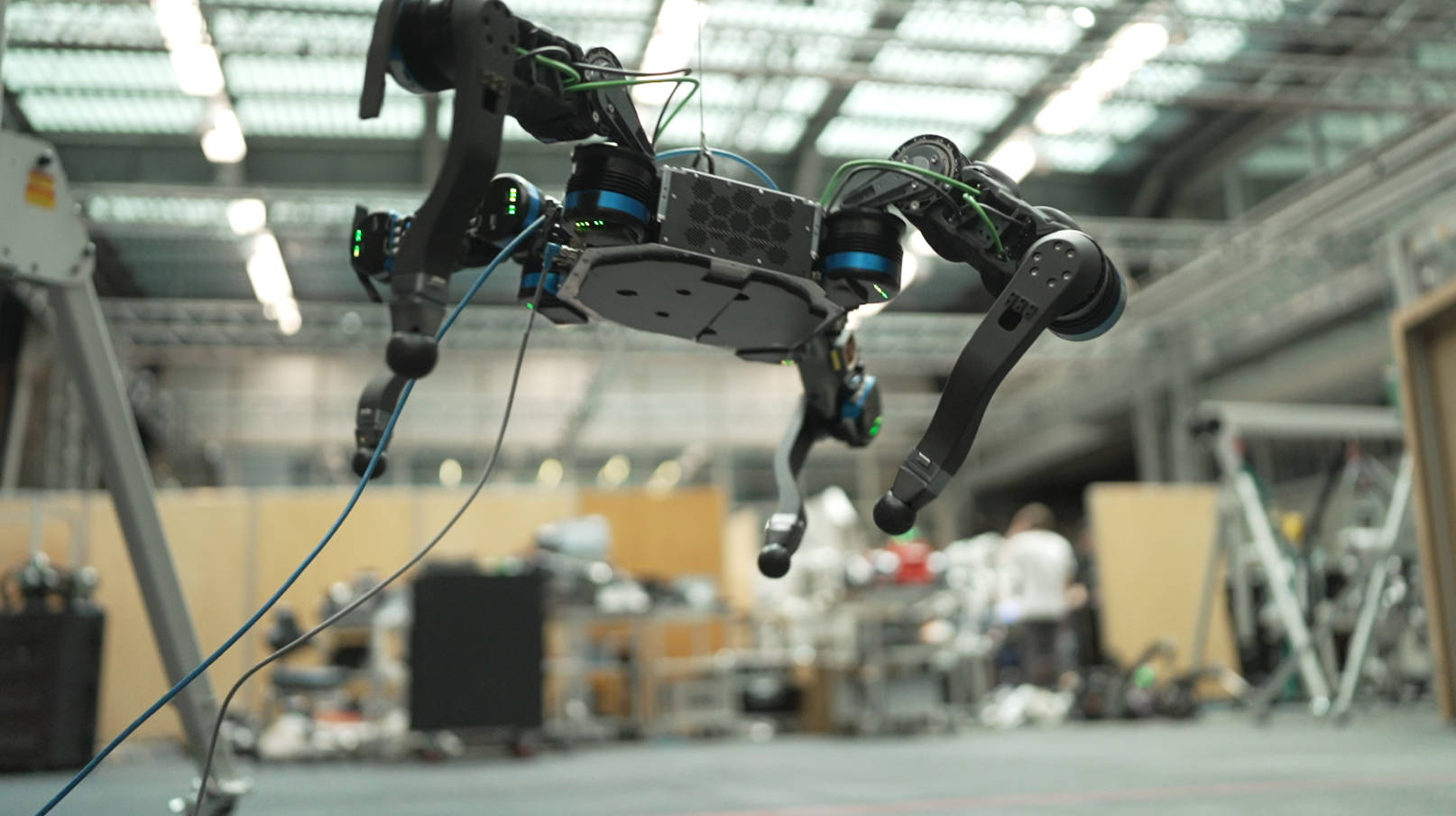
This paper presents a multistage reinforcement-learning approach that trains a single end-to-end policy for commanded point-to-point jumping of a quadruped under lunar gravity, using only mission-compatible onboard sensing. In simulation the policy achieves landing errors smaller than the robot body size, remains robust to control-update freezes of up to 1 s during flight, and successfully transfers to hardware executing a vertical jump under lunar-gravity offloading with torque and power profiles consistent with simulation.
中文摘要: 本文提出一种多阶段强化学习方法,为月球重力下的四足机器人训练单一端到端控制策略,实现按指令的点到点跳跃,且仅依赖任务可用的机载传感器。仿真中该策略的着陆误差小于机器人自身尺寸,并能容忍飞行过程中长达1秒的控制更新冻结。研究进一步分析了月球跳跃的力矩与功率需求,并通过月球重力卸载实验在真实硬件上验证了垂直跳跃,实测力矩与功率曲线与仿真一致且处于硬件限制之内。
💬 A rare combination of RL locomotion, extreme low-gravity physics, and real hardware offloading validation, with an unusually thorough robustness and actuator-demand analysis.
💬 该工作罕见地将强化学习运动控制、极端低重力物理与真实硬件卸载验证结合,并对鲁棒性和执行器负载做了非常细致的分析。
Why read it / 推荐理由: Directly useful for sim-to-real RL motion control and for reasoning about actuator limits and policy robustness under degraded sensing/actuation, all transferable to modular legged platforms. 对sim-to-real强化学习运动控制以及执行器极限、感知与执行退化下策略鲁棒性的分析都很有借鉴意义,可迁移到模块化足式平台。
2. Watch Your Step: Anticipated Perception for Humanoid Locomotion
注意脚下:面向人形机器人运动的预期感知
Authors / 作者: Matthias Heyrman, Chenhao Li, Ioannis Dadiotis, Marco Hutter
arXiv: 2610.29612 · PDF
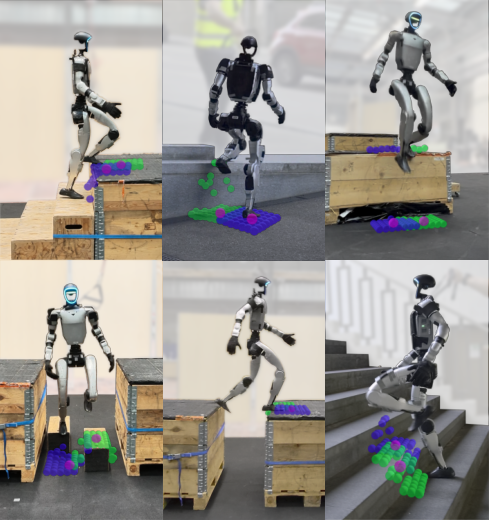
The authors replace dense robot-centric elevation maps with a lightweight foothold prediction model that forecasts future footholds from proprioception and velocity commands, and the policy only observes small elevation patches around these predicted footholds, with the predictor retrained on new policy rollouts. This cuts training iterations to roughly one third, and the policy outperforms full-map policies in sparse-foothold settings such as narrow walled corridors and on unseen terrain, matching attention-based encoders.
中文摘要: 该方法摒弃密集的机器人中心高程图,改用轻量级落足点预测模型从本体感知和速度指令推断未来落足位置,策略仅观测预测落足点周围的小块高程图,并随策略rollout周期性重训练预测器。结果显示达到同等地形难度所需训练迭代减少约三分之二,在狭窄围墙走廊等稀疏落足场景及未见过地形上优于全图策略,性能与基于注意力编码器的方法相当。
💬 A clean perception-bottleneck insight: anticipating footholds instead of compressing full elevation maps improves sample efficiency and generalization without expensive attention.
💬 这是一个清晰的感知瓶颈洞见:用落足点预期替代全高程图压缩,在不引入昂贵注意力机制的情况下同时提升样本效率与泛化性。
Why read it / 推荐理由: Foothold-centric terrain perception is directly applicable to multi-legged modular robots that must reason about sparse footholds on rough terrain. 以落足点为中心的地形感知思路可直接应用于需要在崎岖地形上处理稀疏落足点的多足模块化机器人。
3. Make it Walk: Computational Design of LEGO Walkers
让它行走:LEGO步行机器人的计算设计
Authors / 作者: Siqi Li, Fancheng Gao, Chi-Wing Fu, Peng Song
arXiv: 2610.29505 · PDF
The paper introduces the first computational co-design method for LEGO Technic walkers that produce stable and diverse gaits, using 3D-printed non-circular gears in a gear-linkage mechanism to mechanically prescribe each leg’s foot trajectory and an independent motor per leg synchronized by a simple timing control algorithm. Morphology and control are jointly optimized for target locomotion and appearance, and multiple fabricated walkers demonstrate varied gaits.
中文摘要: 本文提出首个面向LEGO Technic步行机器人的计算协同设计方法,可生成稳定且多样的步态。方法通过含3D打印非圆齿轮的齿轮-连杆机构机械地规定每条腿的足端轨迹,每条腿由独立电机驱动,并用简单可适配的时序控制算法同步多腿运动。作者以该建模为基础对形态与控制进行协同优化以满足目标运动与外观,并制作多台样机展示了多样的步态与外形。
💬 Mechanical gait prescription via non-circular gears combined with per-leg actuation and morphology-control co-design is an elegant, low-cost route to reconfigurable modular walkers.
💬 用非圆齿轮机械地规定步态、配合单腿独立驱动与形态-控制协同设计,是通往可重构模块化步行机器人的优雅低成本路径。
Why read it / 推荐理由: Directly relevant to reconfigurable modular leg design and gait generation, showing how mechanical design can encode and diversify gaits. 与可重构模块化腿部设计和步态生成直接相关,展示了机械设计如何编码并丰富步态。
4. SP-HLM: Sparse-Pose-Driven Motion Generation and Whole-Body Control for Humanoid Loco-Manipulation
SP-HLM:稀疏姿态驱动的运动生成与全身控制用于人形机器人移动操作
Authors / 作者: Zhaohui Yang, Quanbao Lin, Chengqi Shi, Zhenglang Weng, Jicheng Lin, Boyu Chen et al.
arXiv: 2610.30044 · PDF
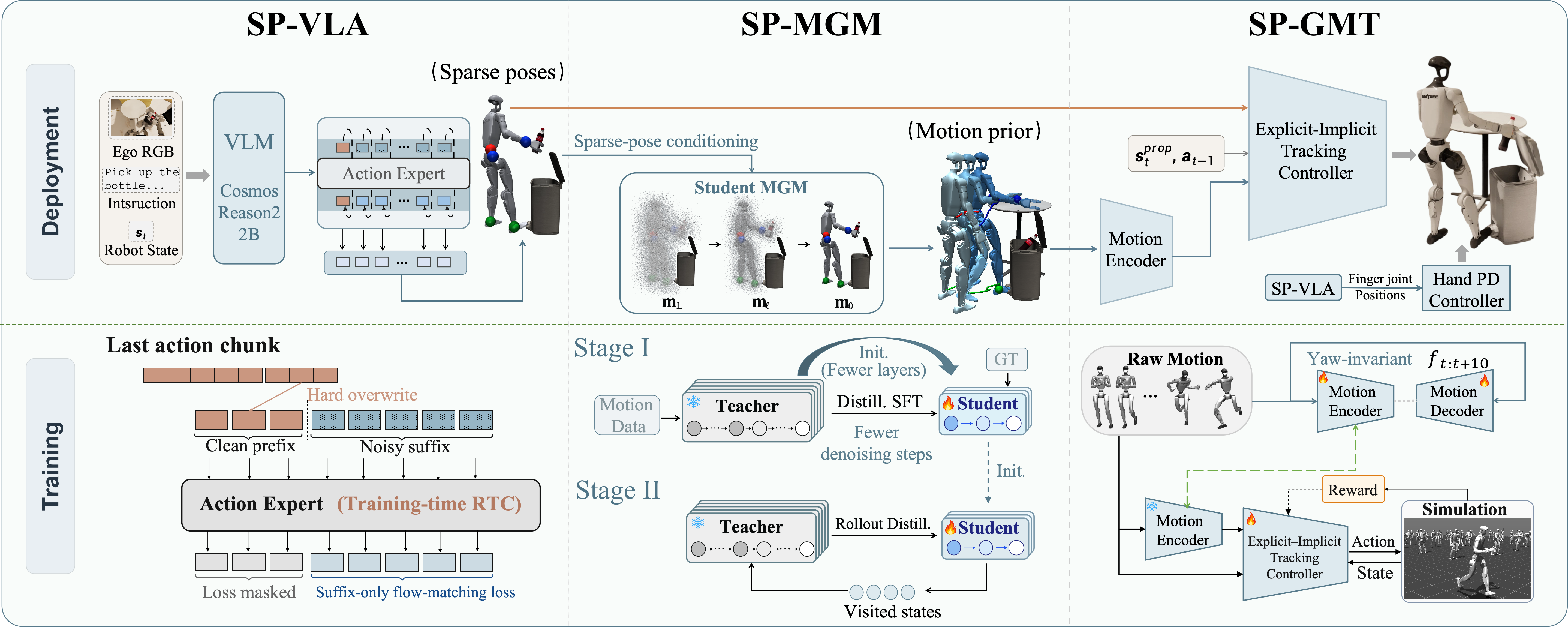
SP-HLM uses a sparse-pose interface combining five task-critical body poses with a learned latent motion prior to separate task intent from whole-body coordination: a VLA model predicts sparse poses and finger joints, a distilled motion generation model reconstructs full-body motion in real time, and a general motion tracker fuses explicit targets with the implicit motion prior for whole-body control. Simulation and real-humanoid experiments show improved tracking, coordination, and loco-manipulation success.
中文摘要: SP-HLM采用稀疏姿态接口,将五个任务关键身体姿态与学习到的隐式运动先验结合,把任务意图与全身协调解耦。视觉-语言-动作模型先预测稀疏姿态与手指关节位置,经两阶段蒸馏的运动生成模型实时重建全身运动,再由通用运动跟踪器融合显式稀疏目标与隐式运动先验实现全身控制。仿真与真实人形机器人实验表明其在运动跟踪、全身协调和移动操作成功率上优于现有方法。
💬 A well-structured hierarchical interface that cleanly separates sparse task-level pose intent from learned whole-body coordination, with real-robot validation.
💬 该工作构建了结构清晰的分层接口,将稀疏任务级姿态意图与学习式全身协调干净分离,并在真实机器人上完成验证。
Why read it / 推荐理由: The sparse-target plus latent-prior tracking formulation is instructive for whole-body control architectures that could be adapted to modular legged platforms. 稀疏目标加隐式先验的跟踪范式对可移植到模块化足式平台的全身控制架构具有启发意义。
5. Certified Neural Approximation of Robust Nonlinear Model Predictive Control
鲁棒非线性模型预测控制的带认证神经网络逼近
Authors / 作者: Hendrik Alsmeier, Maik Pfefferkorn, Rolf Findeisen
arXiv: 2610.29559 · PDF
The authors synthesize neural network controllers that provably inherit the recursive feasibility and stability guarantees of a robust nonlinear MPC policy by treating approximation error as a bounded input disturbance addressed in the MPC design, yielding constructive a priori conditions before deployment. The offline pipeline requires only specified Lipschitz bounds, and simulations show the learned controller reproduces closed-loop MPC behavior while reducing online computation.
中文摘要: 本文提出一种生成神经网络控制器的框架,使其可证明地继承鲁棒非线性模型预测控制的递归可行性与稳定性保证。方法将逼近误差视为有界输入扰动并在MPC设计中加以处理,从而在部署前给出构造性的先验设计条件,而非依赖事后验证或在线安全滤波器。该离线流程仅需给定Lipschitz界,仿真表明学习控制器复现了原MPC的闭环行为并降低在线计算量。
💬 Rare certified-by-construction neural MPC approximation that transfers robustness guarantees rather than patching them afterward with filters.
💬 这是一种少见的“构造即认证”的神经MPC逼近方法,通过继承而非事后滤波器来传递鲁棒性保证。
Why read it / 推荐理由: Offers a principled path to running MPC at high rates on embedded leg controllers without losing stability guarantees, key for modular legged control. 为在嵌入式腿部控制器上高速运行MPC而不失稳定性保证提供了有原则的途径,对模块化足式控制至关重要。