机器人日报
机器人论文日报 — 2026-10-20
🤖 Scanned 694 papers from today’s arXiv announcement (cs.RO / eess.SY / cs.LG), picked 5 for modular & legged robotics — summarized by DeepSeek.
🤖 从今日 arXiv 新论文(cs.RO / eess.SY / cs.LG)中扫描 694 篇,围绕模块化与足式机器人精选 5 篇 — 由 DeepSeek 生成双语摘要。
1. Learning Structured Locomotion References for Optimization-Based Whole-Body Control
学习结构化运动参考用于基于优化的全身控制
Authors / 作者: Ömer Tarik Banuş, Uluç Saranli, M. Mert Ankarali
arXiv: 2610.24779 · PDF
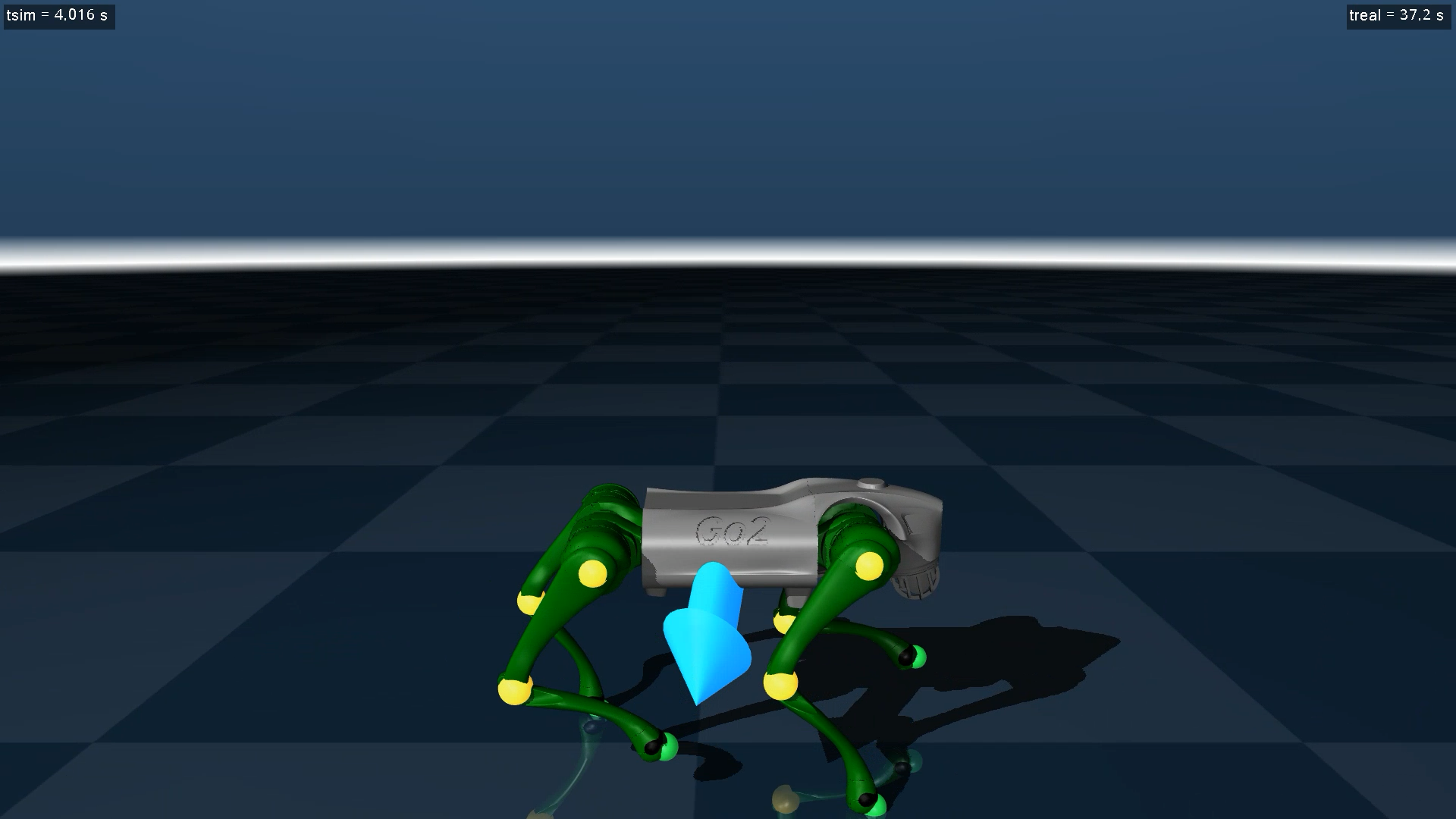
The paper presents a hierarchical quadruped controller where RL adapts structured locomotion references (gait timing, foothold placement, footstep timing) while a gait scheduler, reactive footstep planner, and whole-body impulse controller handle high-frequency execution. Trained in a vectorized controller-in-the-loop environment with a six-direction disturbance curriculum, the learned hierarchy achieves 77.29% mean survival versus 50.35% for the model-based baseline, with ablations showing adaptive foothold placement as the largest contributor.
中文摘要: 本文提出一种分层四足机器人控制器:上层强化学习策略负责调整结构化的运动参考(步态时序、落足点位置、步频等),下层由步态调度器、反应式落足规划器和全身冲量控制器负责高频执行。模型基底层可独立维持标称小跑,使策略专注于学习“何时、如何”修改已可用的运动控制器。在向量化控制器在环环境中使用六方向扰动课程训练后,该分层控制器在测试扰动网格上达到77.29%的平均存活率,而模型基参考控制器为50.35%。训练通道消融表明,自适应落足是提升网格存活率的最大边际贡献者,并揭示了步频自适应具有方向依赖性效应,验证了将学习自适应与基于优化的全身控制通过结构化运动参考相结合的可行性。
💬 A clean hierarchical design that keeps a provably functional MPC/WBC backbone and learns only structured references — directly relevant to modular legged control and sim-to-real adaptation of optimization-based controllers.
💬 清晰的分层设计,保留可证明有效的MPC/WBC主干,仅学习结构化参考——与模块化腿式控制和基于优化控制器的仿真到现实自适应直接相关。
Why read it / 推荐理由: Shows how RL can augment, not replace, an optimization-based whole-body controller, with useful ablations on foothold and gait-rate adaptation. 展示了RL如何增强而非替代基于优化的全身控制器,并给出了关于落足与步频自适应的有用消融分析。
2. Bio-inspired Thrust-Assisted Trotting on a legged-Aerial Robot via Real-Time QP-MPC
基于实时QP-MPC的仿生推力辅助腿足-空中机器人小跑
Authors / 作者: Shreyansh Pitroda, Eric Sihite, Alireza Ramezani, Morteza Gharib
arXiv: 2610.26810 · PDF
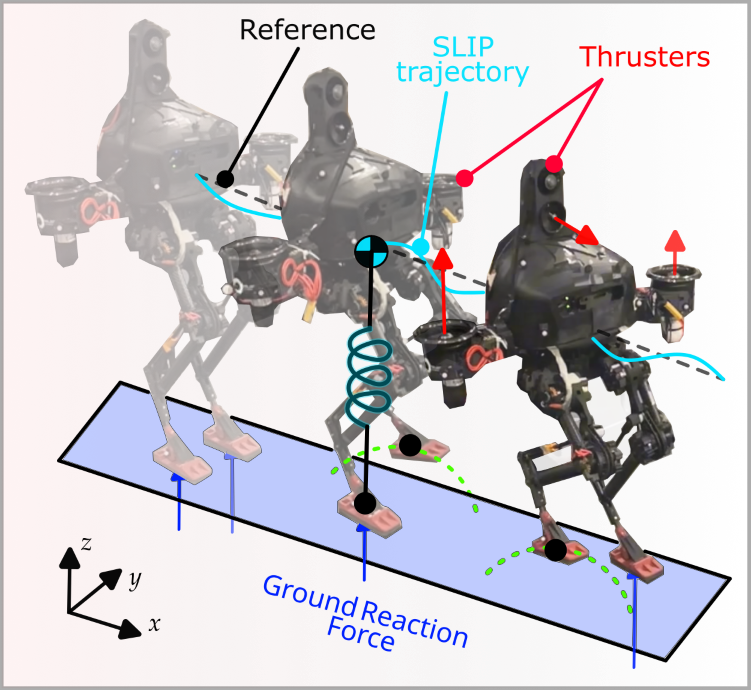
The paper implements a condensed QP-MPC on the thruster-assisted bipedal robot Harpy, inspired by wing-assisted locomotion in birds, to simultaneously regulate ground contact force and thrust vectoring at 500 Hz. A decoupled architecture uses sagittal QP-MPC and frontal cascade orientation stabilization; experiments at 0 and 0.1 m/s reference velocities show mean velocity tracking, joint tracking error within 1 degree, and a QP solve time of 0.18 ms within the 2 ms budget while respecting friction cone constraints.
中文摘要: 本文将推力辅助双足机器人Harpy的弹簧负载倒立摆动力学建模为紧凑的QP型模型预测控制问题,在500 Hz下同时调节地面接触力与主动推力矢量,灵感来自鸟类(如石鸡)的翅膀辅助运动。控制架构采用解耦设计:矢状面动力学由QP-MPC控制,冠状面动力学由级联姿态稳定控制器调节。在0 m/s和0.1 m/s参考速度下的实验表明,虽然瞬时速度有振荡,但平均速度可跟踪参考值;关节跟踪误差保持在1度以内;QP问题在0.18 ms内稳定求解,远低于2 ms计算预算,并满足地面反力摩擦锥约束。
💬 A neat real-time QP-MPC implementation on a hybrid legged-aerial platform that demonstrates the computational feasibility of MPC with contact-force constraints at 500 Hz.
💬 在腿足-空中混合平台上实现了简洁的实时QP-MPC,证明了在500 Hz下带接触力约束的MPC计算可行性。
Why read it / 推荐理由: Useful for understanding real-time QP-MPC formulations with contact-force and thrust vectoring constraints on a legged platform. 有助于理解腿式平台上带接触力与推力矢量约束的实时QP-MPC建模。
3. Anticipatory Gait Switching for Quadrupeds via Look-Ahead MDP Planning
基于前瞻MDP规划的四足机器人预期步态切换
Authors / 作者: Kelvin Aladum, Justin Peel, Nisar Ahmed
arXiv: 2610.24895 · PDF
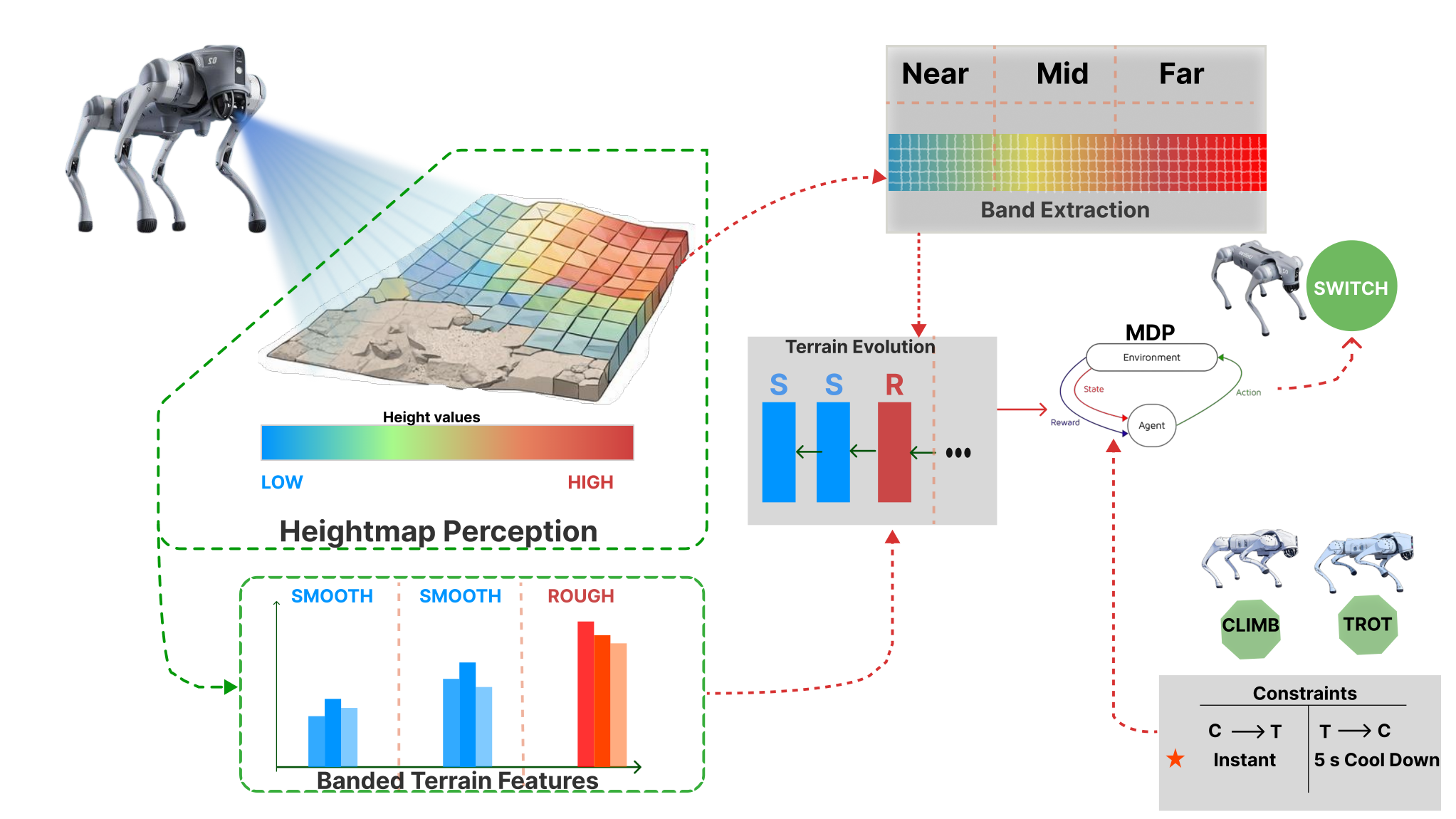
The paper proposes a lightweight height-map-only gait supervisor that partitions the robot-centered height map into near, mid, and far bands and models band evolution as a Markov process. Gait selection is cast as a look-ahead MDP whose transition model and cost encode platform-specific switching constraints, and experiments on a Unitree Go2 show reduced late switching, less time in ineffective gaits on rough terrain, and improved roll stability versus reactive baselines.
中文摘要: 本文提出一种仅依赖高度图的轻量级步态监督器,将机器人中心高度图划分为近、中、远三个区域带,并将区域带演化建模为马尔可夫过程。步态选择被构建为前瞻式马尔可夫决策过程,其转移模型和代价函数显式编码平台特定的切换约束(如停留时间)。在Unitree Go2平台上的室内外实验表明,与调优的反应式基线相比,该方法减少了迟滞切换,降低了在崎岖地形上使用无效步态的时间,并提高了横滚稳定性,实现了预期性且约束感知的步态切换。
💬 Gait switching as look-ahead MDP planning is a simple yet effective idea for terrain-aware modular legged locomotion, validated on real hardware.
💬 将步态切换建模为前瞻MDP规划,是地形感知模块化腿式运动中的简洁有效思路,并在真实硬件上得到验证。
Why read it / 推荐理由: Directly addresses anticipatory gait generation and switching for quadrupeds, with a formulation that could extend to modular multi-legged platforms. 直接针对四足机器人的预期性步态生成与切换,其公式可扩展到模块化多足平台。
4. Solving a Giant Rubik’s Cube with a Quadruped Robot
四足机器人自主复原巨型魔方
Authors / 作者: Lukas Amiet, Gabriel Sánchez-Blanco Repgen, Mayank Mittal, Victor Klemm, Andrei Cramariuc, Marco Hutter et al.
arXiv: 2610.24610 · PDF
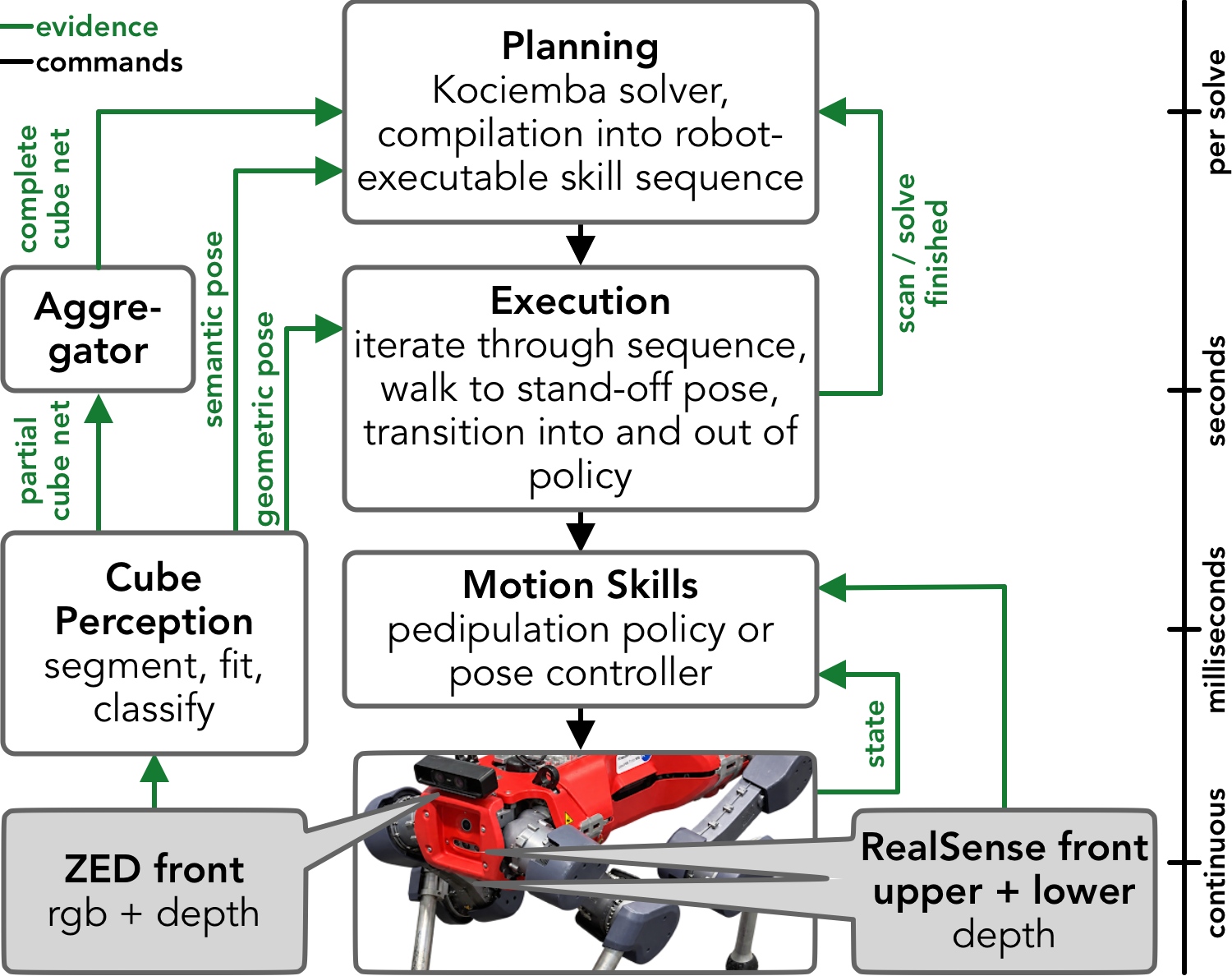
The paper demonstrates a quadruped autonomously solving a giant Rubik’s Cube using only its feet, combining an onboard RGB-D perception pipeline for cube pose and color-state estimation, a planner converting solutions into skill sequences, and learned whole-body skills trained with RL from privileged observations and distilled to deployable policies. The system completes three autonomous hardware solves of about 30 steps each over 8-9 minutes, tolerating placement variations and recovering from disturbances.
中文摘要: 本文展示四足机器人仅用脚自主复原巨型魔方。系统包含机载RGB-D感知流程,通过移动和翻转从部分视角估计魔方的度量位姿和完整颜色状态;规划器将求解转换为机器人可执行的技能序列;用强化学习从特权观测训练全身技能并蒸馏为仅依赖机载深度与本体感知的策略。技能包括在保持层配置的同时重新定向魔方,以及用一只脚固定、另一只脚推动来转动层。部署的策略可容忍机器人与魔方相对位置变化并从外部扰动中恢复,在硬件上完成三次自主求解,每次约30步、耗时8-9分钟。
💬 An impressive integration of learned whole-body pedipulation with perception and planning on a real quadruped, pushing the boundary of dexterous legged manipulation.
💬 在真实四足机器人上出色地集成了学习的全身足部操作、感知与规划,拓展了灵巧腿式操作的边界。
Why read it / 推荐理由: Illustrates learned whole-body control with sim-to-real distillation for a long-horizon contact-rich task on a quadruped. 展示了通过仿真到现实蒸馏学习全身控制来完成四足机器人长时域接触密集任务。
5. Adaptive Rejection of Unknown Hybrid Sinusoidal Disturbances with Application to Humanoid Walking under Unknown Ground Motion
未知混合正弦扰动自适应抑制及其在未知地面运动下双足行走中的应用
Authors / 作者: I-Chia Chang, Jacob Stewart, Petros A. Ioannou, Yan Gu
arXiv: 2610.23879 · PDF
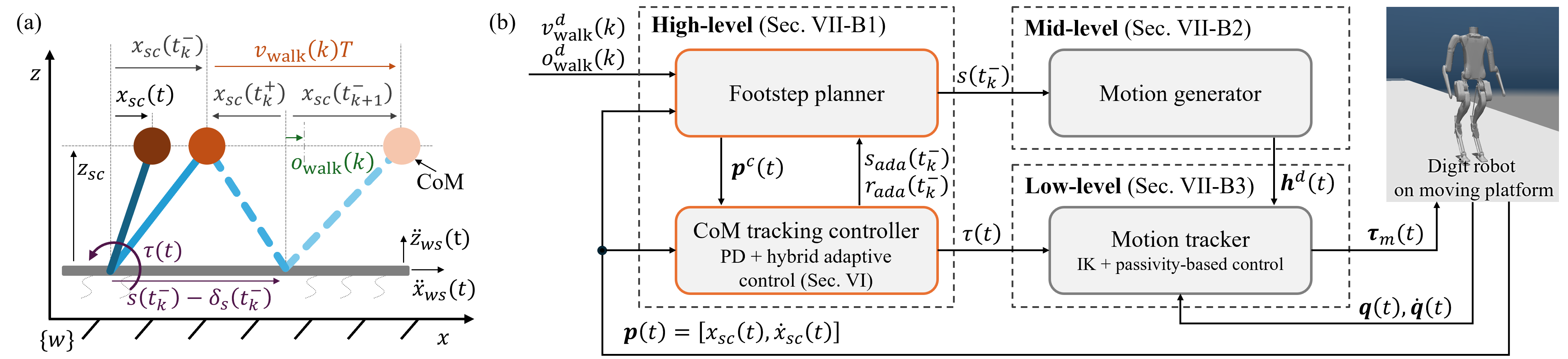
The paper formulates legged robot walking under non-inertial ground motion as unknown-disturbance rejection for hybrid linear systems with hybrid sinusoidal disturbances, deriving necessary and sufficient solvability conditions and a Youla-Kucera output-feedback controller with an adaptive parameter-estimation law. Experiments on bipedal walking under ground motion show over 60% average improvement in body-position tracking in simulation and up to 47% in real-world experiments.
中文摘要: 本文将非惯性环境(地面与周围环境在惯性系中加速)下的腿式机器人行走控制建模为受混合正弦扰动(正弦分量组合并在离散事件处发生相位跳变)的混合线性系统的未知扰动抑制问题。首先推导了扰动抑制问题可解的充要条件,并表征抑制扰动的控制输入;其次利用Youla-Kucera参数化设计输出反馈控制器;最后在扰动及其参数未知的实际情形下,提出自适应律估计控制器参数。双足行走于运动地面上的实验表明,身体位置跟踪精度平均提升超过60%(仿真)和最高47%(实物)。
💬 A theoretically grounded adaptive disturbance-rejection method for legged locomotion on moving ground, addressing a practical robustness gap not covered by learning-based controllers.
💬 针对运动地面上的腿式行走提出有理论依据的自适应扰动抑制方法,弥补了学习型控制器未覆盖的实际鲁棒性缺口。
Why read it / 推荐理由: Provides rigorous hybrid-system tools for rejecting persistent disturbances, useful for robustifying WBC/MPC against environmental motion. 提供严格的混合系统工具来抑制持续扰动,有助于提升WBC/MPC对环境运动的鲁棒性。