机器人日报
机器人论文日报 — 2026-10-19
🤖 Scanned 301 papers from today’s arXiv announcement (cs.RO / eess.SY / cs.LG), picked 5 for modular & legged robotics — summarized by DeepSeek.
🤖 从今日 arXiv 新论文(cs.RO / eess.SY / cs.LG)中扫描 301 篇,围绕模块化与足式机器人精选 5 篇 — 由 DeepSeek 生成双语摘要。
1. Reinforcement Learning Based Multi-Terrain Adaptive Whole-Body Control for a Quadruped Manipulator
基于强化学习的四足机械臂多地形自适应全身控制
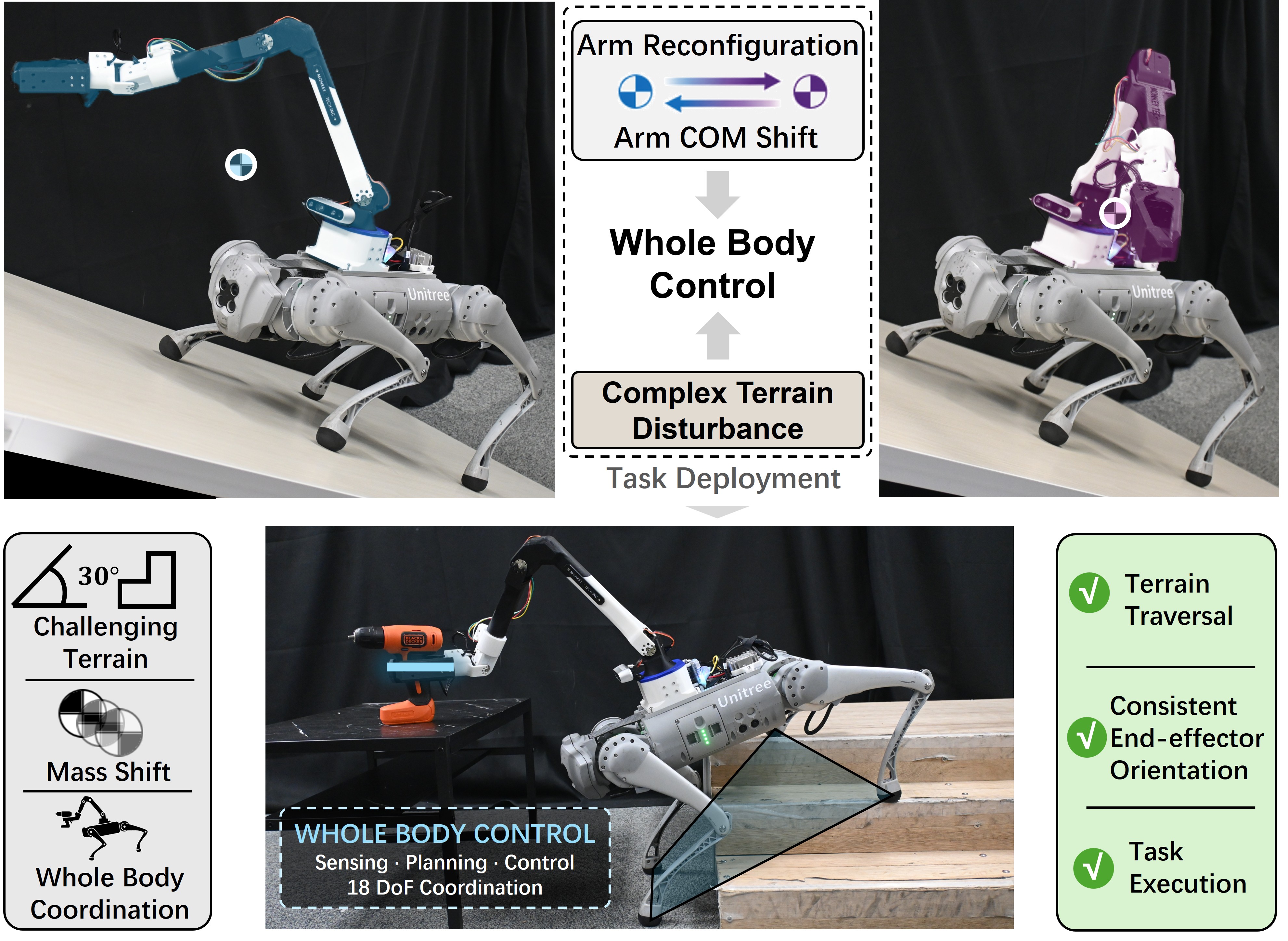
Authors / 作者: Yanzhou Jin, Fei Suo, Chang Liu, Yasuhisa Hasegawa, Liming Chen, Yusuke Iwasawa et al.
arXiv: 2610.23548 · PDF
This paper proposes an RL-based whole-body control framework for loco-manipulation on a small-scale quadruped manipulator, combining a hybrid task representation with task-prioritized whole-body learning to keep end-effector behavior task-consistent under terrain disturbances. The authors build a lightweight quadruped manipulator and demonstrate real-world deployment on slopes up to 30 degrees, stairs, and deformable terrain.
中文摘要: 本文面向小型四足机械臂平台,提出一种基于强化学习的全身控制框架用于复杂地形下的移动操作。方法将混合任务表示与任务优先级全身学习相结合,在运动与操作强耦合、地形扰动存在时保持末端执行器行为与任务一致。作者研制了轻量化四足机械臂样机,并在真实环境中验证:可在最大30度斜坡、楼梯与可变形地面上完成移动操作。实验表明学习型全身控制策略可部署于真实复杂地形,并说明任务一致的全身协调对地形自适应移动操作的重要性。
💬 A clean demonstration that task-prioritized whole-body RL can keep end-effector consistency on a real small quadruped manipulator, with terrain robustness shown on hardware rather than in simulation.
💬 该工作清晰展示了任务优先级全身强化学习能在真实小型四足机械臂上保持末端一致性,且地形鲁棒性在硬件而非仿真中验证。
Why read it / 推荐理由: Directly relevant to whole-body control and RL-based locomotion on real legged hardware, and its task-prioritized formulation is transferable to modular platforms carrying payloads or limbs. 该文直接涉及真实腿足硬件上的全身控制与强化学习运动控制,其任务优先级建模可迁移到承载载荷或附加肢体的模块化平台。
2. FCTS: Failure-Guided Curriculum Tree Search Over Generated Terrain for Legged Parkour
FCTS:面向腿足跑酷的失败引导式生成地形课程树搜索
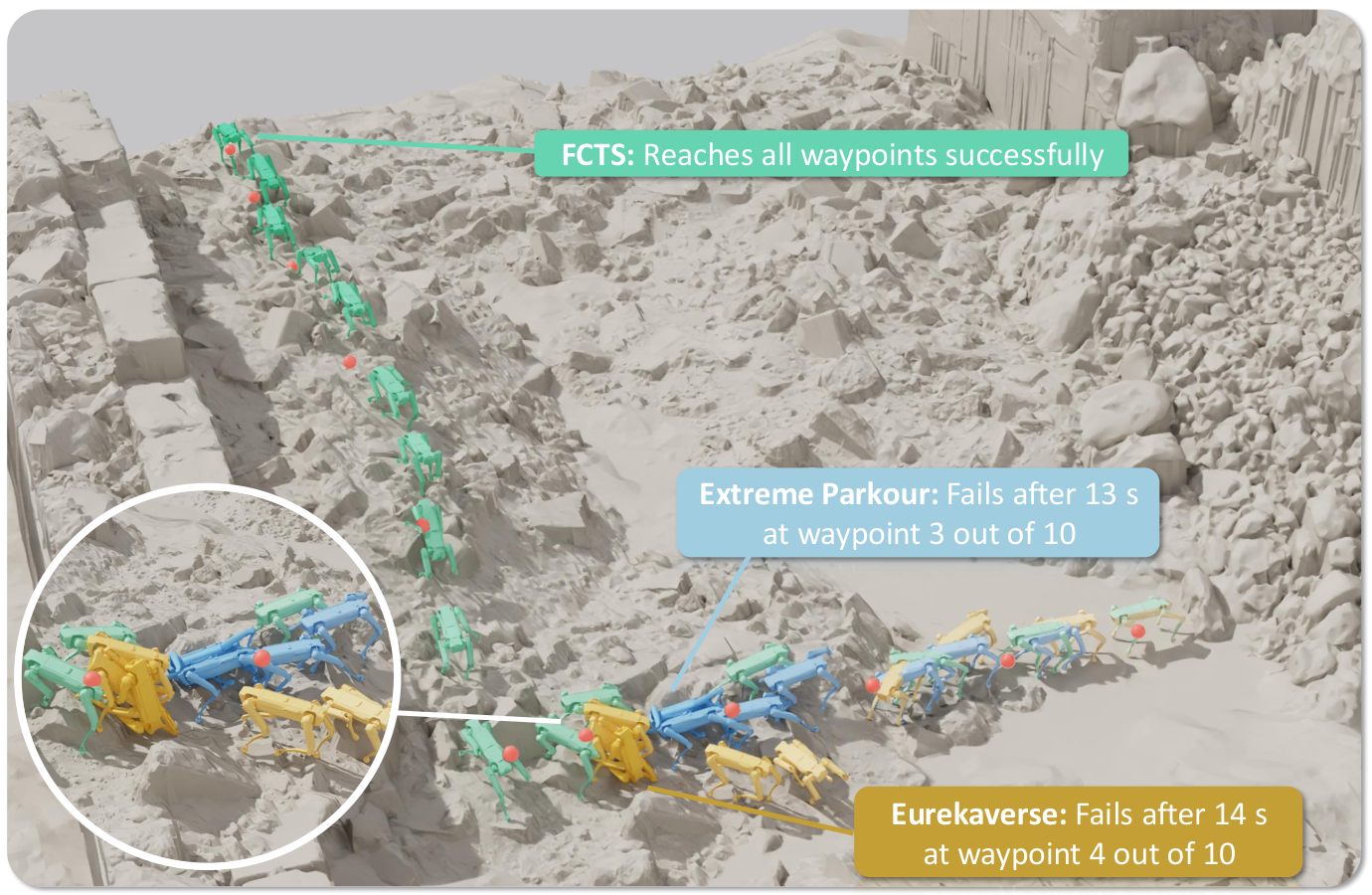
Authors / 作者: Narayanan Palghat Parameswaran (Carnegie Mellon University), Dong-Ki Kim (FieldAI), Jay Patrikar (FieldAI), Santiago Gutierrez (FieldAI), Harshad Zade (FieldAI), Shayegan Omidshafiei (FieldAI) et al.
arXiv: 2610.22619 · PDF
FCTS uses localized traversal failures (location, termination mode, robot state, surrounding geometry) to condition automatic generation of the next training terrains, while Monte Carlo Tree Search explores alternative curriculum trajectories under a fixed training budget. On terrains reconstructed from scanned real construction sites it raises success from 28.4% to 85.8% (medium) and 14.9% to 44.7% (hard) over parkour and LLM-curriculum baselines, with hardware transfer on a quadruped.
中文摘要: 本文提出FCTS,一种失败条件化的地形课程框架:利用局部穿越失败的位置、终止模式、机器人状态与周边地形几何来条件化生成下一阶段训练地形,并用蒙特卡洛树搜索在固定训练预算下探索替代课程轨迹。在由真实建筑工地扫描重建的地形上,相较于最强跑酷与LLM课程基线,中等难度课程成功率由28.4%升至85.8%,高难度由14.9%升至44.7%,并在极难地形上保持更高推进度。四足机器人硬件实验证实所学策略可迁移至真实世界。
💬 Replaces hand-designed or LLM-generated curricula with failure-conditioned terrain synthesis plus tree search, which is a principled answer to the sim-to-real generalization problem in agile legged locomotion.
💬 该文用失败条件化地形生成加树搜索替代手工或LLM课程,为敏捷腿足运动的仿真到现实泛化问题提供了有原则的解法。
Why read it / 推荐理由: The failure-signal-driven curriculum is directly reusable for gait and traverse-capability training of modular multi-legged robots on unstructured terrain. 其失败信号驱动的课程机制可直接用于模块化多足机器人在非结构化地形上的步态与穿越能力训练。
3. BeJEPA: A Goal-Conditioned Humanoid Behavior World Model via Unsupervised RL
BeJEPA:基于无监督强化学习的目标条件人形行为世界模型
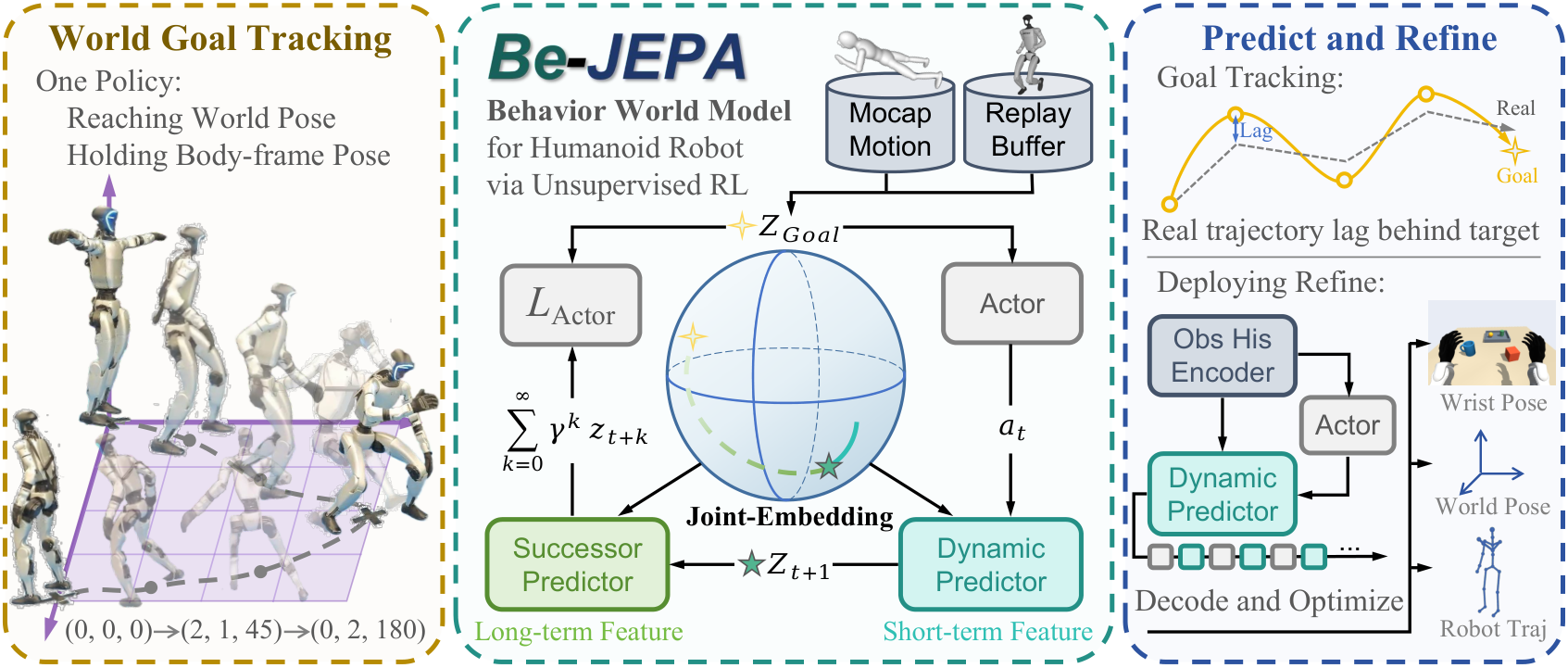
Authors / 作者: Liyun Yan, Haoyang Li, Yang Zhang, Jialing Zhu, Zhanxiang Cao, Zihao Zhou et al.
arXiv: 2610.23127 · PDF
BeJEPA learns a goal-conditioned behavior world model for humanoid whole-body control via a JEPA-style shared representation of body configuration and world placement, combining a Dynamic Predictor for next-state embeddings with a Successor Predictor summarizing expected future embeddings. In 20-second motion tracking it reduces global body-position error by 61.7% versus BFM-Zero and 58.7% versus SONIC on AMASS, and is deployed on a Unitree G1 achieving joint posture, world position, and heading goals.
中文摘要: 本文提出BeJEPA,一种通过无监督强化学习从人体运动先验与机器人交互中获得的目标条件行为世界模型。它用联合嵌入预测架构学习身体构型与世界位姿的共享表示:Dynamic Predictor在动作下预测下一状态嵌入,Successor Predictor将目标条件策略的期望折扣未来状态嵌入压缩为单一向量。二者联合训练使表示既锚定于物理转移又围绕长期行为组织,无需长时想象轨迹即可指导策略改进。在20秒运动跟踪实验中,全局身体位置误差相对BFM-Zero降低61.7%、相对SONIC降低58.7%,并在Unitree G1真机上同时达成姿态、世界位置与朝向目标。
💬 A compact, rollout-free world-model formulation that grounds whole-body control in world-frame goals, which is exactly where root-frame imitation policies tend to fail.
💬 该文提出紧凑、免长时想象的world model公式,将全身控制锚定到世界坐标系目标,而这正是根坐标系模仿策略易失效之处。
Why read it / 推荐理由: Its successor-feature formulation is a useful alternative to long-horizon MPC/RL rollouts for whole-body goal reaching on legged platforms. 其后继特征表示是腿足平台全身目标到达任务中长时域MPC/RL轨迹优化的有用替代方案。
4. No Eyes, No Problem: What Does Touch Contribute to Blind Baoding Ball Manipulation?
无眼亦可:触觉对盲式保定球操作究竟贡献几何?
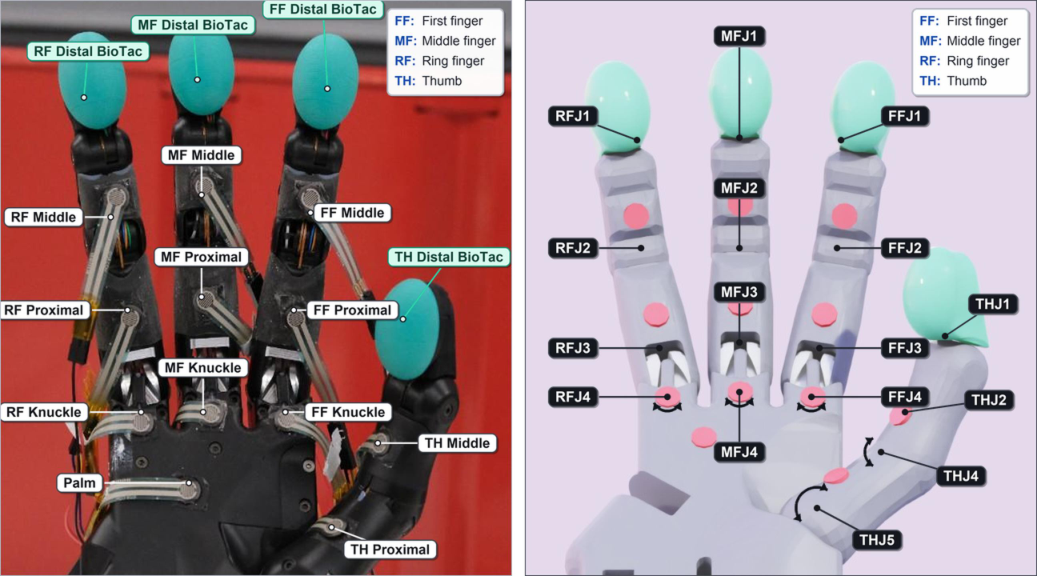
Authors / 作者: Ayush Deshmukh, Nalin Agarwal, Elle Miller, Sethu Vijayakumar
arXiv: 2610.23438 · PDF
The authors learn blind in-hand Baoding ball rotation on the Shadow Dexterous Hand Lite using only proprioception and binary tactile feedback, achieving zero-shot sim-to-real via sensor-aligned simulation embodiment, tactile calibration, and two novel episodic domain randomizations (slew-rate action limits and STuck-AT Taxels). The policy performs 225 consecutive 180-degree rotations at about 0.36 rot/s in one continuous trial and ablates which hand regions and modalities matter.
中文摘要: 本文研究仅依赖本体感觉与二值触觉反馈的盲式手内保定球旋转,在Shadow Dexterous Hand Lite上实现零样本仿真到现实迁移。方法包括传感器对齐且考虑耦合的仿真本体建模、触觉标定,以及两种新颖的回合级域随机化:变化率动作限幅与STuck-AT Taxel故障注入。真实手部实验中策略在单次连续试验内完成225次180度旋转(约0.36转/秒),无视觉与物体状态信息;论文进一步对比仅本体感觉的基线,识别触觉信息最关键的手部区域。
💬 A rigorous sim-to-real study that isolates the contribution of binary tactile sensing through well-motivated domain randomizations, with an unusually long uninterrupted hardware success run.
💬 该文通过有针对性的域随机化严谨隔离二值触觉的贡献,并实现了异常长的真机连续成功运行。
Why read it / 推荐理由: The sensor-alignment and tactile-calibration pipeline, plus the slew-rate and stuck-taxel randomizations, are practical sim-to-real recipes applicable to foot contact sensing in legged robots. 其传感器对齐与触觉标定流程,以及变化率与触元卡死随机化,是可应用于腿足机器人足端接触感知的实用仿真到现实方法。
5. Blind Precise Assembly: Proprioceptive Sim-to-Real Peg-in-Hole for Diverse Parts
盲式精密装配:面向多样零件的本体感觉仿真到现实轴孔装配
Authors / 作者: Antonia Bronars, Younghyo Park, Kushal Kedia, Pulkit Agrawal
arXiv: 2610.23849 · PDF
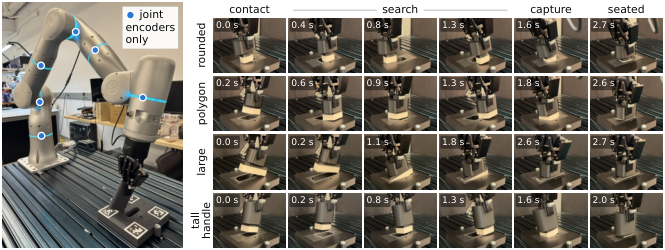
This work trains blind assembly policies observing only short histories of joint positions, velocities, and actions, with unknown fixture and part poses and randomized grasps, entirely in simulation over randomized parts and contacts. The peg-insertion policy transfers zero-shot to hardware, succeeding in 73% of trials across shapes and sizes, and controlled comparisons show blind policies generalize better to unseen parts than matched visual policies at the cost of speed.
中文摘要: 本文研究仅凭本体感觉的盲式精密装配:策略只观测关节位置、速度与自身动作的短历史,不使用视觉、力/力矩或触觉传感,且夹具与零件位姿未知、抓取高度随机化,因而必须完全通过自身本体感觉感知接触来完成装配。方法在仿真中对随机化零件、抓取与接触进行强化学习训练,学到轴孔插入、齿轮啮合与螺母穿线技能。插入策略零样本迁移至真实世界,对不同形状尺寸销钉的成功率为73%;仿真对照实验表明盲式策略对未见零件形状尺寸的泛化明显优于匹配的视觉策略,尽管速度较慢。
💬 A compelling demonstration that proprioception-only policies can solve millimeter-scale contact-rich tasks, with honest discussion of the data cost (thousands of simulated assemblies per clearance regime).
💬 该文有力证明仅本体感觉的策略可完成毫米级富接触任务,并坦诚讨论了数据代价(每种间隙区间需数千次仿真装配)。
Why read it / 推荐理由: Its contact-through-proprioception training recipe and zero-shot transfer analysis inform foot-terrain contact estimation and blind locomotion control without external sensing. 其通过本体感觉感知接触的训练方法与零样本迁移分析,可为足-地接触估计与无外部传感的盲式运动控制提供借鉴。