机器人日报
机器人论文日报 — 2026-10-17
🤖 Scanned 80 papers from the last 3 days of arXiv announcements (cs.RO / eess.SY / cs.LG), picked 5 for modular & legged robotics — summarized by DeepSeek.
🤖 从近 3 天的 arXiv 新论文(cs.RO / eess.SY / cs.LG)中扫描 80 篇,围绕模块化与足式机器人精选 5 篇 — 由 DeepSeek 生成双语摘要。
1. Full-Order Safety for Nonlinear Reduced-Order MPC
面向非线性降阶MPC的全阶安全性保障
Authors / 作者: Luis Pabon, Johannes Köhler, Revant Kasichainula, Marco Pavone
arXiv: 2610.19250 · PDF
CoRE-MPC plans with a nonlinear reduced-order model while propagating two prediction-error radii alongside it, yielding guaranteed recursive feasibility and constraint satisfaction for the full-order system without online full-order evaluation. On an 80-state oscillator chain, Burgers equation, and a 9,768-state finite-element soft robot it runs 13-61x faster than full-order robust MPC with only 27-35% higher closed-loop cost.
中文摘要: 降阶模型使高维非线性系统的MPC求解变得可行,但建模误差可能导致真实系统违反约束。本文提出CoRE-MPC,一种基于非线性降阶模型的鲁棒MPC方法,其关键在于刻画降阶模型如何影响预测误差动态,并沿预测时域传播两个误差半径,从而为全阶系统提供预测误差的严格上界,保证递归可行性与约束满足,且无需在线计算全阶模型。在80状态振子链、Burgers方程以及9768状态有限元软体机器人上验证:两状态降阶模型配合数据驱动边界,使全部1628个节点避开墙壁,20毫秒控制周期下中位求解时间低于1毫秒;相比全阶鲁棒MPC快13至61倍,闭环代价仅增加27%至35%,而现有认证方法要么不可行,要么至少保守两倍。
💬 A rigorous reduced-order MPC certification scheme whose error-radius propagation is directly transferable to reduced-order models used in legged whole-body control.
💬 该降阶MPC认证方案通过传递误差半径保证全阶安全性,可直接迁移到足式机器人全身控制中常用的降阶模型。
Why read it / 推荐理由: If you use simplified centroidal or template models for legged MPC, this gives a principled way to bound the resulting constraint violations without paying full-order compute. 若你在足式MPC中使用质心或模板等简化模型,本文提供了在不承担全阶计算代价的前提下严格约束违约界的原则性方法。
2. KODA: Kinematics—Observation Data Alignment for Humanoid Learning from Human Egocentric Demonstration
KODA:面向人类第一视角演示的人形机器人学习的运动学—观测数据对齐
Authors / 作者: Zibo Zhou, Yueru Chen, Junsong Wu, Weiji Xie, Qingyao Xu, Sheng Yin et al.
arXiv: 2610.21152 · PDF
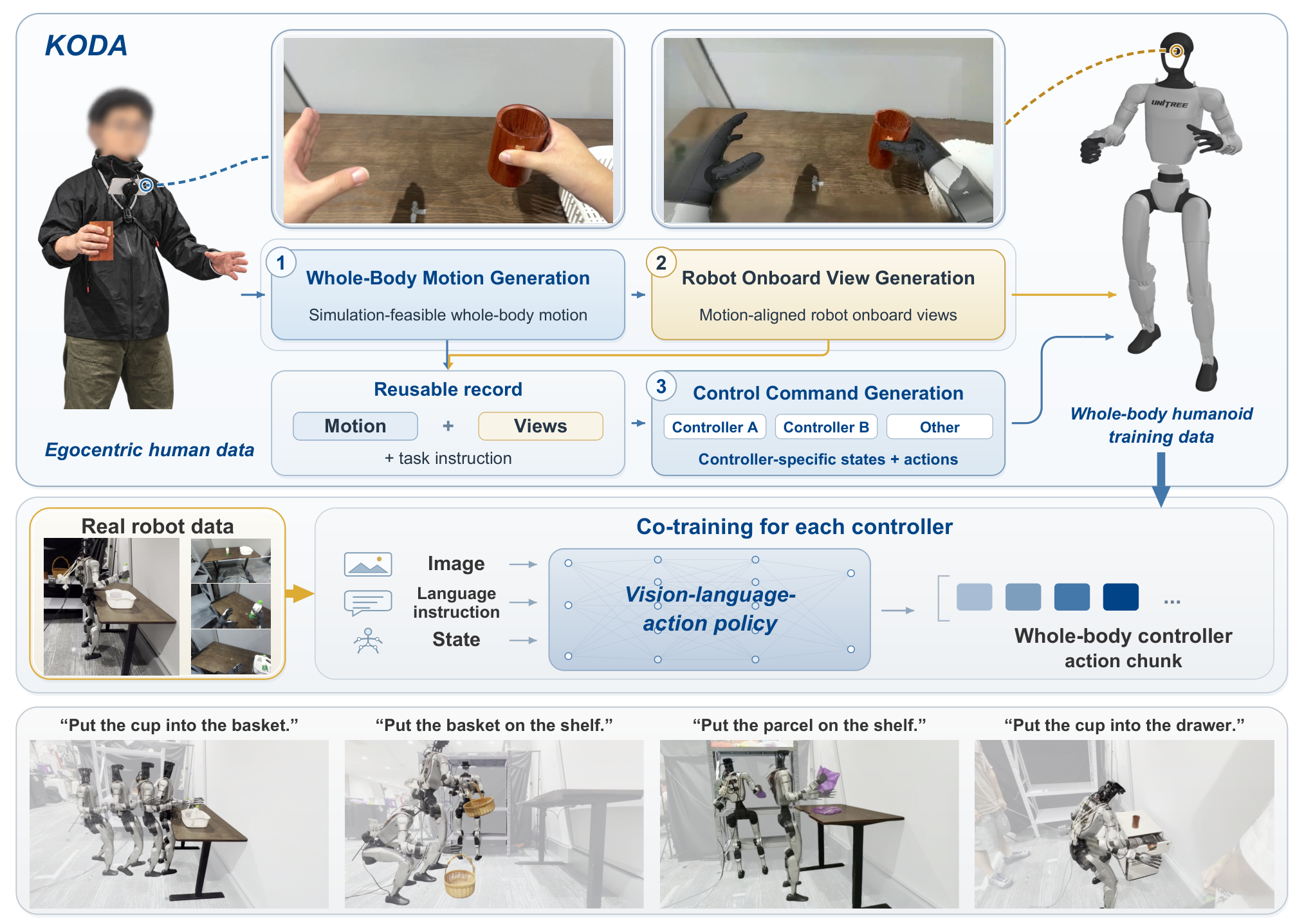
KODA converts egocentric RGB human demonstrations into whole-body VLA training data by first generating a simulator-checked whole-body trajectory with a sparse tracker and sampling-based command optimization, from which robot-view camera poses are derived to synthesize aligned observations. A reusable canonical record then lets controller-specific state-action labels be regenerated for each deployment controller, decoupling data from the low-level controller.
中文摘要: 训练人形机器人全身视觉—语言—动作(VLA)策略需要昂贵的机器人演示,且要求机器人视角观测与控制器兼容的全身状态—动作标签对齐。人类第一视角演示可提供可扩展监督,但存在视角错位与运动线索稀疏的问题。本文提出KODA,将第一视角RGB演示转换为全身VLA训练数据:先利用稀疏跟踪器与基于采样的指令优化生成经仿真器校验的全身轨迹,并由该轨迹直接确定机载相机位姿以合成机器人视角观测,形成可复用的规范记录;随后针对每种部署控制器优化跟踪指令并记录相应动作标签与本体状态,切换控制器时保留规范记录并重新生成监督信号,从而解耦数据与底层控制器。
💬 The canonical-record design that decouples demonstration data from any specific whole-body controller is the interesting methodological idea here.
💬 通过规范记录将演示数据与具体全身控制器解耦,是本文最有价值的方法论思想。
Why read it / 推荐理由: The controller-agnostic supervision pipeline is relevant if you want to reuse motion data across different modular leg configurations and low-level controllers. 若希望在不同模块化腿部构型与底层控制器之间复用运动数据,这种与控制器无关的监督流水线值得参考。
3. RoboSpan: Learning Modular Coordination Policies for High-DoF Whole-Body Mobile Manipulation with Teleoperation
RoboSpan:面向高自由度全身移动操作的可学习模块化协调策略与遥操作
Authors / 作者: Keqiang Ren, Xuecheng Ye, Hanyu Liu, Zhihua Wang, Tao Jian, Yunsheng Ma et al.
arXiv: 2610.19594 · PDF
RoboSpan pairs a 29-DoF whole-body teleoperation platform with the Hierarchical Modular Framework, which decouples the action space into hand, arm, and mobile-base branches and coordinates them via a transformer with inter-modular cross-attention, plus VLM-driven task decomposition and full-palm tactile encoding. On the physical robot it exceeds mainstream baselines by over 20% task success on long-horizon contact-rich whole-body tasks.
中文摘要: 全身移动操作面临运动学异构模块(移动、手臂、手部)之间的运动异质性以及长时程多阶段任务中的误差累积两大挑战,现有遥操作平台也缺乏集成触觉感知。本文提出RoboSpan高自由度全身遥操作与示教平台及分层模块化框架HMF:将29自由度动作空间功能性地解耦为精细手部操作、手臂位姿调整与移动基座空间构型三个分支,并设计带模块间交叉注意力的协调模块化具身Transformer(COMET)实现动态信息交换与动作协调;视觉语言模型驱动的分层任务分解从结构上抑制时序误差传播,全掌二维触觉表征编码分布式接触信号。在29自由度实体机器人上,长时程全身接触密集任务成功率较主流基线提升20%以上。
💬 The functional decoupling of heterogeneous modules with inter-modular cross-attention is a useful design pattern for coordinating reconfigurable leg modules.
💬 将异构模块功能性解耦并用模块间交叉注意力协调,是协调可重构腿部模块的有益设计范式。
Why read it / 推荐理由: Its hierarchical decoupling of locomotion and manipulation branches maps naturally onto modular multi-legged architectures where leg roles are reconfigurable. 其将移动与操作分支分层解耦的思路,天然适用于腿角色可重构的模块化多足架构。
4. Whole-Body Dexterity
全身灵巧性
Authors / 作者: Conor Mc Gartoll, An Dang, Pranay Thangeda, Arjun Gupta, Carolina Higuera, Nima Fazeli et al.
arXiv: 2610.22184 · PDF
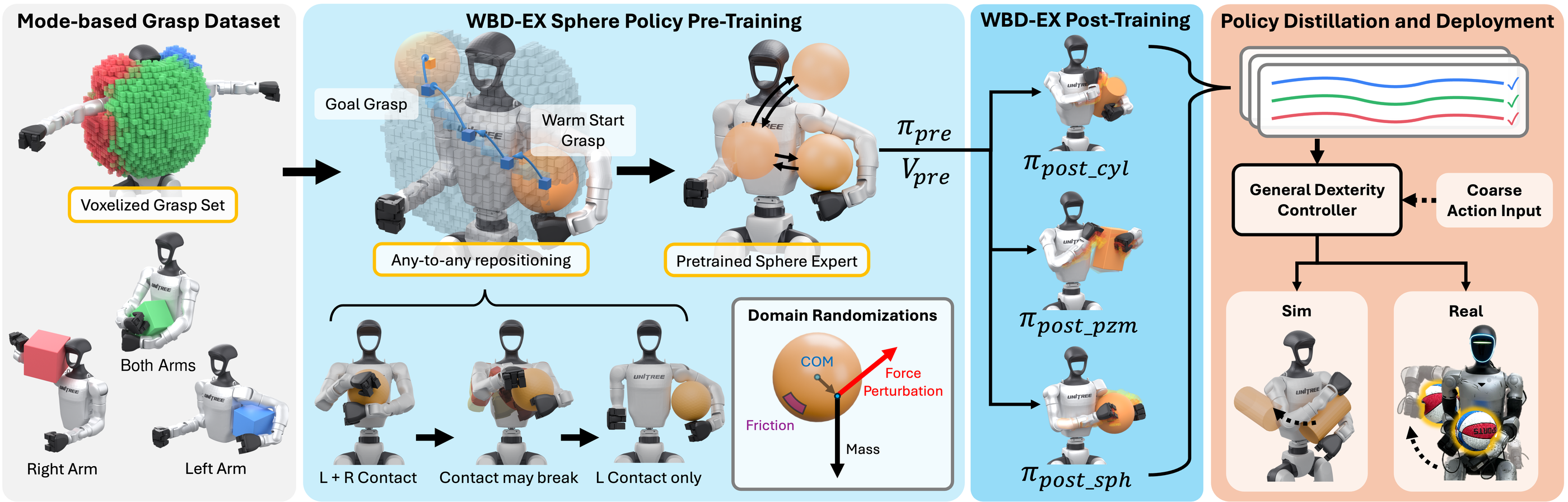
WBD generates a dataset of feasible whole-body grasps using the torso and arms as contact surfaces, trains RL experts on an any-to-any repositioning objective sampled from that dataset, and distills them into one proprioception-plus-geometry policy. The distilled policy transfers zero-shot to a real Unitree G1 and completes 90% of real whole-body manipulation trials versus 18% for direct retargeting and 4% for a generalist whole-body controller.
中文摘要: 当前人形机器人灵巧操作主要局限于末端执行器与简单抓取,难以像人类那样用整个身体支撑和滑动重物。本文提出全身灵巧性(WBD)框架,将躯体与肢体作为接触面进行抓取与操作:其仿真到真实流水线首先生成可行的全身抓取数据集,再在该数据集上采样初始与目标抓取,以通用的任意到任意重定位目标训练强化学习专家,并将多个专家蒸馏为单个仅依赖本体感知与物体几何的策略。蒸馏策略零样本迁移至Unitree G1真机,能在躯干周围重定位篮球与纸箱,并完成将箱子夹于腋下、从货架搬运至桌面并放置的长时程任务;真实任务成功率达90%,而直接重定向为18%,通用全身控制器仅4%。
💬 A convincing sim-to-real recipe where distillation from multi-expert RL into a compact proprioceptive policy drives real-world robustness.
💬 该工作展示了令人信服的仿真到真实方案:将多专家强化学习蒸馏为紧凑的本体感知策略,从而提升真实世界的鲁棒性。
Why read it / 推荐理由: Its generate-experts-then-distill pipeline and multi-contact whole-body formulation are directly applicable to multi-legged platforms using limbs as braces. 其先生成专家再蒸馏的流水线以及多接触全身建模,可直接应用于以肢体作为支撑的多足平台。
5. A Mode-Unified, Continuous, and Biomimetic Control Strategy of a Robotic Lower Limb Prosthesis
机器人下肢假肢的模式统一、连续化与仿生控制策略
Authors / 作者: Hanjun Kim, Sixu Zhou, John Shim, Xinyuan Guo, Kinsey R. Herrin, Aaron J. Young
arXiv: 2610.19183 · PDF
The authors model knee and ankle biomechanics as continuous functions of terrain slope and gait phase, unify locally optimized ascent/descent polynomials via RBF interpolation, map them to slope-dependent impedance parameters, and implement a single FSM controller with bilateral sensing. Ten transfemoral amputees walked level, ramps, and stairs up to 35 degrees, including conditions absent from the training dataset, with r-squared of 0.82-0.99 for knee measures.
中文摘要: 现有仿生下假肢控制器多针对离散运动模式设计,需为平地、坡道和楼梯分别参数化。本文提出模式统一的假肢控制框架,将膝踝生物力学连续表示为地形坡度与步态相位的函数,用径向基函数插值统一局部优化的上坡与下坡多项式模型,在保持分模式模型精度的同时优于全局多项式表示;所得生物力学再转换为连续且随坡度变化的阻抗参数,在单一有限状态机控制器中结合双侧传感进行步态状态估计与实现。10名股骨截肢者实验表明,受试者可从平地过渡到最高35度的坡道与楼梯,包括训练数据集中未出现的13度坡道与15度楼梯条件;膝部指标拟合优度0.82至0.99,踝部运动学0.78至0.96。
💬 Unifying discrete locomotion modes into one continuous slope-and-phase parameterization is a clean idea that echoes gait-generation design for multi-legged robots.
💬 将离散运动模式统一为坡度与相位连续参数化,这一简洁思想与多足机器人步态生成设计相通。
Why read it / 推荐理由: The mode-unified, phase-continuous impedance parameterization and its bilateral FSM implementation offer a useful template for smooth gait-mode transitions on modular legged platforms. 模式统一、相位连续的阻抗参数化及其双侧有限状态机实现,为模块化足式平台的平滑步态模式切换提供了有用范本。