机器人日报
机器人论文日报 — 2026-10-16
🤖 Scanned 413 papers from today’s arXiv announcement (cs.RO / eess.SY / cs.LG), picked 5 for modular & legged robotics — summarized by DeepSeek.
🤖 从今日 arXiv 新论文(cs.RO / eess.SY / cs.LG)中扫描 413 篇,围绕模块化与足式机器人精选 5 篇 — 由 DeepSeek 生成双语摘要。
1. SOMA: Stack-of-Objects Manipulation using a Quadruped Robot
SOMA:使用四足机器人进行堆叠物体操作
Authors / 作者: Stergios E. Bachoumas, Panagiotis Artemiadis
arXiv: 2610.20968 · PDF
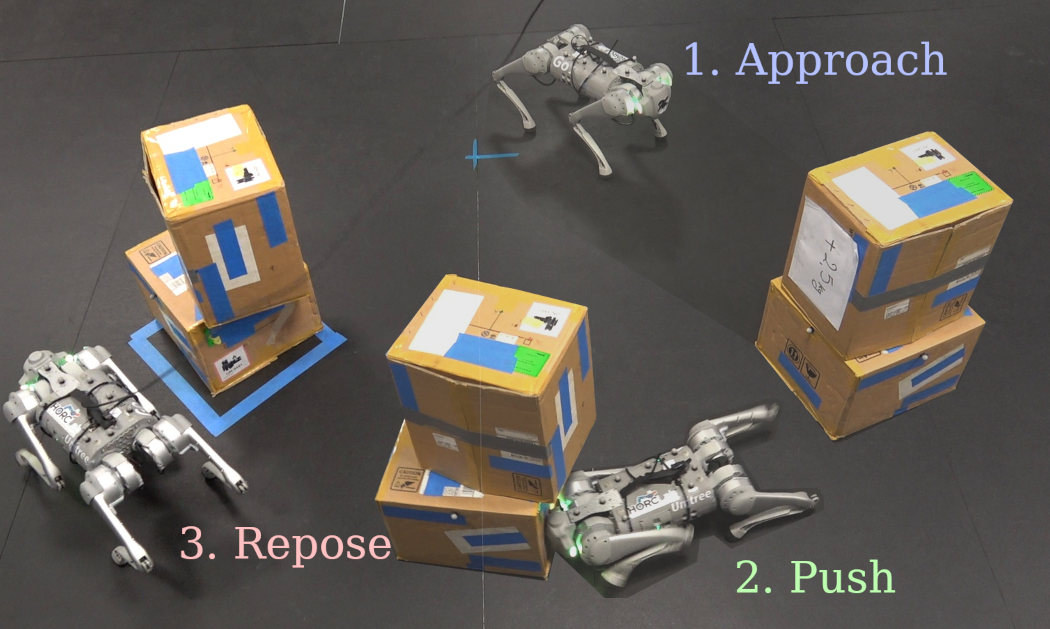
SOMA presents a hierarchical reinforcement learning framework for whole-body non-prehensile manipulation of multi-object stacks using a quadruped robot. It integrates explicit base-height control and a Simplified Structured State Space Sequence encoder for long-horizon reasoning, achieving up to 90.1% success on dynamic two-box stacks and validating zero-shot sim-to-real transfer on a Unitree Go1.
中文摘要: SOMA 提出了一种分层强化学习框架,用于四足机器人对多物体堆叠进行全身非抓取操作。与仅限二维平面推动的传统方法不同,SOMA 集成了显式的机器人基座高度控制,实现了全三维推动策略。该架构将控制分解为高层操作策略和低层运动策略:高层策略使用简化结构化状态空间序列(S5)编码器推理长时程历史,并通过 Beta 分布预测有界目标跟踪命令;低层策略动态调整腿部站立配置。在严格误差容限(位置误差 0.05 m,方向误差 1°)下,SOMA 在单物体复位任务中达到 90.3% 成功率,在动态双箱堆叠任务中达到 90.1%。最后,在 Unitree Go1 四足机器人上实现了零样本仿真到现实迁移,验证了不同负载质量和几何形状下的主动基座高度调整能力。
💬 This work advances quadruped whole-body manipulation by enabling 3D pushing of stacked objects with base-height control and demonstrates successful sim-to-real transfer, highly relevant for modular legged robots requiring versatile manipulation.
💬 该工作通过基座高度控制实现了堆叠物体的三维推动,并成功实现了仿真到现实的迁移,对于需要多样化操作能力的模块化腿式机器人具有高度相关性。
Why read it / 推荐理由: It provides a novel hierarchical RL approach for quadruped manipulation that could inspire whole-body control strategies in modular legged robots. 它提供了一种新颖的分层强化学习方法用于四足操作,可能为模块化腿式机器人的全身控制策略提供灵感。
2. LEAP: Gradient Flow Augmented Lagrangian Trajectory Optimization for Contact Constrained Robots
LEAP:用于接触约束机器人的梯度流增广拉格朗日轨迹优化
Authors / 作者: César E. Ramos Chuquiure, Ryan Tsai, Yutong Zhou, Zihang Huang, Vansh Thakur, Akshunn Trivedi et al.
arXiv: 2610.20936 · PDF
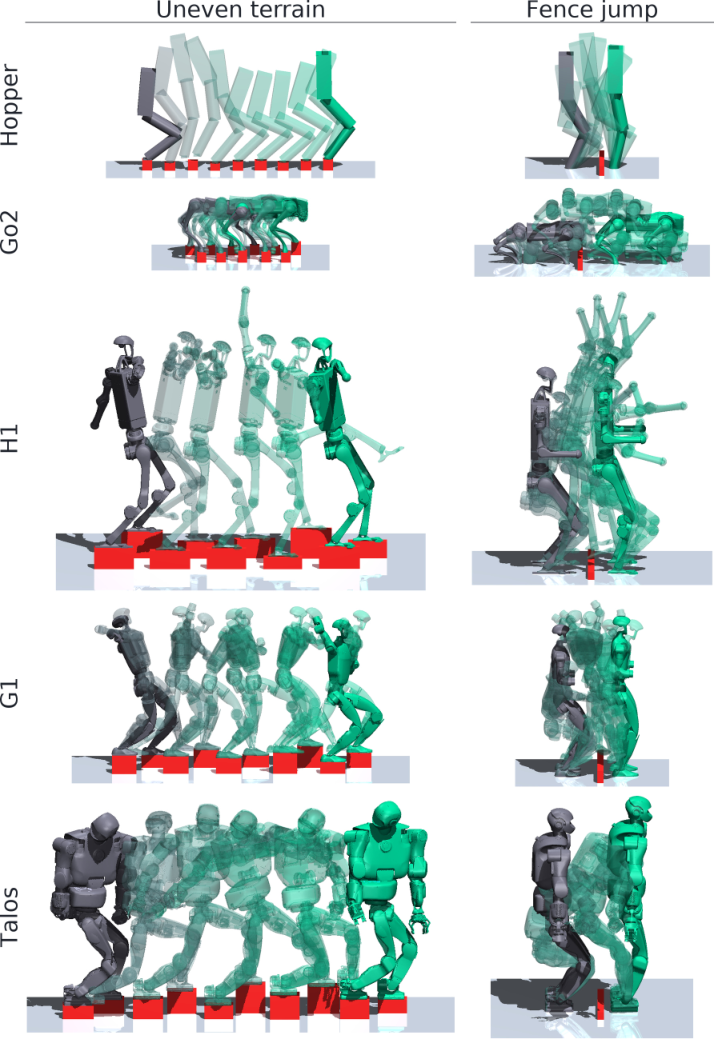
LEAP introduces a trajectory optimization method using pseudospectral collocation and a primal-dual gradient flow of an augmented Lagrangian, avoiding traditional Newton or SQP solves. It successfully solves all tested locomotion benchmarks on five robot platforms, including 32-joint humanoids, with substantial speedups over Crocoddyl and Aligator, and validates trajectories on hardware.
中文摘要: LEAP 提出了一种用于腿式与操作机器人的轨迹优化方法,通过伪谱配点法转录最优控制问题,并采用增广拉格朗日的原始-对偶梯度流代替牛顿或 SQP 求解。由于梯度流具有刚性,设计了带高斯-牛顿度量、动量和基于优值的步长控制器的线性隐式积分器,保持增广拉格朗日单调。在五个机器人平台(从平面跳跃者到 32 自由度人形机器人)的运动基准测试中,LEAP 是唯一能求解所有测试问题的方法,在多个基准上相比 Crocoddyl 和 Aligator 实现显著加速,并在更小计算预算下达到可跟踪参考轨迹。生成轨迹通过高保真仿真和硬件跟踪验证。
💬 LEAP addresses scalability and robustness in contact-constrained trajectory optimization, directly applicable to modular legged robots with many joints and complex contact dynamics.
💬 LEAP 解决了接触约束轨迹优化中的可扩展性和鲁棒性问题,直接适用于具有多关节和复杂接触动力学的模块化腿式机器人。
Why read it / 推荐理由: Its novel optimization technique could enable real-time MPC for modular legged robots with high degrees of freedom and contact constraints. 其新颖的优化技术可为具有高自由度和接触约束的模块化腿式机器人实现实时模型预测控制。
3. CQDC-Warp: GPU-Accelerated Differentiable Quasi-Dynamic Simulation for Contact-Rich Manipulation
CQDC-Warp:用于接触丰富操作的 GPU 加速可微分准动态仿真
Authors / 作者: Yanchen Ding, Jiayi Chen, Jianfeng Xu, Wei Zhao, Li Yi, He Wang
arXiv: 2610.21349 · PDF
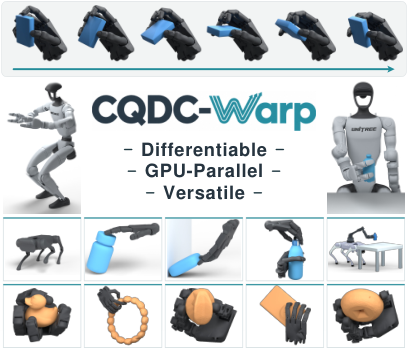
CQDC-Warp presents a GPU-accelerated differentiable quasi-dynamic simulator for batched model predictive control, achieving 79.8% success on Allegro in-hand rotation benchmark and reducing trajectory generation time by up to 50.2x compared to baselines. It enables contact-guided trajectory optimization without prescribed contact schedules and validates real-world replay on a Sharpa hand.
中文摘要: CQDC-Warp 提出了一种用于批量模型预测控制的 GPU 加速可微分准动态仿真器,用于接触丰富操作轨迹的合成。该方法在规划前指定预期的机器人-物体接触,并通过软成本鼓励,而模拟动力学确定接触几何和摩擦响应,无需预设接触模式计划。在 Allegro 手内旋转基准的 17,408 次试验中,框架达到 79.8% 成功率,优于 CFree 的 73.7% 和 IMPACT 的 65.2%,并将平均轨迹生成时间分别减少了 27.0 倍和 50.2 倍。在单个 NVIDIA RTX 4090 上,2048 个并行世界的前向和反向吞吐量分别达到 2.06e5 和 2.25e5 世界步/秒。实验还涵盖 LEAP 和 Shadow 手操作、环境接触利用、双臂操作、全身控制以及 Sharpa 手上的真实世界轨迹回放。
💬 The GPU-accelerated differentiable simulation enables fast MPC for contact-rich tasks, with potential to enhance sim-to-real transfer in modular legged robots through efficient contact handling.
💬 GPU 加速的可微分仿真为接触丰富任务实现了快速模型预测控制,通过高效接触处理有可能增强模块化腿式机器人的仿真到现实迁移。
Why read it / 推荐理由: It offers a high-throughput differentiable simulator that could accelerate MPC and RL training for modular legged robots with contact-rich locomotion. 它提供了高吞吐量的可微分仿真器,可加速接触丰富运动的模块化腿式机器人的模型预测控制和强化学习训练。
4. Inertially Significant Humanoid Teleoperation via Whole Body Model Predictive Control and Online Parameter Estimation
通过全身模型预测控制和在线参数估计实现惯性显著的人形机器人遥操作
Authors / 作者: James Foster, Beomyeong Park, Luigi Penco, Robert Griffin
arXiv: 2610.22176 · PDF
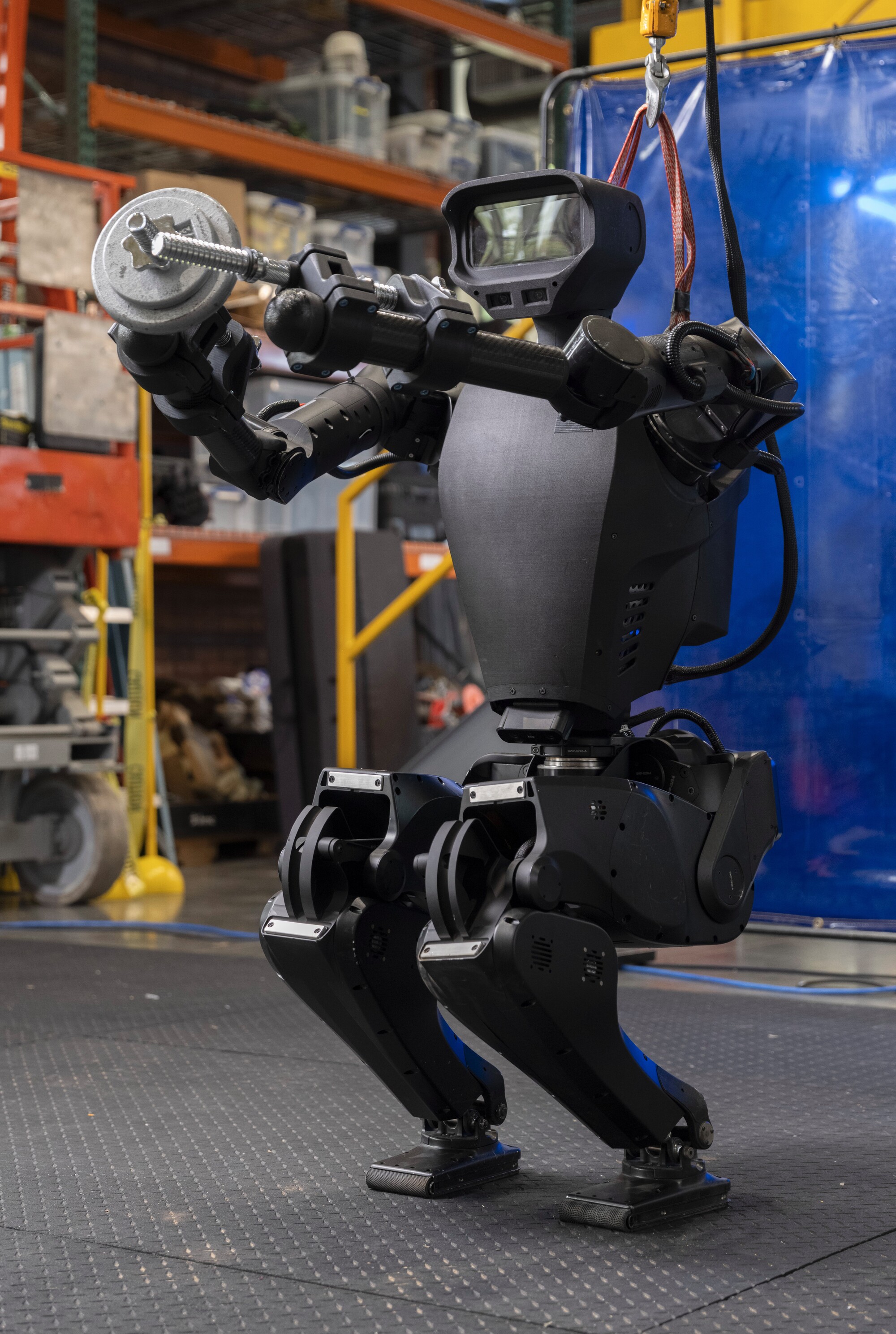
This paper integrates a whole-body model predictive controller (WB-MPC) with an extended Kalman filter for online estimation of time-varying inertial parameters, enabling humanoid robots to handle heavy payloads with accurate feedforward torques. A VR interface allows operators to provide task references while the WB-MPC ensures dynamic balance, validated in simulation and hardware experiments.
中文摘要: 本文提出了一种将全身模型预测控制器(WB-MPC)与扩展卡尔曼滤波器相结合的方法,用于在线估计完全物理一致的时变惯性参数。这些估计值被馈送到 WB-MPC 的完整刚体动力学模型中,从而在外部负载下为任务需求提供更准确的前馈力矩。此外,提供了虚拟现实(VR)界面,使操作员能够提供任务特定参考,而无需考虑负载,将动态平衡委托给 WB-MPC。该框架在人形机器人系统上通过仿真和硬件实验进行了验证。
💬 The integration of online inertia estimation with WB-MPC enhances adaptability to payload variations, a key challenge for modular legged robots that may reconfigure or carry objects.
💬 将在线惯性估计与全身模型预测控制相结合,增强了对负载变化的适应性,这是模块化腿式机器人可能重构或携带物体时面临的关键挑战。
Why read it / 推荐理由: It demonstrates a robust WB-MPC approach with online parameter estimation that could be adapted for modular legged robots dealing with changing dynamics. 它展示了一种带有在线参数估计的鲁棒全身模型预测控制方法,可适用于处理动态变化的模块化腿式机器人。
5. Planning to Learn: Real-Time Robust Adaptive Control on the GPU with Guaranteed Future Learning
规划以学习:在 GPU 上实现具有保证未来学习的实时鲁棒自适应控制
Authors / 作者: Anutam Srinivasan, Siddhant Panse, Glen Chou
arXiv: 2610.20925 · PDF
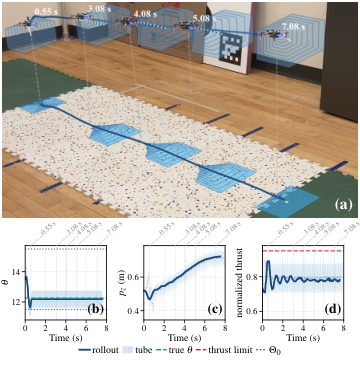
A-SLS is a learning-aware robust adaptive model predictive control framework based on system-level synthesis that forecasts future parameter uncertainty to construct tight reachable sets, reducing conservativeness. It scales to whole-body control for a quadruped with 61 states and 8 uncertain parameters, and is demonstrated on hardware with a Crazyflie drone learning online.
中文摘要: 本文提出了 A-SLS,一种基于系统级综合的学习感知鲁棒自适应模型预测控制(RAMPC)框架。A-SLS 预测未来参数不确定性,并保留过程扰动、参数误差和估计更新之间的相关性,以构建考虑未来信息增益的紧致可达集。开发了 GPU 加速的 A-SLS 求解器以实现实时性能。在非线性机器人系统上,A-SLS 减少了可达管保守性,保持实时性能,并可扩展到具有 61 个状态、8 个不确定参数和 12 个控制输入的四足机器人全身控制。进一步在硬件上演示,物理 Crazyflie 无人机在线学习不确定动力学参数以稳定飞行。
💬 A-SLS provides a computationally efficient RAMPC with guaranteed learning, relevant for modular legged robots that must adapt online to changing dynamics such as leg reconfiguration or payload shifts.
💬 A-SLS 提供了一种具有保证学习的计算高效鲁棒自适应模型预测控制,适用于必须在线适应动态变化(如腿重构或负载转移)的模块化腿式机器人。
Why read it / 推荐理由: It introduces a real-time adaptive MPC that explicitly accounts for future learning, useful for modular legged robots operating in uncertain environments. 它引入了一种实时自适应模型预测控制,明确考虑未来学习,适用于在不确定环境中运行的模块化腿式机器人。