机器人日报
机器人论文日报 — 2026-10-15
🤖 Scanned 427 papers from today’s arXiv announcement (cs.RO / eess.SY / cs.LG), picked 5 for modular & legged robotics — summarized by DeepSeek.
🤖 从今日 arXiv 新论文(cs.RO / eess.SY / cs.LG)中扫描 427 篇,围绕模块化与足式机器人精选 5 篇 — 由 DeepSeek 生成双语摘要。
1. PolyMorph: Learning Locomotion Policy for Cross-Embodiment Adaptation
PolyMorph:面向跨本体适应性的运动策略学习
Authors / 作者: Hyunsik Oh, Seunghun Jeon, Donghoon Youm, Jungwoo Hur, Hyeongjun Kim, Jeong Hyun Lee et al.
arXiv: 2610.19615 · PDF
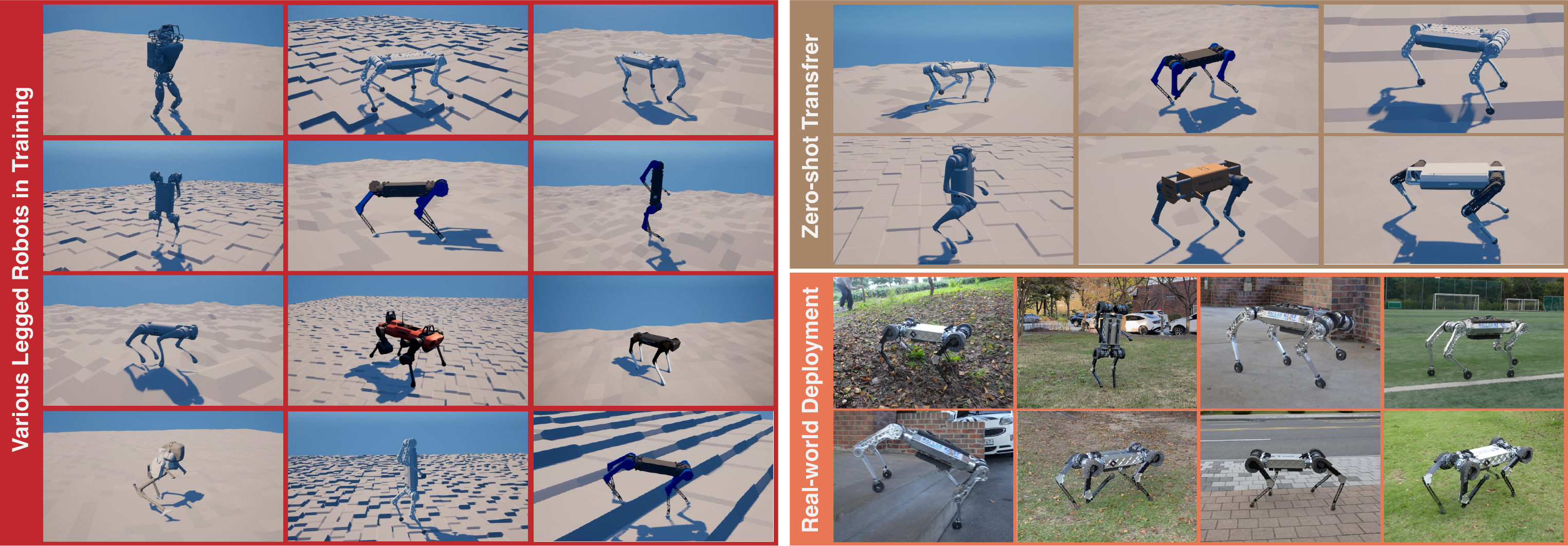
PolyMorph learns a single morphology-conditioned locomotion policy for heterogeneous legged robots by decomposing each URDF into joint-link modules and combining a recurrent encoder, graph-based Transformer, and per-joint decoder. Morphology-normalized rewards, adaptive robot sampling, and URDF-derived PD-gain initialization improve training stability, and one policy generalizes to bipedal, tripedal, and quadrupedal robots, including unseen morphologies and real quadruped platforms in multiple configurations without retraining.
中文摘要: PolyMorph提出一种以形态为条件的学习框架,用单一策略驱动异构腿式机器人。该方法将每个机器人的URDF解析为关节-连杆模块,结合循环编码器、图结构Transformer和逐关节解码器,生成适应不同腿数与关节配置的动作。为提高训练稳定性,作者引入形态归一化奖励、自适应机器人采样以及基于URDF的PD增益初始化。在仿真中,该方法覆盖双足、三足和四足机器人及未见形态变体,并部署于多种配置的真实四足平台;结果表明单一策略无需按机器人重新训练即可跨本体泛化,对可重构模块化腿式机器人设计具有直接参考价值。
💬 Directly tackles morphology-conditioned control for variable leg counts and joint configurations, the core problem of modular legged robots, with real quadruped deployment.
💬 该工作直接解决可变腿数与关节构型下的形态条件控制这一模块化腿式机器人核心问题,并完成了真实四足平台部署。
Why read it / 推荐理由: It offers a concrete recipe for one policy generalizing across reconfigurable leg modules, which is central to Changda’s modular legged robot research. 它给出了一套单一策略跨可重构腿模块泛化的具体方案,对Changda的模块化腿式机器人研究高度相关。
2. E2DRL: End-to-End Differentiable Reinforcement Learning for 3D Obstacle Avoidance in Quadruped Robots
E2DRL:面向四足机器人三维避障的端到端可微强化学习
Authors / 作者: Cheng Fan, Bingyang Zhou, Gang Yang, Zixuan Zhuang, Aoqian Zhang, Pengzhi Yang et al.
arXiv: 2610.19627 · PDF
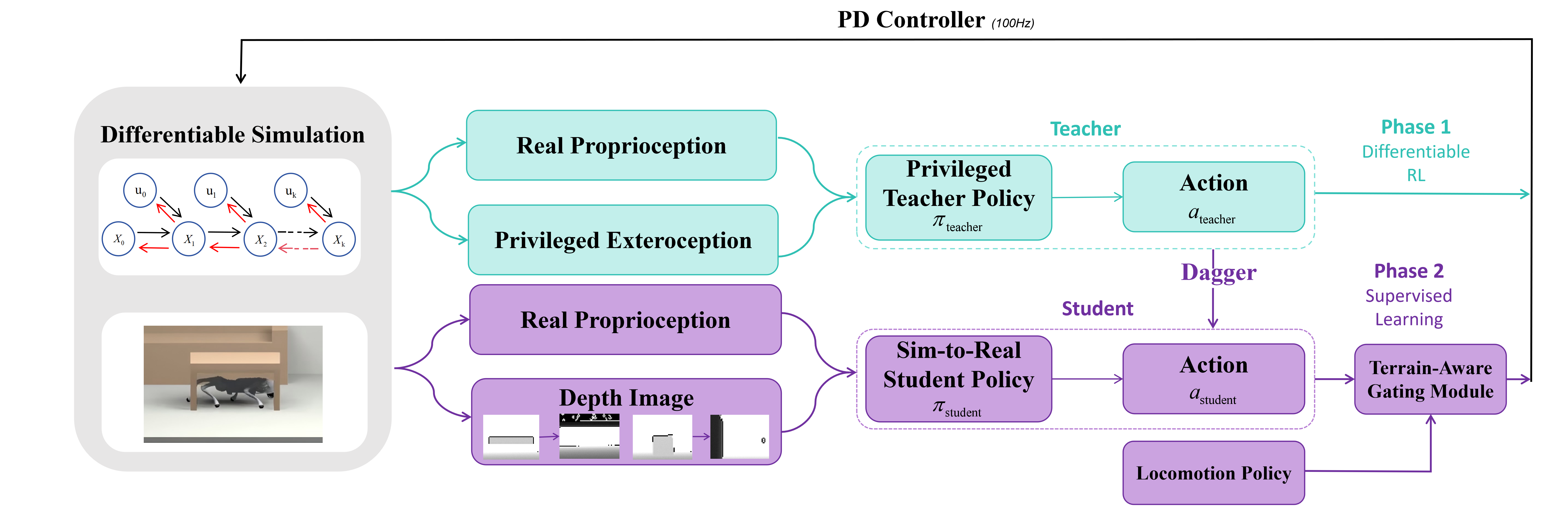
E2DRL extends differentiable reinforcement learning to end-to-end visual 3D obstacle avoidance for quadrupeds by using a soft differentiable obstacle-interaction formulation with multi-keypoint penetration penalties and velocity-conditioned stop-gradient shaping to avoid gradient corruption from hard collisions. A privileged teacher trained with Soft Analytic Policy Optimization in a differentiable simulator is distilled via DAgger into a recurrent depth-based student and blended with a base locomotion policy through terrain-aware gating, achieving higher sample efficiency than PPO and the first sim-to-real validation of this approach on a Unitree Go2.
中文摘要: E2DRL将可微强化学习扩展到四足机器人的端到端视觉三维避障。针对硬碰撞约束与提前终止破坏一阶梯度的问题,作者提出软可微障碍交互形式,采用多身体关键点穿透惩罚和速度条件化的停止梯度塑形来提供一阶训练信号。系统将可微仿真器中以SAPO训练的教师策略经DAgger蒸馏为基于深度图的循环学生策略,再通过地形感知门控与基础运动策略融合部署。仿真中样本效率高于PPO,并首次在Unitree Go2上完成该范式的仿真到现实三维避障验证。
💬 A convincing sim-to-real demonstration that gradients through soft obstacle contact can train visual quadruped avoidance better than PPO and DCBF-NMPC.
💬 该工作有说服力地证明,通过软障碍接触的梯度训练可使四足视觉避障优于PPO与DCBF-NMPC,并完成实机验证。
Why read it / 推荐理由: It shows how differentiable simulation can be pushed from blind walking to real-world visual obstacle avoidance, a useful sim-to-real template. 它展示了可微仿真如何从盲走扩展到真实视觉避障,是值得借鉴的仿真到现实范本。
3. Safe Reinforcement Learning with Receding-Horizon Safety Critic and Differentiable Action Shields
基于滚动时域安全评论家与可微动作护盾的安全强化学习
Authors / 作者: Siwei Ju, Jan Peters, Oleg Arenz
arXiv: 2610.20255 · PDF
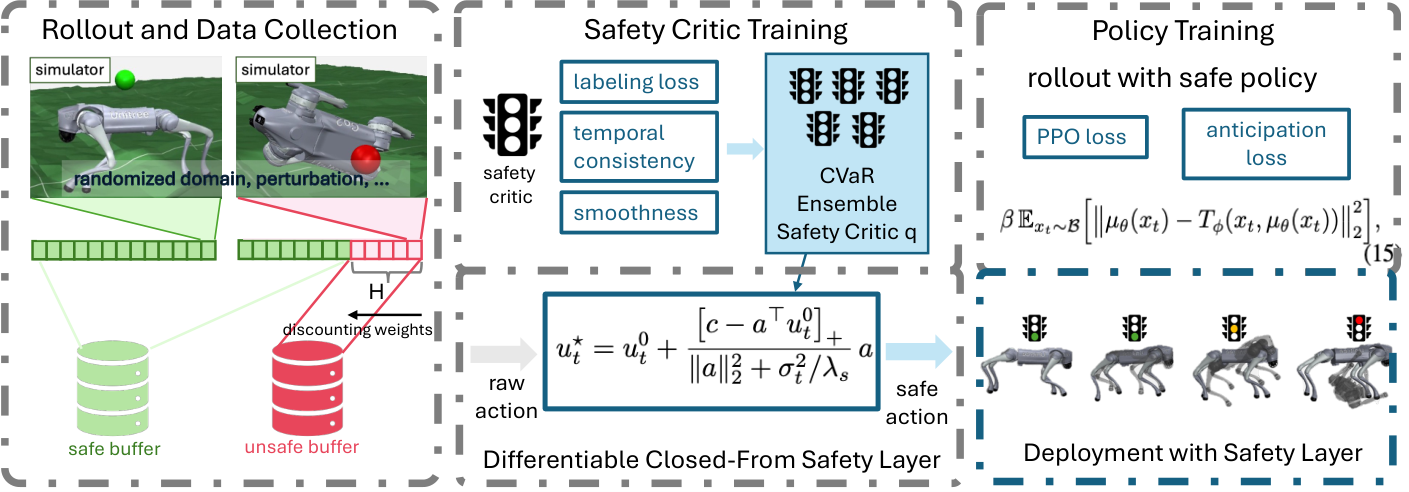
This work learns a receding-horizon safety critic that predicts whether a state will remain non-terminating over a future horizon, trained with horizon classification, CBF-inspired temporal consistency, and smoothness regularization, and aggregated with a conservative CVaR ensemble. From the critic, the authors derive a closed-form differentiable CBF-style safety filter that minimally modifies policy actions, integrated into PPO with an anticipation loss; in simulated quadruped locomotion it reduces catastrophic failures under action noise, perturbations, and terrain shifts while keeping competitive returns.
中文摘要: 该论文学习一种滚动时域安全评论家,用于预测当前状态在未来时域内是否保持非终止,其训练目标融合时域分类、受控制屏障函数启发的时序一致性和平滑正则,并用条件风险价值(CVaR)对评论家集成进行保守聚合。基于该评论家可导出闭式可微的CBF式安全滤波器,以最小幅度修正策略动作,并通过预期损失与PPO联合训练以缓解策略-滤波器失配。在仿真四足运动中,该方法在动作噪声、外部扰动和地形变化下显著减少灾难性失败,同时保持有竞争力的回报,为腿式运动的滚动时域安全控制提供了新思路。
💬 Horizon-based safety critic plus differentiable shield is a practical way to add certified-style safety to RL locomotion without sacrificing agile returns.
💬 基于时域的安全评论家与可微护盾为RL腿式运动提供了一种在不牺牲敏捷回报前提下引入类认证安全的实用途径。
Why read it / 推荐理由: It addresses anticipatory failure prediction and minimal-action shielding, both directly applicable to robust legged locomotion and sim-to-real safety. 它处理了预见性失效预测与最小动作修正护盾,可直接用于鲁棒腿式运动与仿真到现实安全性。
4. Contact-UAN: Unsupervised Actuator Networks as a Residual World Model for Humanoid Control
Contact-UAN:作为人形控制残差世界模型的无监督执行器网络
Authors / 作者: Nolan Fey, Khai Nguyen, Yash Prabhu, Gabriel B. Margolis, Pulkit Agrawal
arXiv: 2610.18991 · PDF
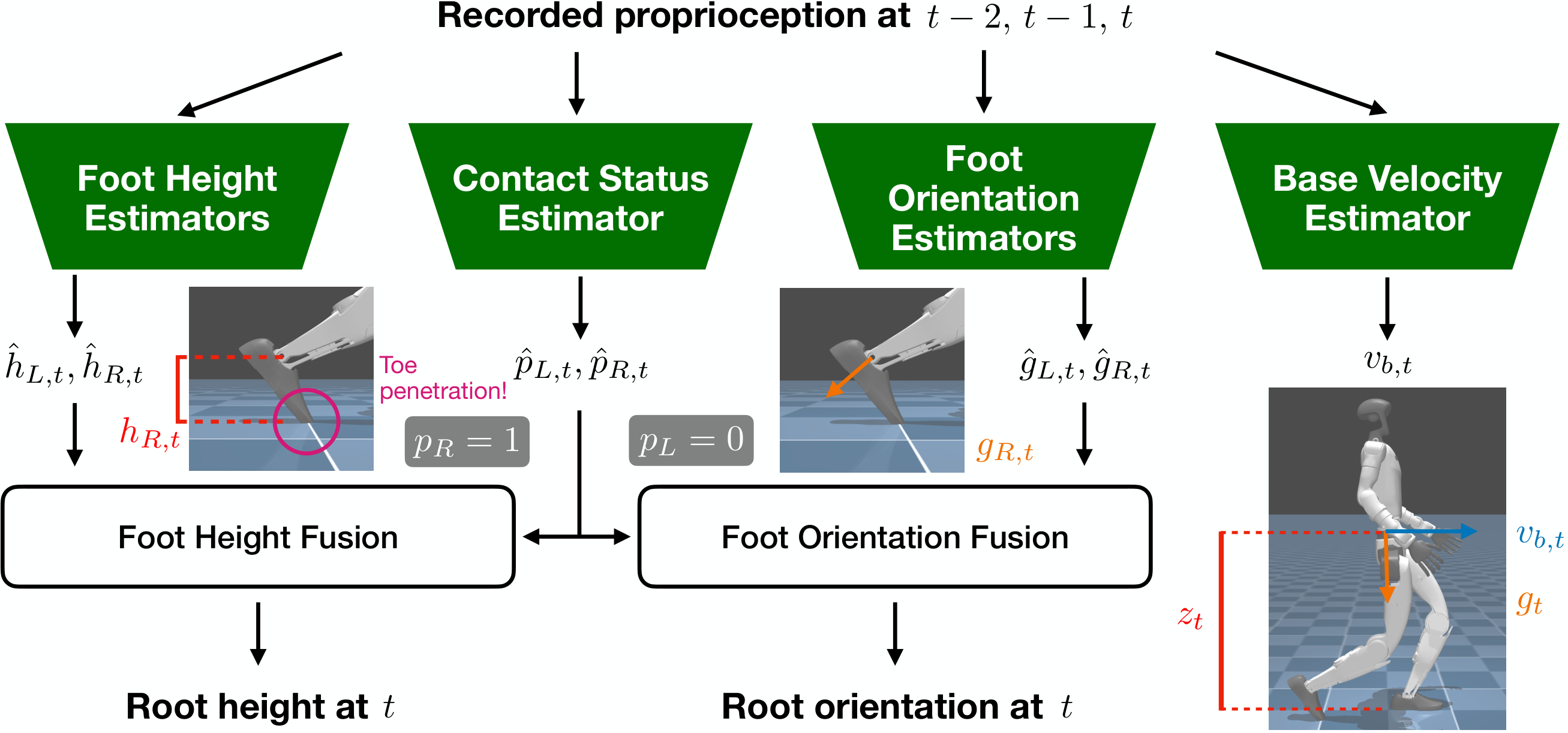
Contact-UAN corrects actuator sim-to-real gaps by learning a residual world model on top of the simulator’s physics priors, using contact-consistent replay so the model corrects actuator dynamics rather than reset artifacts, and inferring simulator-side stance-foot pose from onboard proprioception. Trained on only 6.5 minutes of real walking data, it yields policies that transfer to hardware with 20% lower running torque, 43% lower force-tracking error, improved compliance and impedance control, and robust dynamic jumps.
中文摘要: Contact-UAN通过仿真器物理先验之上的残差世界模型来修正执行器仿真到现实差距。为处理接触一致的训练回放,作者从机载本体感知推断仿真侧支撑足位姿,使残差模型学习执行器动态而非重置伪影。仅用6.5分钟真实行走数据训练的UAN即可泛化到需要精确力与冲量调节的任务,使策略无缝迁移到真实机器人,实现跑步扭矩降低20%、力跟踪误差降低43%,并支持极端顺应、精确阻抗控制与动态鲁棒跳跃。
💬 Contact-aware residual actuator modeling elegantly targets the force-level sim-to-real gap that limits torque efficiency and impact robustness in legged control.
💬 接触感知的执行器残差建模巧妙地针对限制腿式控制扭矩效率与抗冲击能力的力级仿真到现实差距。
Why read it / 推荐理由: It provides a data-efficient residual world-model recipe for contact-consistent sim-to-real transfer, valuable for whole-body leg control. 它提供了数据高效且接触一致的残差世界模型仿真到现实迁移方案,对全身腿部控制很有价值。
5. Beyond Kinematic Tracking: Preserving Expressive Characteristics in Humanoid Whole-Body Control
超越运动学跟踪:在人形全身控制中保持表现性特征
Authors / 作者: Lingfan Bao, Hanshang Zhu, Yan Pan, Jincheng Wang, Jingyang Yu, Tianhu Peng et al.
arXiv: 2610.19393 · PDF
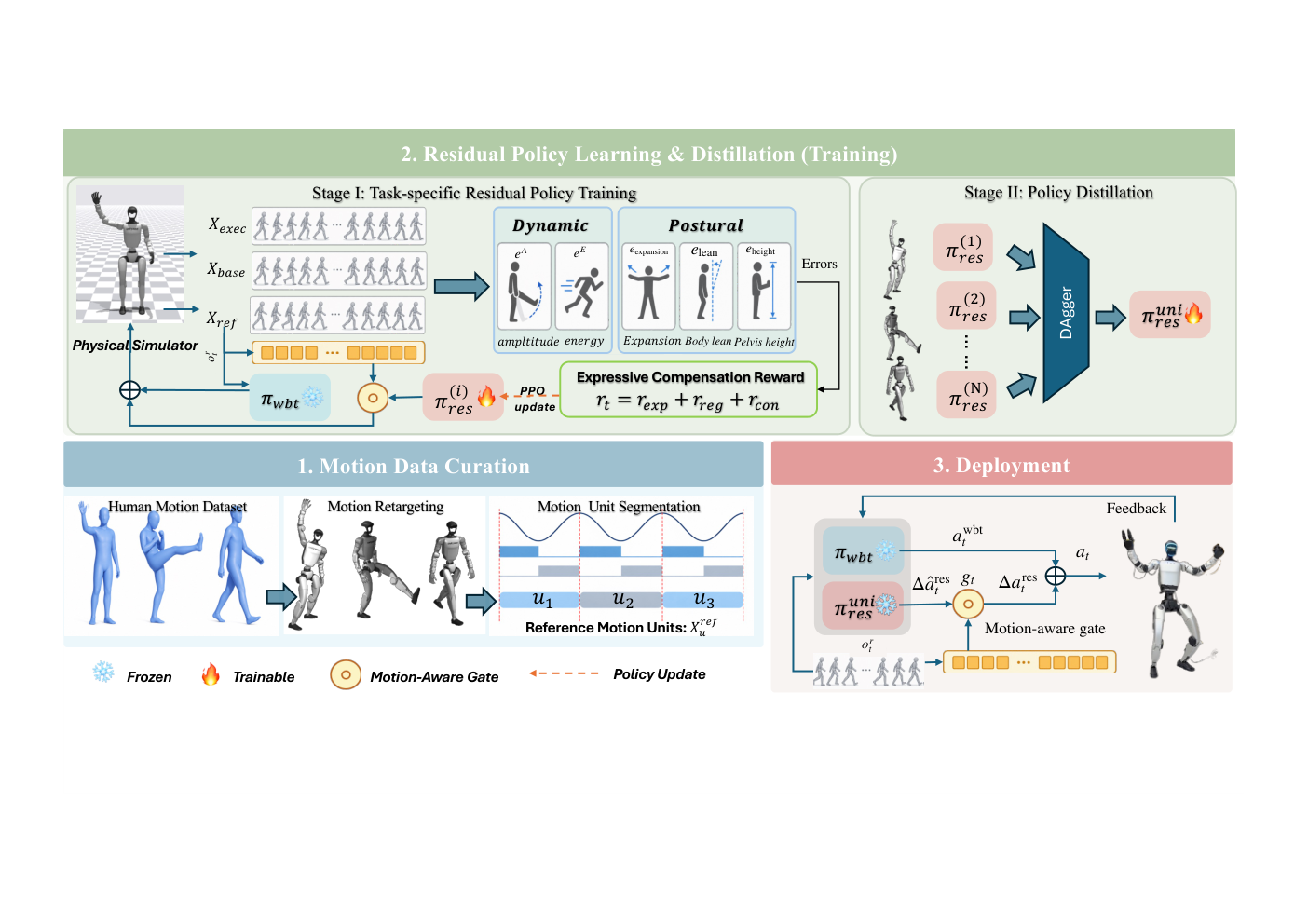
The paper shows that lower positional tracking error does not imply better preservation of motion expressiveness, and proposes a residual learning framework whose compensation objectives target amplitude, energy, body expansion, body lean, and pelvis height. Motion-aware gating allocates correction capacity to active body parts, and per-motion residual policies are distilled into a unified policy; experiments on the Unitree G1 across eight motion categories show better preservation of dynamic and postural characteristics than standard whole-body tracking baselines.
中文摘要: 论文指出平均位置跟踪误差低并不保证更好地保持动作的表现性特征,为此提出一种残差学习框架,其补偿目标针对运动幅度、能量、身体舒展度、身体倾斜与骨盆高度。运动感知门控根据身体部位活跃度分配修正能力,在活跃部位保留较大修正范围,并在其他部位加以限制。作者为冻结的跟踪器训练特定动作的残差策略,并蒸馏为跨动作类别的统一策略。在Unitree G1上的仿真与物理实验表明,该方法在八类动作上比基线更好地保持动态与姿态特征,为全身控制引入运动学跟踪之外的评价与优化维度。
💬 Reframes whole-body control objectives beyond joint tracking, showing residual, motion-aware gating can preserve expressive dynamics without sacrificing stability.
💬 该工作将全身控制目标从关节跟踪重新扩展,证明残差式运动感知门控可在不牺牲稳定性的前提下保持表现性动态。
Why read it / 推荐理由: It offers a residual whole-body control architecture and expressive metrics that generalize to modular and reconfigurable legged platforms. 它提出的残差全身控制架构与表现性指标可推广至模块化与可重构腿式平台。