机器人日报
机器人论文日报 — 2026-10-11
🤖 Scanned 39 papers from the last 3 days of arXiv announcements (cs.RO / eess.SY / cs.LG), picked 5 for modular & legged robotics — summarized by DeepSeek.
🤖 从近 3 天的 arXiv 新论文(cs.RO / eess.SY / cs.LG)中扫描 39 篇,围绕模块化与足式机器人精选 5 篇 — 由 DeepSeek 生成双语摘要。
1. Informationally Decoupled Trajectory Design for Sim-to-Real System Identification
面向Sim-to-Real系统辨识的信息解耦轨迹设计
Authors / 作者: Sangwoo Shin, Ashvin Anilkumar, Ryan Gao, Josiah P. Hanna
arXiv: 2610.10905 · PDF
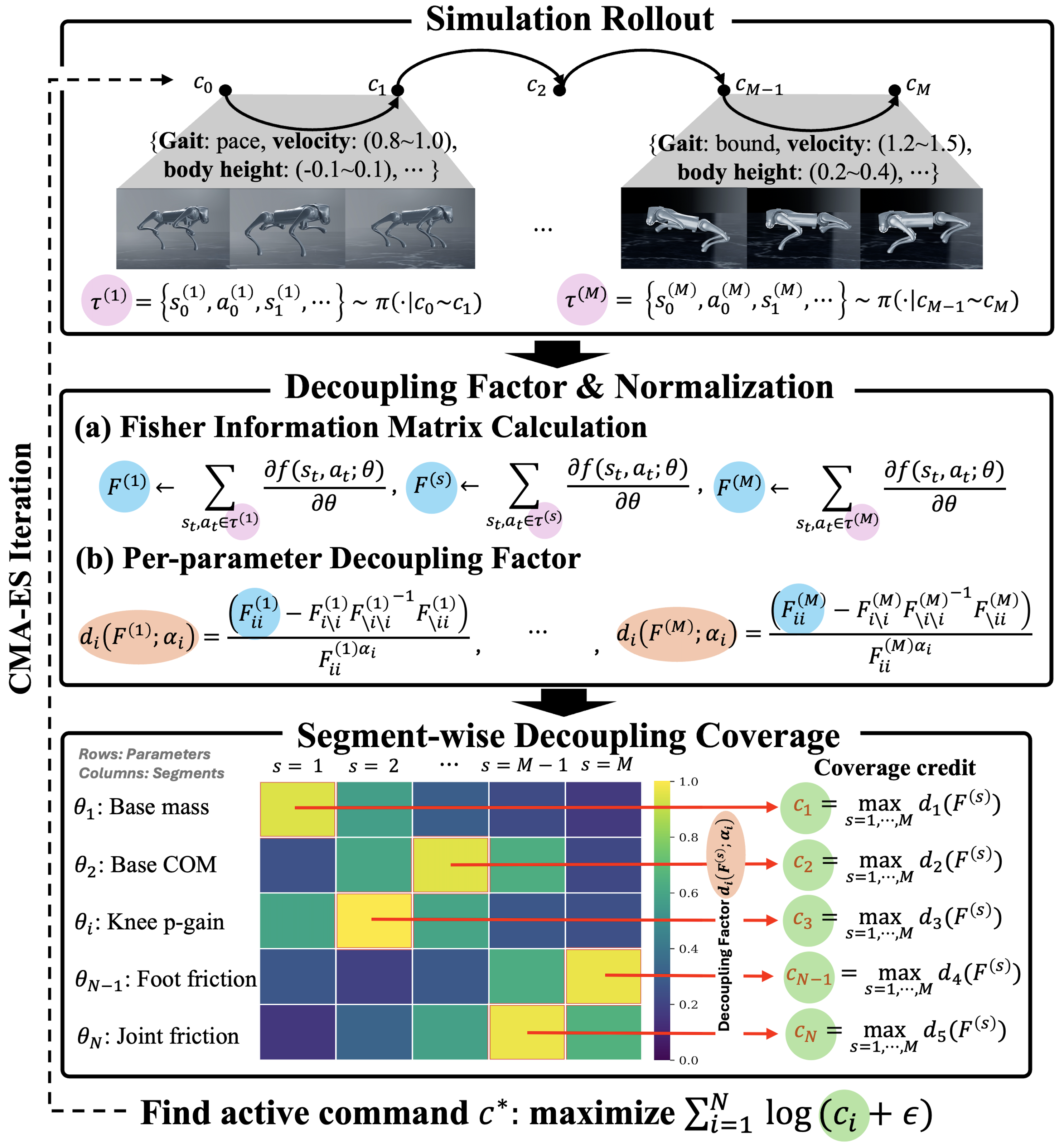
The paper introduces Informationally Decoupled Trajectory Design (IDTD), which optimizes exploration trajectories using the Schur complement of the Fisher information matrix to decouple the effects of individual dynamic parameters. It normalizes the score, selects per-parameter trajectory segments, and aggregates them logarithmically, yielding trajectories that unambiguously expose distinct parameter subsets. Evaluated on a linear system, Go2 quadruped, G1 humanoid, and Crazyflie, IDTD reduces identification error by 39.6% on average compared to the strongest prior active exploration baseline.
中文摘要: 本文提出信息解耦轨迹设计框架 (IDTD),用于基于采样的系统辨识。该方法基于费舍尔信息矩阵的 Schur 补构建探索目标,并对分数进行逐参数归一化,为每个参数选择最有利的轨迹段,再以对数方式聚合,从而生成由互补区间构成的轨迹,使各区间上不同参数子集对运动的贡献可被唯一归因。在从线性动力学系统到 Go2 四足机器人、G1 人形机器人和 Crazyflie 四旋翼的多种仿真环境中,IDTD 相比最强主动探索基线平均降低参数辨识误差 39.6%,提升了 sim-to-real 迁移的可靠性。
💬 A principled information-theoretic approach to trajectory design that directly addresses parameter ambiguity in sim-to-real identification, with demonstrated gains on legged platforms.
💬 这是一种基于信息论原理的轨迹设计方法,直接解决 sim-to-real 辨识中的参数模糊性问题,并在腿式平台上展示了增益。
Why read it / 推荐理由: It offers a general, theoretically grounded method for generating informative trajectories that can be directly applied to modular legged robot system identification and sim-to-real transfer. 它提供了一种通用且有理论依据的信息轨迹生成方法,可直接应用于模块化腿式机器人系统辨识与 sim-to-real 迁移。
2. Walking on Roofs: Exploring the Potential of Walking Robots for Construction Work on Roofs
屋顶行走:探索步行机器人在屋顶施工中的潜力
Authors / 作者: Bjoern-Felix Dettmar, Arne Roennau
arXiv: 2610.12272 · PDF
This work presents the first systematic assessment of quadruped locomotion on sloped roof surfaces using a Unitree Go2 with standard ball feet. Experiments on a custom roof test rig show that slippage increases quadratically with incline, get-up/lie-down only works on small inclines, and critical failures occur at 25°. The study identifies task-specific foot design, advanced contact mechanics, and RL-based roof-adapted gaits as necessary future directions.
中文摘要: 本文首次系统评估了商用四足机器人 Unitree Go2 在斜坡屋顶环境中的运动能力。通过搭建专用屋顶测试平台,实验发现标准球形足端在斜坡上打滑随坡度二次方增加,起卧动作仅能在小坡度完成,25° 中等坡度即频繁出现严重失效。该研究为四足机器人在屋顶作业这一新场景提供了基线评估,并指出未来需结合任务专用足端设计、先进接触力学以及基于强化学习的屋顶自适应步态控制。
💬 A rare application-driven study that quantifies how standard quadruped hardware fails on sloped surfaces, motivating task-specific foot design and adaptive control.
💬 一项少见的应用驱动研究,定量揭示了标准四足硬件在斜坡上的失效模式,为任务专用足端设计与自适应控制提供了动机。
Why read it / 推荐理由: It provides empirical failure modes and design requirements for legged robots on sloped terrain, directly relevant to foot design and gait adaptation for modular legged platforms. 它提供了腿式机器人在斜坡地形上的实证失效模式与设计需求,与模块化腿式平台的足端设计和步态适应直接相关。
3. A Reconfigurable Fabric Based Pneumatic Actuator with Button Fastened Constraint Modules for Multi Mode Actuation
一种基于可重构织物的气动驱动器:采用按钮固定约束模块实现多模式驱动
Authors / 作者: Kentaro Kimura, Hiroki Ishizuka, Yusuke Sakaue, Sei Ikeda, Osamu Oshiro
arXiv: 2610.11054 · PDF
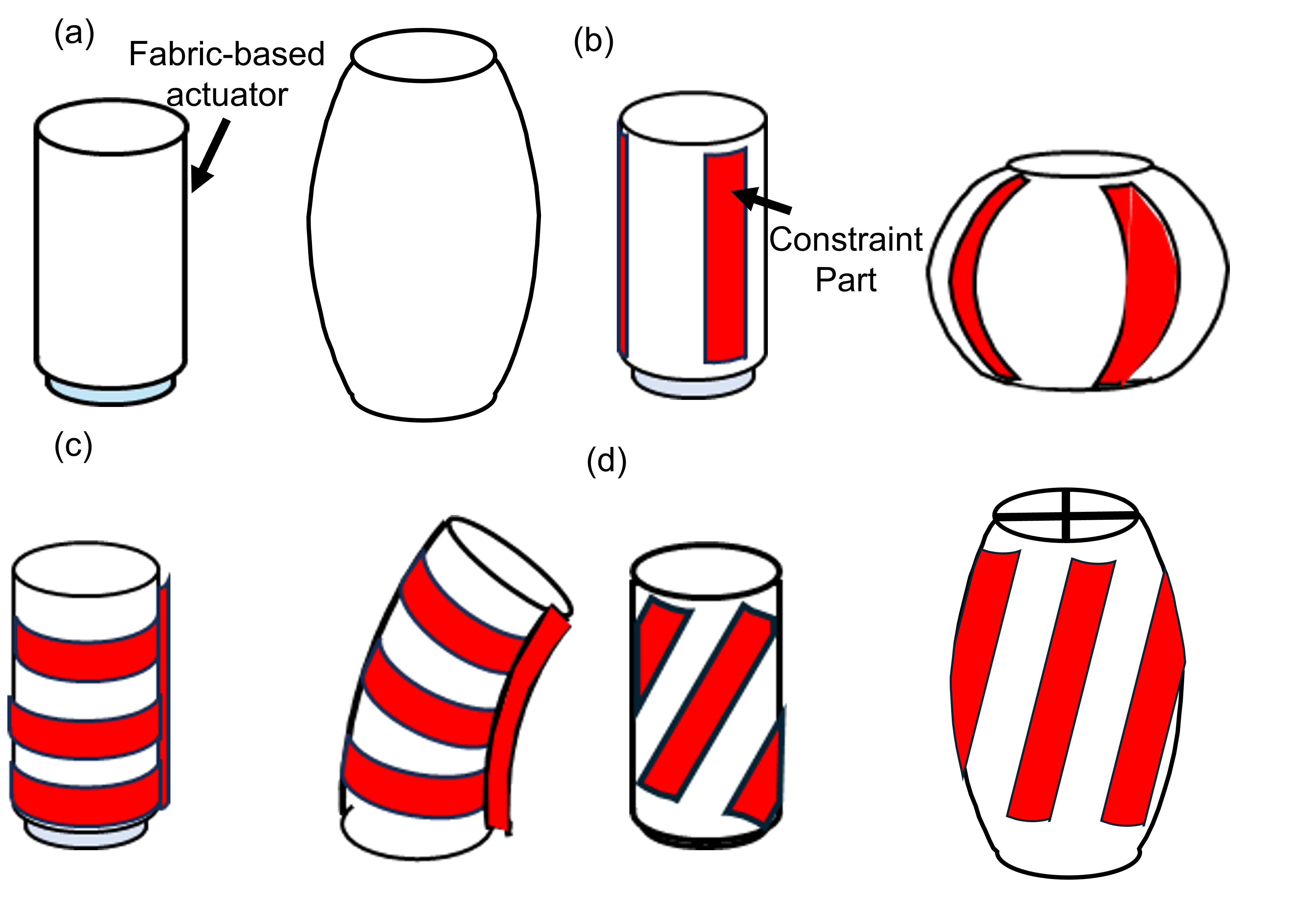
The paper presents a fabric-based pneumatic actuator that allows tool-free, reusable switching among four actuation modes—isotropic expansion, contraction, bending, and twisting—by attaching low-stretch constraint fabric modules to a buttoned textile sleeve. It also integrates an attachable capacitive tactile sensor for task-dependent contact sensing. Experiments show an elongation ratio of 1.2, bending of ~60°, twisting of ~90° at 24 kPa, blocking forces >10 N, and low-hysteresis tactile sensing (~12%).
中文摘要: 本文提出一种基于织物的可重构气动驱动器,通过将低拉伸约束织物模块以按钮方式附着在纺织套筒上,无需工具即可在等向膨胀、收缩、弯曲和扭转四种驱动模式间快速可逆切换。驱动器还可加装电容式织物触觉传感器以实现任务相关的接触感知。实验表明:伸长比 1.2,24 kPa 下最大弯曲角约 60°、扭转角约 90°,各模式阻塞力均超过 10 N;触觉传感器电容随力单调变化,迟滞约 12%,在预载下循环响应稳定。
💬 The button-fastened constraint modules enable rapid, reusable reconfiguration of actuation modes, offering a compelling design pattern for modular soft robots.
💬 按钮固定约束模块实现了驱动模式的快速可重用重构,为模块化软体机器人提供了一种极具吸引力的设计范式。
Why read it / 推荐理由: Its reconfigurable modular actuation concept and attachable tactile sensing can inspire the design of reconfigurable leg modules and contact-aware control in modular legged robots. 其可重构模块化驱动概念与可附着触觉感知可为模块化腿式机器人的可重构腿模块设计与接触感知控制提供启发。
4. VioLA: Learning Generalist Humanoid Control Policies from Human Data
VioLA:从人类数据学习通用人形机器人控制策略
Authors / 作者: Mert Albaba, Jens Beißwenger, Anna Manasyan, Daniel Marta, Michael J. Black, Wieland Brendel et al.
arXiv: 2610.12435 · PDF
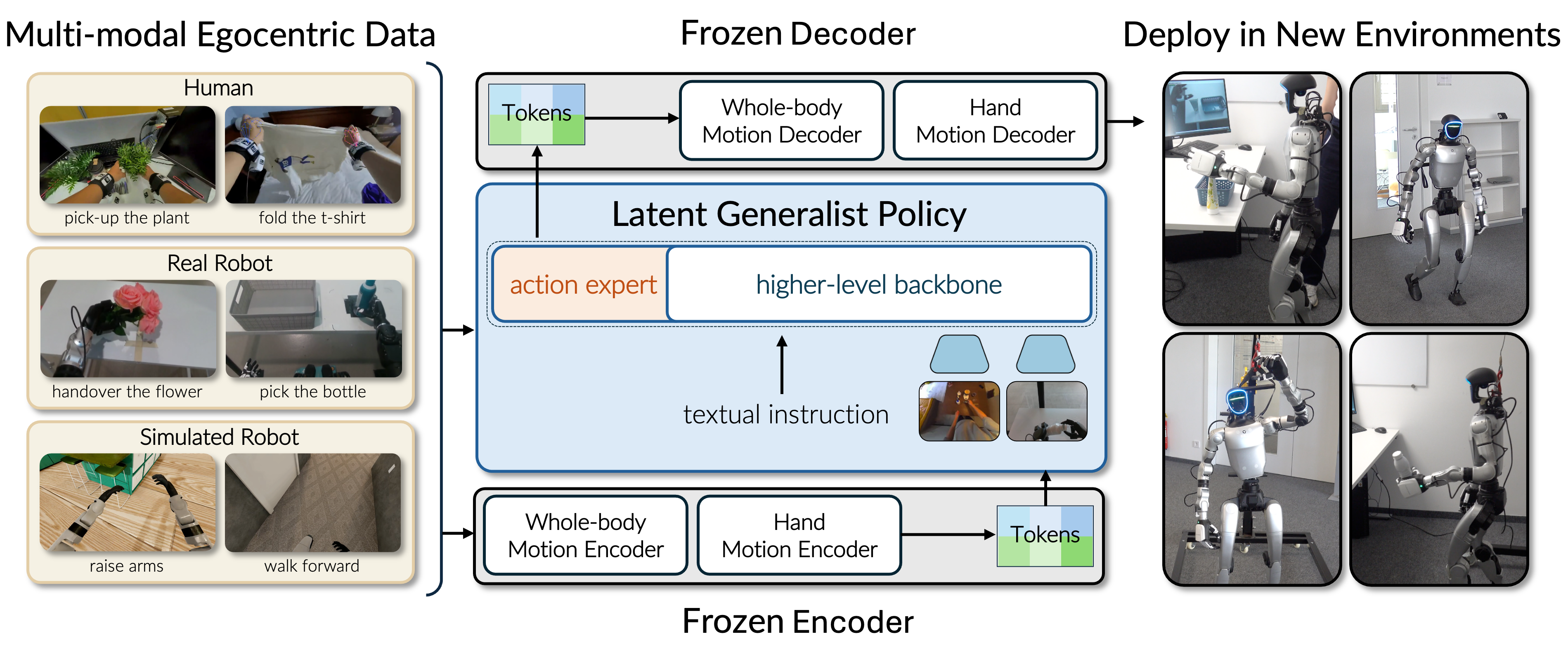
VioLA is a generalist humanoid policy that predicts body and hand motion latents rather than joint commands, executed by pretrained body/hand controllers whose motion encoders map human and robot motion into shared latent spaces. This allows training on 140.6 million frames, 93.2% human, enabling zero-shot instruction following on a real robot with 100% locomotion success versus 16.7% and 0% for GR00T N1.7 and Ψ₀, and 88.6% manipulation success without task-specific fine-tuning.
中文摘要: VioLA 是一种通用人形机器人策略,不直接预测关节指令,而是预测身体与手部运动潜变量,由预训练的身体/手部控制器执行,其运动编码器将人类与机器人运动映射到同一潜空间,从而使人类视频可直接作为策略动作空间的标注。训练数据达 1.406 亿帧,其中 93.2% 为人类数据。在真实机器人上,VioLA 无需任务微调即可零样本跟随运动指令,成功率 100%,而 GR00T N1.7 和 Ψ₀ 分别为 16.7% 和 0%;操作任务零样本成功率达 88.6%。
💬 A clean latent-action approach that leverages large-scale human motion to achieve strong zero-shot whole-body control, with impressive real-robot results.
💬 一种简洁的潜动作方法,利用大规模人类运动数据实现强大的零样本全身控制,并在真实机器人上取得令人印象深刻的成果。
Why read it / 推荐理由: The latent motion representation and human-to-robot transfer strategy offer a strong template for RL-based whole-body control and sim-to-real learning on modular legged robots. 其运动潜表征与人类到机器人的迁移策略为模块化腿式机器人的基于 RL 的全身控制与 sim-to-real 学习提供了有力范本。
5. Humanoid World Action Model With Joint State—Action Generation
联合状态-动作生成的人形世界动作模型
Authors / 作者: Yan Yang, Jikun Rong, Minzhao Zhu, Zheyi Zhao, Qirui Hu, Zihan Lan et al.
arXiv: 2610.12026 · PDF
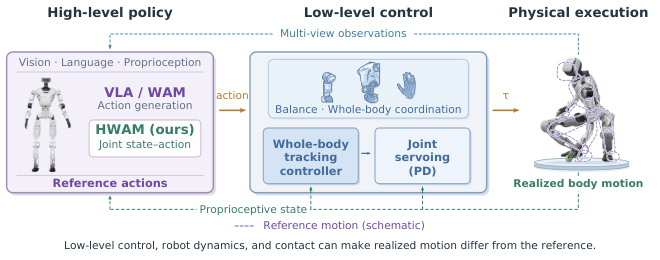
HWAM addresses the action–execution gap in hierarchical humanoid systems by making the post-execution proprioceptive state an explicit prediction target, jointly generating reference actions and realized body states. It is trained through three conditional paths—Policy, Forward Dynamics, and Inverse Dynamics—to incorporate execution supervision. This joint state–action generation provides a principled way to improve whole-body action learning and world-model-based control.
中文摘要: HWAM 针对分层人形系统中的“动作-执行鸿沟”问题,将机器人执行后的本体感知状态作为显式预测目标,联合生成参考动作与实际身体状态。模型通过策略路径、前向动力学路径和逆向动力学路径三种互补条件路径进行训练,将执行运动监督融入动作学习。这种联合状态-动作生成方式为改善全身动作学习和基于世界模型的控制提供了原理性方法。
💬 Explicitly modeling the executed state within a world-action model is a sensible way to bridge reference actions and real robot motion in hierarchical whole-body control.
💬 在世界动作模型中显式建模执行状态,是弥合分层全身控制中参考动作与真实机器人运动之间差距的合理思路。
Why read it / 推荐理由: The joint state–action generation and world-model formulation are directly applicable to MPC/WBC pipelines and RL-based motion control on legged and humanoid platforms. 其联合状态-动作生成与世界模型框架可直接应用于腿式与人形平台的 MPC/WBC 流程以及基于 RL 的运动控制。