机器人日报
机器人论文日报 — 2026-10-10
🤖 Scanned 80 papers from the last 3 days of arXiv announcements (cs.RO / eess.SY / cs.LG), picked 5 for modular & legged robotics — summarized by DeepSeek.
🤖 从近 3 天的 arXiv 新论文(cs.RO / eess.SY / cs.LG)中扫描 80 篇,围绕模块化与足式机器人精选 5 篇 — 由 DeepSeek 生成双语摘要。
1. HULK: Learning Whole-Body Forceful Loco-Manipulation for Humanoids
HULK:面向人形机器人的全身强力移动操作学习
Authors / 作者: An Dang, Arturo Flores Alvarez, Yu-Ming Chen, Conor Mc Gartoll, Helen Sun, Aaron Ames et al.
arXiv: 2610.08970 · PDF
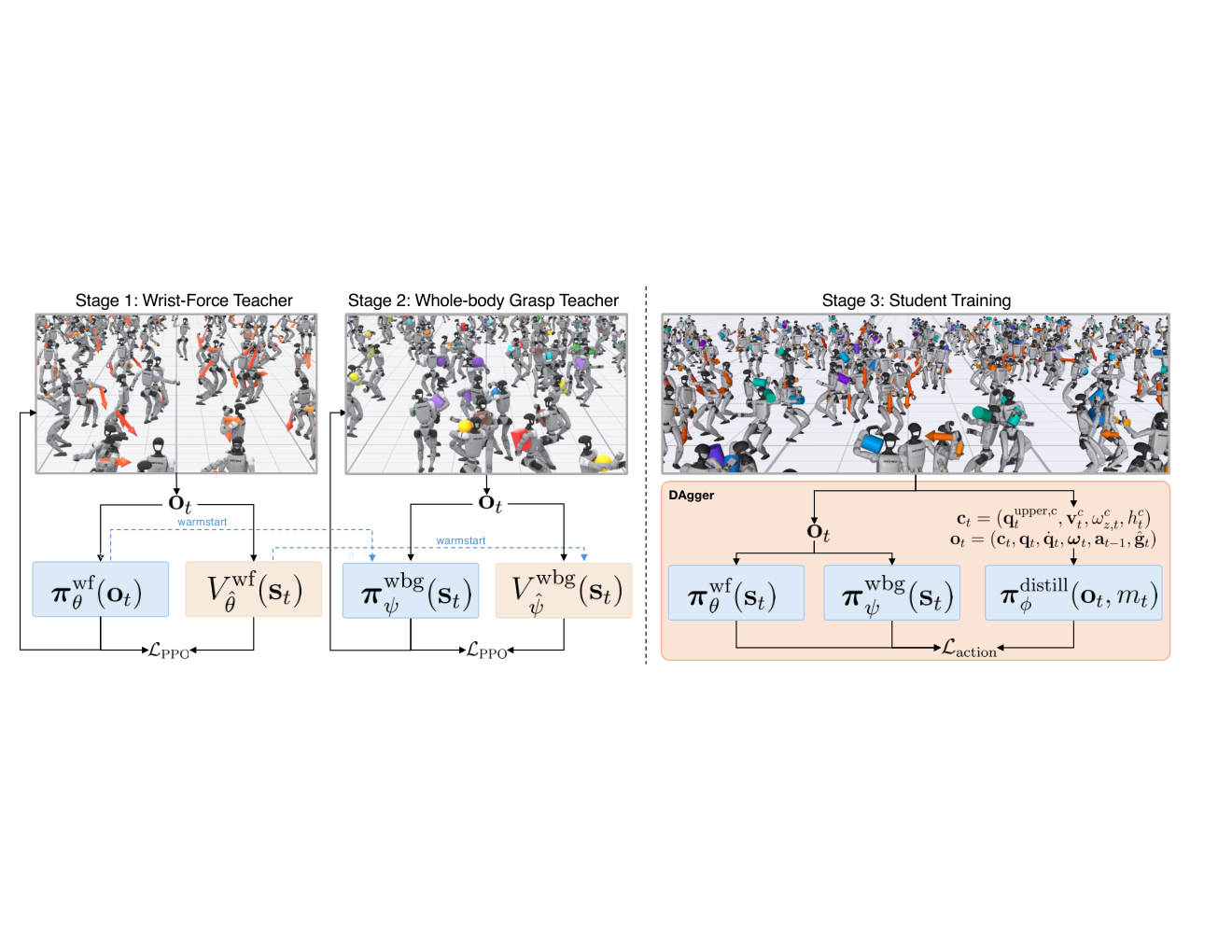
HULK is a whole-body control framework that combines MPC-guided reinforcement learning with a capture-point control barrier function to enable humanoids to carry heavy payloads and withstand forceful disturbances. It trains two teacher policies (wrist-force tracking and object-holding locomotion) and distills them into a single deployable policy, evaluated on the Unitree G1. In simulation, the barrier-augmented teacher reduces DCM excursion by 35.7% versus MPC-guided RL alone and withstands torso pushes up to 130 N.
中文摘要: HULK 提出了一个用于人形机器人全身强力移动操作的控制器框架。该方法利用模型预测控制(MPC)为强化学习提供负载动力学预测,训练两个教师策略:一个在腕部受力下跟踪手臂运动,另一个在身体抱持大型物体时行走。训练中引入捕获点控制屏障函数以提升负载下的平衡能力,并将两个教师策略蒸馏为单一策略。在 Unitree G1 上的仿真与实验表明:带屏障函数的教师在每臂 10 kg 负载下获得最低的前向与侧向速度跟踪误差,相比仅用 MPC 引导的强化学习,发散运动分量(DCM)偏移幅度降低 35.7%,腕力教师可承受高达 130 N 的躯干推力。
💬 A strong example of combining MPC structure with RL and safety constraints for whole-body forceful locomotion, directly relevant to modular legged control.
💬 该工作将 MPC 结构与强化学习及安全约束结合用于全身强力运动,对模块化足式机器人控制具有直接参考价值。
Why read it / 推荐理由: Demonstrates how MPC priors and control barrier functions can make RL-based whole-body controllers robust to heavy payloads and disturbances on real hardware. 展示了如何用 MPC 先验与控制屏障函数使基于强化学习的全身控制在真实硬件上对重载和扰动具有鲁棒性。
2. Precise SE(3) End-Effector Tracking in Whole-Body Humanoid Control
全身人形控制中的精确 SE(3) 末端执行器跟踪
Authors / 作者: Joohwan Seo, Xiaofeng Guo, Jinkun Cao, Roberto Horowitz, Rocky Duan, Guanya Shi et al.
arXiv: 2610.09479 · PDF
ResGAC combines geometric admittance control with residual reinforcement learning for precise end-effector pose tracking during whole-body humanoid motion. It uses a left-invariant SE(3) formulation and a ground-attached heading frame to decouple planar locomotion from manipulation reference motion, validated on a real Unitree G1. ResGAC outperforms baselines including SONIC across four standing tracking benchmarks and achieves 90% success in a standing peg-in-hole task.
中文摘要: ResGAC 将几何导纳控制(GAC)与残差强化学习相结合,用于人形机器人全身运动中的精确末端执行器位姿跟踪。几何导纳控制提供结构化的 SE(3) 任务空间反馈并生成标称手臂关节位置目标,残差强化学习补偿未建模动力学并协调运动与平衡。该方法采用左不变几何表述,使同一控制律可适用于不同操作参考系,并通过地面附着航向坐标系在保留平面运动的同时去除骨盆滚转、俯仰和起伏对操作参考的干扰。在真实 Unitree G1 上的四项站立跟踪基准中,ResGAC 均优于包括 SONIC 在内的基线,并在站立插孔任务中达到 90% 成功率。
💬 A clean hierarchical design of geometric feedback plus residual RL that is highly transferable to modular legged platforms requiring precise end-effector control.
💬 该工作提出几何反馈加残差强化学习的分层设计,对需要精确末端控制的模块化足式平台具有很强的可迁移性。
Why read it / 推荐理由: It offers a principled way to achieve precise manipulation during dynamic locomotion, a key challenge for multi-legged modular robots with arms. 它为动态行走中的精确操作提供了系统性方法,这是带臂多足模块化机器人的关键挑战。
3. HuMBLE: Human Motion-Driven Behavior Learning for Embodied Locomotion
HuMBLE:面向具身运动的人体运动驱动行为学习
Authors / 作者: Mike Zhang, Dongho Kang, Kevin Bergamin, Nicola Burger, Robin Deits, Jonathan Foster et al.
arXiv: 2610.10489 · PDF
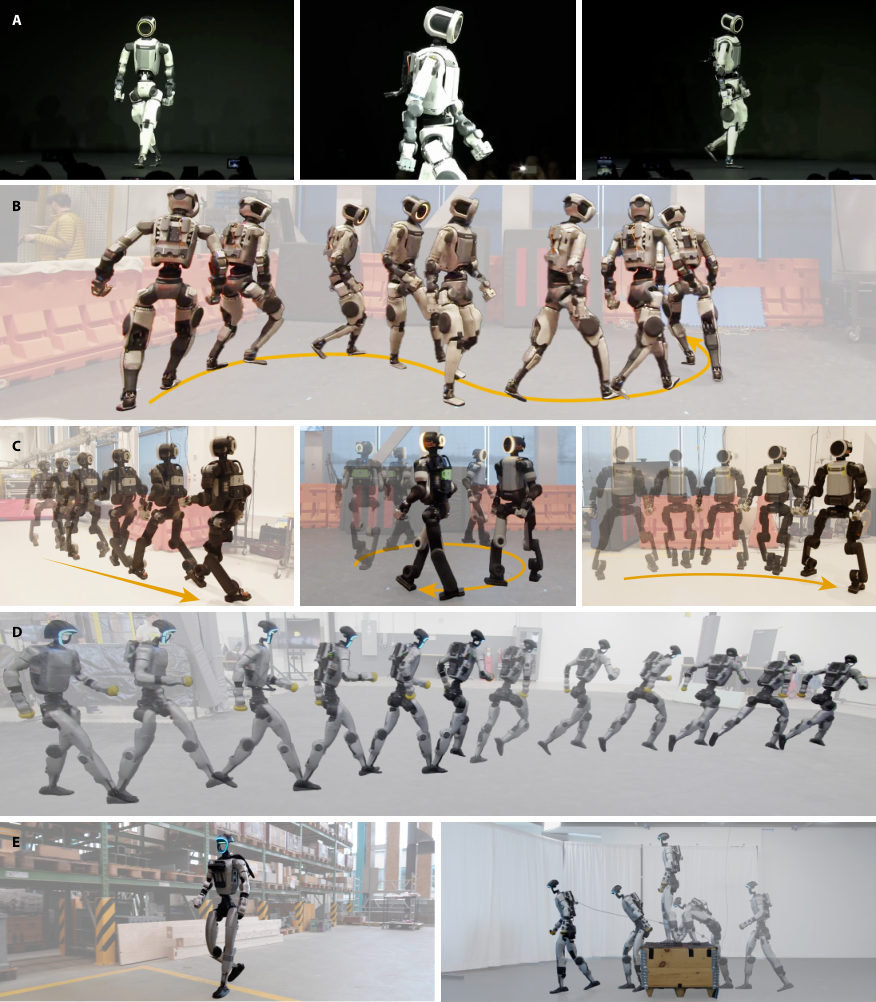
HuMBLE learns steerable, robust, and biomimetic humanoid locomotion by distilling a reference-conditioned RL policy into a proprioception-only prior and then fine-tuning it with multi-task RL that balances command tracking and human-motion style regularization. It is validated on three humanoid robots (Atlas R1, Atlas D1, Unitree G1) including real-world user-controlled indoor and outdoor locomotion. The framework generalizes beyond the human motion dataset while retaining natural gait characteristics.
中文摘要: HuMBLE 提出一种从人体运动数据学习实时可操控、鲁棒且仿生的人形运动策略的框架。该方法先用强化学习训练全身参考条件策略,再将其蒸馏为仅依赖本体感觉和平面躯干速度指令的轻量先验策略,最后用多任务强化学习微调:一个目标条件任务跟踪任意速度指令,一个参考引导任务以人体数据作为显式风格正则化器。该框架在 Boston Dynamics Atlas R1、Atlas D1 和 Unitree G1 三款人形机器人上验证,实现了室内外用户直接控制的鲁棒行走,在扩展指令覆盖范围的同时保持自然步态风格。
💬 Shows a practical recipe for blending motion priors with RL command tracking, relevant to gait generation and sim-to-real for legged platforms.
💬 该工作给出了将运动先验与强化学习指令跟踪融合的实用方案,对足式平台的步态生成与仿真到现实迁移具有参考意义。
Why read it / 推荐理由: The teacher-student distillation plus multi-task fine-tuning pipeline is directly applicable to generating natural gaits for modular legged robots. 其教师-学生蒸馏加多任务微调流程可直接用于为模块化足式机器人生成自然步态。
4. TAPNAV: Humanoid Navigation through Tactile Active Perception
TAPNAV:基于触觉主动感知的人形机器人导航
Authors / 作者: Huaze Liu, Zhenyu Wu, Jaehwi Jang, Junjie Sheng, Andrew Collins, Aaron Xie et al.
arXiv: 2610.10748 · PDF
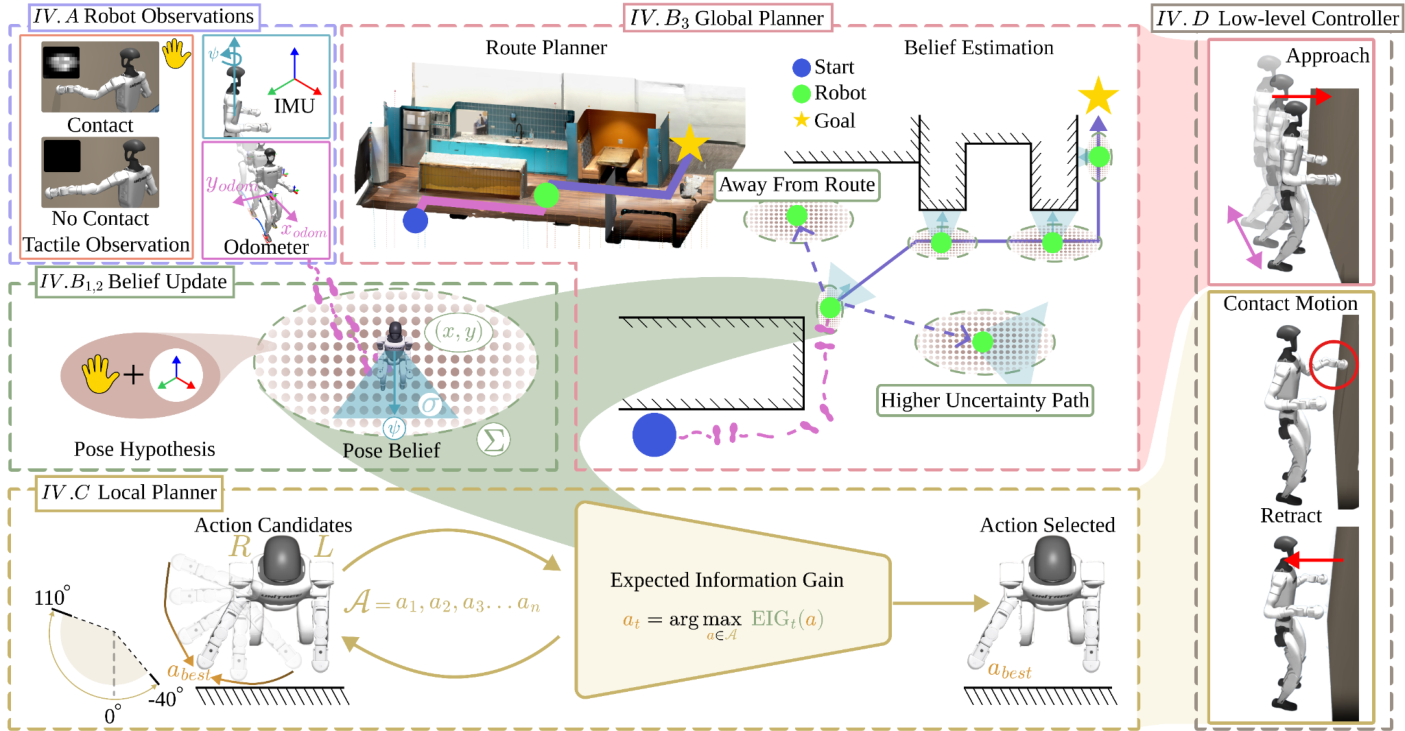
TAPNAV enables humanoid navigation in vision-denied environments by actively probing surrounding structures with tactile contact, maintaining a pose belief and coupling uncertainty-aware global planning with information-gain-driven local probing. A whole-body controller coordinates locomotion and end-effector contact for planned probing motions. Evaluated in simulation and on a Unitree G1, it achieves lower state estimation error and higher task completion than baselines.
中文摘要: TAPNAV 提出一种触觉主动感知框架,使不依赖视觉的人形机器人能够通过主动触碰周围结构实现导航。系统基于里程计、IMU 和触觉接触观测维护位姿信念,将不确定性感知的全局路径规划与基于信息增益的局部探测动作选择相结合:全局规划器搜索可借助触觉修正保持定位不确定性有界的路径,局部规划器选择最大化期望信息增益的探测动作。全身控制器协调行走与末端接触以执行导航和探测运动。在仿真和 Unitree G1 上的实验表明,该方法比基线具有更低的状态估计误差和更高的任务完成率。
💬 Novel integration of tactile active perception, uncertainty-aware planning, and whole-body control, relevant to traverse-capability-aware navigation.
💬 该工作创新性地整合了触觉主动感知、不确定性感知规划与全身控制,对通行能力感知导航具有参考价值。
Why read it / 推荐理由: It shows how whole-body control can be used for active tactile exploration, a promising direction for modular legged robots in perceptually degraded environments. 它展示了如何用全身控制实现主动触觉探索,为模块化足式机器人在感知退化环境中的导航提供了有前景的方向。
5. Workhorse: Learning Robust Whole-Body Humanoid Loco-Manipulation from Human Data
Workhorse:从人类数据学习鲁棒的全身人形移动操作
Authors / 作者: Songbo Hu, Qiayuan Liao, Yufeng Chi, Kevin Zakka, Yakun Sophia Shao, Pieter Abbeel et al.
arXiv: 2610.09117 · PDF
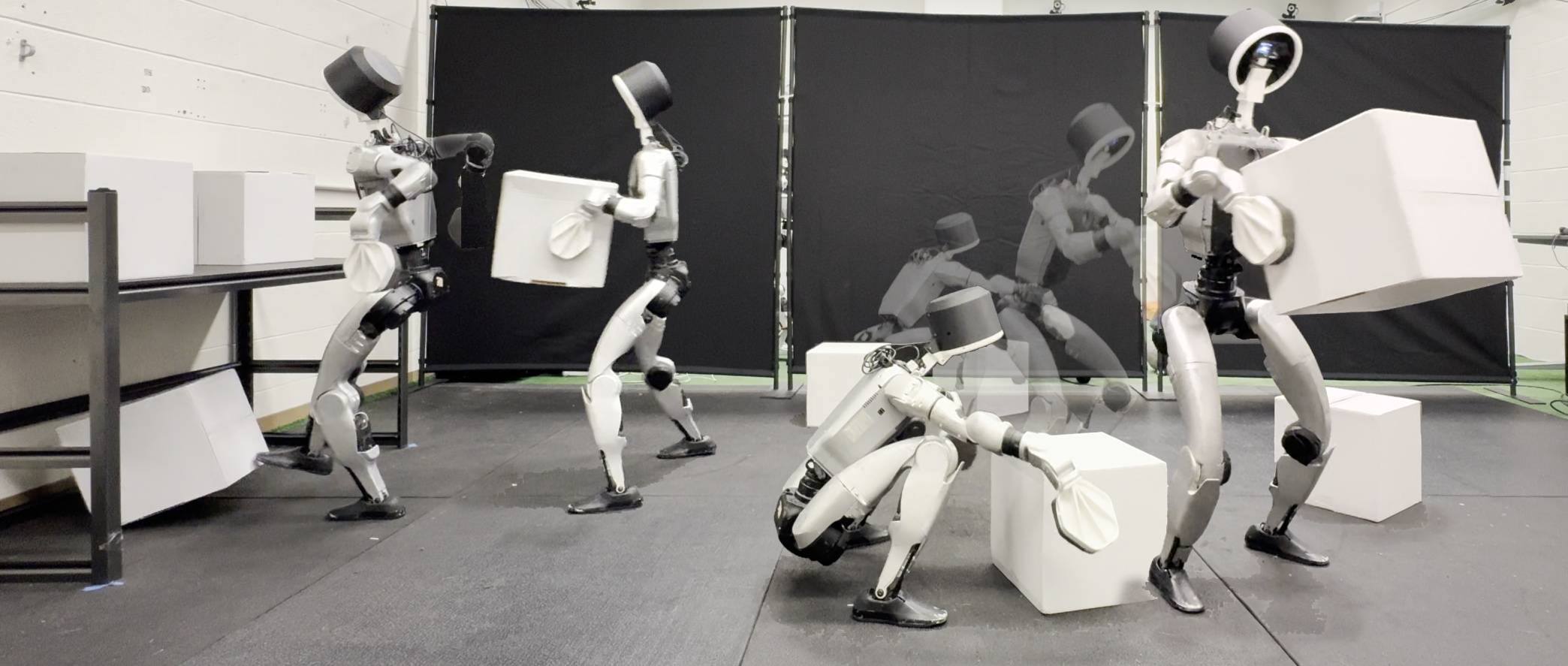
Workhorse learns contact-rich whole-body loco-manipulation from robot-free human demonstrations using a visual planner that predicts five-link targets and an RL whole-body tracker that follows them. Both policies train separately on the same human poses without retargeting, with data augmentation to imitate each other’s deployment errors. On a real Unitree G1, it performs box sorting, catching, and suitcase climbing, achieving 77% sorting success in simulation and 64% under 40 N·s pushes.
中文摘要: Workhorse 提出一种从无机器人的人体演示中学习接触丰富的全身移动操作的方法。视觉规划器预测躯干、双腕和双脚五个连杆的目标位姿,强化学习全身跟踪器在机器人上跟随这些目标。两个策略在相同录制人体姿态上分别训练,无需重定向,并通过数据增强模拟对方在部署时的误差。在真实 Unitree G1 上,系统完成了用双手和踢腿整理箱子、接住抛来的箱子以及推倒并爬过行李箱等任务;在仿真中箱子整理成功率为 77%,在 40 N·s 推力扰动下为 64%。
💬 Demonstrates a practical human-data-driven pipeline for robust whole-body loco-manipulation with real-robot validation and recovery behaviors.
💬 该工作展示了从人类数据驱动鲁棒全身移动操作的实用流程,并具备真实机器人验证和恢复行为。
Why read it / 推荐理由: It provides a blueprint for learning coordinated locomotion and manipulation from human data, valuable for modular legged robots with reconfigurable limbs. 它为从人类数据学习协调的移动与操作提供了蓝图,对具有可重构肢体的模块化足式机器人有价值。