机器人日报
机器人论文日报 — 2026-10-09
🤖 Scanned 443 papers from today’s arXiv announcement (cs.RO / eess.SY / cs.LG), picked 5 for modular & legged robotics — summarized by DeepSeek.
🤖 从今日 arXiv 新论文(cs.RO / eess.SY / cs.LG)中扫描 443 篇,围绕模块化与足式机器人精选 5 篇 — 由 DeepSeek 生成双语摘要。
1. Higher-Order Morphology Priors for Quadruped Reinforcement Learning Under Actuator Degradation
执行器退化下四足强化学习的高阶形态先验
Authors / 作者: Derek You, Zafir Shamsi, Keqin Wang, Christine Allen-Blanchette
arXiv: 2610.10934 · PDF
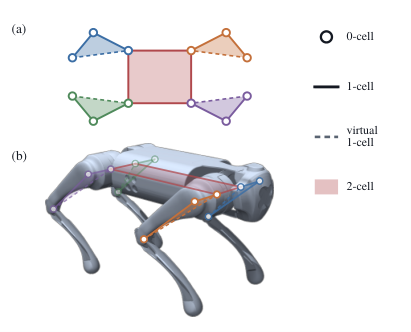
This paper models a Unitree Go1 as a cell complex with limb- and body-level rank-2 cells and applies Hodge-based message passing to create a morphology-aware graph policy. Under actuator degradation training, the node-edge-face Hodge actor achieves the highest return on unseen actuator degradations, with higher survival rates and lower velocity-tracking error compared to baselines. The results demonstrate that higher-order morphological structure serves as a useful inductive bias for whole-body compensation when actuators degrade.
中文摘要: 本文将Unitree Go1四足机器人建模为胞腔复形,引入肢体和躯干级别的秩2胞元,并采用Hodge消息传递构建形态感知图策略。在执行器退化训练下,节点-边-面Hodge actor在未见过的执行器退化情形中获得最高回报,同时具有更高的存活率和更低的速度跟踪误差。结果表明,高阶形态结构可作为有效的归纳偏置,用于执行器退化时的全身补偿控制。
💬 Introduces a novel cell-complex morphological prior that improves robustness to actuator degradation, directly relevant to modular legged robot control under faults.
💬 引入新颖的胞腔复形形态先验,提升执行器退化下的鲁棒性,与模块化腿式机器人故障控制直接相关。
Why read it / 推荐理由: It offers a principled graph-based morphology representation that could generalize to reconfigurable modular legged platforms with actuator faults. 提供了一种基于图的形态表示方法,有望推广到执行器故障下的可重构模块化腿式平台。
2. Teaching a Robot Dog New Tricks: Diverse Quadruped Skills via Combined Reinforcement and Imitation Learning with Adversarial Task Selection
教机器狗新技能:通过对抗任务选择的强化与模仿学习实现多样化四足技能
Authors / 作者: Lemon Foxmere, Anthony Furman, Yizheng Du, Oliver Chang, Leilani Gilpin, Steve McGuire
arXiv: 2610.10601 · PDF
This paper proposes a three-stage method that trains a single policy to perform 22 distinct tasks such as walking, digging, and hopping, and composes them into novel behaviors like crawling. Multiple teacher policies are first trained via RL, then a student policy is distilled using combined RL and imitation learning under an adversarial task selection process that focuses on worst-performing tasks. The policy is deployed on a Unitree B1 quadruped, demonstrating real-world robustness and better command tracking than PPO and distill-then-finetune baselines.
中文摘要: 本文提出一种三阶段方法,训练单一策略执行行走、挖掘、跳跃等22种不同任务,并能组合成爬行等新行为。首先通过强化学习训练多个教师策略,然后采用多教师蒸馏训练学生策略,结合强化学习和模仿学习目标,并采用对抗任务选择过程专注于表现最差的任务。最终策略部署在Unitree B1四足机器人上,展示了真实环境鲁棒性,且命令跟踪优于PPO和先蒸馏后微调基线。
💬 Demonstrates a scalable multi-skill learning framework with adversarial task selection and real-robot validation, valuable for modular legged robots requiring diverse locomotion modes.
💬 展示了具有对抗任务选择机制的可扩展多技能学习框架,并在真实机器人上验证,对需要多样化运动模式的模块化腿式机器人有价值。
Why read it / 推荐理由: It provides a practical recipe for training a single policy to handle many skills on real quadrupeds, which is essential for modular legged robots that need to switch between gaits and tasks. 提供了在真实四足机器人上训练单一策略处理多种技能的实用方案,这对于需要在步态和任务间切换的模块化腿式机器人至关重要。
3. Toward Lunar Legged Robots: Field Deployment Lessons at LUNA
面向月球腿式机器人:LUNA野外部署经验
Authors / 作者: Adrian Fuhrer, Joseph Church, Oliver Fischer, William Talbot, Nicolas Faesch, Yannic Hofmann et al.
arXiv: 2610.12276 · PDF
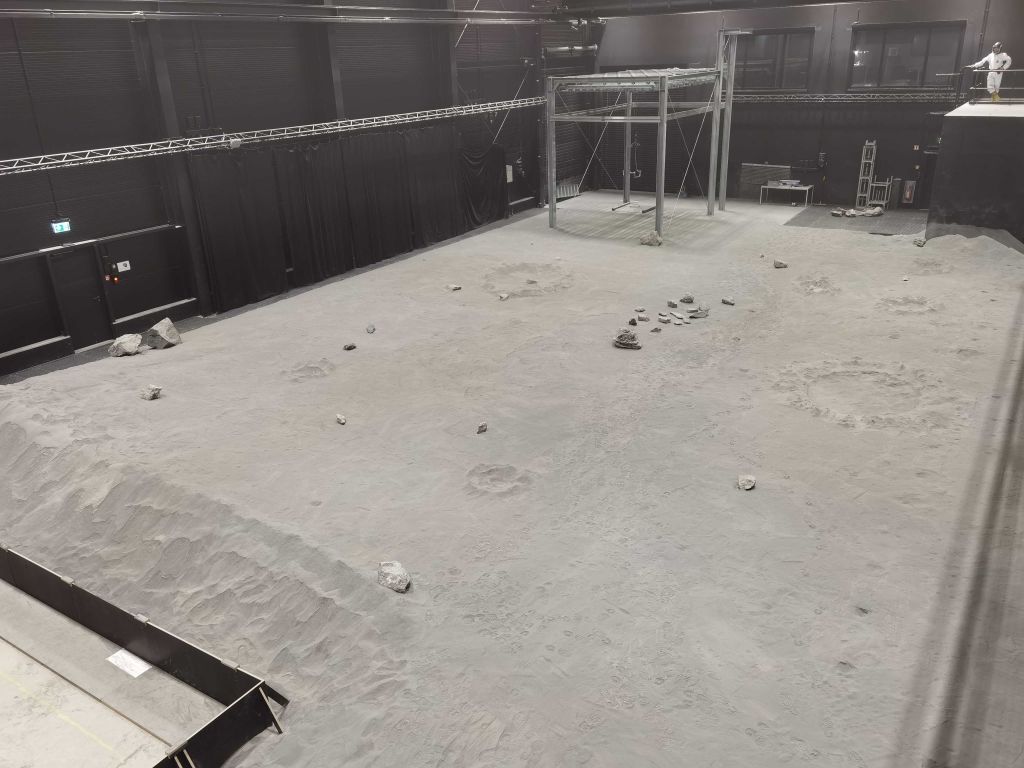
This paper reports lessons from the 2025 LUNA analogue campaign where ANYmal-D and Magnecko legged robots traversed loose regolith simulant and crater-like terrain, collecting long-horizon navigation and visual-inertial data. The study shows that quadrupedal robots can traverse regolith simulant but performance is affected by sinkage, slip, dust-generating contacts, and perception failures due to overexposure, shadows, and low-texture regions. These results highlight the need for tighter integration of regolith-aware locomotion policies, illumination-robust perception, and mission-level validation for future lunar legged robots.
中文摘要: 本文报告了2025年LUNA模拟活动中ANYmal-D和Magnecko腿式机器人在松散月壤模拟物和类陨石坑地形上行走的经验,并收集了长时导航和视觉惯性数据。研究表明,四足机器人能够穿越月壤模拟物,但性能受到沉陷、滑移、扬尘接触以及过曝、阴影和低纹理区域导致的感知失败的影响。这些结果强调需要将月壤感知运动策略、光照鲁棒感知和任务级验证更紧密地集成,以支持未来月球腿式机器人。
💬 Provides rare field data on quadruped locomotion over lunar regolith simulant, exposing key challenges for sim-to-real transfer in extreme terrains.
💬 提供了罕见的四足机器人在月球模拟月壤上行走的现场数据,揭示了极端地形下仿真到现实迁移的关键挑战。
Why read it / 推荐理由: It offers real-world insights into locomotion on granular, unstable terrain that are directly relevant to modular legged robots operating in unstructured environments. 提供了在颗粒状不稳定地形上运动的真实世界见解,与模块化腿式机器人在非结构化环境中的操作直接相关。
4. A Balanced Data Diet: Addressing the Exploration Bottleneck in Mega-Scale RL for Robot Control
平衡数据饮食:解决机器人控制大规模强化学习中的探索瓶颈
Authors / 作者: Octi Zhang, Mateo Guaman Castro, Patrick Yin, Ignacio Dagnino, Abhishek Gupta, Rosario Scalise et al.
arXiv: 2610.12465 · PDF
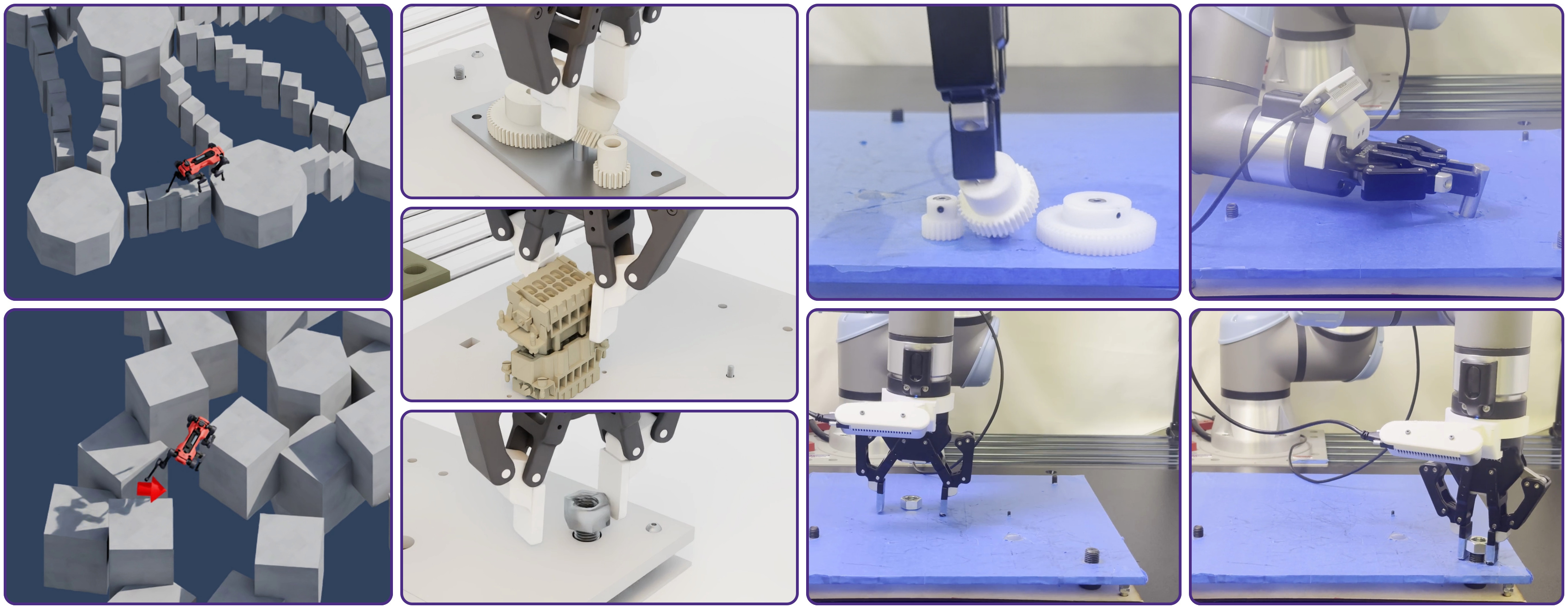
This paper introduces Success Guided Sampling (SGS), an adaptive sampler that concentrates RL training on task configurations around the frontier of the policy’s capabilities to address the exploration bottleneck in mega-scale parallel simulation. The method mitigates the waste of learning experience on already mastered or impossible tasks, enabling more effective scaling to large-scale parallel simulation. Experiments using up to 2^20 parallel environments show improved learning efficiency and performance.
中文摘要: 本文提出成功引导采样(SGS),一种自适应采样器,将强化学习训练集中在策略能力前沿附近的任务配置上,以解决大规模并行仿真中的探索瓶颈。该方法减少了在已掌握或无法尝试的任务上浪费学习经验,使大规模并行仿真扩展更有效。使用多达2^20个并行环境的实验表明,学习效率和性能得到提升。
💬 Addresses a key scalability issue in massively parallel RL for robot control, with potential to accelerate sim-to-real training of legged locomotion policies.
💬 解决了机器人控制中大规模并行强化学习的关键可扩展性问题,有望加速腿式运动策略的仿真到现实训练。
Why read it / 推荐理由: It proposes a simple yet effective sampling strategy that could significantly speed up RL training for modular legged robots in simulation. 提出了一种简单有效的采样策略,可显著加速模块化腿式机器人在仿真中的强化学习训练。
5. DAMP: Humanoid Locomotion via Denoised Belief Learning and Adversarial Motion Priors
DAMP:通过去噪信念学习和对抗运动先验的人形机器人运动
Authors / 作者: Puying Shen, Wenhao Cui, Huaxing Huang, Bangyu Qin, Shengtao Li, Ziyang Dong et al.
arXiv: 2610.11505 · PDF
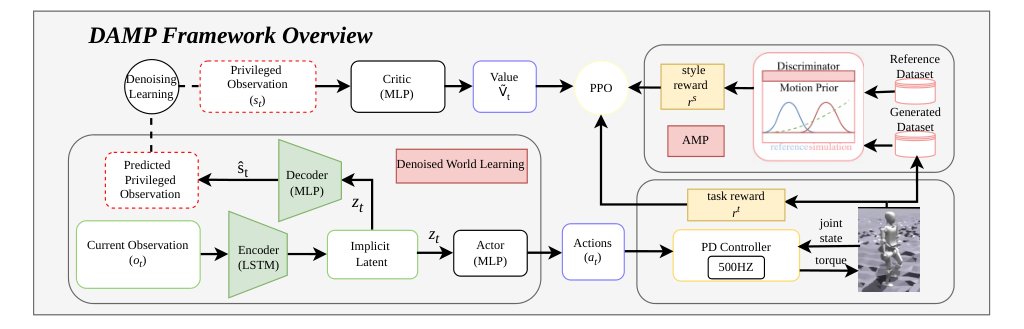
This paper introduces DAMP, a reinforcement learning framework for robust and naturalistic humanoid locomotion over challenging terrains without relying on perceived information. The framework uses recurrent neural networks to capture temporal dependencies and implicitly infer privileged and task-relevant latent information, aligning learned representations with task objectives. The end-to-end framework achieves sim-to-real transfer, demonstrating robustness and generalization on real-world terrains.
中文摘要: 本文提出DAMP,一种强化学习框架,用于在未依赖感知信息的情况下实现具有挑战地形上的鲁棒且自然的人形机器人运动。该框架利用循环神经网络捕捉时间依赖并隐式推断特权及任务相关的潜在信息,使学习到的表示与任务目标对齐。该端到端框架实现了仿真到现实的迁移,在真实地形上展示了鲁棒性和泛化能力。
💬 Combines denoised belief learning with adversarial motion priors for blind humanoid locomotion, offering a sim-to-real pipeline relevant to legged robots without exteroception.
💬 将去噪信念学习与对抗运动先验结合用于盲式人形机器人运动,提供了一种与无外感知腿式机器人相关的仿真到现实流程。
Why read it / 推荐理由: It presents a method for robust locomotion without perception that could be adapted to modular legged robots in degraded sensing conditions. 提出了一种无需感知的鲁棒运动方法,可适应于感知退化条件下的模块化腿式机器人。