机器人日报
机器人论文日报 — 2026-10-08
🤖 Scanned 474 papers from today’s arXiv announcement (cs.RO / eess.SY / cs.LG), picked 5 for modular & legged robotics — summarized by DeepSeek.
🤖 从今日 arXiv 新论文(cs.RO / eess.SY / cs.LG)中扫描 474 篇,围绕模块化与足式机器人精选 5 篇 — 由 DeepSeek 生成双语摘要。
1. LLA-MPPI: Rapidly Adaptive Whole-body Control of Legged Robots with GPU-Accelerated Parallel Simulations
LLA-MPPI:基于GPU加速并行仿真的腿足机器人快速自适应全身控制
Authors / 作者: Sebin Jung, Maitham F. AL-Sunni, Juan Alvarez-Padilla, Zachary Manchester, Changliu Liu, John M. Dolan
arXiv: 2610.10465 · PDF
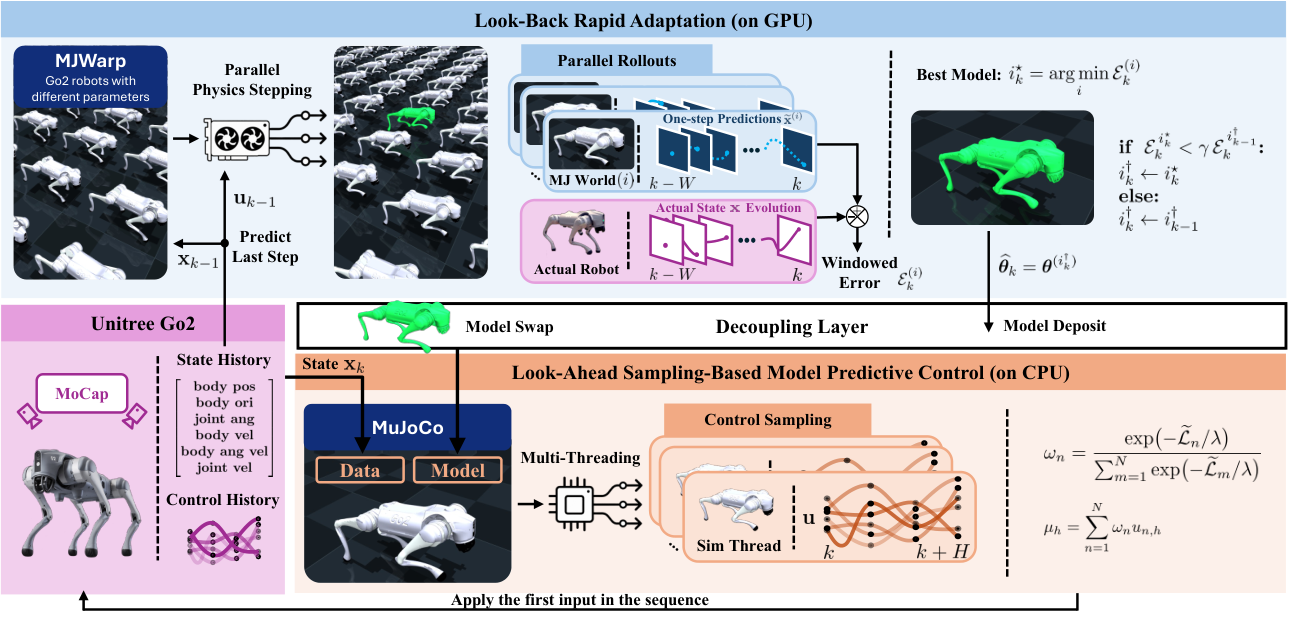
LLA-MPPI converts whole-body adaptation into a selection over a bank of GPU-batched contact simulators with different physical parameters. Windowed prediction errors select the simulator that best explains recent motion, and a whole-body MPPI planner optimizes controls through the selected model. It achieves 97.5% success across four simulated tasks versus 74% for the strongest baseline, and hardware validation on Unitree Go2 demonstrates walking under mid-run payload addition, walking after one leg is disabled, and pushing a box while increasing its mass on the fly.
中文摘要: 针对腿足机器人全身控制器在部署动力学变化时性能退化的问题,本文提出LLA-MPPI(Look-back and Look-ahead Adaptive Model Predictive Path Integral控制)。该方法将全身自适应转化为对一组具有不同物理或结构参数的GPU批量接触仿真器的选择:通过窗口化预测误差选择最能解释近期运动的仿真器,再由全身MPPI规划器通过所选模型优化控制量。框架无需离线训练,所选假设具有物理可解释性。在四个仿真任务中成功率97.5%,最强基线为74%,使用真实模型的oracle为98.5%。在Unitree Go2上的硬件验证展示了中途加载 payload 行走、单腿禁用后行走以及推动箱子并实时增加其质量的能力。
💬 A training-free adaptive whole-body MPPI that handles contact dynamics changes and leg failure on real hardware is directly relevant to modular legged robot fault tolerance and reconfiguration.
💬 一种无需训练的自适应全身MPPI,能在真实硬件上处理接触动力学变化和腿部故障,与模块化腿足机器人的容错和重构直接相关。
Why read it / 推荐理由: It offers a practical, training-free approach to whole-body control that adapts online to model changes and leg loss on a real quadruped, highly relevant to modular and reconfigurable legged systems. 它提供了一种实用的、无需训练的全身控制方法,能在真实四足机器人上在线适应模型变化和腿部缺失,与模块化和可重构腿足系统高度相关。
2. Energy-Efficient Gait Adaptation via Hierarchical Reinforcement Learning for Quadrupedal Locomotion Across Diverse Terrains
基于分层强化学习的四足机器人多地形节能步态自适应
Authors / 作者: Ammar Issa, Anubhav Singh, Anton Tsaritsin, Sergey Kolyubin
arXiv: 2610.10297 · PDF
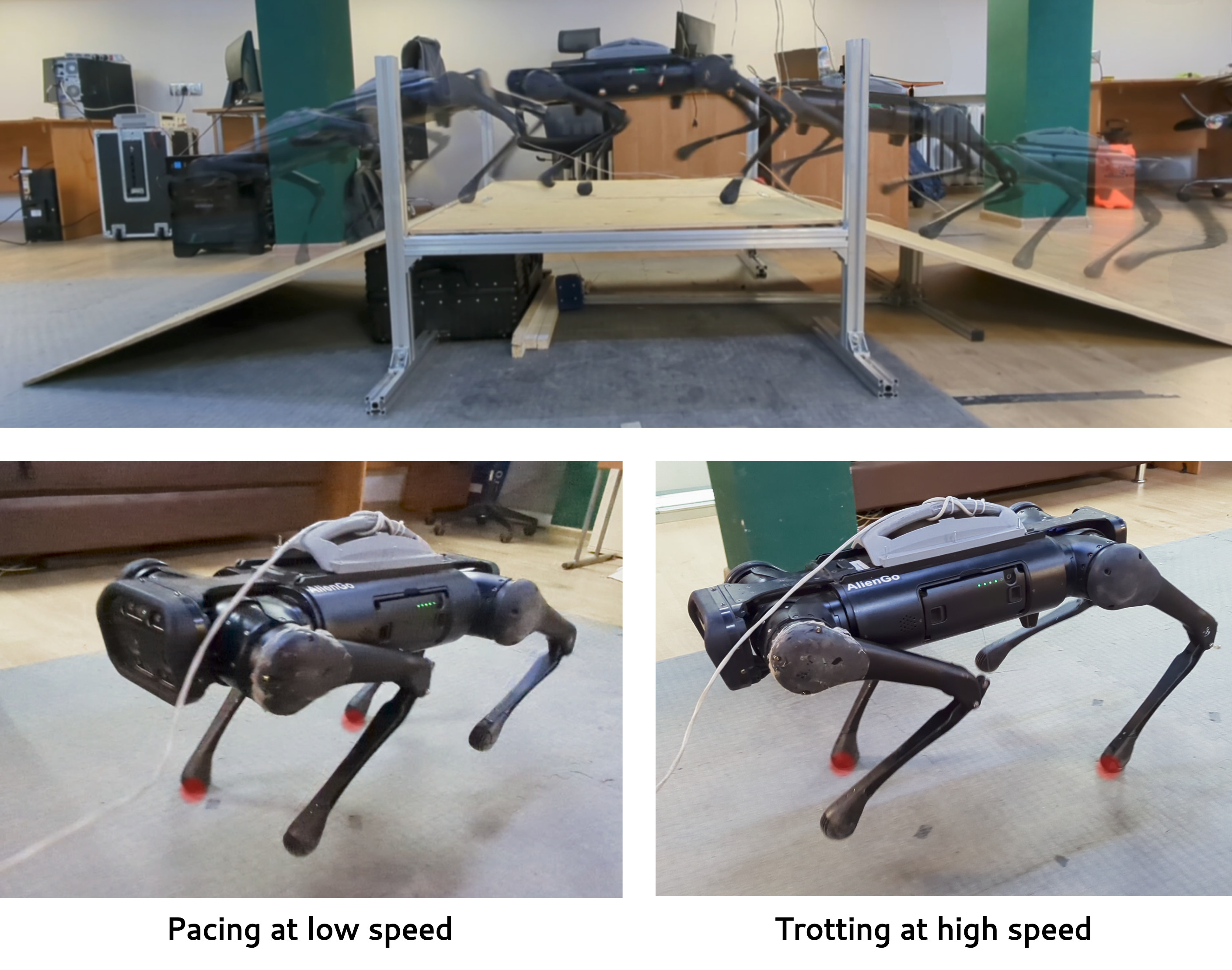
This work proposes a hierarchical reinforcement learning framework that separates a high-frequency policy for stable joint-level motion execution from a low-frequency gait adaptation policy that explicitly minimizes cost of transport (CoT). A three-stage Isaac-based training procedure enables zero-shot sim-to-real transfer with improved tracking accuracy, robustness, and energy efficiency. The learned hierarchy exhibits automatic speed-dependent gait adaptation, transitioning from pacing at low speeds to trotting at higher speeds, validated in simulation across flat, rough, and inclined terrains and zero-shot deployed on a Unitree AlienGo quadruped.
中文摘要: 针对腿足机器人节能与鲁棒运动控制的挑战,本文提出一种分层强化学习框架,将高频的关节级稳定运动执行策略与低频的显式最小化运输成本(CoT)的步态自适应策略分离。通过三阶段基于Isaac的训练流程,实现了零样本仿真到现实迁移,提升了跟踪精度、鲁棒性和能效。学习到的分层结构展现出自动的速度依赖步态自适应:低速时采用踱步,高速时切换为小跑。在仿真中与代表性单策略和分层基线对比,在广泛指令速度范围内降低了CoT,并在平坦、崎岖和倾斜地形上保持鲁棒运动。最后在Unitree AlienGo四足机器人上实现零样本部署验证。
💬 The hierarchical separation of gait adaptation from motion execution is a clean approach to energy-efficient locomotion that directly informs modular legged gait generation.
💬 将步态自适应与运动执行分层分离是节能运动的一种清晰方法,可直接为模块化腿足步态生成提供参考。
Why read it / 推荐理由: It demonstrates a hierarchical RL architecture that achieves automatic speed-dependent gait transitions and zero-shot sim-to-real on a quadruped, closely matching the reader’s interests in RL-based motion control and gait generation. 它展示了一种分层RL架构,实现了自动速度依赖的步态切换和四足零样本sim-to-real,与读者在基于RL的运动控制和步态生成方面的兴趣高度吻合。
3. FlashNeRD: Performance-First Contact-Rich Neural Robot Dynamics
FlashNeRD:性能优先的富接触神经机器人动力学
Authors / 作者: Mohammadmehdi Ataei, Mohammad Amin Nabian, Jie Xu, Miles Macklin, Yashraj Narang, Eric Heiden et al.
arXiv: 2610.09130 · PDF
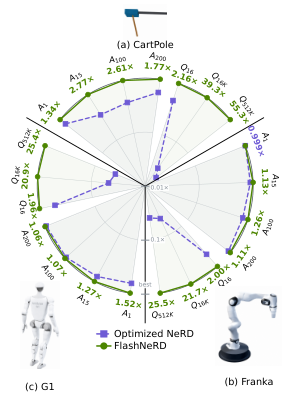
FlashNeRD removes three limitations of Neural Robot Dynamics (NeRD) with a parallel streaming architecture for faster and more accurate predictions, an encoder accepting contacts anywhere, and two-way coupling with analytical object solvers. Across five robots it achieves up to 55× speedup over optimized NeRD with better long-rollout accuracy; PPO trains an ANYmal locomotion policy in 34 seconds, 3.8× faster than the analytical simulator, and with DIAL-MPC the robot climbs all six test platforms where fixed-contact NeRD manages one.
中文摘要: 本文提出FlashNeRD,针对神经机器人动力学(NeRD)的三个局限进行改进:通过并行流式架构使每次预测更快更准确;通过编码器接受任意位置的接触;并与解析求解器仿真的物体实现双向耦合。在五个机器人上的实验表明,其动力学模型比优化后的NeRD快达55倍,且长时程 rollout 更准确。该加速也扩展到策略学习:PPO在34秒内训练出ANYmal运动策略,比解析仿真器快3.8倍,比优化NeRD快2.7倍。结合DIAL-MPC采样规划,机器人在六个测试平台上全部攀爬成功,而固定接触NeRD仅成功一个,规划时间约为解析仿真器的一半。
💬 A fast, differentiable, contact-rich neural dynamics model with two-way object coupling can substantially accelerate MPC and RL for legged locomotion and sim-to-real.
💬 一种快速、可微分、富接触的神经动力学模型,具备双向物体耦合,可显著加速腿足运动的MPC和RL以及sim-to-real。
Why read it / 推荐理由: It provides a high-speed, accurate learned dynamics model that directly benefits model-based control and RL training for legged robots, with strong sim-to-real potential. 它提供了一种高速、准确的学习动力学模型,可直接惠及腿足机器人的基于模型控制和RL训练,并具有强大的sim-to-real潜力。
4. CMP-IRRT*: A Perception-Assisted Height-Adaptive Planner for Quadruped Robots
CMP-IRRT*:一种感知辅助的四足机器人高度自适应规划器
Authors / 作者: Mingfan Zhao, Wendong Mao, Zhongfeng Wang
arXiv: 2610.10470 · PDF
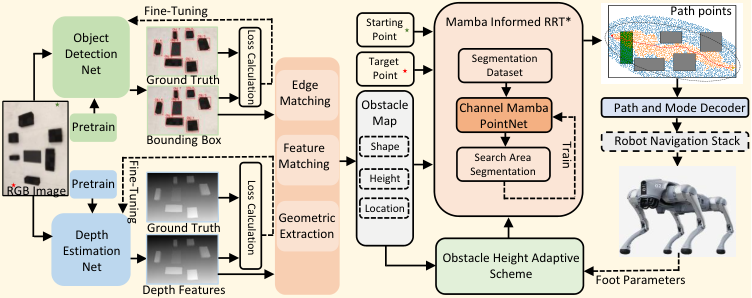
CMP-IRRT* is a Channel Mamba PointNet-guided Informed RRT* planner that uses a calibrated top-view RGB observation to estimate obstacle regions and convert depth predictions into a ground-relative height map. The planner performs height-conditioned collision checking, treating high obstacles as blocked while allowing low obstacles to be traversed, and uses the CMP guide to bias sampling. Experiments show reduced explored nodes and iterations, up to 16.3% path length reduction when low obstacles are traversable, and a Unitree Go2 demonstration of executable bypassing and traversal behaviors.
中文摘要: 本文提出CMP-IRRT*,一种感知辅助的高度自适应规划框架,基于Channel Mamba PointNet引导的Informed RRT规划器。给定标定的俯视RGB观测,感知模块估计障碍区域并将深度预测转换为地面相对高度图。规划器执行高度条件碰撞检查,将高障碍视为阻挡而允许低障碍穿越,并利用CMP引导采样偏向有希望区域,同时保留标准自由空间和informed采样回退。在2D规划基准上,CMP-IRRT减少了探索节点和迭代次数;消融实验支持Mamba引导的贡献。在构建的可穿越性感知场景中,当低障碍可穿越时路径长度减少达16.3%,Unitree Go2演示展示了可执行的绕行和穿越行为。
💬 A traversability-aware planner that exploits height-conditioned collision checking is directly applicable to legged robots that can step over low obstacles.
💬 一种利用高度条件碰撞检查的可穿越性感知规划器,可直接应用于能够跨越低障碍的腿足机器人。
Why read it / 推荐理由: It addresses traverse-capability-aware path planning for quadrupeds with a learned perception guide, aligning with the reader’s interest in traversability-aware navigation and real-robot validation. 它利用学习到的感知引导解决了四足机器人的可穿越性感知路径规划问题,与读者在可穿越性导航和真实机器人验证方面的兴趣一致。
5. ClimbLab: MATLAB Simulation Platform for Legged Climbing Robotics
ClimbLab:腿足攀爬机器人MATLAB仿真平台
Authors / 作者: Kentaro Uno, Warley F. R. Ribeiro, Yusuke Koizumi, Keigo Haji, Koki Kurihara, William Jones et al.
arXiv: 2610.09315 · PDF
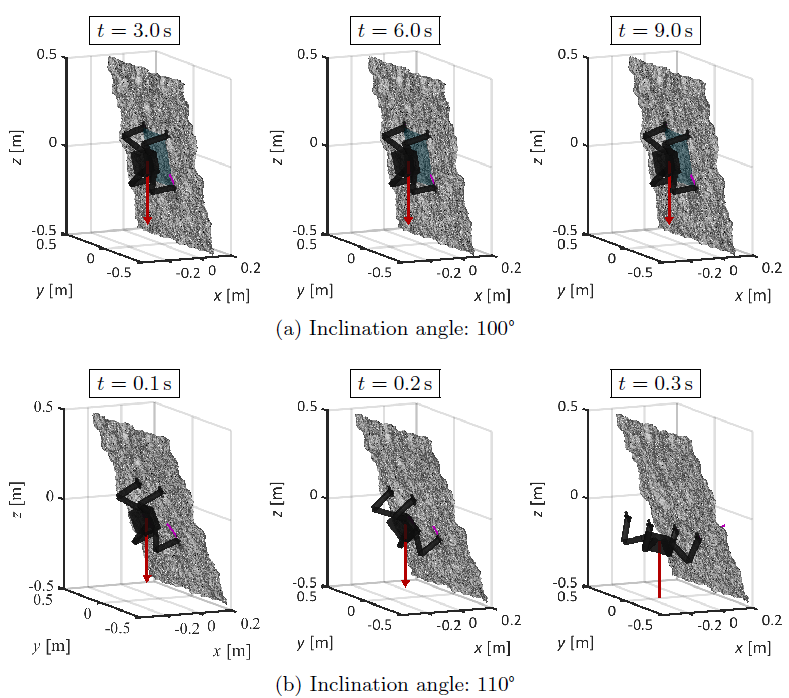
ClimbLab is an open-sourced MATLAB simulation and analysis platform dedicated to legged climbing robots. It enables designing any limbed robotic system as an articulated multi-body with a floating base and simulates walking and climbing in arbitrary environments, with variable inclination, gravity, ground stiffness, and point-cloud terrain maps. The simulator employs a rigid body dynamics engine and is demonstrated with quadrupedal robots gripping walls and climbing steep slopes.
中文摘要: 本文介绍ClimbLab,一个面向腿足攀爬机器人的开源MATLAB仿真与分析平台。该仿真器可将任意有腿机器人系统设计为具有浮动基座的铰接多体,并模拟其在任意环境中的行走和攀爬。主要可变环境参数包括倾角、重力和地面刚度,且可加载任意点云作为地形图。仿真器采用刚体动力学引擎。文章首先描述仿真器结构、计算流程,随后展示代表性仿真示例,其中四足机器人能够在墙壁上抓握或在陡坡上攀爬。
💬 An open MATLAB platform for legged climbing with configurable morphology and terrain parameters is useful for rapid prototyping and analysis of modular legged designs.
💬 一个用于腿足攀爬的开源MATLAB平台,具备可配置的形态和地形参数,对于模块化腿足设计的快速原型和分析很有用。
Why read it / 推荐理由: It offers a freely available simulation and analysis tool for legged climbing that supports arbitrary limb configurations and terrain, aiding modular legged robot design and control research. 它提供了一个免费的腿足攀爬仿真与分析工具,支持任意肢体配置和地形,有助于模块化腿足机器人设计与控制研究。