机器人日报
机器人论文日报 — 2026-10-05
🤖 Scanned 388 papers from today’s arXiv announcement (cs.RO / eess.SY / cs.LG), picked 5 for modular & legged robotics — summarized by DeepSeek.
🤖 从今日 arXiv 新论文(cs.RO / eess.SY / cs.LG)中扫描 388 篇,围绕模块化与足式机器人精选 5 篇 — 由 DeepSeek 生成双语摘要。
1. Around the World: Unified Learned Locomotion on a 270 g Continuous-Rotation Quadruped
环游世界:270克连续旋转四足机器人上的统一学习式运动控制
Authors / 作者: Arturo Flores Alvarez, Nathan Lintu, Dennis Hong
arXiv: 2610.02728 · PDF
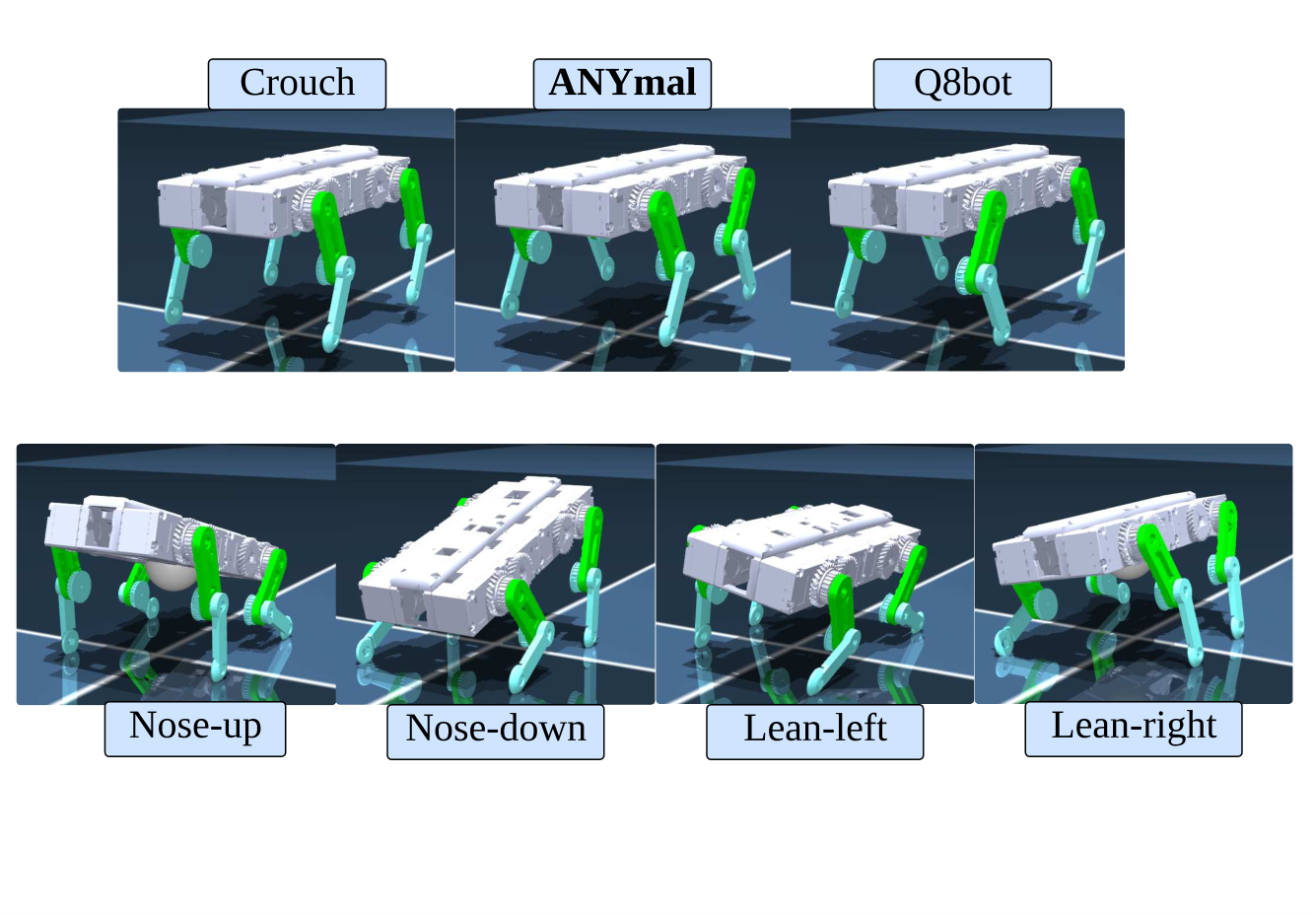
The authors present a single posture-conditioned reinforcement learning policy that runs onboard a 270 g continuous-rotation quadruped, unifying upright walking, inverted walking, and landing recovery on a continuous joint-space torus T^8. The sub-100k-parameter network achieves forward velocity RMSE of 0.037 m/s upright and 0.050 m/s inverted, resumes walking in 24 of 30 release trials, and works across four interchangeable foot geometries and four indoor surfaces.
中文摘要: 本文针对270克连续旋转四足机器人MiNI-Q,提出一种完全板载运行的后验条件强化学习策略。该策略在连续关节空间环面T^8上定义参考轨迹,并通过重力条件变换将直立行走、倒立行走与落地恢复统一到单一策略中,无需状态机或相位切换。协调姿态与释放课程用于训练这一行为族,并通过执行器辨识、跨引擎验证和嵌入式部署实现硬件迁移。参数少于10万的网络在直立和倒立状态下跟踪前进速度的RMSE分别为0.037 m/s和0.050 m/s,30次释放试验中24次成功恢复行走,并在四种可互换足部几何与四种室内表面上运行。硬件实验与仿真消融揭示了表征、条件化与训练选择对平台运动范围的利用。
💬 This work elegantly exploits a continuous-rotation leg morphology with a single learned policy, offering a compelling template for unified multi-posture control on lightweight legged platforms.
💬 该工作优雅地利用连续旋转腿构型与单一学习策略,为轻量腿式平台的统一多姿态控制提供了有价值的范例。
Why read it / 推荐理由: Highly relevant to modular/reconfigurable legged robots, demonstrating onboard RL with posture-conditioned control and real-robot sim-to-real transfer on a sub-kilogram platform. 与模块化/可重构腿式机器人高度相关,展示了板载强化学习、姿态条件控制以及亚公斤级平台上的真实机器人sim-to-real迁移。
2. Filter-Aware Fine-Tuning for Safe Humanoid Whole-Body Tracking
面向安全人形全身跟踪的滤波器感知微调
Authors / 作者: Pranit Mohnot, Christian Helten, Daniele Gammelli, Marco Pavone
arXiv: 2610.02341 · PDF
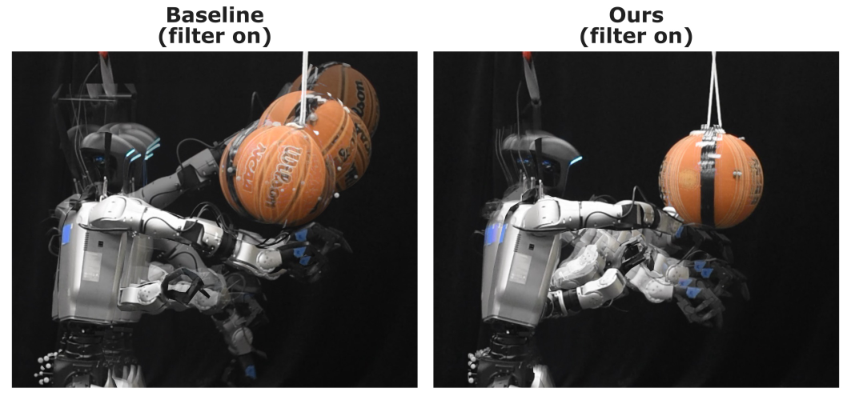
The paper identifies fundamental mismatches between a whole-body tracking RL policy and runtime safety filters (CBFs), and proposes CoFiT, a filter-aware fine-tuning method for pretrained trackers. CoFiT reduces violation time by 91% on TWIST2 and 21% on SONIC compared to filter-only training, and on Unitree G1 hardware it reduces violation time by 83% for TWIST2 and completes all trials without operator intervention.
中文摘要: 本文指出,将全身跟踪强化学习策略与运行时安全滤波器(如控制障碍函数CBF)独立处理会引入动态、目标和信息层面的根本性不匹配,进而影响安全性和跟踪性能。为此,作者提出CoFiT(约束滤波器感知微调),一种针对预训练跟踪器的滤波器感知微调方法,使策略在训练中考虑滤波干预带来的状态分布变化。在多种约束场景中,CoFiT相比仅使用滤波器的方法将违规时间在TWIST2上降低91%,在SONIC上降低21%,同时所需的安全修正更小。在Unitree G1硬件上,CoFiT将TWIST2的违规时间降低83%,所有试验均无需操作员干预,而基线50%的试验需要操作员急停。
💬 Directly addresses the policy-filter interface for whole-body tracking, with strong hardware validation and clear implications for safe legged locomotion control.
💬 直接针对全身跟踪中的策略-滤波器接口问题,硬件验证充分,对安全腿式运动控制具有明确意义。
Why read it / 推荐理由: Essential for researchers integrating safety filters with learned whole-body controllers, offering concrete methods and real-robot results on a humanoid platform. 对于将安全滤波器与学习式全身控制器集成的研究者至关重要,提供了具体方法和人形平台上的真实机器人结果。
3. LLA-MPC on Embedded Hardware: Rapid Adaptive Control with Thousands of Parallel Models
嵌入式硬件上的LLA-MPC:基于数千并行模型的快速自适应控制
Authors / 作者: Henry Z. Liao, Maitham F. AL-Sunni, John M. Dolan
arXiv: 2610.03616 · PDF
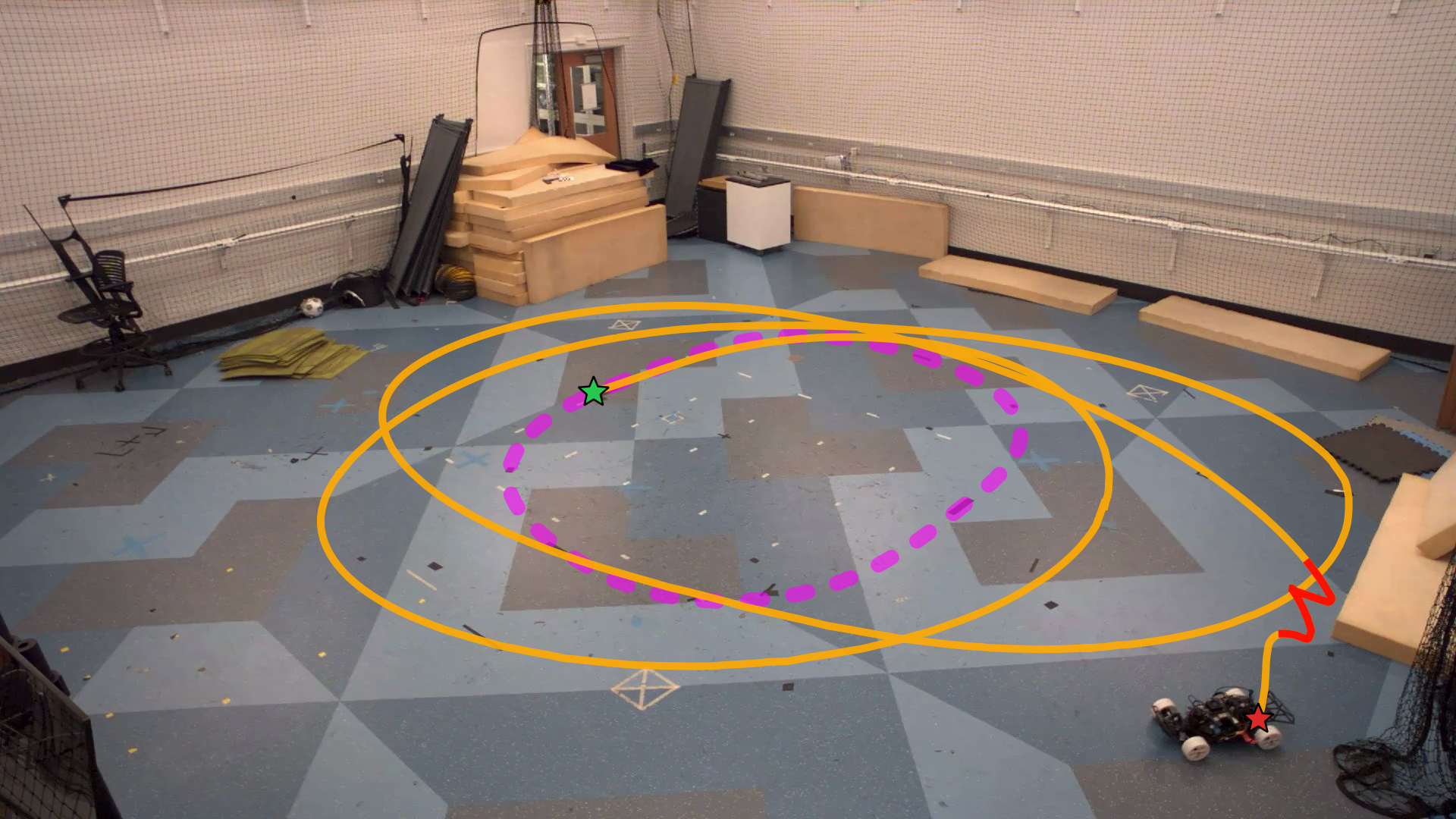
This work presents a generalized embedded implementation of Look-Back and Look-Ahead Adaptive MPC (LLA-MPC), a learning-free framework that performs online system identification by evaluating thousands of candidate models in real time. Validated on the F1TENTH platform under computation and state-estimation constraints, it completes high-speed tracking tasks on low-friction changing surfaces where a fixed nominal model fails.
中文摘要: 本文提出LLA-MPC(回看与前瞻自适应模型预测控制)的通用嵌入式实现,该框架无需学习,通过实时评估数千个候选模型实现在线系统辨识与自适应控制。作者将原仅用于仿真且模型结构固定的方法推广为模块化动力学与积分器,并在计算资源和状态估计受限的F1TENTH平台上进行验证。实验表明,在低摩擦且表面变化的条件下,LLA-MPC能够完成高速跟踪任务,而固定标称模型则失败。代码与视频已公开。
💬 Demonstrates that massively parallel online model identification can run on embedded hardware, a practical insight for adaptive MPC in legged robots facing changing terrains.
💬 证明了大规模并行在线模型辨识可在嵌入式硬件上运行,为腿式机器人应对变化地形的自适应MPC提供了实用见解。
Why read it / 推荐理由: Directly relevant to MPC on embedded systems with real-time adaptation, offering a modular and hardware-validated approach that could transfer to legged locomotion. 与嵌入式系统上的实时自适应MPC直接相关,其模块化且经硬件验证的方法可迁移至腿式运动控制。
4. Bidirectional Voronoi-biased Exploration Curriculum for Reinforcement Learning
用于强化学习的双向Voronoi偏置探索课程
Authors / 作者: Juri Pfammatter, Kaixian Qu, Clemens Schwarke, Victor Klemm, Marco Hutter
arXiv: 2610.03395 · PDF
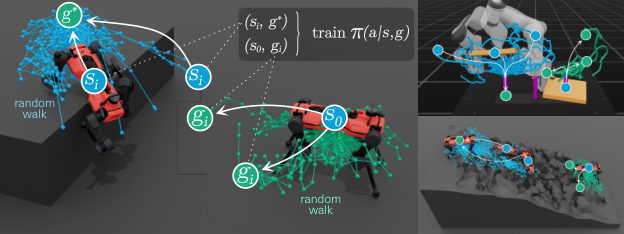
BVER is a reference-free curriculum for goal-conditioned RL that expands start states and goals bidirectionally, inspired by bidirectional RRT planning, biasing both toward unexplored task space. On quadrupedal box climbing it achieves 95% success on a 0.4 m box with roughly 65% fewer iterations than the best baseline, is the only method to learn a 0.7 m box, and produces policies robust to start, goal, and yaw variation.
中文摘要: 本文提出BVER(双向Voronoi偏置探索课程),一种无需参考运动或演示的目标条件强化学习课程方法。受双向RRT规划启发,BVER同时从目标向外扩展起始状态、从初始状态分布向外扩展目标,并利用Voronoi偏置将两者引向未探索的任务空间,最终在双向样本上训练单一目标条件策略。在点质量迷宫、四足机器人爬箱和机械臂套环任务中,BVER学习速度超过所有对比的无参考课程方法。在爬箱任务中,它以比最优基线少约65%的迭代次数在0.4米箱子上达到95%成功率,并且是唯一学会攀爬0.7米箱子的方法,所得策略对起始、目标和偏航变化具有鲁棒性。
💬 A promising automatic curriculum that improves sample efficiency and robustness for challenging legged locomotion tasks like box climbing, without relying on demonstrations.
💬 一种有前景的自动课程方法,无需演示即可提升四足爬箱等挑战性腿式运动任务的样本效率与鲁棒性。
Why read it / 推荐理由: Relevant to RL-based motion control for legged robots, especially for learning traversability over obstacles without hand-crafted curricula or demonstrations. 与腿式机器人的强化学习运动控制相关,尤其适用于无需手工课程或演示即可学习越障通行能力。
5. Hierarchical Control via MPC-RL for Multi-Timescale Battery Systems
面向多时间尺度电池系统的MPC-RL分层控制
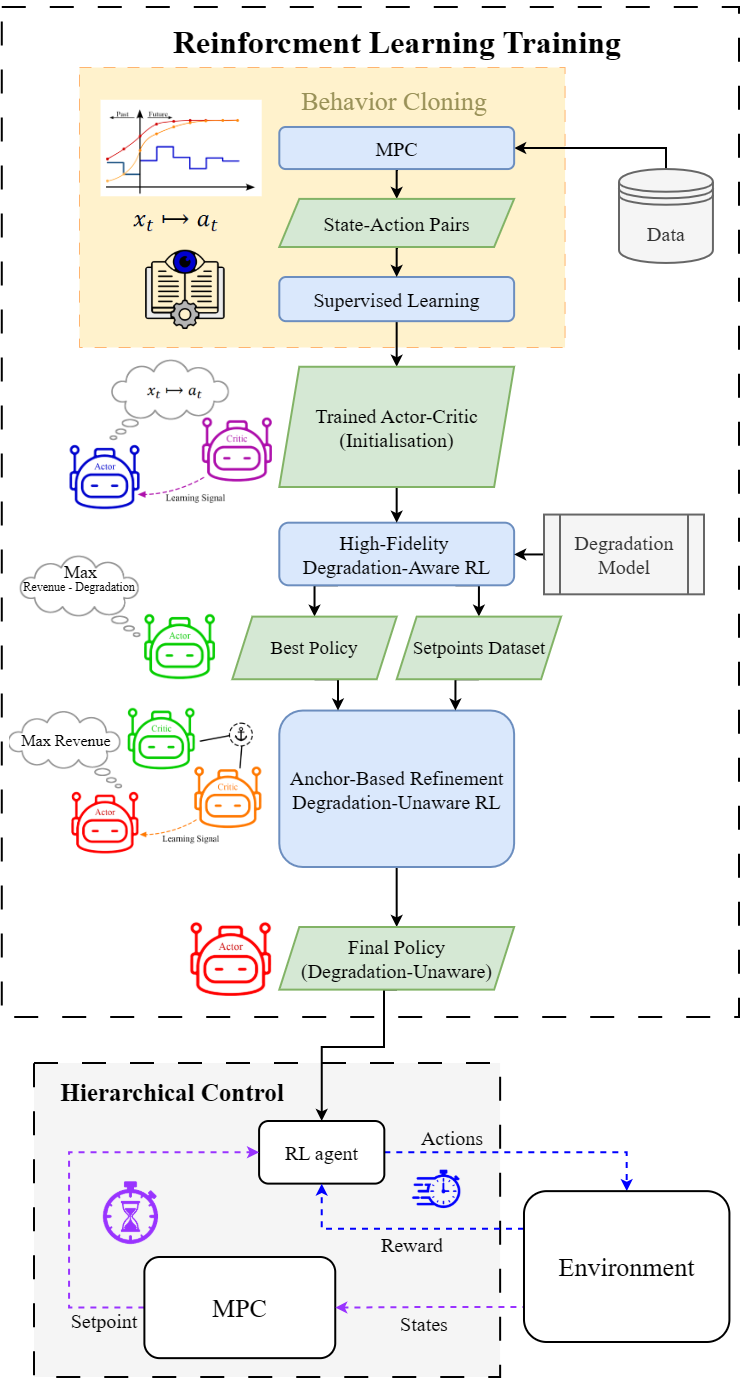
Authors / 作者: Rasa Pourjam, Ehecatl Antonio del Río Chanona, Paulina Quintanilla
arXiv: 2610.03508 · PDF
The paper proposes a hierarchical MPC-RL framework that separates slow-timescale setpoint optimization (high-level MPC) from fast-timescale tracking (low-level pretrained RL agent), applied to battery energy storage in frequency regulation markets. Compared to MPC baselines, it extends battery lifetime by 84% and increases operational profit by 34%.
中文摘要: 本文提出一种MPC与强化学习结合的分层控制框架,用于处理多时间尺度系统中快慢决策的共存问题。高层MPC在慢时间尺度上优化长期设定点,低层预训练RL智能体在快时间尺度上实时跟踪这些设定点,从而避免模型线性化或在线求解重复最优控制问题。该框架应用于参与频率调节市场的电池储能系统,以平衡秒级快速盈利机会与数周至数月的电池退化。设计采用退化感知的RL智能体离线训练生成安全长期设定点,并微调一个退化不敏感的智能体用于快速运行时跟踪。与MPC基线相比,该方法将电池寿命延长84%,运营利润提高34%。
💬 Although applied to battery systems, the MPC-RL hierarchy and multi-timescale decomposition offer a conceptual template for combining long-horizon planning with fast reactive control in robotics.
💬 尽管应用于电池系统,其MPC-RL分层与多时间尺度分解为机器人中结合长时程规划与快速反应控制提供了概念模板。
Why read it / 推荐理由: Provides a clean hierarchical MPC-RL architecture that may inspire multi-timescale whole-body control or gait generation in modular legged robots. 提供了清晰的分层MPC-RL架构,或可启发模块化腿式机器人中的多时间尺度全身控制或步态生成。