机器人日报
机器人论文日报 — 2026-10-04
🤖 Scanned 39 papers from the last 3 days of arXiv announcements (cs.RO / eess.SY / cs.LG), picked 5 for modular & legged robotics — summarized by DeepSeek.
🤖 从近 3 天的 arXiv 新论文(cs.RO / eess.SY / cs.LG)中扫描 39 篇,围绕模块化与足式机器人精选 5 篇 — 由 DeepSeek 生成双语摘要。
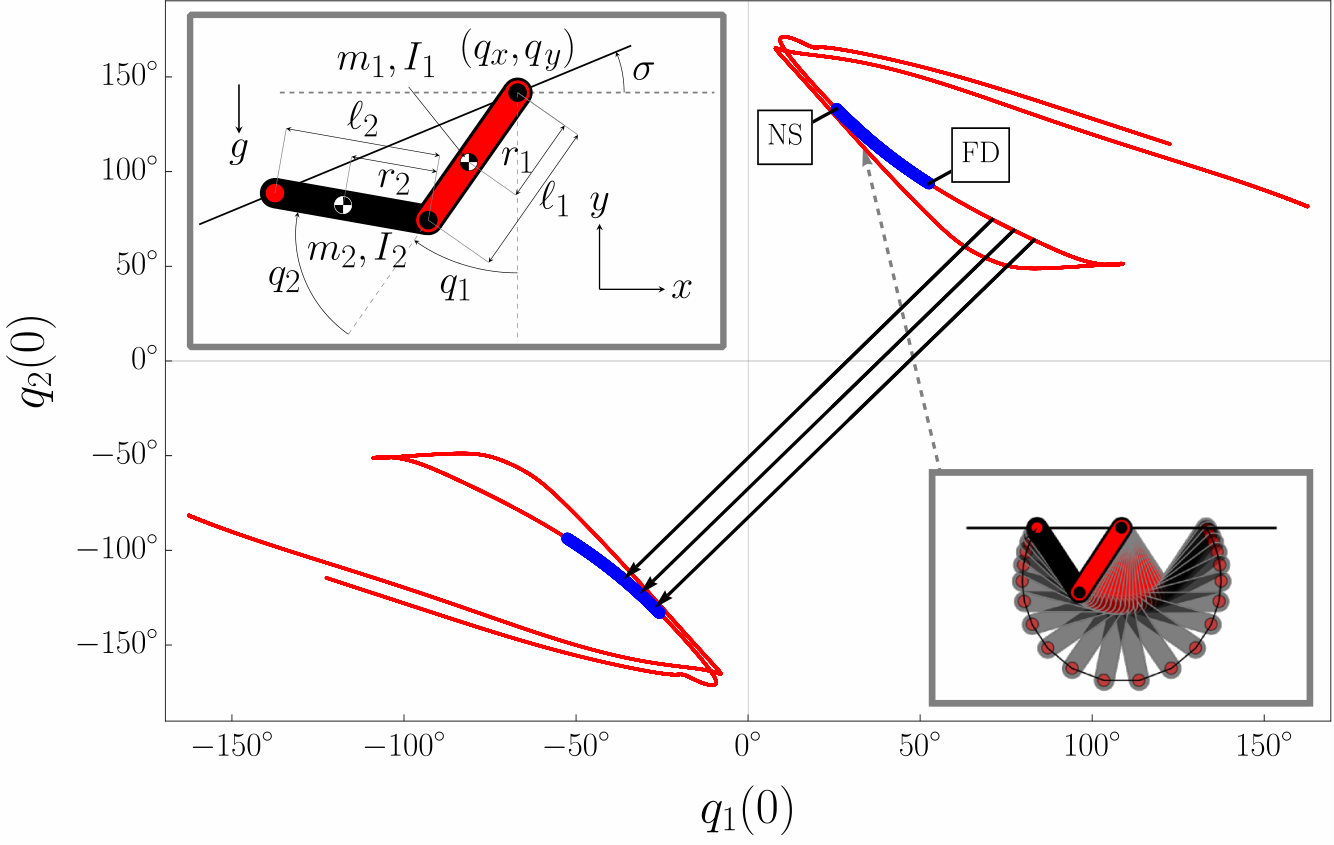
1. The Effect of Gait Stability Based on Two Types of Impact Strategies for Two-Link Walking and Brachiating Robots
双连杆步行与臂行机器人两种冲击策略下的步态稳定性影响研究
Authors / 作者: Alan Estrada Flores, Nelson Rosa Jr
arXiv: 2610.01004 · PDF
This paper investigates the impulsive dynamics of single-joint, two-link models for walking and brachiating gaits, focusing on how slope and switching time affect gait stability. It compares time-based and state-based switching strategies and analyzes bifurcations within families of gaits, providing theoretical insights into hybrid limit cycles for legged locomotion.
中文摘要: 本文研究了单关节双连杆模型在步行和臂行步态中的脉冲动力学,重点分析了坡度和切换时间对步态稳定性的影响。通过对比基于时间和基于状态的切换策略,探讨了步态族中的分岔现象,为腿足机器人的混合极限环稳定性提供了理论依据。研究结果有助于理解冲击式步态在参数变化下的稳定边界,对模块化腿式机器人的步态生成与控制具有参考价值。
💬 Provides a rigorous dynamical systems perspective on gait stability that is directly applicable to the design of robust switching strategies in modular legged robots.
💬 从动力系统角度严格分析了步态稳定性,对模块化腿式机器人鲁棒切换策略的设计有直接参考价值。
Why read it / 推荐理由: Offers fundamental insights into impact dynamics and stability that can inform the control of reconfigurable legged platforms. 为可重构腿式平台的控制提供了冲击动力学和稳定性的基础性见解。
2. Multi-Reference Path Tracking Control for an Agricultural Tractor with Nonlinear Model Predictive Control
基于非线性模型预测控制的农业拖拉机多参考路径跟踪控制
Authors / 作者: Marcel Moll, Timo Oksanen
arXiv: 2610.00057 · PDF
This work develops a nonlinear model predictive control (NMPC) path tracking controller that incorporates multiple segments of a piecewise-linear reference path directly into the objective function. It presents methods for selecting viable reference segments and validates the controller in field tests, achieving a mean absolute cross-track error of 6.1 cm with an average solver convergence time of 3.45 ms.
中文摘要: 本文提出了一种非线性模型预测控制(NMPC)路径跟踪控制器,将分段线性参考路径的多个片段直接纳入目标函数中。文章给出了从完整路径中选取可行参考段的方法,并在田间试验中验证了控制器性能,平均绝对横向误差为6.1厘米,求解器平均收敛时间为3.45毫秒。该方法展示了NMPC在复杂路径跟踪中的实时性与鲁棒性,对腿式机器人的轨迹跟踪控制具有借鉴意义。
💬 Demonstrates a practical and computationally efficient NMPC formulation for path tracking that can be adapted to legged robot locomotion on uneven terrain.
💬 展示了实用且计算高效的NMPC路径跟踪公式,可适配于腿式机器人在非结构化地形上的运动控制。
Why read it / 推荐理由: Offers a real-world validated NMPC approach with fast convergence, relevant for MPC-based motion control in modular legged systems. 提供了一种经过实地验证的快速收敛NMPC方法,对模块化腿式系统的MPC运动控制具有参考意义。
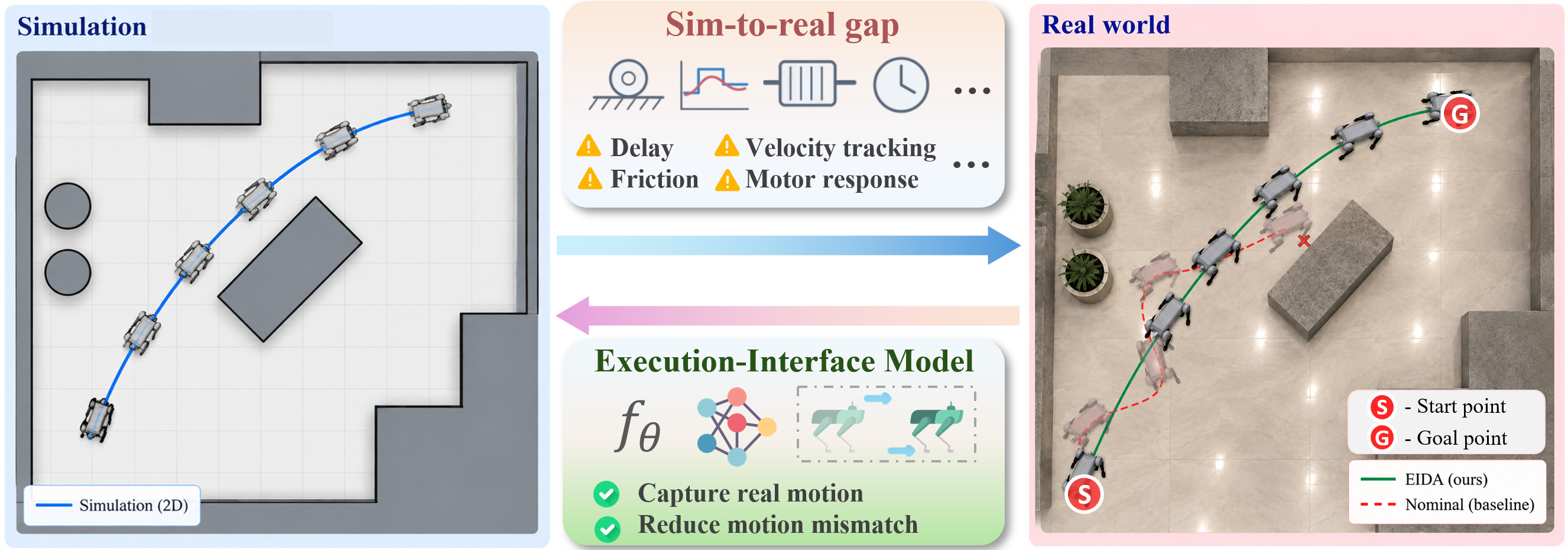
3. EIDA: Execution-Interface Dynamics Adaptation for Real-to-Sim-to-Real Robot Navigation
EIDA:面向真实-仿真-真实机器人导航的执行接口动力学自适应
Authors / 作者: Yiwei Qian, Shanze Wang, Qingyuan Hu, Xinming Zhang, Wei Zhang
arXiv: 2610.01219 · PDF
EIDA addresses sim-to-real transfer failures by fitting execution-interface dynamics from target-platform data without reconstructing actuator dynamics. It updates simulator geometry and predicts velocity feedback, and is evaluated on Jackal and Unitree Go2, achieving higher navigation success rates and zero collisions in all 20 physical Go2 trials.
中文摘要: EIDA针对仿真到现实迁移中的失败问题,提出了一种从目标平台执行数据中拟合执行接口动力学的方法,无需重建执行器动力学。该方法更新仿真器几何并预测速度反馈,在Jackal和Unitree Go2平台上验证,导航成功率显著提升,且在物理Go2的20次试验中均无碰撞到达目标。EIDA通过轻量级GPU并行仿真器实现了高效的自适应,为腿式机器人的仿真到现实迁移提供了新思路。
💬 Presents a lightweight adaptation technique that bridges the sim-to-real gap without complex actuator modeling, directly applicable to legged robot navigation.
💬 提出了一种轻量级自适应技术,无需复杂执行器建模即可弥合仿真到现实的差距,可直接应用于腿式机器人导航。
Why read it / 推荐理由: Provides a practical solution for improving sim-to-real transfer in legged robots, validated on a quadruped platform with real-world results. 为腿式机器人提供了一种改进仿真到现实迁移的实用方案,并在四足平台上进行了真实环境验证。
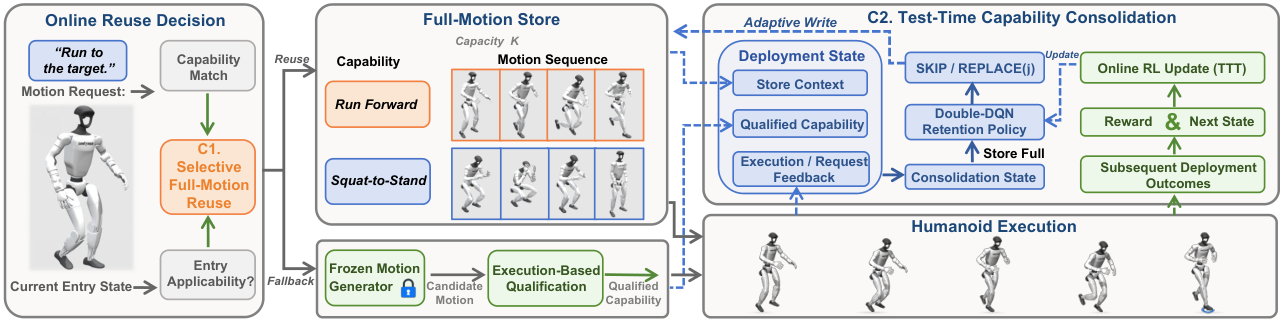
4. HumanoidTTT: Test-Time Capability Reuse for Efficient Humanoid Control
HumanoidTTT:面向高效人形控制的测试时能力复用
Authors / 作者: Jingtai Yang, Yining Wu, Yanjun Li, Zeyu Zhang, Hao Tang
arXiv: 2610.00198 · PDF
HumanoidTTT introduces a framework for test-time capability reuse in continual humanoid control, featuring Selective Full-Motion Reuse to authorize direct reuse of validated motions from certified entry states, and Test-Time Capability Consolidation to manage a bounded store of capabilities. Experiments show zero unsafe accepts and a 16.4x speedup over fresh generation, with online consolidation improving efficiency.
中文摘要: HumanoidTTT提出了一种用于持续人形控制的测试时能力复用框架,包含选择性全运动复用(仅从认证的适用入口状态直接复用已验证的完整运动)和测试时能力巩固(利用后续部署反馈在有限存储中调整合格能力的保留)。实验表明,该方法实现了零不安全接受,端到端速度比重新生成快16.4倍,在线巩固相比固定版本每200次请求额外避免13.2次生成器调用。该工作为模块化腿式机器人的技能复用与高效控制提供了新思路。
💬 Introduces a novel approach to reusing validated motion capabilities at test time, which can inspire efficient skill management in modular legged robots.
💬 提出了一种在测试时复用已验证运动能力的新方法,可启发模块化腿式机器人的高效技能管理。
Why read it / 推荐理由: Offers a framework for efficient reuse of motion skills that could be extended to modular legged systems for improved long-term autonomy. 提供了一种高效复用运动技能的框架,可扩展至模块化腿式系统以提升长期自主性。
5. Bellman Meets Lyapunov: Unsupervised Reinforcement Learning via Mastering Chaos
贝尔曼遇见李雅普诺夫:通过掌控混沌的无监督强化学习

Authors / 作者: Tristan Shah, Wooyoung Chung, Volodomyr Makarenko, Juan Wachs, Stas Tiomkin
arXiv: 2610.02012 · PDF
This paper introduces Forward CIP (F-CIP), an RL-native formulation of the Controllable Information Production objective that depends only on system dynamics, eliminating the need for selecting information variables. It proves compatibility with RL algorithms and demonstrates unsupervised discovery of primitive behaviors like balancing, and with a simple velocity reward, learns coordinated gaits such as hopping and running without reward engineering.
中文摘要: 本文提出了Forward CIP(F-CIP),一种基于可控信息产生目标的强化学习原生公式,仅依赖于系统动力学,无需选择信息变量。文章证明了F-CIP与现有RL算法的兼容性,并展示了其无监督发现平衡等基本行为的能力;结合简单的速度奖励,能学习到跳跃和奔跑等协调步态,而无需人工奖励设计。该方法通过掌控混沌来发现基本运动技能,为腿式机器人的无监督运动学习提供了新途径,有望减少奖励工程并提升步态生成的自主性。
💬 Provides a principled unsupervised RL framework that discovers locomotion primitives without reward engineering, potentially valuable for modular legged robots.
💬 提供了一个无需奖励工程即可发现运动原语的原则性无监督RL框架,对模块化腿式机器人具有潜在价值。
Why read it / 推荐理由: Introduces a novel intrinsic motivation method that could simplify reward design and enable autonomous gait discovery in legged robots. 引入了一种新颖的内在动机方法,可简化奖励设计并实现腿式机器人的自主步态发现。