机器人日报
机器人论文日报 — 2026-10-01
🤖 Scanned 583 papers from today’s arXiv announcement (cs.RO / eess.SY / cs.LG), picked 5 for modular & legged robotics — summarized by DeepSeek.
🤖 从今日 arXiv 新论文(cs.RO / eess.SY / cs.LG)中扫描 583 篇,围绕模块化与足式机器人精选 5 篇 — 由 DeepSeek 生成双语摘要。
1. Dense Temporal Motion Retargeting for Legged Robots
面向腿式机器人的密集时序运动重定向
Authors / 作者: Jaeryeong Kim, Taerim Yoon, Jin Cheng, Sungjoon Choi, Stelian Coros
arXiv: 2609.38617 · PDF
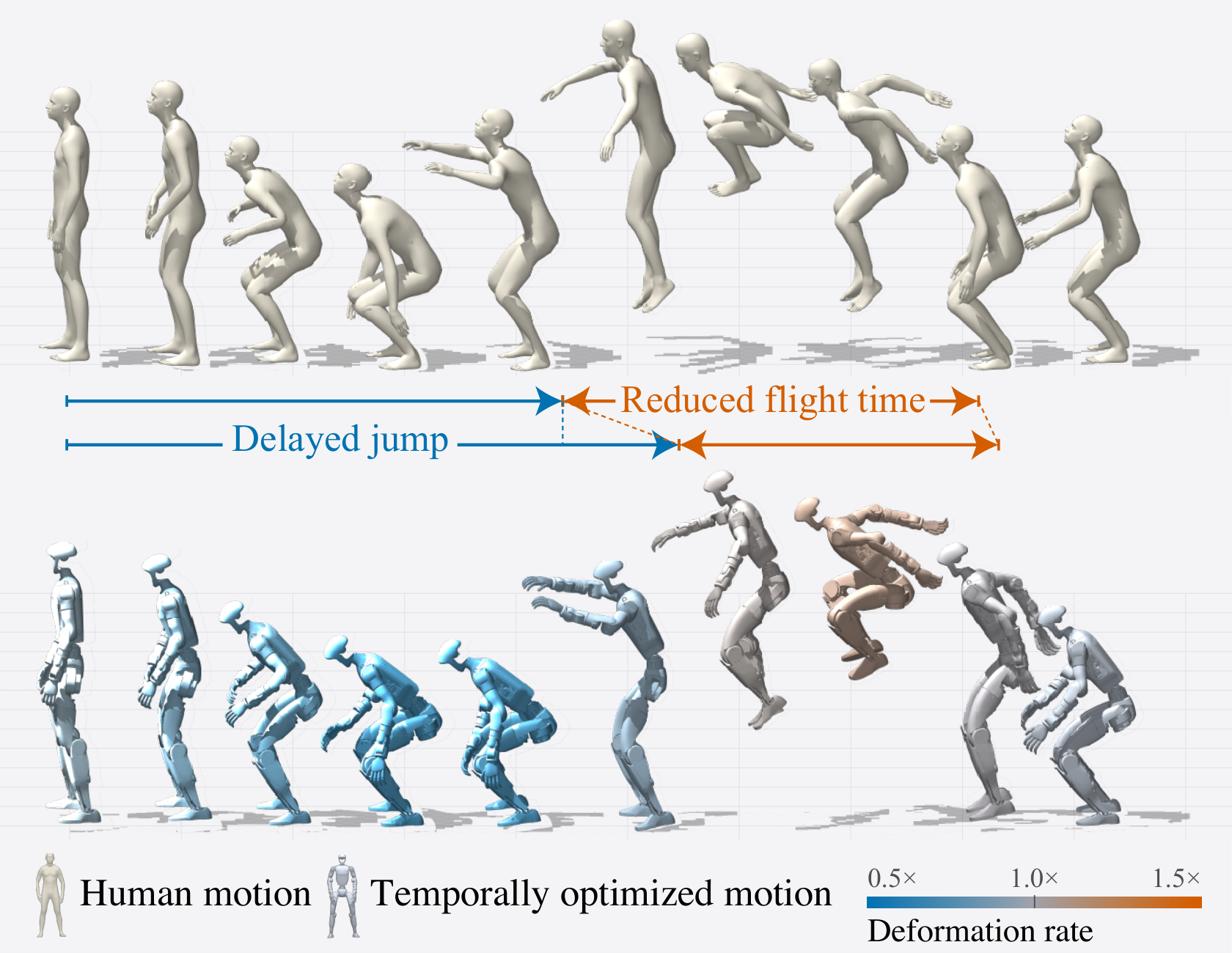
DTMR jointly optimizes motion timing and control at every control step within a single sampling-based MPC problem solved in parallel on GPU, enabling selective deformation of only the timing-critical parts of a motion. Evaluated on two hours of human motion with four humanoid robots, it outperforms temporal-deformation baselines, especially on dynamic jumps, and is ~19x faster; policies trained on its references transfer to a real humanoid.
中文摘要: 该文提出密集时序运动重定向(DTMR),将运动的时间安排与控制在同一优化问题中联合求解,且在每个控制步上进行时序调整,从而只对真正需要改变时序的片段进行变形;问题采用基于采样的模型预测控制并在GPU上并行求解。作者在四款人形机器人上用两小时人体运动数据进行评估,结果表明DTMR在动态动作(如跳跃)上明显优于基线,在相同变形预算下比时序优化基线更精确且快约19倍,并且基于其参考轨迹训练的策略成功迁移到真实人形机器人。
💬 A clean demonstration that embedding timing deformation into sampling-based MPC yields both accuracy and speed gains, with real-robot transfer.
💬 该工作清晰地表明,把时序变形嵌入基于采样的MPC可同时提升精度与速度,并实现真机迁移。
Why read it / 推荐理由: It offers a practical MPC-based retargeting recipe for dynamic legged/humanoid motions and a strong speed-accuracy argument over prior temporal optimization. 它为动态腿式/人形运动提供了一条可用的基于MPC的重定向方案,并在速度与精度上优于以往时序优化方法,值得一读。
2. LocoWM: High-Precision Locomotion through World-Model-Guided Residual Adaptation
LocoWM:基于世界模型引导残差自适应的高精度运动控制
Authors / 作者: Zijie Zhao, Shengqian Chen, Xiaoxu Wang, Han Jiang, Yuanheng Zhu, Dongbin Zhao
arXiv: 2609.39179 · PDF
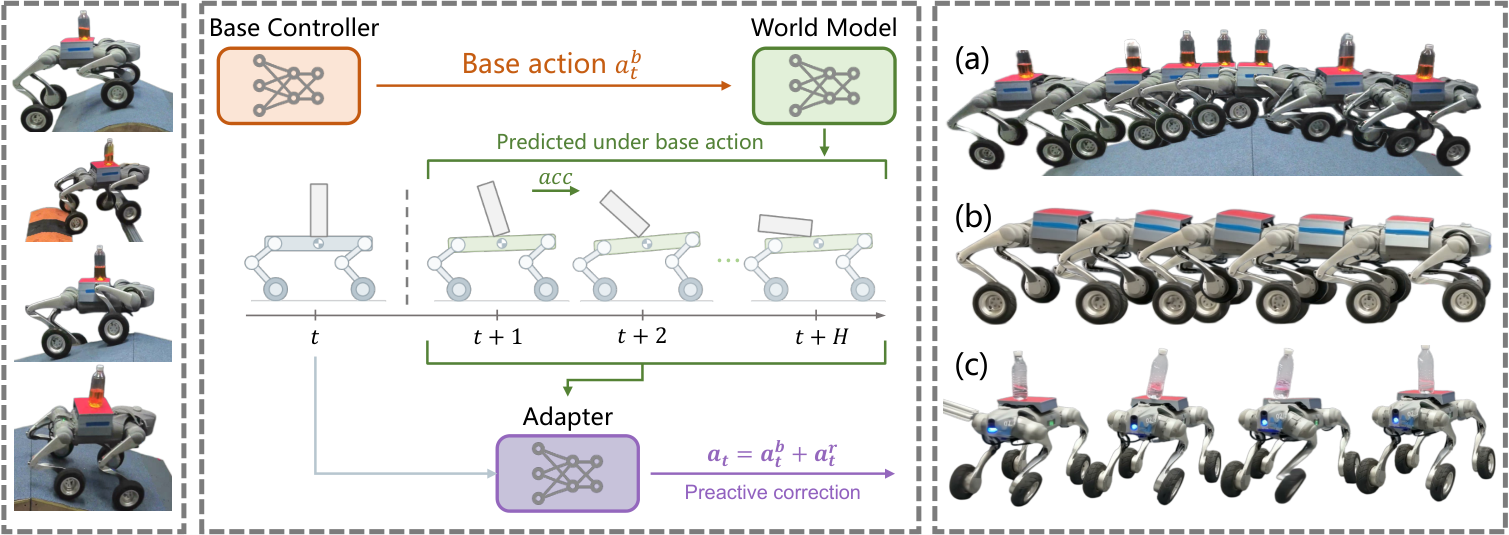
LocoWM trains a base locomotion policy plus an action-conditioned world model that predicts future proprioceptive states, then freezes both and learns a residual adapter that preactively corrects anticipated deviations instead of reacting after the fact. Two-stage training cleanly separates locomotion learning from precision adaptation, yielding improved precision and robustness over end-to-end and reactive residual baselines on terrain leveling, acceleration compensation, and push recovery.
中文摘要: LocoWM提出一种世界模型引导的预主动残差自适应框架:先训练基础运动策略和一个以动作为条件的世界模型,从本体感受历史与基础动作预测未来物理状态序列;随后冻结这两个模块,训练残差适配器根据预测序列生成加性动作修正,以补偿预期偏差而非事后反应。两阶段训练将运动能力获取与精度自适应解耦。在地形平整、加速度补偿和推力恢复任务上,该方法相较端到端和反应式残差基线在控制精度与扰动鲁棒性上均有提升。
💬 The preactive residual formulation is a neat way to add precision to an existing locomotion policy without retraining it, which is attractive for modular controllers.
💬 预主动残差形式无需重训即可为已有运动策略增加精度,对模块化控制器设计具有吸引力。
Why read it / 推荐理由: The two-stage world-model-plus-residual design is directly reusable for adding task-precision layers on top of a general legged locomotion policy. 两阶段的世界模型加残差设计可直接复用于在通用腿式运动策略之上叠加任务精度层。
3. Beyond Policy Alignment: Closing the Planning-Learning Loop for Robot Control with Learned World Models
超越策略对齐:用学习世界模型闭合机器人控制的规划-学习回路
Authors / 作者: Kowndinya Boyalakuntla, Yuhan Liu, Abdeslam Boularias
arXiv: 2609.39751 · PDF
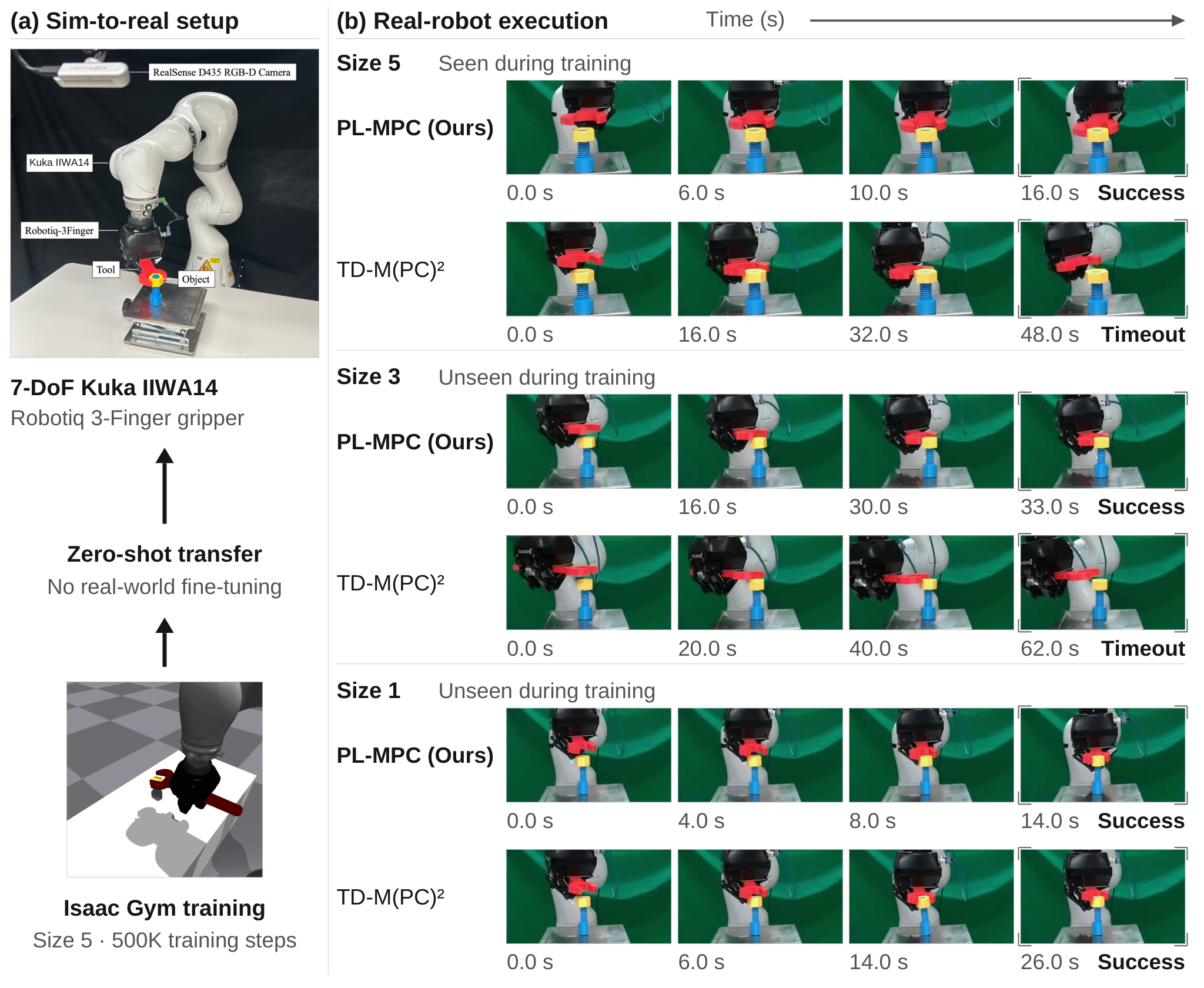
PL-MPC augments TD-MPC-style planning-learning loops by changing critic supervision and planner terminal-value estimation: hybrid multi-step TD targets, disagreement-aware terminal values to downweight uncertain critic estimates during MPPI planning, and return-weighted actor distillation favoring high-return planner-executed actions. On HumanoidBench it substantially raises returns on balance-hard and hurdle while staying competitive on DMControl, with ablations revealing task-dependent component interactions.
中文摘要: 该文提出PL-MPC,在TD-MPC类规划-学习框架上进一步改进 critic 监督与规划器终值估计:采用混合多步TD目标让critic在自举前接触更多真实回报;用不一致性感知的终值估计降低MPPI规划中不确定critic值的影响;并通过回报加权策略蒸馏强调高回报回合中规划器实际执行的动作。世界模型结构与MPPI优化器保持不变。在HumanoidBench上,balance-hard的TAR从98±18提升到387±255,hurdle从199±13提升到466±200,在DMControl上仍具竞争力,消融显示不同任务中组件交互存在差异。
💬 A focused study of the critic-supervision and terminal-value side of the planning-learning loop, with clear ablations rather than blanket benchmark claims.
💬 该工作聚焦规划-学习回路中critic监督与终值估计一侧,消融清晰,未做泛化性夸大。
Why read it / 推荐理由: For MPC-leaning legged researchers, it offers concrete, low-overhead modifications that improve learned planner performance on humanoid benchmarks. 对偏MPC的腿式研究者而言,它给出了若干低开销修改,可提升学习型规划器在人形基准上的表现。
4. Experience-Driven Continual Learning of Terrain Traversability for Quadruped Robots
面向四足机器人的经验驱动地形可通过性持续学习
Authors / 作者: Luca Bricarello, João Carlos Virgolino Soares, Alberto Sanchez-Delgado, Fulvio Mastrogiovanni, Claudio Semini
arXiv: 2609.39755 · PDF
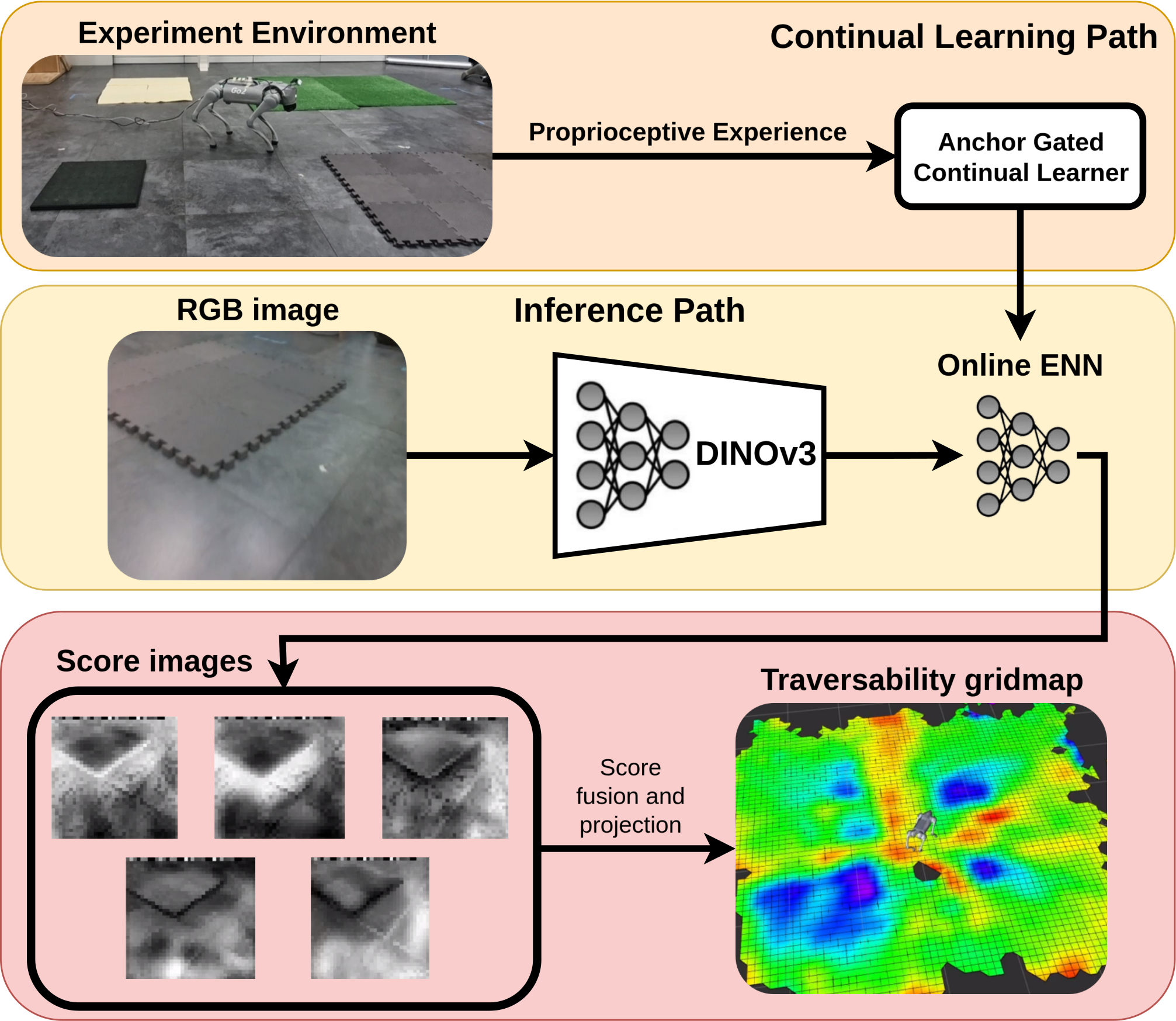
The paper learns pre-contact traversability from DINOv3 visual descriptors mapped by an evidential regressor to five proprioceptive interaction indicators (slip, normal force, traction, cost of transport, touchdown loading rate) with aleatoric and epistemic uncertainty. Continual adaptation uses bounded experience replay plus a validation gate, and predictions with uncertainty are projected into a local multilayer map for downstream planning, linking locomotion experience to conservative traversability scoring without retraining for weight changes.
中文摘要: 该文利用冻结的DINOv3骨干网络从接触前图像生成视觉描述子,并通过紧凑的证据回归器预测五个本体感受交互指标(平面足滑移、平均法向地面反力、牵引指数、运输代价、触地加载率)及其偶然与认知不确定性。持续学习结合有界经验回放与验证门控,仅在候选模型对近期留出数据提升且对历史留出数据退化在容差内时替换部署模型。预测与认知不确定性被投影到局部多层地图并合成保守可通过性评分图,权重可调整而无需重训,服务于下游导航。
💬 Connects experience-based proprioceptive labels with uncertainty-aware traversability mapping, a promising direction for traverse-aware path planning on legged platforms.
💬 把基于经验的本体感受标签与不确定性感知可通过性建图联系起来,对腿式平台的可通过路径规划很有前景。
Why read it / 推荐理由: It directly feeds the reader’s interest in traverse-capability-aware path planning by turning locomotion experience into uncertainty-aware traversability maps. 该文将运动经验转化为带不确定性的可通过性地图,直接契合读者对可通过能力感知路径规划的关注。
5. Systematically Exploring the Capabilities of GPT-6 Astra as Embodied Policies
系统评估GPT-6 Astra作为具身策略的能力
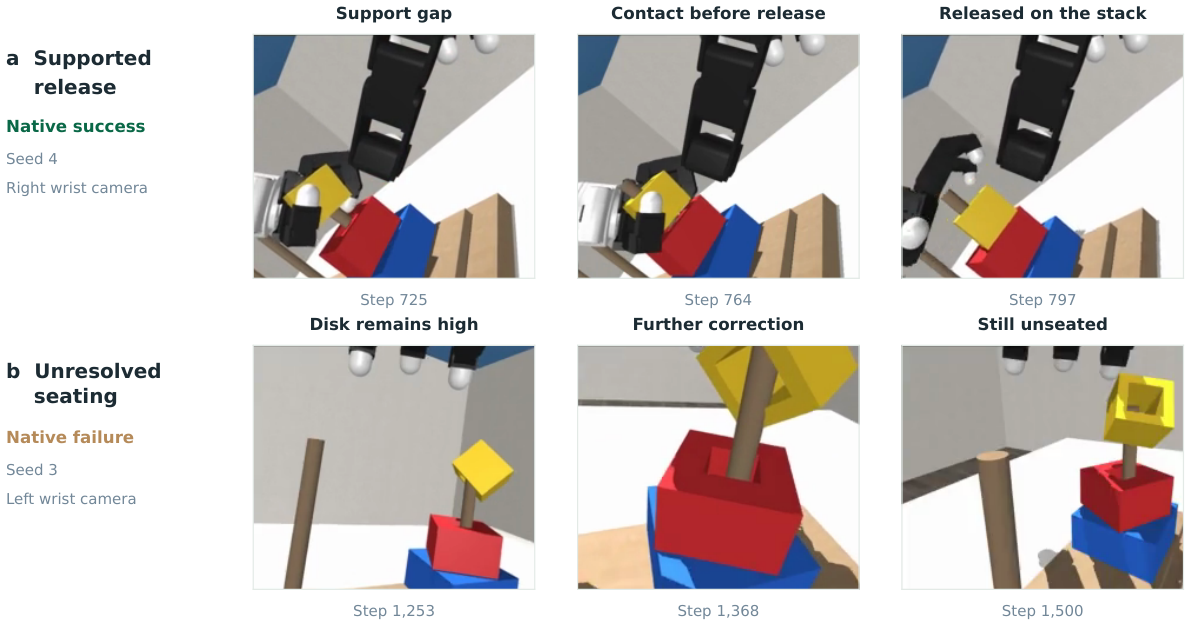
Authors / 作者: Galbot Team, Xuchuan Chen, Xiaoqian Cheng, Yu Deng, Lihe Ding, Shaocong Dong et al.
arXiv: 2609.38537 · PDF
This paper benchmarks GPT-6 Astra as an embodied policy across manipulation, dexterous manipulation, mobile manipulation, navigation, locomotion, and humanoid loco-manipulation, mixing direct control, hybridization with learned policies, and feedback-driven adaptation. Hybrid control with π0.5 reaches 48% on RoboDojo, 50% on DexJoCo, and 38.7% on RoboCasa365, and Astra beats baselines on 13/30 HumanoidBench tasks; however, dense motion-reference generation for locomotion fails across all five obstacle-course attempts, revealing a gap between high-level decisions and reliable low-level action generation.
中文摘要: 该文系统评估GPT-6 Astra作为具身策略的能力,覆盖夹爪操作、灵巧操作、移动操作、导航、运动控制和人形locomanipulation,考察直接控制、与学习策略混合以及反馈驱动自适应三种模式。与π0.5混合控制在RoboDojo子集达48%成功率,DexJoCo十次试验达50%,RoboCasa365达38.7%;在人形locomanipulation中,Astra在30个HumanoidBench任务中的13个超过基线方法。但在运动控制中,密集运动参考生成不可靠:单个障碍赛道的五次连续尝试均未到达目标,尽管稳定性与前向推进有改善,揭示了高层任务决策与可靠底层动作生成之间的差距。
💬 A useful capability-boundary study showing where VLM/VLA-style policies still fail for legged locomotion, especially dense motion-reference generation.
💬 该研究揭示了VLM/VLA式策略在腿式运动(尤其密集运动参考生成)上仍会失败的能力边界。
Why read it / 推荐理由: It gives an honest, multi-domain baseline for knowing when to trust foundation-model policies versus dedicated locomotion controllers. 它提供了诚实的多领域基线,有助于判断何时应信任基础模型策略、何时应使用专用运动控制器。