机器人日报
机器人论文日报 — 2026-09-30
🤖 Scanned 1182 papers from today’s arXiv announcement (cs.RO / eess.SY / cs.LG), picked 5 for modular & legged robotics — summarized by DeepSeek.
🤖 从今日 arXiv 新论文(cs.RO / eess.SY / cs.LG)中扫描 1182 篇,围绕模块化与足式机器人精选 5 篇 — 由 DeepSeek 生成双语摘要。
1. Passive-Dynamic-Walking-Inspired Dynamics Guidance for Energy-Efficient Humanoid Locomotion
受被动动态行走启发的动力学引导实现高能效人形机器人运动
Authors / 作者: Hyeonjin Choi, Joongheon Kim, Daekyum Kim
arXiv: 2609.35935 · PDF
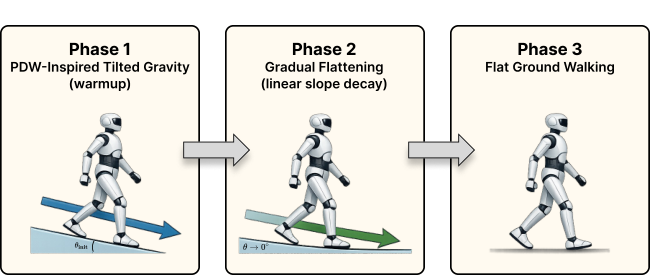
This work proposes a PDW-inspired training framework that temporarily applies a tilted-gravity field together with curriculum-coupled reward terms to shape early learning toward mechanically economical gait coordination, then removes all PDW-specific guidance before nominal-dynamics optimization. On a 29-DoF Unitree G1 across five seeds, it cuts mechanical cost of transport by 6.8-15.2% over 0.5-2.0 m/s without harming velocity tracking, with the benefit attributed to reduced positive actuator work and extending to unassisted omnidirectional locomotion.
中文摘要: 该文针对强化学习仅通过能耗惩罚间接引导步态力学的问题,提出一种受被动动态行走(PDW)启发的动力学引导框架:训练早期在平坦碰撞几何上施加倾斜重力场,模拟下坡等效条件,并配合与课程耦合的奖励项促进经济步态发现,随后在标称动力学优化前完全移除所有 PDW 专属引导。整个框架无需参考轨迹、步态相位或接触时序。在 29 自由度 Unitree G1 上以五个随机种子进行前向运动实验,在 0.5–2.0 m/s 速度范围内将机械运输代价降低 6.8%–15.2%,且不损害速度跟踪性能。机械功分解表明能耗降低主要来自正执行器做功的减少;奖励匹配对比进一步区分了引导阶段加快步态习得与重力倾斜对收敛后经济性的额外贡献。该方法还可扩展至无辅助的全向运动,在行走专用运动先验提供运动学协调后收益依然存在。
💬 A neat bio-inspired training trick—slope-equivalent gravity shaping—that yields measurable energy savings on real humanoid hardware without extra sensing or reference motion.
💬 一个简洁的生物启发式训练技巧——斜坡等效重力整形——在无需额外传感或参考运动的情况下,于真实人形硬件上取得可测量的节能效果。
Why read it / 推荐理由: It offers a concrete, seed-validated recipe for cutting cost of transport in RL locomotion policies, directly relevant to designing energy-aware controllers for modular legged platforms. 它提供了经多种子验证的RL运动策略节能方案,对模块化腿式平台的能耗敏感控制器设计具有直接参考价值。
2. Predictive Safety Curricula for Robust Legged Locomotion
面向鲁棒腿式运动的预测性安全课程学习
Authors / 作者: Ivan Ovinnikov, Pascal Sutter, Christian Gehring, Jordis Herrmann
arXiv: 2609.37070 · PDF
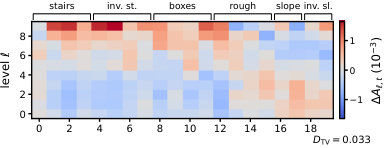
PSC trains a distributional safety critic from policy rollouts and uses its forecasts of future safety cost to prioritize terrain contexts and randomized events during locomotion training, leaving the task reward and policy loss unchanged. It outperforms terrain progression, advantage-based replay, and learning-progress curricula, and on ANYmal-D hardware reduces shank-collision incidence by 63% relative to the learning-progress curriculum across three seeds, while eliminating observed shank collisions on a production stair-climbing platform.
中文摘要: 标准课程学习主要调节任务难度而非安全关键经验的分布,导致平均性能高但罕见且后果严重的失败持续存在。本文提出预测性安全课程(PSC)框架:从策略 rollout 中训练分布式安全评论家,利用其对未来安全代价的预测来优先采样地形上下文与历史随机事件,仅改变训练分布而不改动任务奖励与策略优化损失。在受控崎岖地形运动及两套生产级运动系统中评估,PSC 相对地形推进、优势回放和学习进度课程均提升可靠性,在困难地形与观测退化时增益最大。在 ANYmal-D 硬件上以三个匹配种子将小腿碰撞发生率相对学习进度课程降低 63%,且每个种子均有下降;在生产爬楼梯平台上,评估试验中消除了观测到的小腿碰撞。
💬 Treats safety as a curriculum-allocation problem rather than a reward-shaping problem, with a convincing hardware-level collision reduction on a commercial quadruped.
💬 将安全性视为课程分配问题而非奖励塑形问题,并在商用四足平台上给出有说服力的硬件级碰撞降低结果。
Why read it / 推荐理由: Its allocation principle is embodiment-agnostic and can be transferred to multi-legged modular platforms where safety-critical terrain experience is scarce. 该分配原理与具体构型无关,可迁移至安全关键地形经验稀缺的多足模块化平台。
3. Recompositional Robotics: Cross-Domain, Open-set, and Lifelong Modularity Beyond Morphology
重构机器人学:超越形态的跨域、开放集与终身模块化
Authors / 作者: Steven Swanbeck, Jonathan Salfity, Corrie Van Sice, Robert Blake Anderson, Mitch Pryor
arXiv: 2609.37734 · PDF
This position paper reframes modular robotics around changing a robot’s fundamental capabilities rather than only its structure, introducing the notions of integration span (cross-domain reconfigurability across kino-dynamics, perception, compute, and coordination) and integration inertia (resistance to reconfiguration). It argues that current modular robots reduce inertia mainly in the structural domain while it remains high elsewhere, and defines recompositional robotics as adaptation over a heterogeneous module set that maximizes span while minimizing inertia.
中文摘要: 模块化机器人研究已能实现在线改变机器人形态,并能把形态决策自动传播到运动规划与控制中。然而作者指出,更具潜力的目标不是让机器人结构可变,而是让其基本能力可变,能力是运动动力学、感知、计算与高层协调行为等多个域的联合函数。为此,文章提出“集成跨度”(integration span)以刻画跨域重构能力,并提出其对偶概念“集成惯量”(integration inertia)以度量重构阻力。当前模块化机器人只在结构域降低了集成惯量,而在其他贡献于集成跨度的域中惯量仍然很高。作者主张,实践中效用最大的系统是那些最大化跨度并最小化惯量的系统,并将这一一般性问题称为重构机器人学:在一组异构模块(含算法、感知与结构模块)上实现开放集、终身的适应性。
💬 A conceptual framework that broadens modularity from hardware-only reconfiguration to capability-level adaptability—useful vocabulary for modular legged robot research.
💬 一个将模块化从纯硬件重构扩展至能力级适应性的概念框架,为模块化腿式机器人研究提供了有用的术语体系。
Why read it / 推荐理由: It gives the reader a principled way to argue why reconfigurable leg modules matter beyond morphology, and how to reason about cross-domain module interfaces. 它让读者能从原理上论证可重构腿模块超越形态的意义,并为跨域模块接口设计提供思路。
4. EquivDP3: A SIM(3)-Invariant Point-Cloud Encoder for Data-Efficient Humanoid Loco-Manipulation
EquivDP3:面向数据高效人形移动操作任务的 SIM(3) 不变点云编码器
Authors / 作者: Abu Hanif Muhammad Syarubany, Chang D. Yoo
arXiv: 2609.36575 · PDF
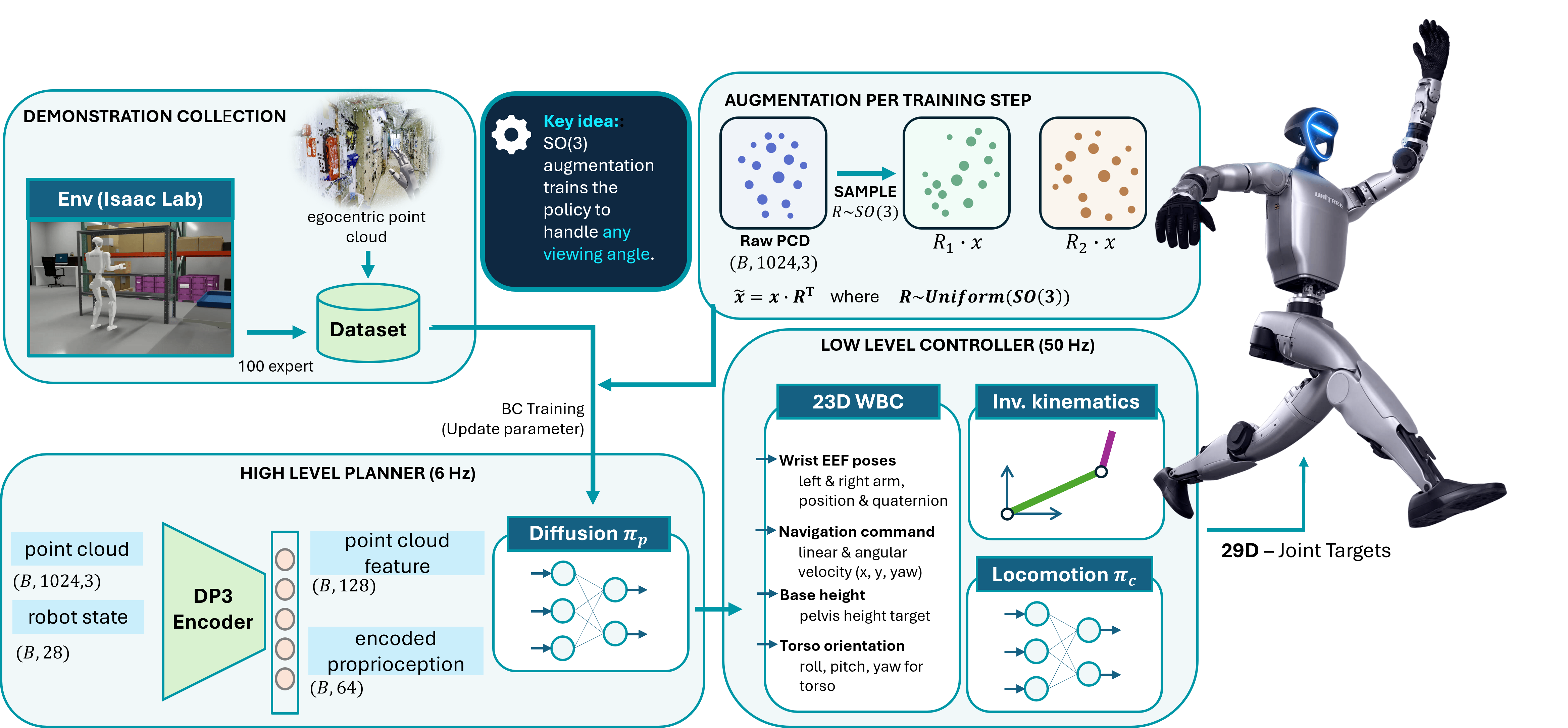
EquivDP3 extends SIM(3)-equivariant vector-neuron encoders from wheeled manipulators to a 43-joint Unitree G1 humanoid, using a two-stage policy where a high-level diffusion planner with an equivariant point-cloud encoder emits 6 Hz whole-body command chunks executed at 50 Hz by a frozen pretrained RL locomotion policy plus differential IK for the arms. Across two IsaacLab benchmarks and four non-equivariant baselines, its advantage concentrates in the low-data regime, reaching 67.1% success at 5-10 demonstrations versus 38.2-52.4% for baselines, while all encoders converge at 50-100 demonstrations.
中文摘要: 面向物体位姿与光照泛化的视觉运动策略通常仅有少量示范可用。3D 扩散策略(DP3)虽以点云特征条件化扩散动作生成器,但其 PointNet 式编码器缺乏对旋转、平移与缩放(SIM(3))的内置等变性。本文将该等变性思想从轮式操作臂扩展到结构显著更复杂的 43 自由度 Unitree G1 人形机器人,提出 EquivDP3 两阶段策略:高层扩散规划器采用 SIM(3) 等变向量神经元网络编码器,以 6 Hz 输出全身指令块,再由冻结的预训练 RL 运动策略以 50 Hz 执行,手臂部分由微分逆运动学模块处理,整体以行为克隆端到端训练。在两个 IsaacLab 仿真基准与四个非等变基线对比中,其优势集中于低数据区间:5–10 个示范时成功率达 67.1%,而基线为 38.2%–52.4%;当示范数增至 50–100 时各编码器趋于收敛(74.3%–85.2%)。仅本体感觉消融实验证实该差距确为感知能力差异所致。
💬 Brings SIM(3) equivariance into whole-body humanoid loco-manipulation and shows the payoff is concentrated exactly where real robot demonstration collection is hardest—the low-data regime.
💬 将 SIM(3) 等变性引入人形全身移动操作,并证明其收益恰好集中在真实机器人示范采集最困难的低数据区间。
Why read it / 推荐理由: It demonstrates how structured geometric priors in perception can be combined with a frozen RL locomotion controller, a decomposition pattern directly reusable for modular leg platforms. 它展示了如何在感知端引入结构化几何先验并与冻结的RL运动控制器结合,这一分解范式可直接复用于模块化腿式平台。
5. OTRetarget: Joint Robot and Object Motion Retargeting via Optimal Transport
OTRetarget:基于最优传输的机器人与物体联合运动重定向
Authors / 作者: Guillaume Besset, Erwann Carn, Timothée Carecchio, Valentin Tordjman-Levavasseur, Fabian Schramm, Yann de Mont-Marin et al.
arXiv: 2609.36602 · PDF
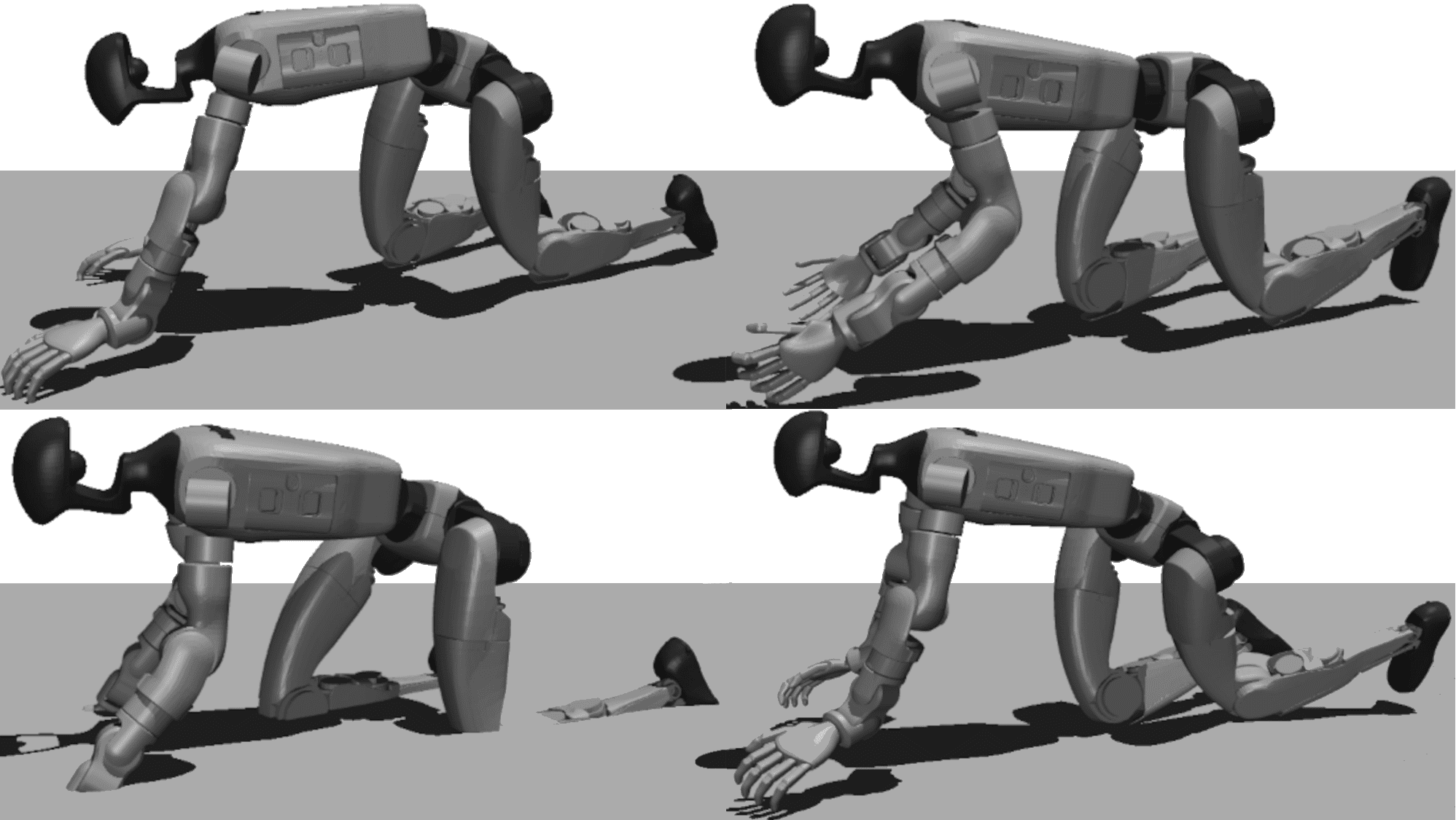
OTRetarget jointly retargets robot and multi-object motion from human demonstrations by representing surface interactions as signed distances, closest surface points, and relative directions, then transferring them across human, robot, and object geometries via entropic optimal transport. These interaction targets are embedded in a constrained inverse-kinematics formulation that balances contact preservation with motion style and simultaneously optimizes robot and object poses per frame, achieving 87% robot-object interaction Jaccard score and 8.7 mm depth error on OMOMO versus 28% and 29.3 mm for OmniRetarget.
中文摘要: 将人类动作迁移至人形机器人时,不仅需要适应机器人形态,还需在体型比例差异下保持与地面及被操作物体的接触一致性;然而仅靠骨骼运动无法完整描述这些交互,固定物体轨迹又会限制新构型的适应能力。本文提出 OTRetarget,一种从人类示范中联合重定向机器人与多物体运动的统一方法。该方法用带符号距离、最近表面点与相对方向表示表面交互,并借助熵正则最优传输在人体、机器人与物体几何之间迁移这些量。所得交互目标被嵌入一个约束逆运动学问题中,在保持接触与维持运动风格之间取得平衡,并逐帧联合优化机器人与物体位姿。该形式无需对场景或示范进行缩放即可处理机器人—物体及物体—物体交互。在 OMOMO 数据集上,机器人—物体交互 Jaccard 分数达 87%,深度误差 8.7 mm,而 OmniRetarget 分别为 28% 与 29.3 mm,并给出在真实机器人上的演示。
💬 A principled optimal-transport formulation of contact-aware retargeting that jointly optimizes robot and object poses, removing the need to rescale the scene.
💬 一种基于最优传输的接触感知重定向原理化方法,联合优化机器人与物体位姿,无需对场景进行缩放。
Why read it / 推荐理由: Contact-consistent retargeting is a key enabler for reusing human motion data on modular legged robots with varying limb configurations and proportions. 接触一致的重定向是让肢体构型与比例各异的模块化腿式机器人复用人类运动数据的关键使能技术。