机器人日报
机器人论文日报 — 2026-09-29
🤖 Scanned 1245 papers from today’s arXiv announcement (cs.RO / eess.SY / cs.LG), picked 5 for modular & legged robotics — summarized by DeepSeek.
🤖 从今日 arXiv 新论文(cs.RO / eess.SY / cs.LG)中扫描 1245 篇,围绕模块化与足式机器人精选 5 篇 — 由 DeepSeek 生成双语摘要。
1. Model-Informed Safe Reinforcement Learning for Bipedal Locomotion via Step-to-Step Prediction
基于步到步预测的模型信息安全强化学习用于双足运动
Authors / 作者: Victor Paredes, Ayonga Hereid
arXiv: 2609.34486 · PDF
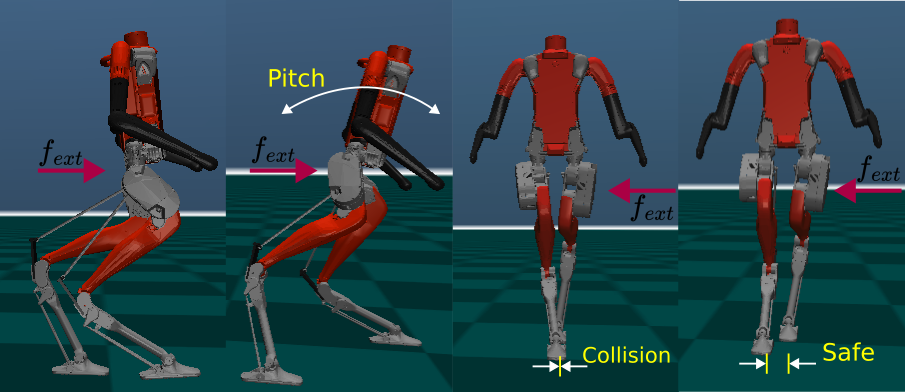
The paper proposes a model-informed RL framework for bipedal locomotion anchored to the ALIP template, using a discrete exponential control barrier function (DECBF) as both a training-time shaping signal and a runtime action filter to enforce step-to-step safety. Evaluated on the Digit humanoid in MuJoCo with a whole-body controller, the approach reduces safety violations under external disturbances compared to an unconstrained baseline, though a safety-tracking tradeoff appears under larger lateral-velocity transients.
中文摘要: 本文提出一种基于模型信息的强化学习框架,用于双足机器人运动控制。该方法以角动量线性倒立摆(ALIP)模板为锚点,通过离散指数控制屏障函数(DECBF)提供步到步的安全证书,并将其同时用作训练时的塑形信号和运行时动作滤波器,以最小调整摆动脚落点来满足模板级约束。在MuJoCo中对Digit人形机器人进行全身控制器栈评估,相比无约束基线,该方法在外部扰动试验中减少了安全违规事件,但在较大侧向速度瞬态下表现出安全与跟踪的权衡。
💬 A principled integration of template-based safety certificates with RL that could inspire safety-aware modular legged controllers.
💬 将模板级安全证书与强化学习原理性结合,可启发面向模块化腿式机器人的安全感知控制器设计。
Why read it / 推荐理由: It offers a concrete method to embed safety certificates into RL for legged robots, directly relevant to design and control of modular legged systems. 为腿式机器人强化学习提供了嵌入安全证书的具体方法,与模块化腿式系统的设计与控制直接相关。
2. Terrain-Aware Autonomous Planetary Exploration for Exteroceptive-Proprioceptive Mapping with Quadruped Scouts
基于外感-本体感知建图的四足侦察机器人地形感知自主行星探索
Authors / 作者: Alberto Sanchez-Delgado, João Carlos Virgolino Soares, Victor Barasuol, Claudio Semini
arXiv: 2609.35493 · PDF
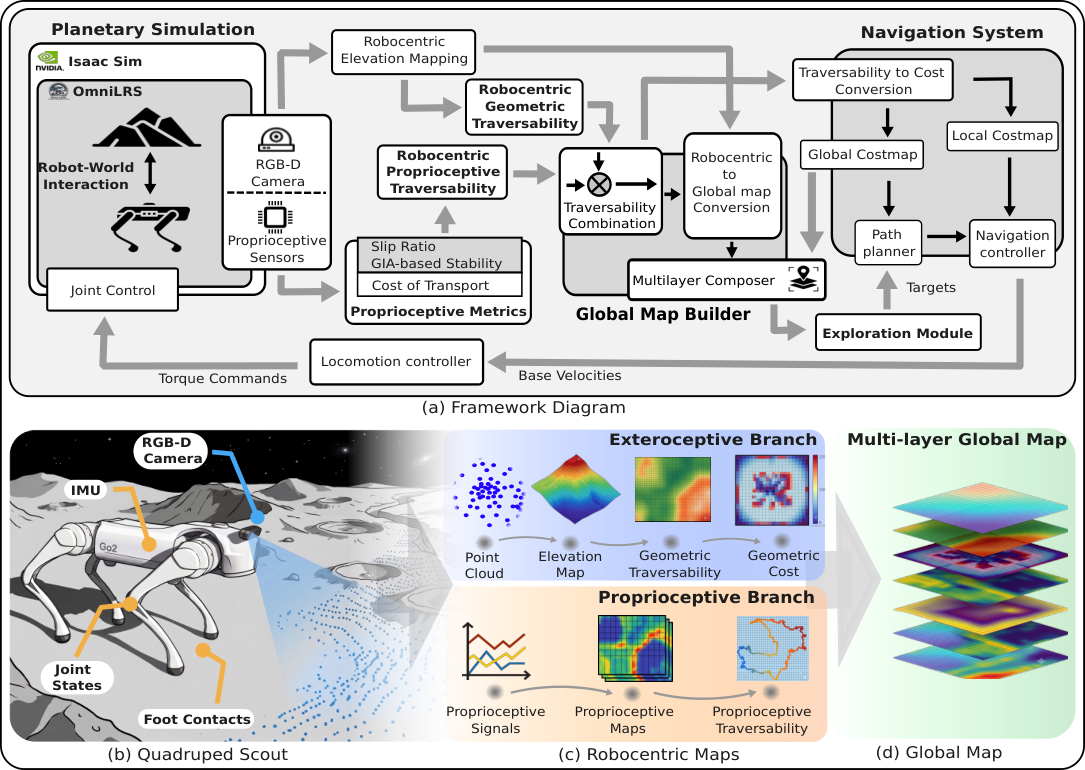
This work presents a terrain-aware exploration framework that fuses RGB-D exteroceptive mapping with proprioceptive terrain cues for quadruped robots in lunar-like environments. It builds robot-centered elevation maps, estimates traversability and navigation costs, and incrementally registers local maps into a global multi-layer representation for autonomous exploration. Isaac Sim results show autonomous map expansion and lower average cost of transport during navigation compared to initial exploration.
中文摘要: 本文提出一种面向月球样环境的四足机器人地形感知自主探索框架,融合RGB-D外感建图与本体感知地形线索。系统构建以机器人为中心的栅格高程图,估计几何可通行性并推导导航代价,同时增量式配准局部地图到全局多层表示,用于自主探索目标选择。在NVIDIA Isaac Sim中,该方法实现了自主探索、地图扩展以及地形几何与机器人-地形交互的空间关联,后续导航的平均运输代价(CoT)低于初始探索阶段。
💬 Shows how proprioceptive interaction cues can complement geometric traversability for legged exploration planning.
💬 展示了本体感知交互线索如何补充几何可通行性,用于腿式机器人探索规划。
Why read it / 推荐理由: It combines terrain-aware mapping, traversability cost, and autonomous navigation on quadrupeds, aligning with traverse-capability-aware path planning for legged robots. 结合了地形感知建图、可通行性代价与四足自主导航,契合腿式机器人穿越能力感知路径规划方向。
3. Proprioceptive Force Estimation for Quadruped Locomotion and Human-Robot Interaction
用于四足运动与人机交互的本体感知力估计
Authors / 作者: Run Wang, Xu Yang, Alapati Tuerxun, Yilin Mo
arXiv: 2609.34222 · PDF
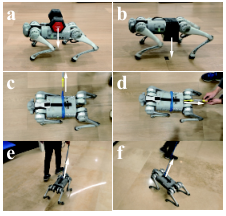
The paper jointly trains a proprioceptive force estimator and locomotion policy with supervised force and velocity outputs and learned latent context. The estimated 3D force conditions locomotion and analytically maps to planar-velocity and yaw-rate commands for leash guidance. Simulation sweeps report force RMSE of 1.44–2.83 N; compared to a domain-randomized baseline, velocity-tracking and base-orientation errors drop by 21.6% and 46.5%, survival increases from 68.29% to 94.60%, and Unitree Go1 experiments demonstrate payload and leash guidance.
中文摘要: 本文联合训练本体感知力估计器与运动策略,通过监督力/速度输出和学习潜在上下文,估计三维外力。估计力用于调节运动,并通过解析映射生成平面速度和偏航角速度指令以实现牵引引导。在持续载荷仿真中,力分量RMS误差为1.44–2.83 N;相比域随机化基线,速度跟踪和基座姿态误差分别降低21.6%和46.5%,平均存活率从68.29%提升至94.60%。Unitree Go1实验展示了静态垂直/水平力估计、承载8.5 kg(超过70 N训练力上限)载荷运动及牵引引导。
💬 A practical proprioceptive force estimation interface that supports both payload locomotion and human-robot interaction on a real quadruped.
💬 一种实用的本体感知力估计接口,在真实四足机器人上同时支持负载运动与人机交互。
Why read it / 推荐理由: It addresses force-aware locomotion and interaction on quadrupeds, relevant to whole-body control and real-robot deployment. 研究四足机器人的力感知运动与交互,与全身控制和实机部署相关。
4. Uni-VLaT: Whole-Body Tactile Adaptation of VLA Policies for Humanoid Loco-Manipulation
Uni-VLaT:用于人形运动操纵的VLA策略全身触觉自适应
Authors / 作者: Zihao Wang, Shutong Liu, Siqi Zheng, Liu Cao, Ruoqi Chen, Rundong Liu et al.
arXiv: 2609.35450 · PDF
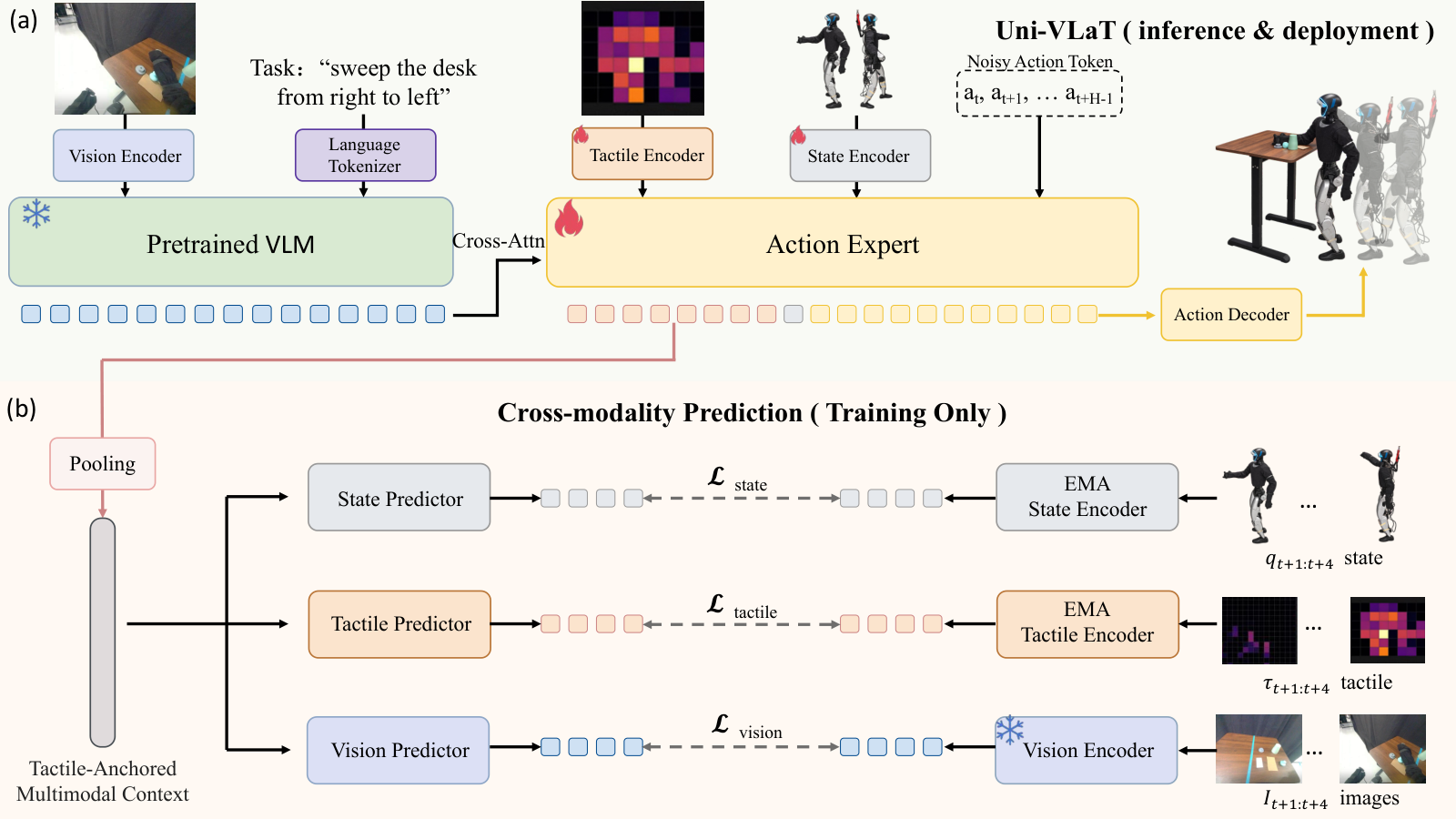
Uni-VLaT integrates distributed whole-body tactile sensing into vision-language-action policies for contact-rich humanoid loco-manipulation. A tactile pathway is trained to predict future tactile, proprioceptive, and visual representations, building a tactile-anchored multimodal context. Real-robot experiments across five tasks achieve 75% average success, outperforming a no-tactile baseline by 43 points and a tactile baseline without predictive supervision by 7 points, with large gains on Table Sweeping and Back-Tap Walking.
中文摘要: Uni-VLaT将分布式全身触觉传感集成到视觉-语言-动作(VLA)策略中,用于接触丰富的人形运动操纵。该方法引入触觉通路,不仅用于动作生成,还预测未来触觉、本体感知和视觉表示,从而构建以触觉为锚的多模态上下文。在五个真实机器人任务(触觉触发运动、持续物理交互、人机接触和运动操纵)上,平均成功率达75%,比无触觉基线高43个百分点,比无预测监督的触觉基线高7个百分点;在两个预训练VLA骨干上,桌面清扫提升30个百分点,背拍行走提升85–90个百分点。
💬 Demonstrates that predictive tactile supervision significantly improves contact-rich whole-body control on real humanoids.
💬 表明预测性触觉监督能显著提升真实人形机器人接触丰富的全身控制性能。
Why read it / 推荐理由: It shows a novel way to incorporate whole-body tactile sensing into VLA policies, with strong real-robot results relevant to whole-body control. 展示了将全身触觉传感融入VLA策略的新方法,实机结果突出,与全身控制密切相关。
5. Multi-Terrain Mastery: A Comprehensive Controller for Bipedal Locomotion
多地形掌控:一种全面的双足运动控制器
Authors / 作者: Oluwami Dosunmu-Ogunbi, Aayushi Shrivastava
arXiv: 2609.33174 · PDF
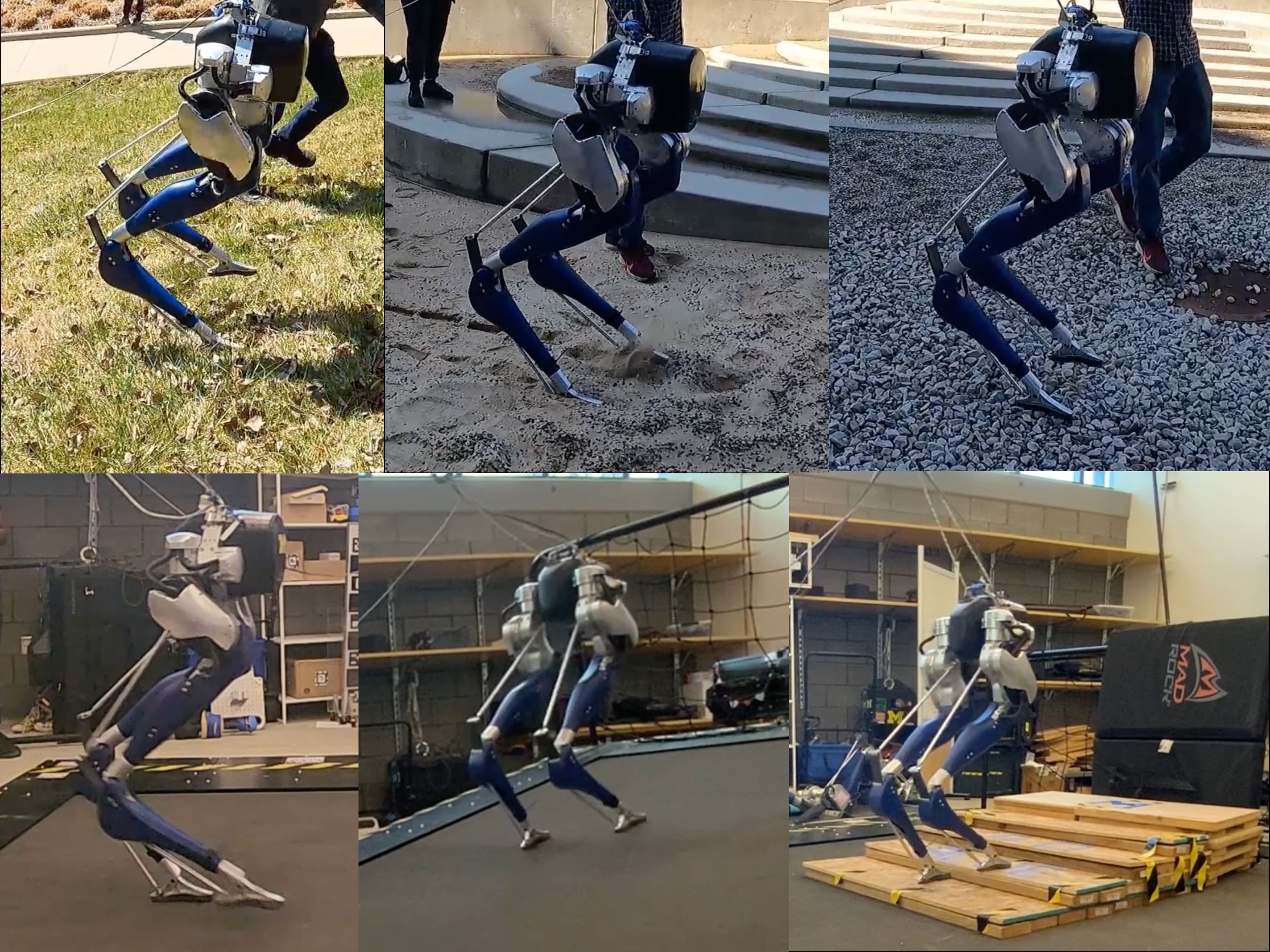
This paper presents a multi-terrain controller for bipedal locomotion that extends prior stance-ankle-based stability work to steep wet grassy slopes, compliant terrains (sand, gravel, rocks), and constrained terrains such as staircases. A new impact map is introduced to maintain robustness against unseen terrains, and the control structure for real-time deployment is detailed. Validation is performed on the 20-DoF Cassie bipedal robot.
中文摘要: 本文提出一种用于双足运动的多地形控制器,在先前基于支撑踝关节的稳定控制基础上,将能力扩展到陡峭湿滑草坡、沙地、砾石、岩石等柔性地形以及楼梯等受限地形。针对这些地形的特殊需求,引入新的冲击映射以保持对未见过地形的鲁棒性,并详细讨论了在机器人上实时部署的控制结构。控制器在20自由度的Cassie双足机器人上进行了验证。
💬 A comprehensive controller that unifies diverse terrain handling on a physical biped, valuable for robust legged locomotion design.
💬 一种在真实双足机器人上统一处理多种地形的综合控制器,对鲁棒腿式运动设计具有参考价值。
Why read it / 推荐理由: It provides a single controller validated on multiple challenging terrains with a real biped, relevant to locomotion control and sim-to-real. 提供在真实双足机器人上验证的多地形统一控制器,与运动控制和仿真到现实迁移相关。