机器人日报
机器人论文日报 — 2026-09-27
🤖 Scanned 61 papers from the last 3 days of arXiv announcements (cs.RO / eess.SY / cs.LG), picked 5 for modular & legged robotics — summarized by DeepSeek.
🤖 从近 3 天的 arXiv 新论文(cs.RO / eess.SY / cs.LG)中扫描 61 篇,围绕模块化与足式机器人精选 5 篇 — 由 DeepSeek 生成双语摘要。
1. An Analysis of Streaming Deep Reinforcement Learning for Adaptive Continual Learning in Robotics
面向机器人自适应持续学习的流式深度强化学习分析
Authors / 作者: Teeratham Vitchutripop, Alyssa Quarles, Wenhe Zhang, Richard Xue, Daniel Rakita
arXiv: 2609.28807 · PDF
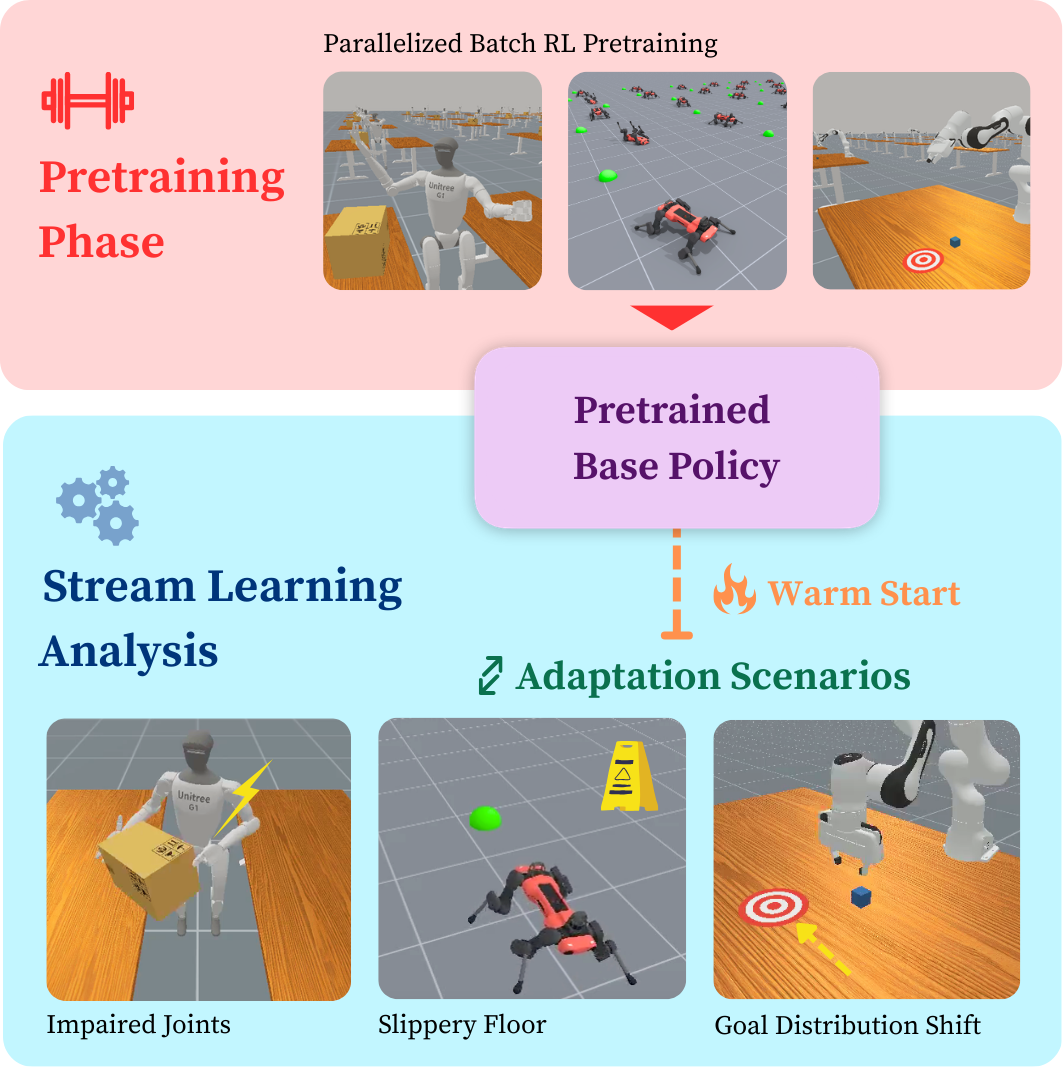
This paper presents the first systematic analysis of streaming deep RL for continual adaptation in robotics, where policy updates use only the latest experience after an initial pretraining phase. Experiments on quadruped locomotion show that with suitable optimizers and plasticity-loss mitigation, the policy rapidly adapts online to changes in the robot body, environment, and goals, outperforming batch-based on-policy methods.
中文摘要: 本文首次系统分析了面向机器人自适应持续学习的流式深度强化学习:在初始预训练阶段之后,策略更新仅使用最新经验,而非批量离线数据。作者在四足机器人运动任务上实验,发现配合特定优化器与可塑性损失缓解技术,网络能够利用预训练中的任务知识,在线快速适应自身结构、环境和目标的变化。结果表明流式学习优于基于批处理的同策略方法,任务成功率更高,为腿足机器人终身适应未知变化提供了一条可行路径。
💬 Directly relevant to lifelong adaptation of legged locomotion policies, with a clear analysis of streaming updates and plasticity loss rather than a pure benchmark.
💬 该工作直接面向腿足运动策略的终身适应,重点分析流式更新与可塑性损失,而非单纯刷基准。
Why read it / 推荐理由: It offers concrete evidence that streaming RL can keep a quadruped policy adapting on the fly, which matters for modular legged robots that must cope with changing morphologies and terrains. 该文证明流式强化学习能让四足策略持续在线适应,对需要应对构型与环境变化的模块化腿足机器人很有参考价值。
2. Online Sim-to-Real Adaptation via Closed-Loop System Modeling
基于闭环系统建模的在线仿真到现实适应
Authors / 作者: Yuhao Huang, Samuel A. Moore, Boyuan Chen
arXiv: 2609.28878 · PDF
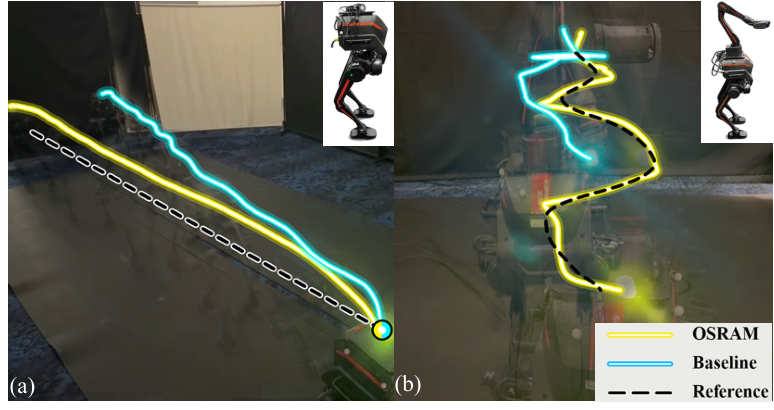
OSRAM treats the deployed robot and its controller as a unified closed-loop system and meta-learns a task-level command-response model across randomized simulated dynamics, then rapidly finetunes it on hardware. Instead of changing the policy, it adapts reference commands online, reducing residual sim-to-real tracking errors for bipedal velocity tracking and loco-manipulation on real hardware.
中文摘要: OSRAM 将实际机器人与已有控制器视为统一的闭环动力系统,在仿真中跨随机化动力学元学习任务级“指令—响应”模型,部署后利用少量真实交互快速微调。该方法不修改底层控制策略,而是在线优化参考指令以补偿残余动力学失配。在双足速度跟踪与移动操作任务中,仿真与硬件实验均表明闭环建模提升了未见动力学下的预测与跟踪精度,有效降低仿真到现实的跟踪误差。
💬 A practical sim-to-real framework that adapts commands rather than retraining policies, with real bipedal and loco-manipulation hardware validation.
💬 该工作通过调整指令而非重训策略实现仿真到现实迁移,并在双足与移动操作硬件上验证,实用性强。
Why read it / 推荐理由: The command-side adaptation idea is directly transferable to modular legged platforms where the controller should stay fixed while residual dynamics errors are corrected online. 其“指令侧适应”思路可迁移到模块化腿足平台:控制器保持不变,仅在线修正残余动力学误差。
3. Variable-Horizon Model Predictive Control for Switched Systems
切换系统的变时域模型预测控制
Authors / 作者: Rui Zhao, Zhiqiang Zuo, Yang Shi, Yijing Wang, Zheng Li, Guanrong Chen
arXiv: 2609.29100 · PDF
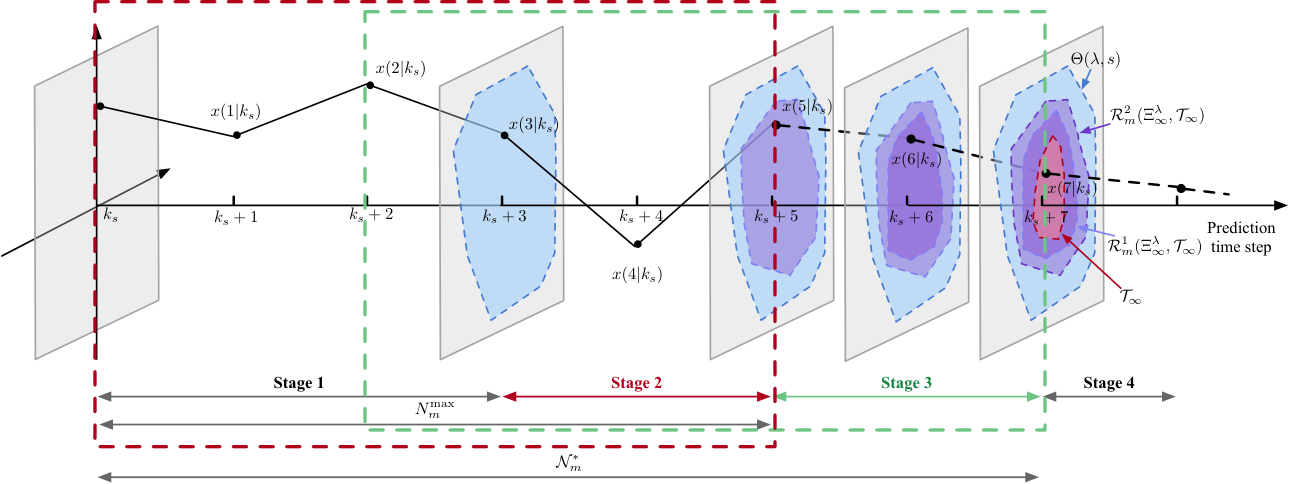
This paper proposes a variable-horizon MPC scheme for switched systems with control and state constraints, using a switching feasible set to decouple dwell-time conditions from MPC constraints and relax dwell-time requirements. Algorithms construct the feasible set and characterize the domain of attraction, guaranteeing recursive feasibility and asymptotic stability, and short-horizon variants further expand the domain of attraction.
中文摘要: 本文研究受控制与状态约束的切换系统模型预测控制,提出变时域切换 MPC 方法。通过将系统状态引导至精心设计的切换可行集,使驻留时间条件与 MPC 约束结构解耦,从而将驻留时间要求放宽至无约束切换系统的水平。作者进一步给出构造切换可行集与刻画吸引域的算法,保证递归可行性与闭环渐近稳定性,并设计短时域切换 MPC 方案,使预测时域长度与严格驻留时间界解耦,扩大整体吸引域。仿真验证了方法的有效性。
💬 A rigorous MPC contribution for switched systems that maps naturally onto modular legged robots whose contact and configuration modes switch.
💬 该文为切换系统提供了严谨的 MPC 理论,可自然映射到接触与构型模态频繁切换的模块化腿足机器人。
Why read it / 推荐理由: Modular legged robots are inherently switched systems, so these dwell-time and feasibility results are directly useful for gait and mode-switching MPC design. 模块化腿足机器人本质上是切换系统,其驻留时间与可行性结论可直接用于步态与模态切换的 MPC 设计。
4. AD-WM: Action-Discriminative World Models for Counterfactual Model Predictive Control
AD-WM:面向反事实模型预测控制的动作判别世界模型
Authors / 作者: Jiabin Qiu, Zixuan Chen, Hongye Cao, Jieqi Shi, Jing Huo, Yang Gao
arXiv: 2609.30264 · PDF
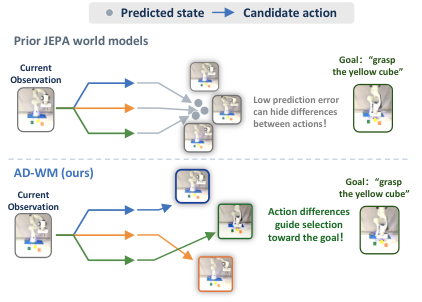
AD-WM introduces an action-discriminative joint-embedding world model for counterfactual MPC, combining residual latent dynamics with predictor-level action-recovery regularization via inverse dynamics and a normalized recovery objective. It improves hard-start success on OGBench-Cube from 3.7% to 52.0% over a matched baseline and achieves zero-shot Franka pick-and-place transfer from 42.2% to 71.1% without lab-specific adaptation.
中文摘要: AD-WM 提出一种面向反事实 MPC 的动作判别联合嵌入世界模型,将残差潜动力学与预测器级动作恢复正则相结合,通过逆向动力学和归一化恢复目标鼓励规划转移保留动作信息,辅助头在测试时被丢弃,不改变 MPC 流程。在 OGBench-Cube 上,困难起始成功率从基线 3.7% 提升至 52.0%;在冻结 V-JEPA 2 编码器与匹配 DROID 后训练下,机器人抓放零样本迁移成功率从 42.2% 提升至 71.1%。
💬 Shows that action discrimination, not just factual prediction, is key for MPC-style planning with learned models.
💬 该工作表明,对基于学习模型的 MPC 规划而言,动作判别能力比单纯事实预测精度更关键。
Why read it / 推荐理由: It provides a concrete recipe for making learned world models usable for predictive control, which could extend to legged locomotion planning under contact uncertainty. 它给出了让学习世界模型可用于预测控制的实用方案,有望扩展到接触不确定下的腿足运动规划。
5. FlyCNS: Connectome-Grounded Information Organization for Communication-Constrained Embodied Control
FlyCNS:面向通信受限具身控制的连接组启发信息组织
Authors / 作者: Jinchang Zhang, Jiakai Lin, Guoyu Lu
arXiv: 2609.28816 · PDF
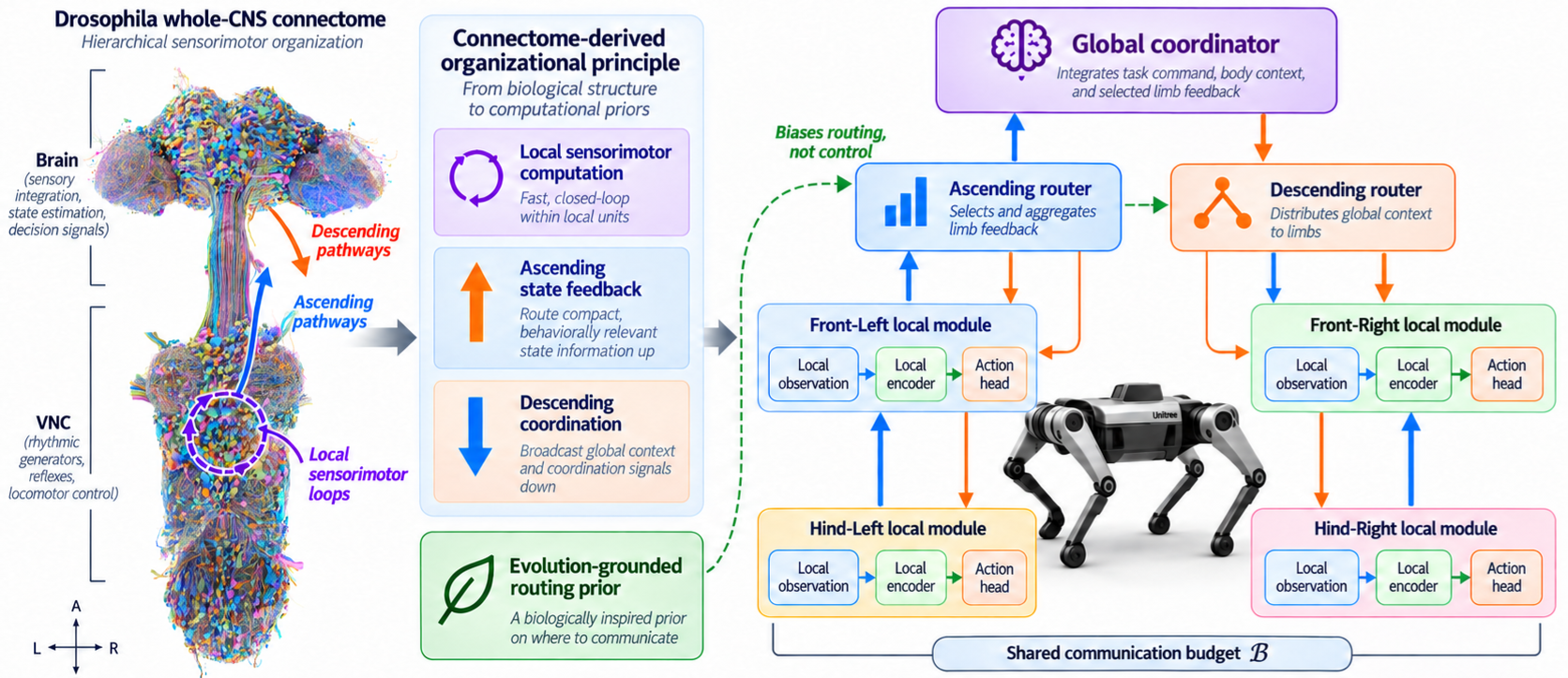
FlyCNS studies how computation and communication should be organized in distributed embodied control, using the Drosophila brain-nerve-cord connectome as a weak prior for allocating long-range ascending and descending pathways. On a Unitree Go1, it degrades gracefully as the communication budget tightens, using only about 21-22% of full communication while maintaining a tracking score near 0.882.
中文摘要: FlyCNS 研究通信受限具身控制中的信息组织问题:哪些计算应保持局部、哪些信息值得传输以实现全身协调。该方法借鉴果蝇脑—神经索连接组,保留各肢体的局部感觉运动计算,并通过上行与下行路径实现选择性远程通信。作者从真实连接组提取两类路径的方向结构复杂度作为通信分配的弱先验,而消息内容、传输时机与运动策略均由强化学习自适应学习。在 Unitree Go1 仿真中,通信预算收紧时性能退化更平缓,最受限设置下仅用约 21—22% 的通信量仍保持约 0.882 的跟踪得分,与全通信参考差距不超过 6.1%。
💬 Connectome-inspired communication allocation for distributed whole-body control, with quantified graceful degradation on a legged robot.
💬 该文以连接组启发分布式全身控制的通信分配,并在腿足机器人上量化了性能的平缓退化。
Why read it / 推荐理由: It offers a novel angle on distributed whole-body coordination for legged robots, where local limb controllers must share only limited information. 它为腿足机器人的分布式全身协调提供了新视角:各肢体局部控制器之间只需有限的信息共享。