机器人日报
机器人论文日报 — 2026-09-24
🤖 Scanned 321 papers from today’s arXiv announcement (cs.RO / eess.SY / cs.LG), picked 5 for modular & legged robotics — summarized by DeepSeek.
🤖 从今日 arXiv 新论文(cs.RO / eess.SY / cs.LG)中扫描 321 篇,围绕模块化与足式机器人精选 5 篇 — 由 DeepSeek 生成双语摘要。
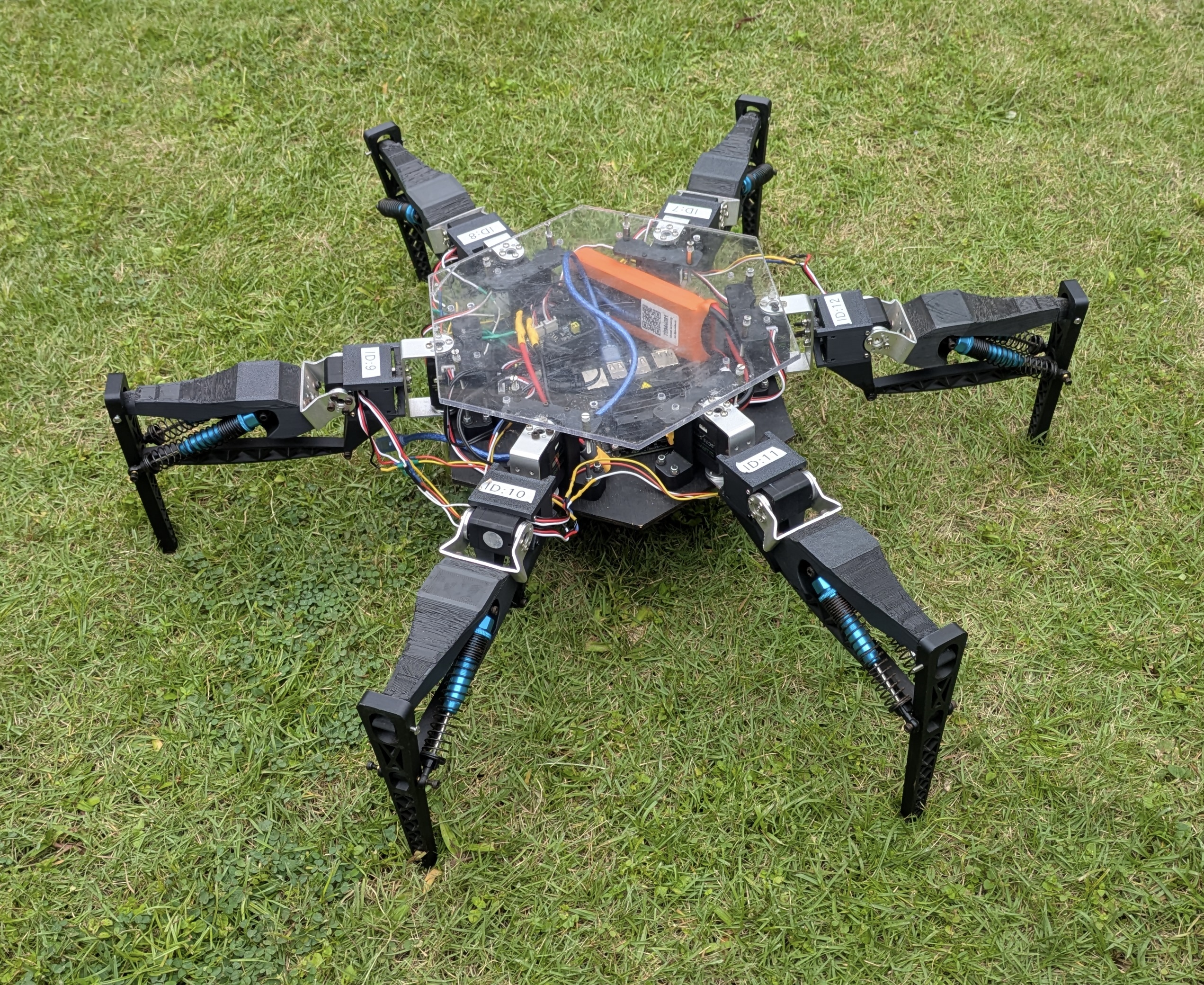
1. Spiderbot: An Open-Source Energy-Efficient Hexapod with Passive Gravity Compensation
Spiderbot:具有被动重力补偿的开源高能效六足机器人
Authors / 作者: Ritwik Sharma, Vimarsh Shah, Saransh Agrawal
arXiv: 2609.26989 · PDF
Spiderbot is an open-source hexapod robot that uses a 4-bar linkage with a passive spring to mechanically support body weight, combined with a 2-DOF per-leg design to reduce energy consumption. It consumes only 1.5W during standing, a reduction of over 90% over the unsprung version and up to 96% over other similar hexapods, while supporting payloads up to 3.25kg. The platform achieves successful sim-to-real transfer of an RL locomotion policy and is evaluated on flat and rough terrains, slopes up to 15°, and step obstacles, with all hardware and software released.
中文摘要: Spiderbot 是一款开源六足机器人,采用带被动弹簧的四杆机构来机械支撑机身重量,并结合每腿 2 自由度设计以降低能耗。站立时仅消耗 1.5W 功率,比无弹簧版本降低超过 90%,比其他类似六足机器人降低高达 96%,同时可承载 3.25kg 的负载。该平台通过强化学习策略实现了成功的 sim-to-real 迁移,并在平坦和崎岖地形、15° 斜坡及台阶障碍物上进行了评估,所有硬件和软件均已开源。
💬 This work demonstrates how passive gravity compensation and a reduced-DOF leg design can drastically cut energy consumption in legged robots, with an open-source platform and successful RL sim-to-real transfer.
💬 这项工作展示了被动重力补偿和降低自由度腿部设计如何大幅降低足式机器人的能耗,并提供了开源平台和成功的强化学习 sim-to-real 迁移。
Why read it / 推荐理由: It provides a complete, low-cost, open-source hexapod platform with passive gravity compensation and validated RL sim-to-real transfer, directly relevant to modular legged robot design and energy-efficient locomotion. 它提供了一个完整、低成本、开源的六足机器人平台,具有被动重力补偿和经过验证的强化学习 sim-to-real 迁移,与模块化足式机器人设计和节能运动直接相关。
2. ForgetMimic: Motion Unlearning for Reinforcement Learning Humanoid Control
ForgetMimic:面向强化学习人形控制的运动遗忘学习
Authors / 作者: Xukun Luan, Zhongxiang Lei, Chen Gong, Shaowei Li, Yuanguo Bi, Jinyan Liu
arXiv: 2609.28378 · PDF
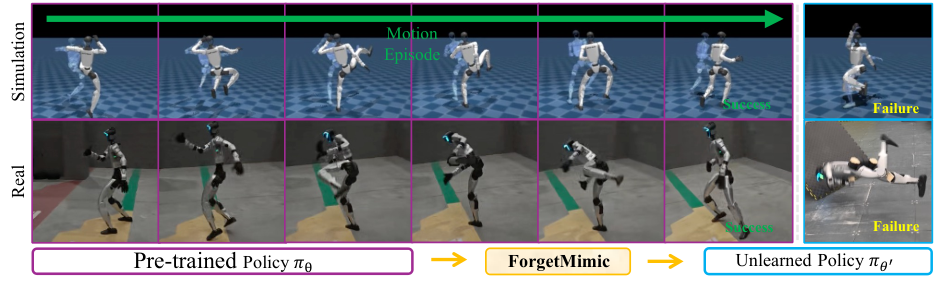
ForgetMimic is the first motion-level unlearning method for physical humanoid control, enabling a policy trained on multiple motions to forget a targeted subset while preserving performance on the remaining motions. The method identifies and resolves two key training mechanisms that lead to unlearning failure, and is validated on Unitree G1 and H2 humanoid robots across 12 motions including Dance, Fight, and Flip, effectively eliminating memory of designated motions while maintaining normal operation of others.
中文摘要: ForgetMimic 是首个面向物理人形控制的运动级遗忘学习方法,使在多个运动上训练的策略能够遗忘目标子集,同时保持其余运动的性能。该方法识别并解决了导致遗忘失败的两个关键训练机制,并在 Unitree G1 和 H2 人形机器人上针对 12 种运动(包括舞蹈、格斗、翻跟头等)进行了验证,有效消除了对指定运动的记忆,同时保持其他运动的正常运行。
💬 This paper introduces a novel motion unlearning paradigm for RL-based humanoid control, with practical safety and privacy motivations and validation on real humanoid robots.
💬 本文为基于强化学习的人形控制引入了一种新颖的运动遗忘范式,具有实际的安全和隐私动机,并在真实人形机器人上进行了验证。
Why read it / 推荐理由: It addresses a critical and underexplored problem in RL-based motion control—selectively forgetting motions—which is relevant for safe and compliant deployment of learned locomotion policies. 它解决了基于强化学习的运动控制中一个关键且未被充分探索的问题——选择性遗忘运动,这对于安全且合规地部署学习到的运动策略具有重要意义。
3. Gray-Box Model Predictive Control for Articulated Dump Trucks via Gaussian Process Learning of Sideslip
基于高斯过程侧滑学习的铰接式自卸卡车灰箱模型预测控制
Authors / 作者: Arash Shahirpour, Jens Ahlers, Christopher Schulte, Tim Reuscher
arXiv: 2609.27597 · PDF
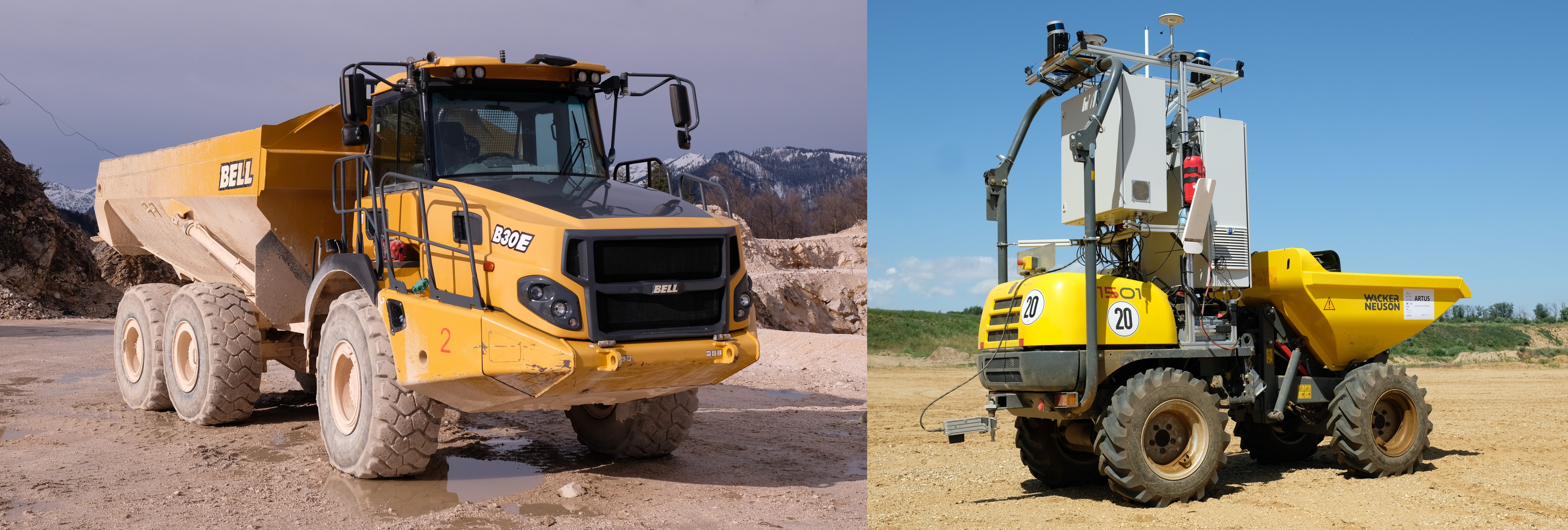
This work proposes a gray-box model for articulated dump trucks (ADTs) that augments a kinematic model with a Gaussian Process Regression (GPR) learned sideslip angle, identified as the primary cause of kinematic model inaccuracy. The gray-box model improves lateral velocity prediction and, when used in MPC, reduces maximum lateral tracking error from over 2 m to 0.56 m compared to white-box MPCs in simulation. The approach addresses the trade-off between kinematic simplicity and dynamic accuracy for autonomous mining vehicles.
中文摘要: 这项工作提出了一种用于铰接式自卸卡车(ADT)的灰箱模型,通过高斯过程回归(GPR)学习侧滑角来增强运动学模型,侧滑角被确定为运动学模型不准确的主要原因。灰箱模型改善了横向速度预测,并在仿真中用于 MPC 时,与白箱 MPC 相比,将最大横向跟踪误差从 2 米以上降低到 0.56 米。该方法解决了自动驾驶矿用车辆在运动学简单性和动力学准确性之间的权衡问题。
💬 This paper demonstrates a practical gray-box MPC approach that combines kinematic models with learned dynamics for improved tracking in articulated vehicles, with potential transferability to legged robot control.
💬 本文展示了一种实用的灰箱 MPC 方法,将运动学模型与学习到的动力学相结合,以改善铰接车辆的跟踪性能,并具有迁移到足式机器人控制的潜力。
Why read it / 推荐理由: It offers a methodology for enhancing MPC with learned residual dynamics (sideslip) that could be adapted to legged robots dealing with unmodeled terrain interactions. 它提供了一种通过学习残差动力学(侧滑)来增强 MPC 的方法,可适用于处理未建模地形相互作用的足式机器人。
4. Tractable Reinforcement Learning for Full Class of Signal Temporal Logic Specifications Using Spatiotemporal Tube Reward
基于时空管奖励的完整信号时序逻辑规范的可处理强化学习
Authors / 作者: Vaishnavi Jagabathula, P Sangeerth, Pushpak Jagtap
arXiv: 2609.28396 · PDF
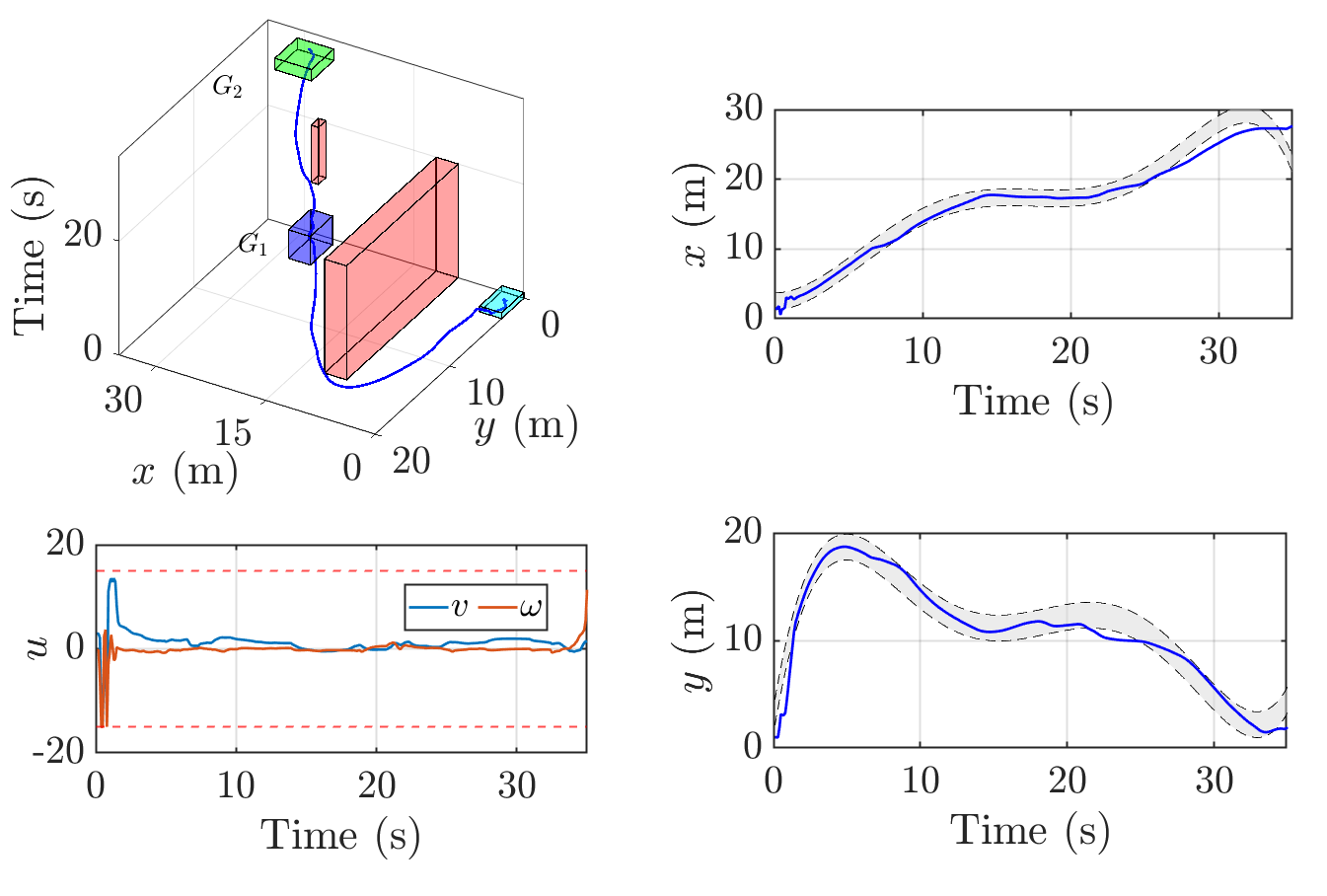
This paper proposes a time-aware reinforcement learning framework that leverages the geometric properties of Spatiotemporal Tubes (STTs) to satisfy the full class of Signal Temporal Logic (STL) specifications for robotic systems with unknown dynamics and actuator limits. By mapping logical and temporal complexities into time-varying geometric boundaries, the method trains a time-aware Soft Actor-Critic agent with a continuous, geometry-aware reward, eliminating the need for state history and explicit logical evaluation. The framework ensures robust satisfaction of specifications while strictly adhering to input constraints.
中文摘要: 本文提出了一种时间感知的强化学习框架,利用时空管(STT)的几何特性来满足完整类别的信号时序逻辑(STL)规范,适用于具有未知动力学和执行器限制的机器人系统。通过将逻辑和时间复杂性映射为时变几何边界,该方法使用连续的、几何感知的奖励训练时间感知的 Soft Actor-Critic 智能体,无需状态历史或显式逻辑评估。该框架确保在严格遵守输入约束的同时稳健地满足规范。
💬 This work provides a computationally efficient and history-free RL approach for enforcing complex temporal logic specifications, which could be valuable for specifying and learning legged locomotion tasks.
💬 这项工作提供了一种计算高效且无需历史状态的强化学习方法,用于强制执行复杂的时序逻辑规范,对于指定和学习足式运动任务具有重要价值。
Why read it / 推荐理由: It introduces a tractable method to incorporate high-level STL specifications into RL for robot control, potentially simplifying the specification of complex legged locomotion behaviors. 它引入了一种将高级 STL 规范纳入机器人控制强化学习的可处理方法,可能简化复杂足式运动行为的规范制定。
5. LEAP-CBF: A Safety Filter for Uncertain Systems with Least-Effort Adversarial Potentials
LEAP-CBF:基于最小努力对抗势的不确定系统安全滤波器
Authors / 作者: Oswin So, Eric Yu, Chuchu Fan
arXiv: 2609.28364 · PDF
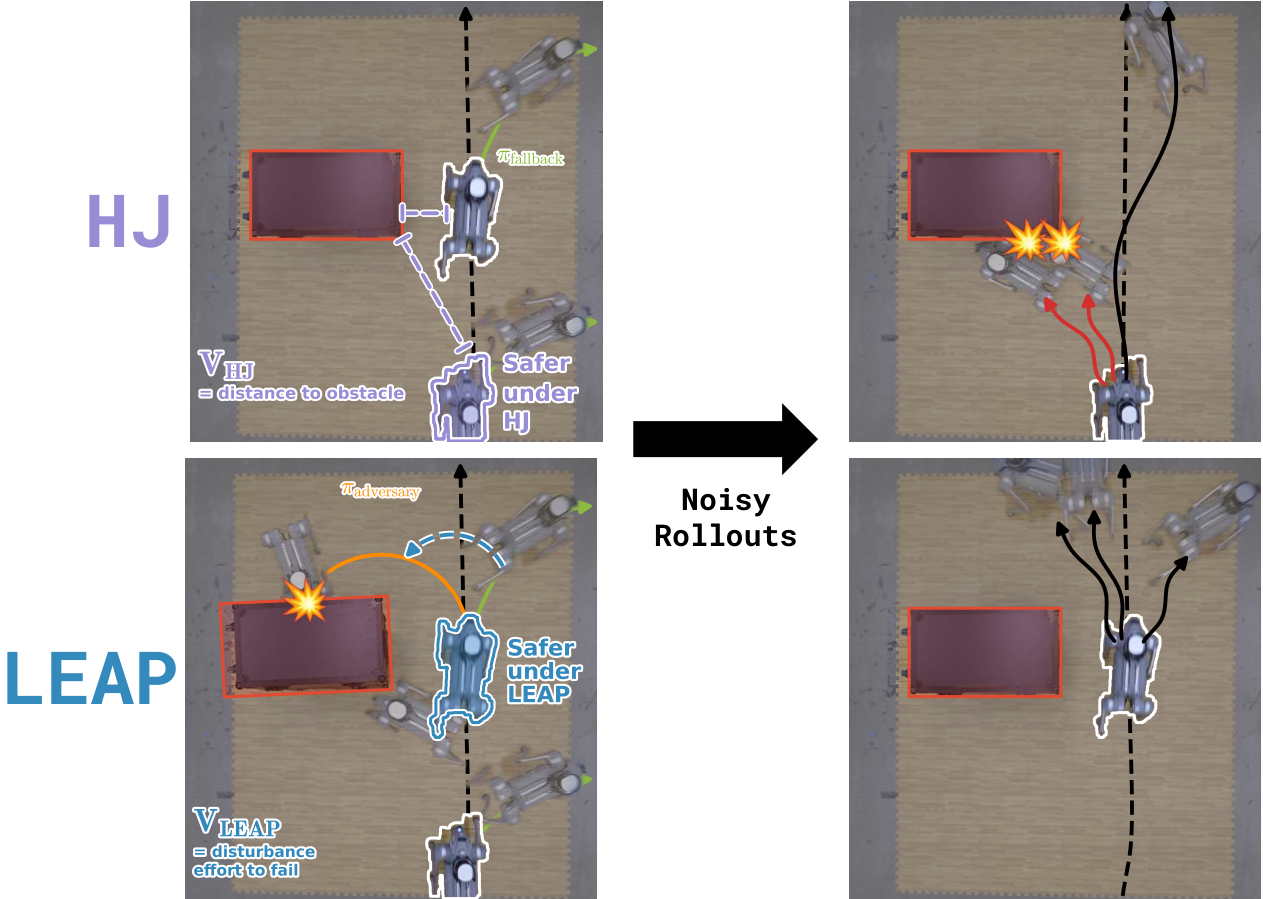
LEAP-CBF introduces Least-Effort Adversarial Potentials (LEAP), a certificate that quantifies robustness against disturbances by measuring the effort required to cause failure. LEAP serves as a control barrier function for undisturbed systems and enables a safety filter robust to bounded cumulative disturbance effort. The method is constructed via on-policy deep reinforcement learning and validated in simulation on multi-agent systems and hardware experiments on a quadruped and quadrotors, demonstrating effectiveness against real-world disturbances and uncertainties.
中文摘要: LEAP-CBF 引入了最小努力对抗势(LEAP),这是一种通过衡量导致失败所需的努力来量化对抗扰动鲁棒性的证书。LEAP 可作为无扰动系统的控制障碍函数,并构建对有限累积扰动努力具有鲁棒性的安全滤波器。该方法通过同策略深度强化学习构建,并在多智能体系统仿真以及四足机器人和四旋翼的硬件实验中验证,展示了应对真实世界扰动和不确定性的有效性。
💬 This paper presents a novel safety filter that combines reinforcement learning with control barrier functions, and validates it on a real quadruped robot, making it directly relevant to safe legged locomotion.
💬 本文提出了一种新颖的安全滤波器,将强化学习与控制障碍函数相结合,并在真实四足机器人上进行了验证,与安全足式运动直接相关。
Why read it / 推荐理由: It offers a practical and validated approach for ensuring safety in uncertain environments, with hardware demonstration on a quadruped, which is highly relevant for legged robot control. 它提供了一种在不确定环境中确保安全的实用且经过验证的方法,并在四足机器人上进行了硬件演示,与足式机器人控制高度相关。