机器人日报
机器人论文日报 — 2026-09-22
🤖 Scanned 672 papers from today’s arXiv announcement (cs.RO / eess.SY / cs.LG), picked 5 for modular & legged robotics — summarized by DeepSeek.
🤖 从今日 arXiv 新论文(cs.RO / eess.SY / cs.LG)中扫描 672 篇,围绕模块化与足式机器人精选 5 篇 — 由 DeepSeek 生成双语摘要。
1. STRIDER: Stepping-Enabled Multi-Gait Hierarchical 3D Loco-Manipulation Framework for Humanoid Robots
STRIDER:面向人形机器人的阶梯式多步态分层3D移动操作框架
Authors / 作者: Yuanzhuo Li, Wen Zhao, Zhe Yong, Xiang Meng, Gang Han, Hengle Ren et al.
arXiv: 2609.23483 · PDF
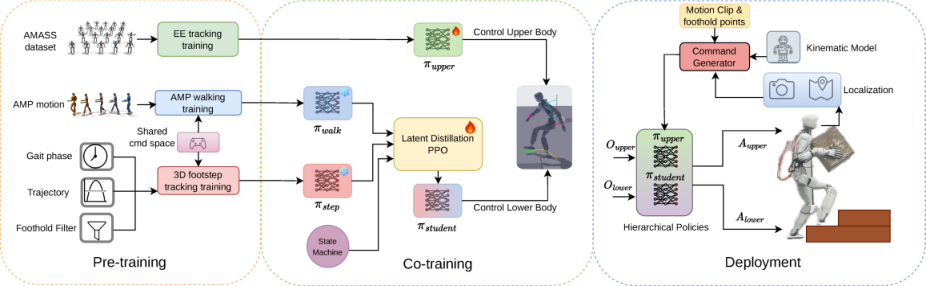
STRIDER is a hierarchical multi-gait framework that integrates terrain-aware 3D stepping logic, Adversarial Motion Priors-based natural walking, and Cartesian upper-body control. It introduces Latent Distillation Proximal Policy Optimization (LD-PPO) with teacher-conditioned latent alignment to fuse walking and stepping experts into a single student policy. Experiments on the TianGong Omni humanoid show improved foothold-tracking and posture tracking over vanilla distillation-PPO.
中文摘要: STRIDER是一种面向人形机器人的分层多步态移动操作框架,融合了地形感知的3D踏步逻辑、基于对抗运动先验(AMP)的自然行走以及笛卡尔上半身控制。其踏步专家在支撑脚坐标系中选择可行落脚点并生成考虑离地间隙的摆动轨迹。为将行走与踏步专家融合为单一可执行策略,作者提出潜在蒸馏近端策略优化(LD-PPO),在蒸馏过程中引入教师条件潜在对齐,联合优化在线强化学习、DAgger动作重建和潜在对齐,从而在异构技能间共享表示。在天工Omni人形机器人上的仿真和实机实验表明,LD-PPO在落脚点跟踪和姿态跟踪方面优于普通蒸馏PPO。
💬 Proposes a principled latent distillation method to unify heterogeneous locomotion experts, with real-robot validation on a humanoid.
💬 提出了一种原则性的潜在蒸馏方法来统一异构运动专家,并在人形机器人上进行了实机验证。
Why read it / 推荐理由: The LD-PPO distillation mechanism and hierarchical stepping logic are directly transferable to modular legged platforms needing multi-gait control. LD-PPO蒸馏机制和分层踏步逻辑可直接迁移到需要多步态控制的模块化腿式平台。
2. Smoothness as a Constraint for Stable Humanoid Locomotion
将平滑性作为稳定人形机器人运动的约束
Authors / 作者: Utsav Panchal, Denis Kleyko, Unal Artan, Amy Loutfi
arXiv: 2609.24552 · PDF
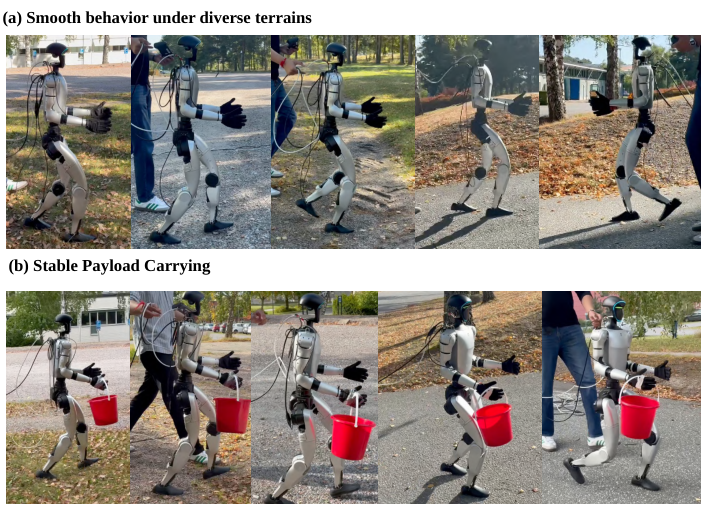
DeCap is a constrained reinforcement learning algorithm that decouples whole-body smoothness into separate upper- and lower-body constraint groups, formulating smoothness as explicit constraints on physical motion limits. It uses a bounded barrier penalty that activates proactively near feasibility boundaries. On a real-world humanoid whole-body control task, DeCap reduces upper-body action rate by 2.50x and acceleration by 2.18x compared to reward-based smoothness policies.
中文摘要: DeCap是一种约束强化学习算法,将全身平滑性分解为上半身和下半身两个独立的约束组,把平滑性建模为对物理运动极限的显式约束,而非奖励项。该方法引入有界障碍惩罚,在接近可行性边界时主动激活并在约束极限处保持有界。在真实人形机器人全身控制任务中,相比基于奖励的平滑性策略,DeCap将上半身动作速率降低2.50倍、加速度降低2.18倍,同时改善了下半身平滑性并减少了瞬态运动。该工作表明固定的平滑性约束集能够迁移到不同任务。
💬 Constraint-based smoothness formulation avoids reward tuning and demonstrates clear improvements on real hardware.
💬 基于约束的平滑性公式避免了奖励调参,并在真实硬件上展示了明显改进。
Why read it / 推荐理由: The decoupled constraint formulation can inform whole-body control of modular legged robots where upper and lower modules require different responsiveness. 解耦约束公式可为模块化腿式机器人的全身控制提供参考,因为其上下模块需要不同的响应性。
3. MimicAgent: Quadruped Skills via Prompt-to-Trajectory Generation
MimicAgent:通过提示到轨迹生成实现四足技能
Authors / 作者: Lucky Kant Nayak, Narayanan Palghat Parameswaran, Neehar Peri, Deva Ramanan
arXiv: 2609.24145 · PDF
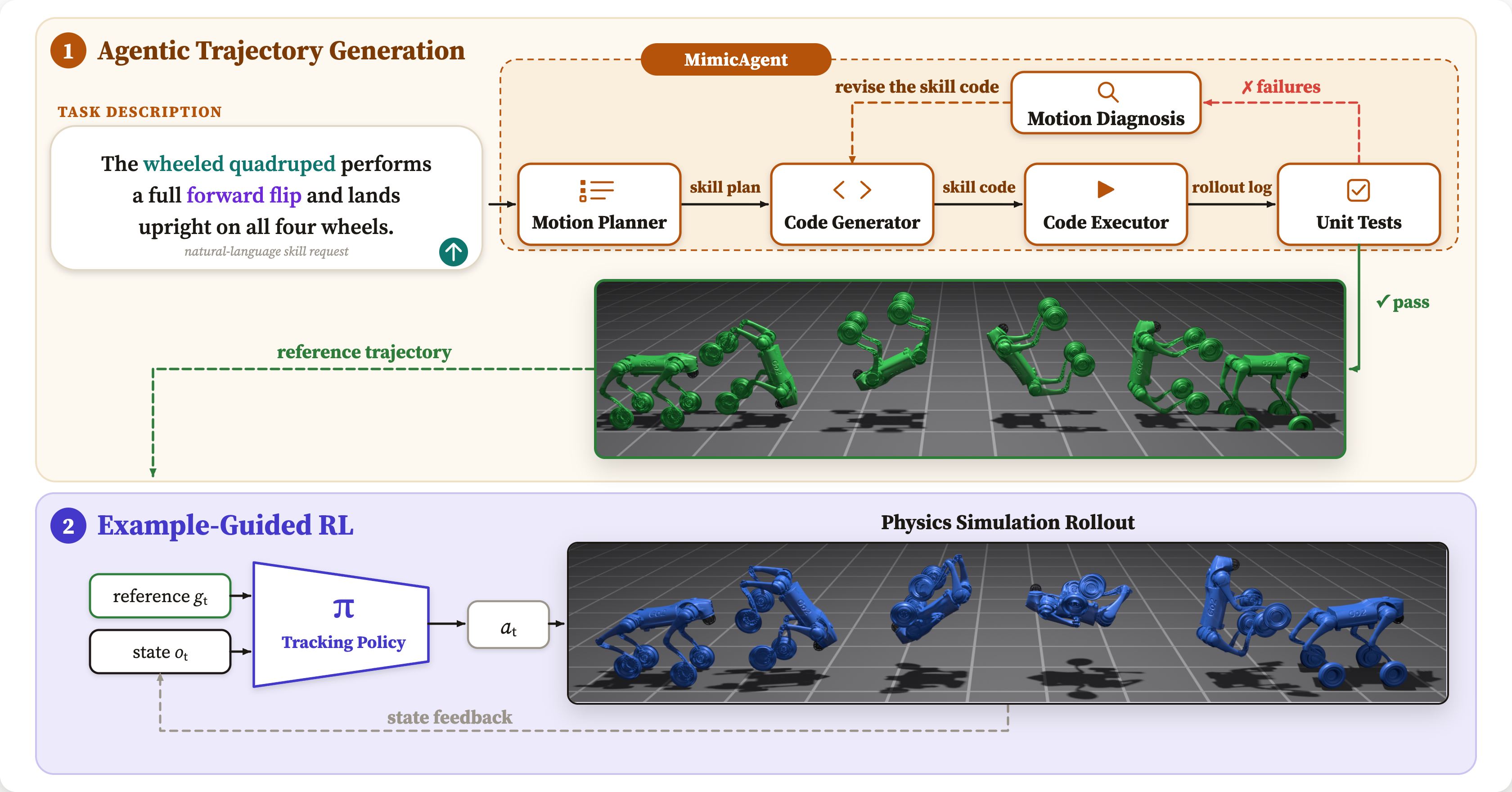
MimicAgent is a prompt-to-trajectory generation framework that leverages coding agents to produce quadruped reference trajectories from skill prompts, which are then used to train example-guided RL policies. It addresses the difficulty of reward shaping and the lack of reference motion data for quadrupeds. Experiments show that 87% of prompts yield semantically aligned reference trajectories, enabling deployable policies in simulation and the real world.
中文摘要: MimicAgent是一个提示到轨迹生成框架,利用编码智能体根据技能提示生成四足机器人参考轨迹,再通过示例引导的强化学习训练可在仿真和现实中部署的策略。该方法针对奖励塑形困难以及四足机器人缺乏大规模参考运动数据的问题,借鉴人形机器人示例引导RL的成功经验,将参考运动生成而非奖励函数设计作为核心。实验表明,在其智能体框架内使用Claude Fable 5.1时,87%的提示能生成语义对齐的参考轨迹。该工作为四足机器人动态技能学习提供了可扩展的自动化轨迹生成途径。
💬 Agentic trajectory generation sidesteps reward engineering and shows high semantic alignment for quadruped skills.
💬 智能体式轨迹生成绕过了奖励工程,并在四足技能上展现出高语义对齐度。
Why read it / 推荐理由: The prompt-to-trajectory paradigm can accelerate gait generation for modular legged robots without hand-crafted reward functions. 提示到轨迹的范式可加速模块化腿式机器人的步态生成,无需手工设计奖励函数。
4. UniPoint: Unified Point-Level Sensor Fusion for Humanoid Locomotion Across Challenging Terrains
UniPoint:面向挑战性地形人形机器人运动的统一点级传感器融合
Authors / 作者: Sicen Li, Zhen Chu, Chao Li, Qiuguo Zhu, Jun Wu
arXiv: 2609.23666 · PDF
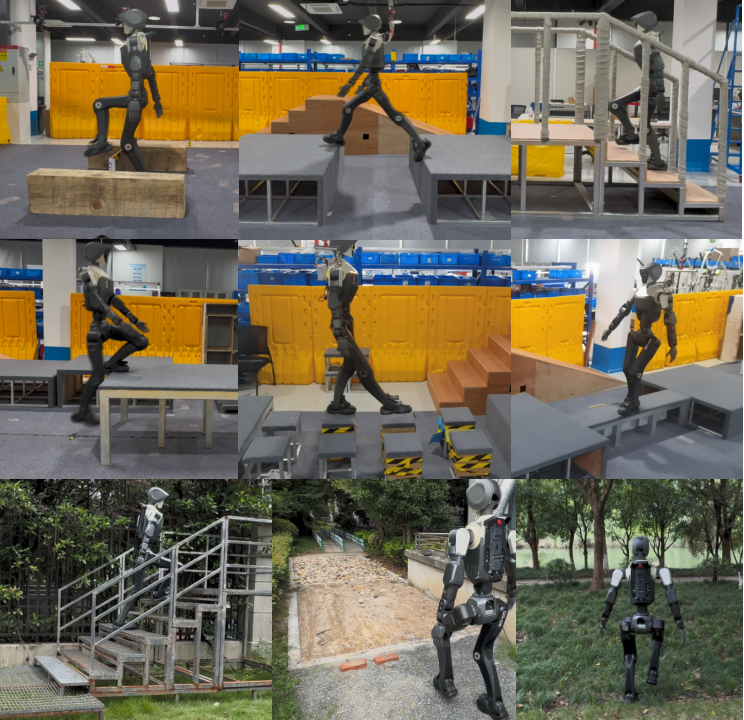
UniPoint is a whole-body locomotion framework that early-fuses a 360-degree LiDAR and two depth cameras into a single base-frame point set. It uses voxelization, linear self-attention, and proprioception-queried cross-attention to encode a fixed number of tokens, decoupling computation from sensor count. A single policy trained with terrain-aware rewards and perception-degradation injection is deployed on a DR02 humanoid, validated on seven terrain types including 70-cm platforms.
中文摘要: UniPoint是一种用于人形机器人全身运动的多源点级传感器融合框架,将360度LiDAR和两个深度相机的测量早期融合为基座坐标系下的单一3D点集。通过体素化重采样为固定数量的token,并利用线性自注意力和本体感知查询的交叉注意力进行编码,使前向计算量与传感器数量解耦。该点集保留细长垂直障碍物,单模态故障仅移除部分token,实现优雅降级。采用地形感知奖励、感知退化注入和域随机化一次训练得到单一策略,在DR02人形机器人上部署于RK3588,并在七种地形、九种真实场景中验证,包括70厘米高平台。
💬 Early point-level fusion with graceful degradation is a robust perception backbone for real-world rough-terrain locomotion.
💬 具有优雅降级的早期点级融合是真实世界崎岖地形运动的鲁棒感知骨干。
Why read it / 推荐理由: The sensor-fusion and degradation-injection techniques are valuable for sim-to-real transfer on modular legged robots traversing varied terrain. 传感器融合和退化注入技术对于在多样地形上穿行的模块化腿式机器人的仿真到现实迁移具有价值。
5. DeViGrasp: Robust Visual Mobile Grasping for Quadruped Manipulators under Degraded Perception
DeViGrasp:退化感知下四足机械臂的鲁棒视觉移动抓取
Authors / 作者: Liang Zhou, Jiaming Su, Yancong Wei, Kangkang Dong, Houde Liu
arXiv: 2609.22278 · PDF
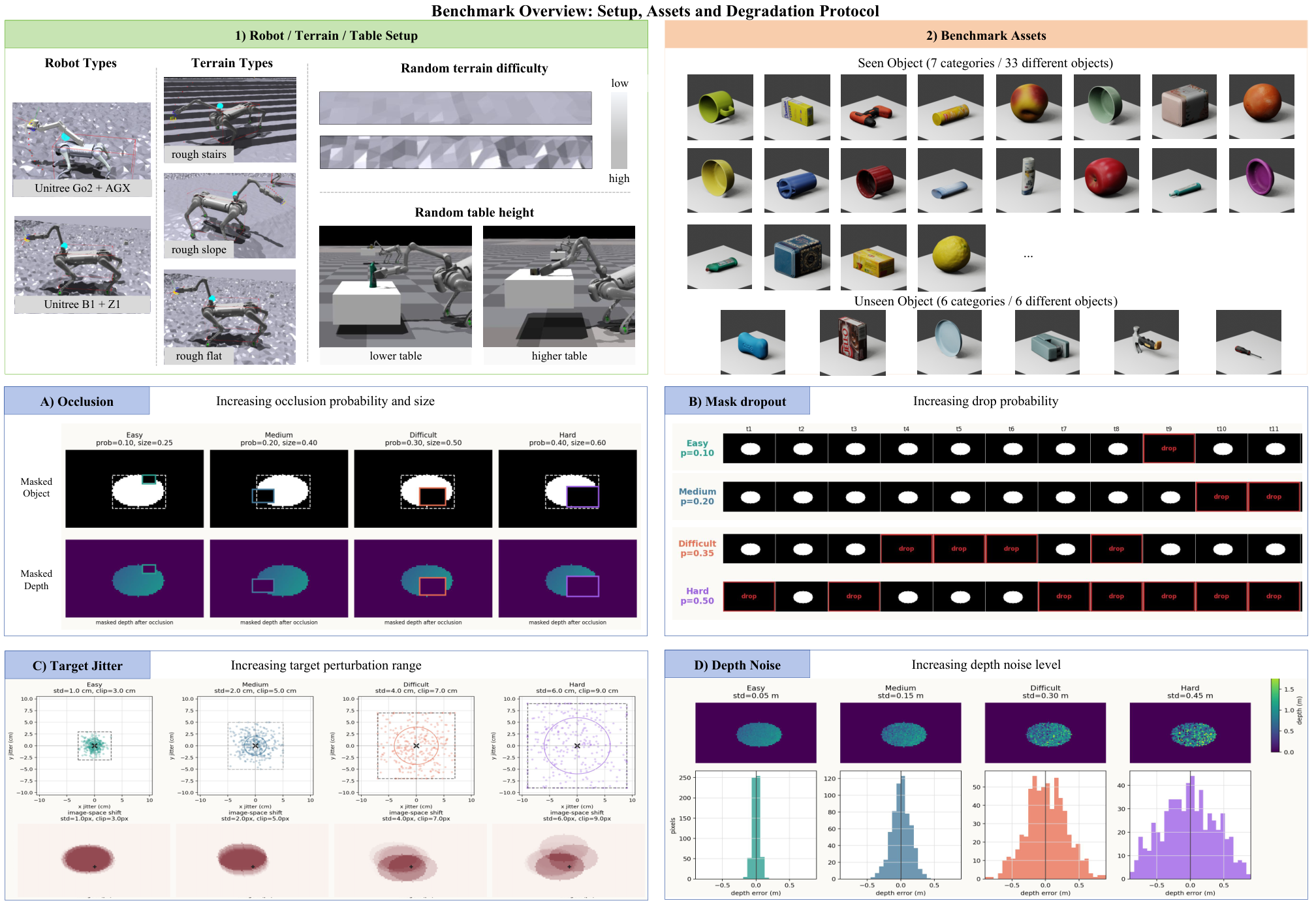
DeViGrasp introduces a benchmark and a teacher-student framework for mobile grasping with quadruped manipulators under degraded vision, including occlusion, mask dropout, depth noise, and localization jitter. The privileged teacher attends to offline grasp candidates, while the deployable student fuses dual-view segmented-depth observations with memory and recovery hypotheses. It outperforms baselines across degradation levels, unseen objects, and complex terrains.
中文摘要: DeViGrasp针对四足机械臂在退化视觉条件下的移动抓取问题,提出了基准DeViGrasp-Bench和教师-学生框架DeViGrasp-Net。退化包括遮挡、分割掩码丢失、深度噪声和目标定位抖动。特权教师基于物体、机器人、末端执行器和任务状态关注离线抓取候选;可部署学生通过目标保持记忆和时间记忆注意力融合双视角分割深度观测与当前、记忆及恢复目标假设。实验表明,DeViGrasp-Net在退化等级、未见物体和复杂地形上优于VBC和适配的DQ-Net,在困难设置下达到较高成功率。
💬 Systematically tackles perception degradation in quadruped mobile manipulation with a memory-augmented teacher-student design.
💬 通过记忆增强的教师-学生设计,系统性地解决了四足移动操作中的感知退化问题。
Why read it / 推荐理由: The reliability-aware temporal estimation and degradation benchmark are relevant for robust whole-body control on modular legged platforms. 可靠性感知的时间估计和退化基准对于模块化腿式平台上的鲁棒全身控制具有相关性。