机器人日报
机器人论文日报 — 2026-09-21
🤖 Scanned 280 papers from today’s arXiv announcement (cs.RO / eess.SY / cs.LG), picked 5 for modular & legged robotics — summarized by DeepSeek.
🤖 从今日 arXiv 新论文(cs.RO / eess.SY / cs.LG)中扫描 280 篇,围绕模块化与足式机器人精选 5 篇 — 由 DeepSeek 生成双语摘要。
1. Duty Factor Predicts Robust Constrained Quadrupedal Locomotion Across Gait Types
占空比可预测跨步态类型的鲁棒约束四足运动
Authors / 作者: James Zhu, David Ologan, George Ortiz, Thomas Chun Fai Lee, Selvin Garcia Gonzalez, Ardalan Tajbakhsh et al.
arXiv: 2609.22073 · PDF
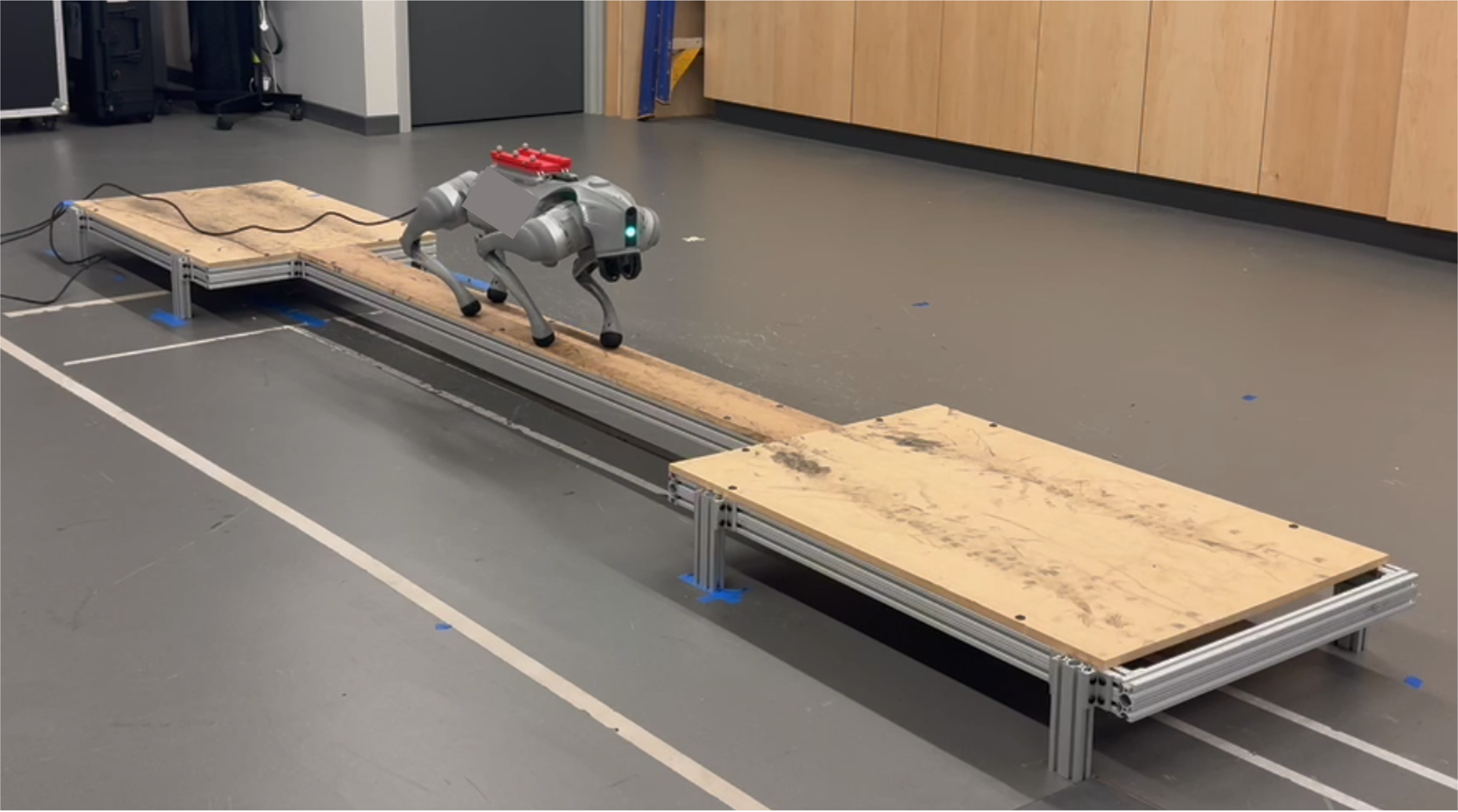
This work investigates how duty factor, rather than nominal gait type, governs the robustness of quadrupedal locomotion. Through whole-body trajectory optimization with LQR, learned controllers, and centroidal MPC, the authors show duty factor is a stronger predictor of local error convergence and validate on a physical quadruped in narrow terrain.
中文摘要: 该研究探究了占空比(而非名义步态类型)对四足运动鲁棒性的主导作用。作者采用全身轨迹优化结合LQR反馈、学习型运动控制器以及质心模型预测控制三种架构,证明占空比是局部误差收敛更强的预测指标,并在物理四足机器人上于狭窄地形中验证了该趋势。结果表明占空比可作为跨步态、跨控制架构理解和选择鲁棒四足运动的一个简单有效低维参数。
💬 Directly addresses gait parameter selection and robustness across optimization, learning, and MPC controllers, with hardware validation on constrained terrain.
💬 该工作直接研究步态参数选择与鲁棒性,横跨优化、学习和MPC控制器,并在受限地形上完成硬件验证。
Why read it / 推荐理由: It provides a unifying low-dimensional control parameter for modular legged platforms, useful for gait generation and MPC on narrow terrain. 它为模块化足式平台提供了统一的低维控制参数,对狭窄地形上的步态生成与MPC具有实用价值。
2. FootQuery: Future-Touchdown-Guided Retrieval from Depth History for Perceptive Humanoid Locomotion
FootQuery:面向感知型人形运动、由未来着地点引导的深度历史检索
Authors / 作者: Tao Dong, Jia Yu, Yuxuan Fan, Linna Zhao, Jiaqi Gong, Andong Yang et al.
arXiv: 2609.21447 · PDF
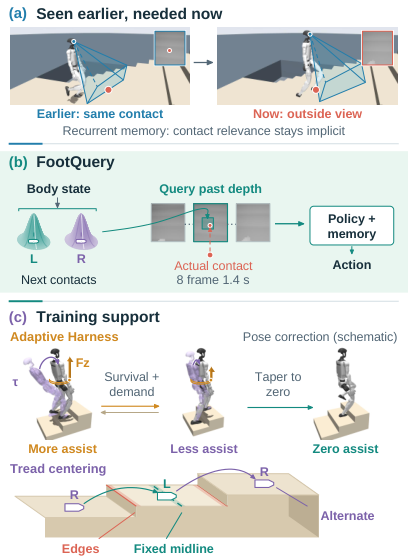
FootQuery retrieves relevant terrain from depth history by querying each foot’s predicted next touchdown, fusing per-foot features with global visual memory for control. Trained with contact-projection supervision and a force curriculum, it traverses stairs, gaps and platforms, demonstrated on a Unitree G1 with only proprioception and onboard depth.
中文摘要: FootQuery利用每只脚预测的下一次着地点去查询深度历史,从而检索相关地形信息,并将逐脚特征与全局视觉记忆融合以生成控制动作。训练时通过将实际接触投影到历史图像中来监督检索,并采用渐进力辅助课程与台阶中线塑形。在仿真中最难的楼梯、间隙和平台场景优于各消融版本,真机实验在Unitree G1上仅用本体感知和机载深度即实现室内外连续穿越。
💬 A novel memory-retrieval mechanism tied to predicted footholds, with strong real-robot whole-body locomotion results.
💬 提出与预测落足点绑定的新颖记忆检索机制,并取得出色的真机全身运动结果。
Why read it / 推荐理由: It offers a leg-centric perception-and-memory scheme that could transfer to modular multi-legged platforms needing foothold anticipation. 它提供了以腿为中心的感知与记忆方案,可迁移到需要提前预判落足点的模块化多足平台。
3. LIMBO: Learning and Internalizing Model-Free Barrier Objectives for Agile and Safe Whole-Body Control
LIMBO:学习并内化无模型障碍目标以实现敏捷安全的全身控制
Authors / 作者: Jake Gonzales, Arturo Flores Alvarez, Yu-Ming Chen, Aaron D. Ames, Lillian J. Ratliff, Manikantan Nambi
arXiv: 2609.22075 · PDF
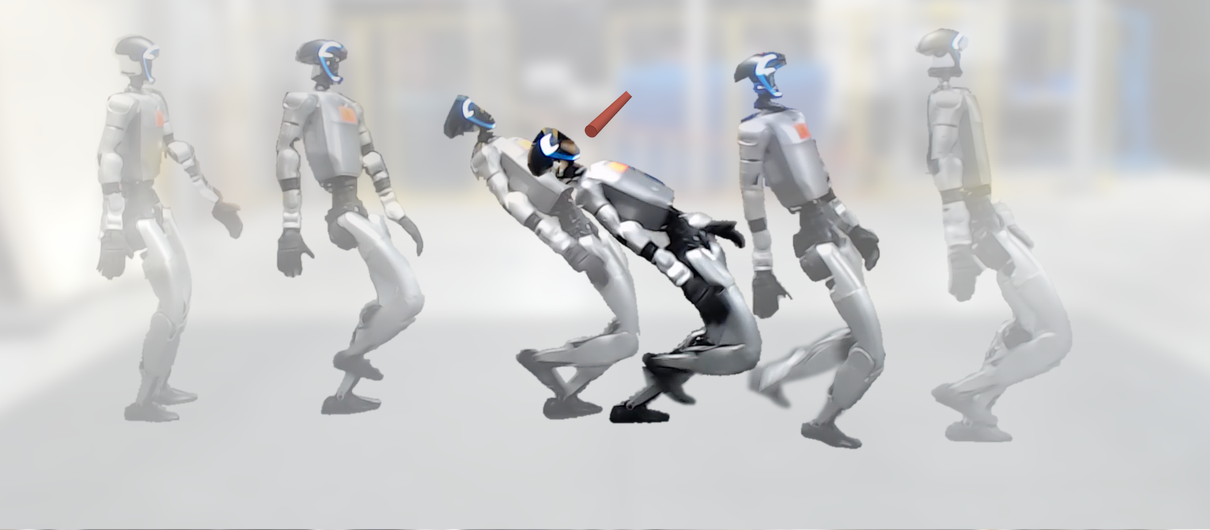
LIMBO synthesizes a state-action control barrier function around a frozen base controller and distills it into a task policy, avoiding an online safety filter at deployment. On a 29-DoF humanoid it achieves dodgeball avoidance and limbo locomotion under low obstacles, showing risk-guided boundary sampling explores the edge of recoverability.
中文摘要: LIMBO在冻结的基控制器周围合成状态-动作控制障碍函数,并将其安全结构蒸馏进任务策略,使部署时无需在线安全滤波器。学习到的安全价值在合成阶段驱动风险引导采样靠近可恢复边界,在任务学习阶段提供动作级安全反馈。在29自由度人形机器人上完成躲避球与低障碍下弯腰穿行任务,并证明风险引导边界采样能系统探索可恢复边界,调节采样集中度可产生从下蹲到新型后仰穿行的多样策略。
💬 Scales learned Q-CBFs to high-DoF whole-body control and internalizes safety, a strong methodological advance for WBC.
💬 将学习型Q-CBF扩展到高自由度全身控制并实现安全内化,是WBC方向的重要方法学进展。
Why read it / 推荐理由: The safety-certificate distillation idea is directly reusable for modular legged robots operating near fragile objects or uneven terrain. 其安全证书蒸馏思想可直接复用于在易碎物体或崎岖地形附近作业的模块化足式机器人。
4. SABER: Learning Attention-based Semantic Affordance for Legged Locomotion
SABER:面向足式运动的学习型注意力语义可供性
Authors / 作者: Hari Prasanth Palanivelu (Michael), Samuel Sze (Michael), Kennard Garrison Johannes (Michael), Albertus Hendrawan Adiwahono (Michael), Meng Yee (Michael), Chuah
arXiv: 2609.21572 · PDF
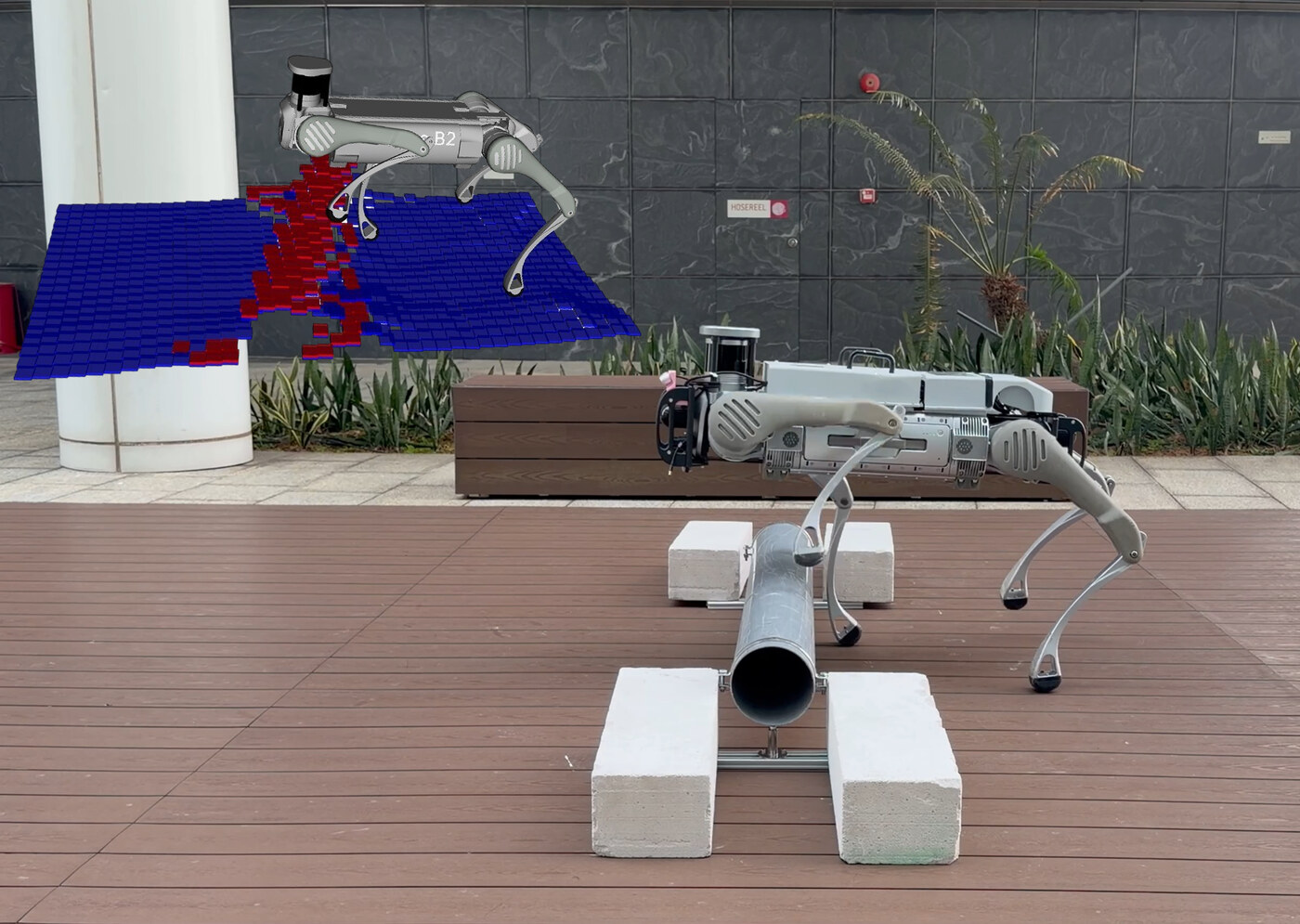
SABER is a planner-free RL policy that jointly reasons about terrain geometry and semantic contact permission using a unified terrain-affordance map. A learned signed semantic bias on cross-attention logits reweights flagged cells by distance to the nearest foot, reducing forbidden contacts by 55% when removed, with real-robot validation.
中文摘要: SABER是一种无规划器的强化学习策略,利用统一地形可供性图同时推理地形几何与语义接触许可,每个栅格编码局部三维几何和语义接触代价。方法在交叉注意力logits上引入学习到的带符号语义偏置,该偏置由接触代价门控并按最近足端距离重新加权被标记栅格,使危害在仍能影响下一步落足处重塑注意力、在无法影响处衰减。消融显示移除语义偏置使违禁接触增加55%而速度跟踪不变,并在真机上验证。
💬 Introduces semantic contact permission into learned legged locomotion, extending affordance beyond geometry with an efficient attention mechanism.
💬 将语义接触许可引入学习型足式运动,以高效注意力机制把可供性从几何扩展到语义层面。
Why read it / 推荐理由: It shows how to respect semantically fragile terrain, a key concern for field deployment of legged platforms in industrial settings. 它展示了如何尊重语义上易损的地形,这对足式平台在工业场景中的实地部署至关重要。
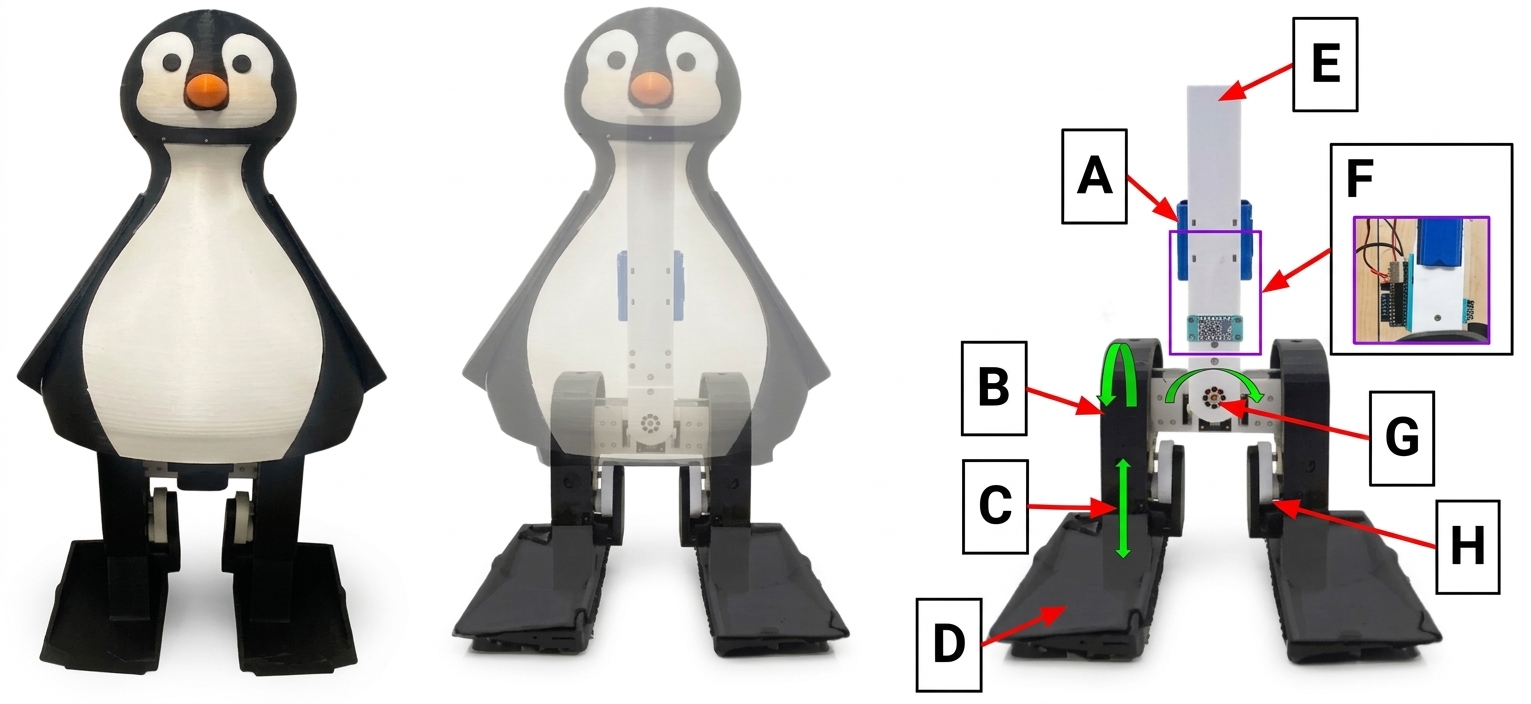
5. When to Waddle: A Comparative Study of Bipedal Torso-Stabilization on Low-Friction Surfaces
何时摇摆:低摩擦表面上双足躯干稳定策略的对比研究
Authors / 作者: Naomi Oke, Ben Gu, George Ortiz, Stacy Ashlyn, Cordelia Pride, Sarah Bergbreiter et al.
arXiv: 2609.21185 · PDF
Inspired by penguin waddling, this study compares upright gait with torso-over-stance-leg motion across COM placements and friction levels in MuJoCo and hardware. Torso-over-stance-leg motion yields faster, more efficient low-friction locomotion at high COM, while the trend reverses at higher friction.
中文摘要: 受企鹅摇摆步态启发,本文在MuJoCo仿真与五自由度双足硬件上,跨不同质心位置对比直立步态与躯干越支撑腿策略,摩擦系数取0.1、0.3、0.5、0.7。仿真中躯干越支撑腿运动在低摩擦下产生更多成功控制器和更高前进速度,高质心配置最快;硬件在μ=0.12时同样提高速度并降低运输成本,且高质心更优。μ=0.45时质心趋势反转,低质心更快更省能,步态策略对速度影响减弱但仍改变侧向足部运动。
💬 Links gait parameters and COM placement to friction-dependent robustness, with a clean sim-to-hardware comparison.
💬 将步态参数与质心位置同摩擦依赖的鲁棒性联系起来,并给出清晰的仿真到硬件对比。
Why read it / 推荐理由: The friction-adaptive gait and COM study informs robust gait selection for leg modules operating on slippery or varied terrain. 其摩擦自适应步态与质心研究,可为腿模块在湿滑或变化地形上的鲁棒步态选择提供依据。