机器人日报
机器人论文日报 — 2026-09-20
🤖 Scanned 38 papers from the last 3 days of arXiv announcements (cs.RO / eess.SY / cs.LG), picked 5 for modular & legged robotics — summarized by DeepSeek.
🤖 从近 3 天的 arXiv 新论文(cs.RO / eess.SY / cs.LG)中扫描 38 篇,围绕模块化与足式机器人精选 5 篇 — 由 DeepSeek 生成双语摘要。
1. Learning Slope-Adaptive Whole-Body Locomotion for Humanoid Robots in Roofing Construction
学习面向屋顶施工的人形机器人斜坡自适应全身运动
Authors / 作者: Songyang Liu, Shuai Li
arXiv: 2609.20558 · PDF
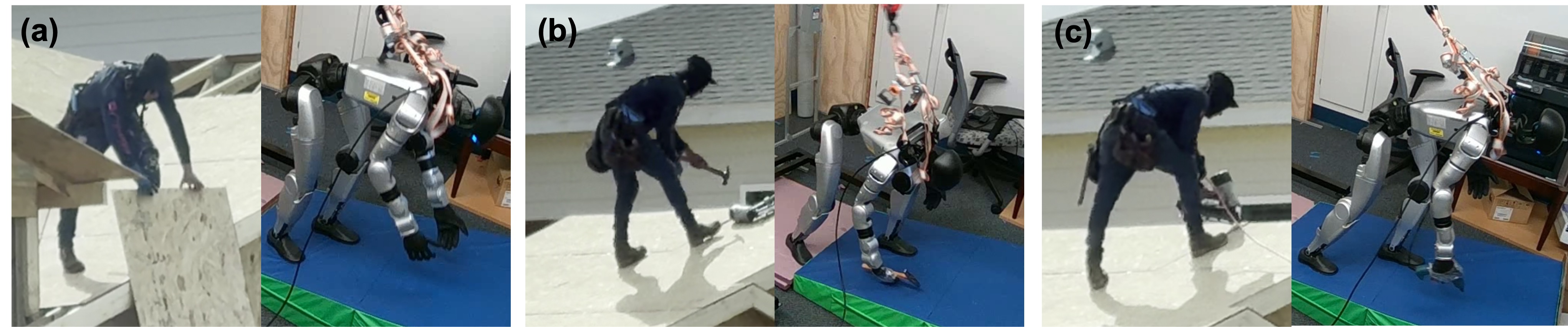
The paper presents a task-semantic, scene-grounded framework that learns roofer-style whole-body motions for a Unitree G1 humanoid. Human demonstrations are retargeted with a metric roof model to ground support contacts and work relations via trajectory-level optimization, and execution-aware RL preserves these relations under tracking errors. It achieves work-clearance errors of 0.256–0.531 cm and 3/3 successful evaluations across nailing, hammering, and pushing tasks.
中文摘要: 本文提出一种任务语义与场景锚定的全身运动学习框架,使Unitree G1人形机器人能够在斜屋顶上完成屋面施工动作。系统先通过跟踪系统捕获人体示范并重定向到机器人,同时利用带尺度信息的屋顶模型提供跟踪系统缺失的空间参考;随后通过轨迹级优化,将推断出的支撑接触点与标注的作业关系锚定到屋顶几何上,并采用考虑执行误差的强化学习训练策略,使其在动态跟踪误差下仍保持这些约束关系。实验涵盖多动作跟踪、屋顶坡度覆盖矩阵、五路钉枪消融、锤击与横向推压跨任务测试,以及与纯强化学习和零样本遥操作的对比。结果表明机器人能满足支撑、作业间隙和非穿透准则,跨任务作业间隙误差为0.256–0.531 cm,每项任务3/3成功。
💬 This work is valuable for modular legged-robot researchers because it tightly couples contact grounding, whole-body WBC-like relation preservation, and execution-aware RL on real hardware, offering a transferable recipe for slope-adaptive locomotion with manipulation-like tasks.
💬 该工作将接触锚定、类全身控制的关系保持与考虑执行误差的强化学习紧密结合,并在真实硬件上验证,为模块化腿足机器人在斜坡环境下的运动-作业一体化控制提供了可迁移的范式。
Why read it / 推荐理由: It is directly relevant to slope-adaptive whole-body control and sim-to-real RL for legged robots, with concrete real-robot results and useful ablations. 该文直接涉及腿足机器人斜坡自适应全身控制与sim-to-real强化学习,并提供真实机器人结果和系统性消融,值得深入阅读。
2. Walking on the Slope: Stable Bipedal Gaits with Genetic-Algorithm-Optimized Trajectories
斜坡行走:基于遗传算法优化轨迹的稳定双足步态
Authors / 作者: Madhav Rijal
arXiv: 2609.20570 · PDF
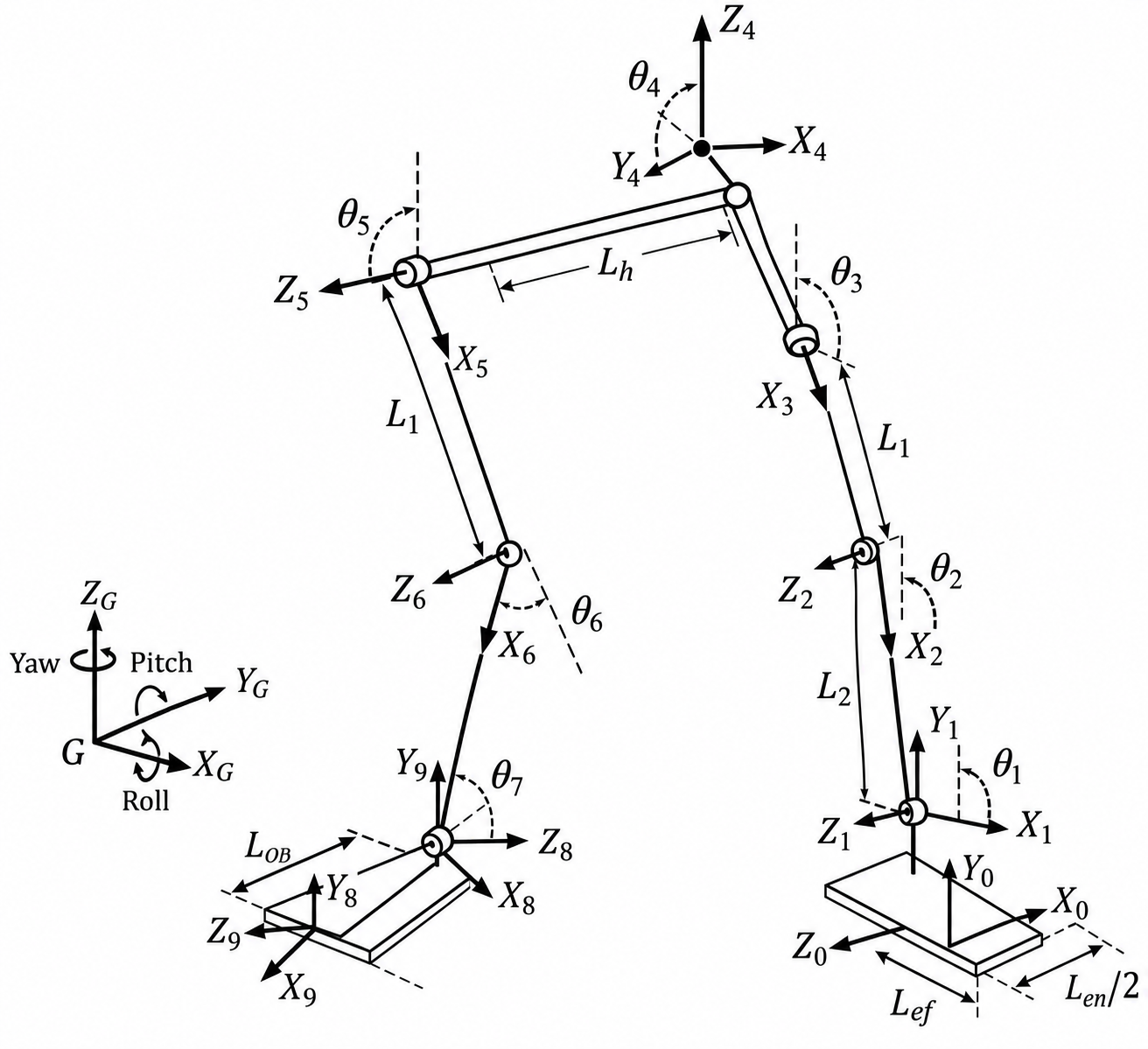
This paper models an 8-DOF biped robot and generates cubic-spline hip and swing-foot trajectories mapped to joint space via closed-form inverse kinematics. Joint torques are computed by Newton–Euler iteration, dynamic stability is evaluated with ZMP, and a genetic algorithm optimizes hip height, swing-foot lift, and frontal-plane tilt under a ZMP feasibility penalty. Simulations show ZMP-stable walking for step times down to 0.5 s and slopes up to 22.5°, with stability governed by link mass distribution rather than total mass.
中文摘要: 本文针对8自由度双足机器人建立运动学与动力学模型,研究其在平地与斜坡上的稳定步态生成与稳定性分析。采用D-H参数与齐次变换推导正运动学,并用闭式逆运动学将基于三次样条生成的髋部与摆动足笛卡尔轨迹映射为关节角;利用Newton-Euler迭代算法计算关节力矩,并以零矩点(ZMP)准则评估动态稳定性。遗传算法在ZMP可行性惩罚下优化髋部高度、最大摆动足抬升量和额状面倾斜角,以最小化关节做功。MATLAB仿真表明,在给定足部几何条件下,名义8自由度模型在步时短至0.5 s、坡度达22.5°时仍保持ZMP稳定;超过该范围ZMP会离开支撑多边形。结果还表明ZMP稳定性主要取决于连杆质量分布而非总质量。
💬 A classic trajectory-optimization-plus-ZMP study that is useful for modular legged design because it quantifies how slope limits depend on foot geometry and mass distribution, though it remains simulation-only.
💬 该文将轨迹优化与ZMP稳定性分析结合,量化了斜坡极限对足部几何和质量分布的依赖,对模块化腿足设计有参考价值,但目前仅停留在仿真层面。
Why read it / 推荐理由: It provides concrete slope-limit and mass-distribution insights for gait generation and stability analysis of multi-legged modular platforms. 该文为多足模块化平台的步态生成与稳定性分析提供了具体的坡度极限和质量分布规律,具有直接参考意义。
3. Winning a Won Game: Strict Reach-Avoid-Stay Control Barrier Functions for High-Dimensional Black-Box Systems
赢下已胜之局:面向高维黑箱系统的严格到达-避障-保持控制障碍函数
Authors / 作者: Donggeon David Oh, Duy P. Nguyen, Gongkai Yuan, Qingchen Li, Jaime Fernández Fisac, Haimin Hu
arXiv: 2609.19449 · PDF
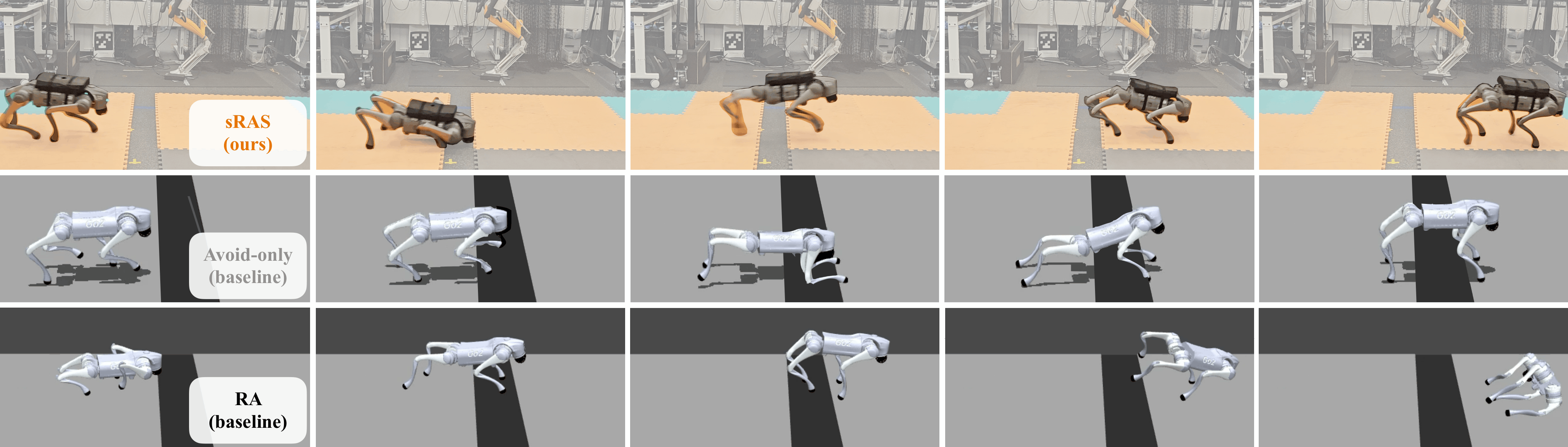
The authors propose a strict reach-avoid-stay (sRAS) Q-control barrier function safety filter for high-dimensional black-box systems under bounded uncertainty. They combine a stay value encoding permanent safe residence in a target set with a reach-avoid value, prove these yield a valid robust discrete-time CBF, and lift them to state-action Q-functions for runtime intervention. Reachability-based adversarial RL approximates the values from black-box interaction only, and the framework is validated on quadruped gap jumping in simulation and hardware.
中文摘要: 本文面向高维黑箱系统,在有界不确定性下提出严格的到达-避障-保持(sRAS)Q控制障碍函数安全滤波器。方法将编码目标集内永久安全驻留的“保持值”与编码安全可达且避开无法保证永久驻留状态的“到达-避障值”相结合,证明二者共同构成有效的鲁棒离散时间控制障碍函数,并将其提升为状态-动作Q函数以支持运行时干预。在精确值与测度零条件下,该滤波器能从几乎所有可胜初始状态保持sRAS可行性,并在首次进入目标集后使系统始终安全驻留。作者采用基于可达性的对抗强化学习,仅通过黑箱交互进行可扩展的值函数近似,无需已知动力学、仿射结构、值函数导数或人工设计障碍函数。实验在仿真与硬件上验证了四足机器人跨沟跳跃任务。
💬 It is highly relevant for modular legged robots needing safety guarantees in dynamic maneuvers such as gap jumping, since it avoids known dynamics and hand-designed barriers while providing formal sRAS guarantees.
💬 该文对需要动态机动(如跨沟跳跃)安全保证的模块化腿足机器人高度相关,其无需已知动力学和人工障碍函数即可提供严格sRAS保证。
Why read it / 推荐理由: It offers a black-box, RL-scalable safety filter with real quadruped hardware validation, useful for safety-critical legged locomotion beyond standard MPC. 该文提供可随强化学习扩展的黑箱安全滤波器,并在真实四足机器人上验证,对超越标准MPC的安全关键腿足运动具有价值。
4. Pose-aware Legged Robot Semantic Exploration with Omnidirectional Perception in Confined Unknown Environments
受限未知环境中基于全向感知的姿态感知腿足机器人语义探索
Authors / 作者: Xiaoyang Zhan, Shiyu Chen, Kenji Shimada
arXiv: 2609.19460 · PDF
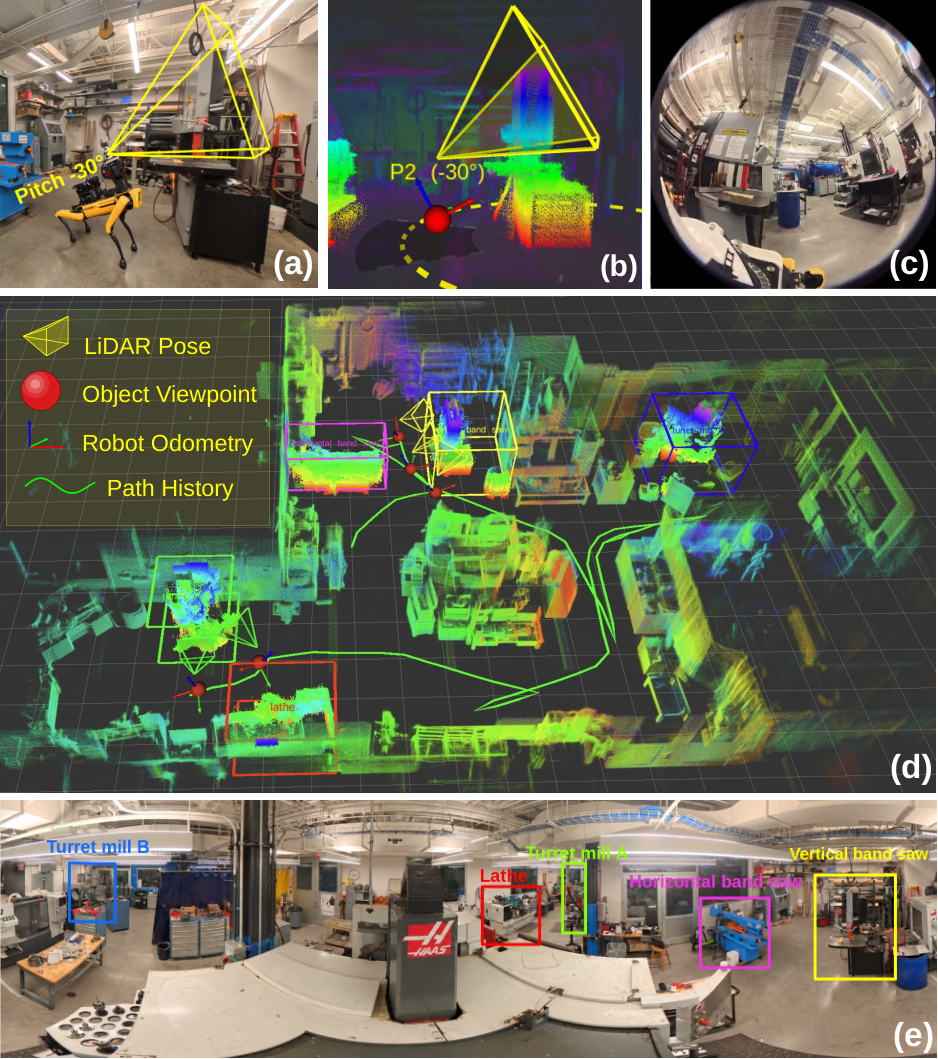
POSE is a pose-aware semantic exploration system that exploits a legged robot’s body pitch and roll with omnidirectional camera–LiDAR perception. A pose-aware viewpoint sampling module selects postures from partial object maps according to expected coverage gain, aim-aligned execution reduces reorientation, and a VLM-assisted object-centric pruning strategy reduces redundant inspection. Simulations show 8–10 percentage points higher target-surface coverage and 17–32% lower exploration time than planar planning, with real-world experiments.
中文摘要: 本文提出POSE——一种姿态感知的语义探索系统,利用腿足机器人固有的俯仰与横滚自由度,并结合全向相机-激光雷达感知,在受限未知环境中同时完成环境建图与目标对象细致观测。其姿态感知视点采样模块根据部分对象地图和期望覆盖增益选择机体姿态,瞄准对齐执行策略减少不必要的机身重定向;同时引入视觉语言模型(VLM)辅助的对象中心视点剪枝策略,利用持续观测历史和鸟瞰图(BEV)减少冗余检查访问。语义视点与几何探索视点统一输入全局探索规划器。仿真表明,相比平面规划基线,POSE将最终目标表面覆盖率提高8–10个百分点,探索时间减少17–32%,并在对象覆盖AUC指标上取得最优。真实实验进一步验证了系统在受限环境中的有效性。
💬 This paper is relevant to legged traverse-capability-aware planning because it uses body posture as an active sensing degree of freedom, improving coverage in confined spaces where planar planning fails.
💬 该文将机体姿态作为主动感知自由度,在平面规划难以覆盖的受限空间中提升观测效果,对腿足机器人通行能力感知规划具有参考价值。
Why read it / 推荐理由: It connects legged pose control with semantic exploration and real-world confined-environment validation, aligning with traverse-capability-aware planning. 该文将腿足姿态控制与语义探索结合,并在真实受限环境中验证,契合通行能力感知路径规划的研究方向。
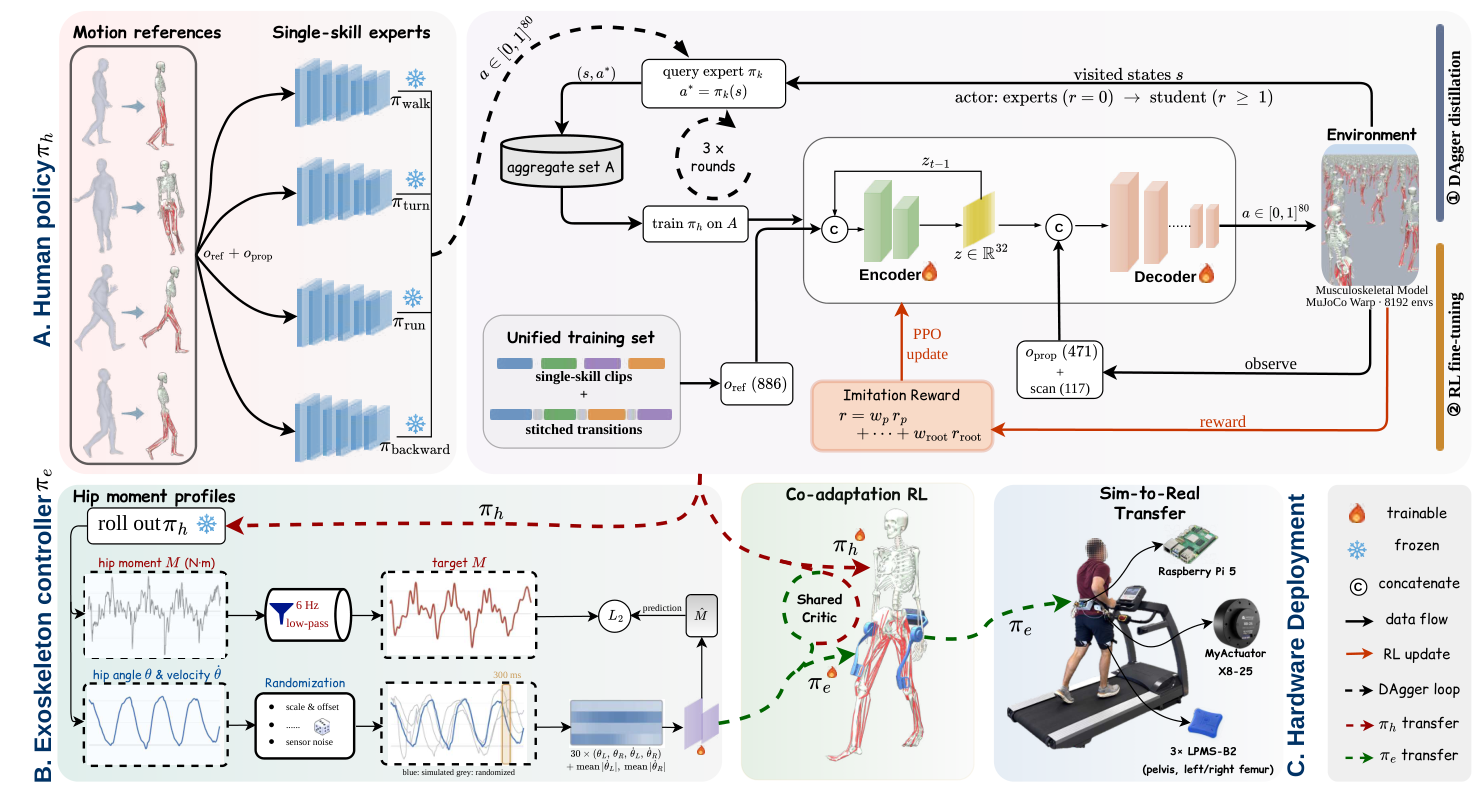
5. UniExo: Unified Multi-Skill Policies for Musculoskeletal Locomotion and Co-Adaptive Exoskeleton Control
UniExo:面向肌肉骨骼运动与共适应外骨骼控制的统一多技能策略
Authors / 作者: Yifei Yuan, Jakob Wolf, Ghaith Androwis, Xianlian Zhou
arXiv: 2609.19690 · PDF
UniExo builds a multi-skill musculoskeletal human policy by distilling four single-skill imitation experts for walking, turning, running, and backward walking into a unified skill-latent network, then fine-tunes it with RL on transition sequences. The unified policy achieves 94.7% mean tracking success on unseen clips and is more robust to perturbations than individual experts. A single hip exoskeleton controller initialized from the human policy’s hip-moment prediction is co-adapted via multi-agent RL across all four skills and deployed on a custom hip exoskeleton.
中文摘要: 本文提出UniExo框架,先构建多技能肌肉骨骼人体策略,再与佩戴者联合训练外骨骼控制策略。作者将步行、转向、跑步和后退行走四个单技能模仿专家蒸馏为一个由技能隐变量组织的统一网络,并通过强化学习在技能转换序列上微调。统一人体策略在四类技能未见片段上平均跟踪成功率达94.7%,且相比各专家策略对扰动更具鲁棒性。随后,从人体策略的髋关节力矩预测初始化单一髋部外骨骼控制器,并通过多智能体强化学习在四种技能上与人体策略共适应,使辅助力矩时序发生偏移并提高向髋关节输出的正功比例。最终在定制髋部外骨骼上部署验证。
💬 Although it targets exoskeletons rather than modular legs, its unified skill-latent multi-skill policy and co-adaptive RL are methodologically relevant to multi-gait legged locomotion control.
💬 尽管面向外骨骼而非模块化腿足,其统一技能隐变量多技能策略与共适应强化学习方法对多步态腿足运动控制具有方法学参考价值。
Why read it / 推荐理由: It offers a transferable multi-skill latent policy and co-adaptation scheme that could inform unified gait generation and transition learning for modular legged robots. 该文提供可迁移的多技能隐变量策略与共适应方案,可为模块化腿足机器人的统一步态生成与转换学习提供思路。