机器人日报
机器人论文日报 — 2026-09-18
🤖 Scanned 344 papers from today’s arXiv announcement (cs.RO / eess.SY / cs.LG), picked 5 for modular & legged robotics — summarized by DeepSeek.
🤖 从今日 arXiv 新论文(cs.RO / eess.SY / cs.LG)中扫描 344 篇,围绕模块化与足式机器人精选 5 篇 — 由 DeepSeek 生成双语摘要。
1. DR-MPC: Fast and Feasible Dynamics-Relaxed Model-Predictive Control for Legged Locomotion
DR-MPC:面向足式运动的高速可行动力学松弛模型预测控制
Authors / 作者: Run Wang, Alapati Tuerxun, Shuo Liu, Wei Xiao, Ján Drgoňa, Yilin Mo et al.
arXiv: 2609.20035 · PDF
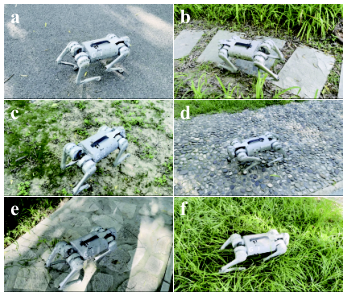
DR-MPC reformulates legged-locomotion MPC by relaxing dynamics equality and affine input constraints into quadratic penalties, leaving only box constraints, and solves the resulting block-arrow QP with a tailored interior-point method using Schur-complement elimination and contact-aligned move blocking. It reports median end-to-end speedups of 16.0x over HPIPM and 4.4x over OSQP with comparable simulated locomotion quality, achieving a 4.4 ms median onboard MPC time validated on a Unitree Go1.
中文摘要: 本文提出动力学松弛模型预测控制(DR-MPC),将足式运动的动力学等式约束与仿射输入约束转化为二次惩罚项,仅保留盒约束,从而构造出具有块箭头Hessian结构的二次规划问题。作者设计了定制内点法求解器,通过Schur补消去状态与仿射输出方向,并在摆腿力消元后进行接触对齐的移动分块,仅需分解降维后的控制子系统。在相同DR-MPC形式下,该方法相比HPIPM取得16.0倍、相比OSQP取得4.4倍的中位端到端加速,仿真运动性能相当,并在Unitree Go1四足机器人上实现4.4毫秒中位机载MPC耗时验证。
💬 A well-motivated MPC redesign that trades exact dynamics feasibility for a structured, fast QP with real quadruped validation, making it highly relevant to onboard whole-body and modular legged control.
💬 该工作以牺牲精确动力学可行性换取结构化快速QP求解,并在真实四足平台上验证,对机载全身控制与模块化足式控制有很强的参考价值。
Why read it / 推荐理由: It offers a practical, open-source-ready MPC solver formulation that could directly reduce control latency in your reconfigurable multi-legged platforms. 它提供了一种可直接落地的MPC求解器新形式,有望降低你可重构多足平台的控制延迟。
2. GLAMDRING: Gait Learning And Morphology co-Design via Reinforcement LearnING of CPGs
GLAMDRING:基于CPG强化学习的步态学习与形态协同设计
Authors / 作者: Amogh Joshi, Kaushik Roy
arXiv: 2609.19452 · PDF
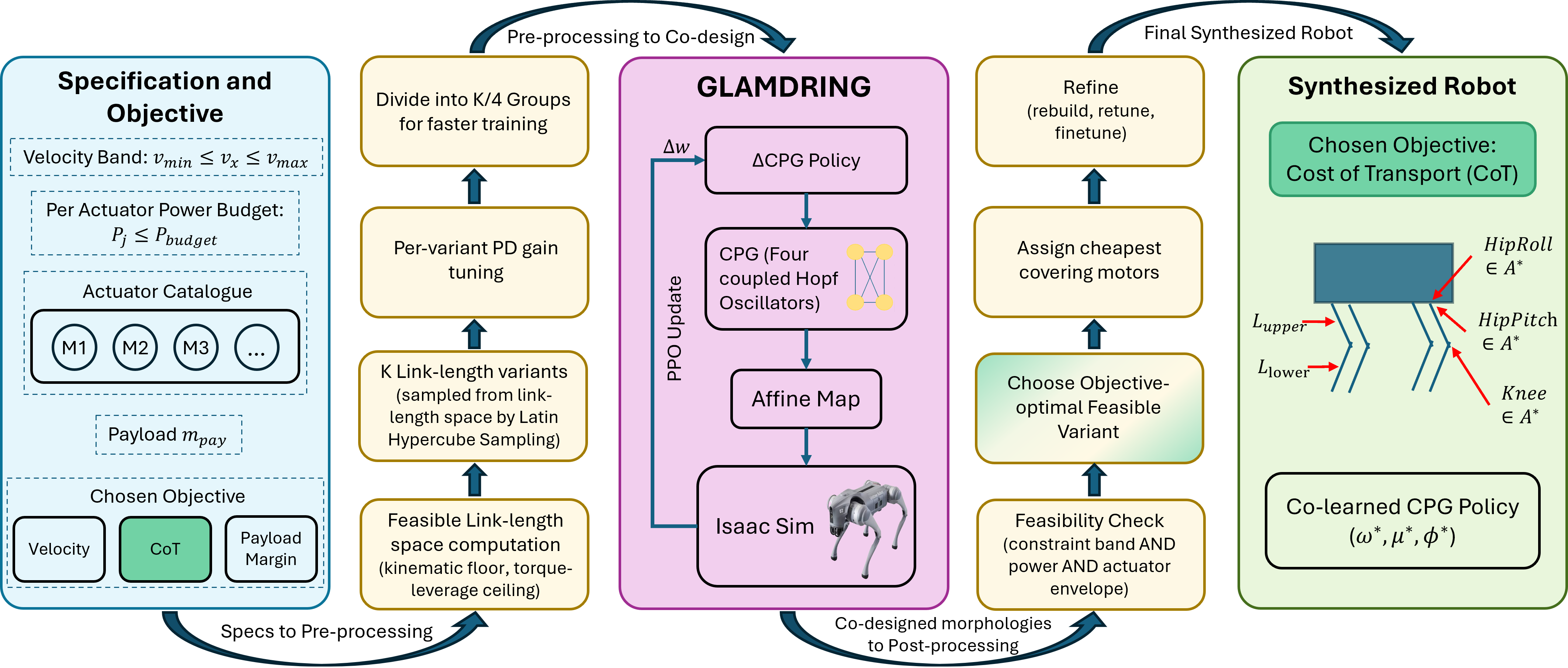
GLAMDRING co-designs quadruped morphology (link geometry and per-joint actuators) and a Hopf-oscillator CPG gait policy under specifications of velocity bounds, per-actuator power budget, actuator library, and payload. It ranks feasible designs by speed, cost of transport, or payload margin, and reduces synthesis cost to a small fixed number of RL runs by learning CPG policies across candidate morphologies and resolving link lengths and actuators post-hoc from logged operating envelopes.
中文摘要: GLAMDRING提出一种步态与形态协同设计框架,在给定前向速度边界、单执行器功率预算、执行器库与负载要求下,为运动任务合成最优四足形态(连杆几何与各关节执行器)并同时学习Hopf振荡器中枢模式发生器(CPG)步态策略。由于身体与运动耦合,最优形态决定驱动方式,而最优步态依赖物理身体。作者通过在候选形态空间中用强化学习训练少量CPG策略,再依据策略记录的工作包络事后解析连杆长度与执行器,将合成成本降至固定次数的RL训练,而非每个候选一次。实验表明协同设计身体与步态对满足运动指标是必要的。
💬 Directly targets the morphology-control coupling central to modular legged design, with a clever approach that avoids per-candidate RL training.
💬 该工作直接面向模块化足式设计中形态与控制的耦合问题,并巧妙避免了逐候选的强化学习训练。
Why read it / 推荐理由: Its joint gait-morphology co-design formulation maps naturally onto your reconfigurable leg module selection and actuator choices. 其步态-形态联合协同设计公式可自然迁移到你可重构腿部模块选型与执行器配置问题。
3. Accelerating Visual Policy Learning with Sampling-Based Model Predictive Control
利用采样模型预测控制加速视觉策略学习
Authors / 作者: Yilang Liu, Haoxiang You, Qian Wang, Daniel Rakita, Ian Abraham
arXiv: 2609.20575 · PDF
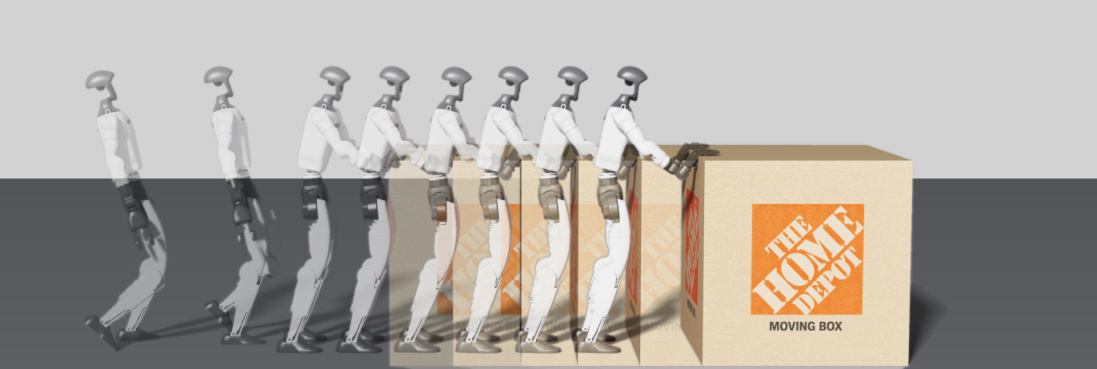
SGPS couples sampling-based MPC action-target refinement with first-order policy gradients, initializing via behavior cloning then alternating sampled refinement with short-horizon differentiable-simulation updates under perturbed states and randomized dynamics. A decoupled formulation excludes rendering from the computation graph, enabling direct learning from depth observations without a state-policy teacher, with policies learned on one GPU for Go2/G1 locomotion and manipulation and zero-shot transfer to a real Go2 using onboard depth.
中文摘要: 本文提出采样引导策略搜索(SGPS),将基于采样的模型预测控制动作目标精化与一阶策略优化相结合。方法先用行为克隆从采样动作初始化策略,再在扰动初始状态与随机动力学下交替进行采样精化与短时域一阶策略梯度更新。针对视觉策略训练,作者采用解耦的一阶策略梯度形式,将渲染排除在计算图之外,从而无需状态策略教师即可直接从深度观测学习。在单块GPU上,SGPS为Unitree Go2与G1学习了运动、越障、推箱与双臂搬运等策略,并蒸馏后零样本迁移到真实Go2,依靠机载深度实现小跑、爬行、跨栏及行为切换。
💬 A promising hybrid of MPC-style sampling and differentiable policy learning that yields real-robot, depth-only locomotion and traversal, relevant to sim-to-real motion control.
💬 该工作将MPC式采样与可微策略学习混合,实现了真实机器人仅用深度的运动与越障,对仿真到真实的运动控制很有参考意义。
Why read it / 推荐理由: It shows a practical route to depth-driven, sim-to-real locomotion policies without a state teacher, useful for your multi-legged control stack. 它展示了无需状态教师、基于深度的仿真到真实运动策略学习路径,对你的多足控制栈具有实用价值。
4. Quantifying Mechanical Intelligence in Legged Robots with Information Theory
用信息论量化足式机器人中的机械智能
Authors / 作者: Zach J. Patterson
arXiv: 2609.19588 · PDF
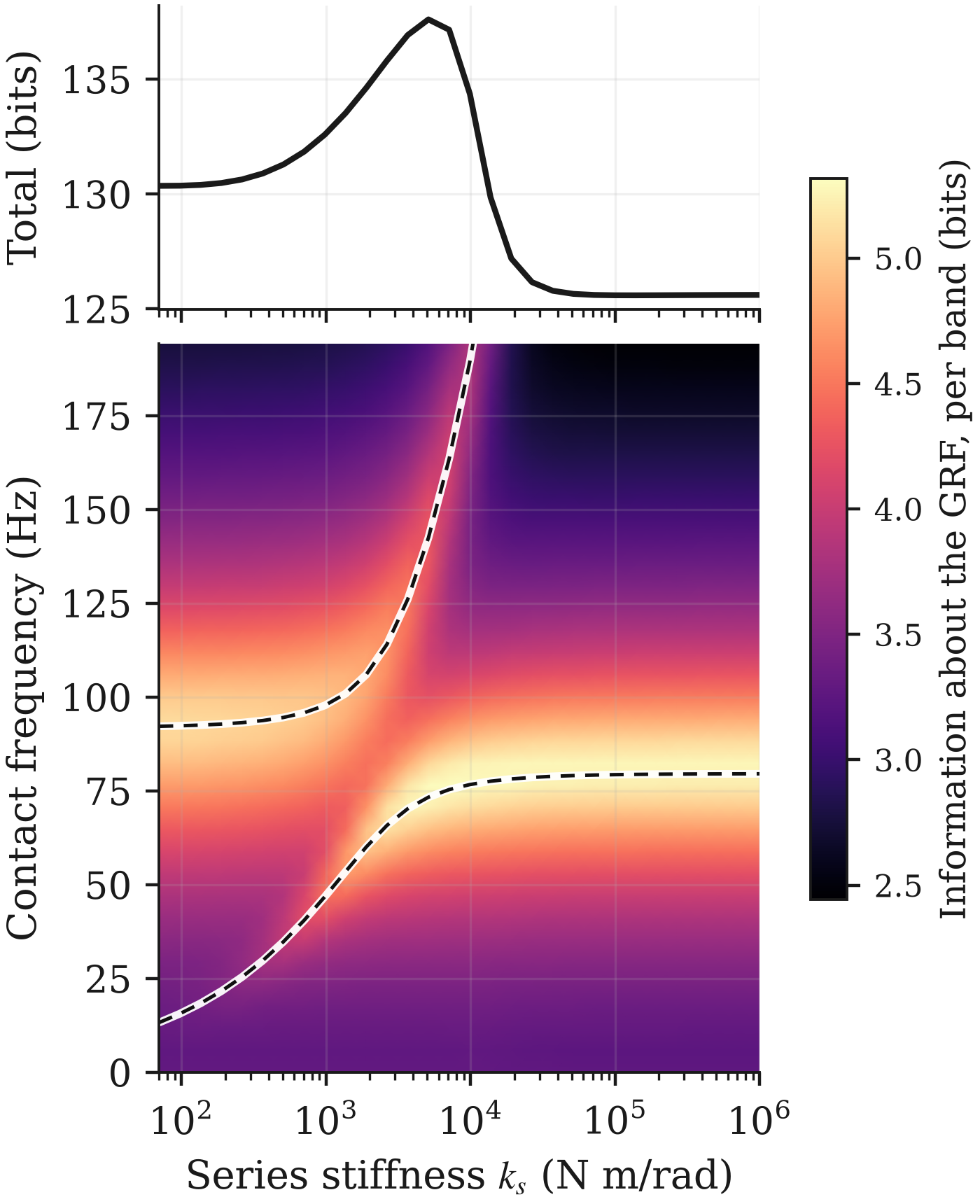
This work proposes information-theoretic metrics to quantify mechanical intelligence, treating body dynamics as both computation and a communication channel to measure bits processed by mechanical modes and across robot coordinates. Using a linear leg-transmission model, a nonlinear single-leg simulation, and learned-policy simulated quadrupeds on challenging terrain, it examines the trade-off between series-elastic actuation compliance and low-gear-ratio proprioceptive transmissions and how these interact with control policies.
中文摘要: 本文提出用信息论度量来量化机械智能,即机器人物理形态所减轻的控制负担。作者将身体动力学同时视为计算过程与通信信道,量化机械模态以及跨机器人坐标所处理的信息比特。方法在复杂度递增的系统上展开:简化线性腿部传动模型、非线性单腿仿真,以及在复杂地形上由学习策略控制的仿真四足机器人。研究考察了通过串联弹性执行器显式引入柔顺性与采用低减速比本体感知传动之间的权衡,以及这些机制在运动过程中如何与控制策略相互作用。该工作为足式机器人工程中的若干既有直觉提供了信息论解释。
💬 A conceptually novel theoretical lens on the morphology-control trade-off that underpins modular and compliant legged design.
💬 该工作从信息论视角新颖地刻画了形态-控制权衡,为模块化与柔顺足式设计提供了理论基础。
Why read it / 推荐理由: It gives a quantitative framework for reasoning about how leg compliance and transmission choices shift control burden, relevant to your module design decisions. 它提供了量化框架来理解腿部柔顺性与传动选择如何改变控制负担,与你模块设计决策密切相关。
5. OmniMimic: Dynamics-completed Motion Augmentation for Multi-style Omnidirectional Quadruped Locomotion
OmniMimic:面向多风格全向四足运动的动力学补全动作增强
Authors / 作者: Sheng Wu, Guoqiang Zhao, Zhe Yang, Fei Teng, Zhikun Zhou, Yanlin Yang et al.
arXiv: 2609.20566 · PDF
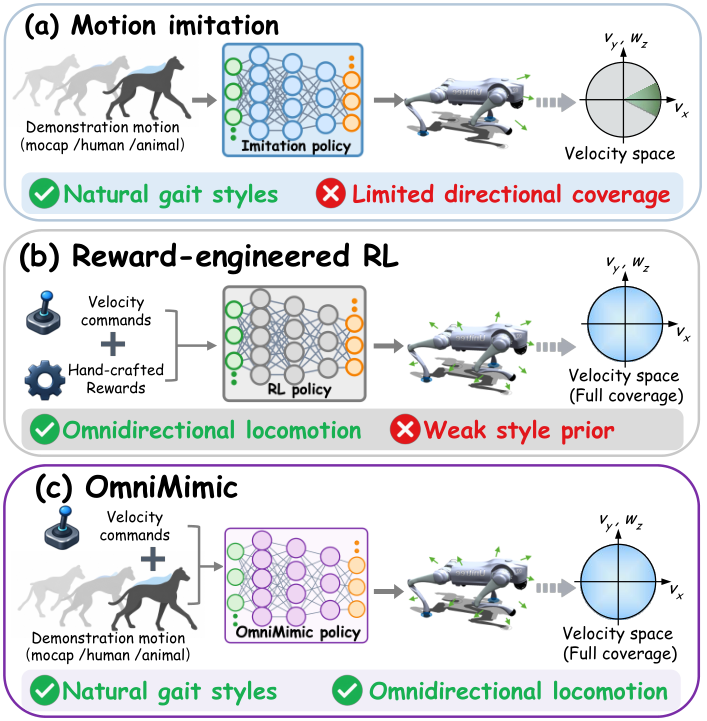
OmniMimic converts directionally limited animal demonstrations into a single multi-gait quadruped policy over target per-axis velocity ranges using temporal reversal, constrained dynamics completion, and sagittal reflection to synthesize robot-specific kinematic and physical supervision. It progressively expands commands from the demonstrated distribution to target bounds and uses a shared actor with soft-gated gait-specialized residual experts, reducing mean foot-position RMSE by 12.9% and velocity-tracking RMSE by 63.1% versus a matched baseline across four simulated gaits.
中文摘要: OmniMimic针对动物示范方向覆盖狭窄、难以为后退、侧移与转向指令提供风格一致监督的问题,提出训练框架,将方向受限的动物示范转化为覆盖目标各轴速度范围的单一多步态策略。方法先结合时间反转、约束动力学补全与矢状面镜像,在观测方向之外构造机器人特定的运动学与物理监督;随后将指令从示范速度分布逐步扩展到目标各轴边界,并采用共享actor加软门控、步态专用残差专家的结构,以平衡可复用运动技能与步态特定修正。在仿真四种步态下,相比匹配的APEX基线,前向与后向参考速度的平均足端位置RMSE降低12.9%,均匀笛卡尔指令网格上的速度跟踪RMSE降低63.1%。
💬 A clean demonstration-augmentation recipe for omnidirectional multi-gait policies that improves tracking without hand-crafted style rewards.
💬 该工作给出了一套清晰的动作增强方案,在无需手工风格奖励的情况下实现了全向多步态策略与更好的速度跟踪。
Why read it / 推荐理由: Its gait-specialized expert gating and command expansion strategy are directly transferable to generating diverse gaits on modular multi-legged platforms. 其步态专用专家门控与指令扩展策略可直接迁移到模块化多足平台上的多样步态生成。