机器人日报
机器人论文日报 — 2026-09-06
🤖 Scanned 289 new arXiv papers (cs.RO / eess.SY / cs.LG, last 96 h), picked 5 for modular & legged robotics — summarized by DeepSeek.
🤖 扫描了近 96 小时 arXiv(cs.RO / eess.SY / cs.LG)的 289 篇新论文,围绕模块化与足式机器人精选 5 篇 — 由 DeepSeek 生成双语摘要。
1. An Adaptive Control Architecture for Slope and Terrain Compensation in Autonomous Navigation in Mediterranean Greenhouses
地中海温室自主导航中斜坡与地形补偿的自适应控制架构
Authors / 作者: Fernando Cañadas-Aránega, Dirk Wollherr, José L. Guzmán, José C. Moreno, José L. Blanco-Claraco
arXiv: 2609.02487 · PDF
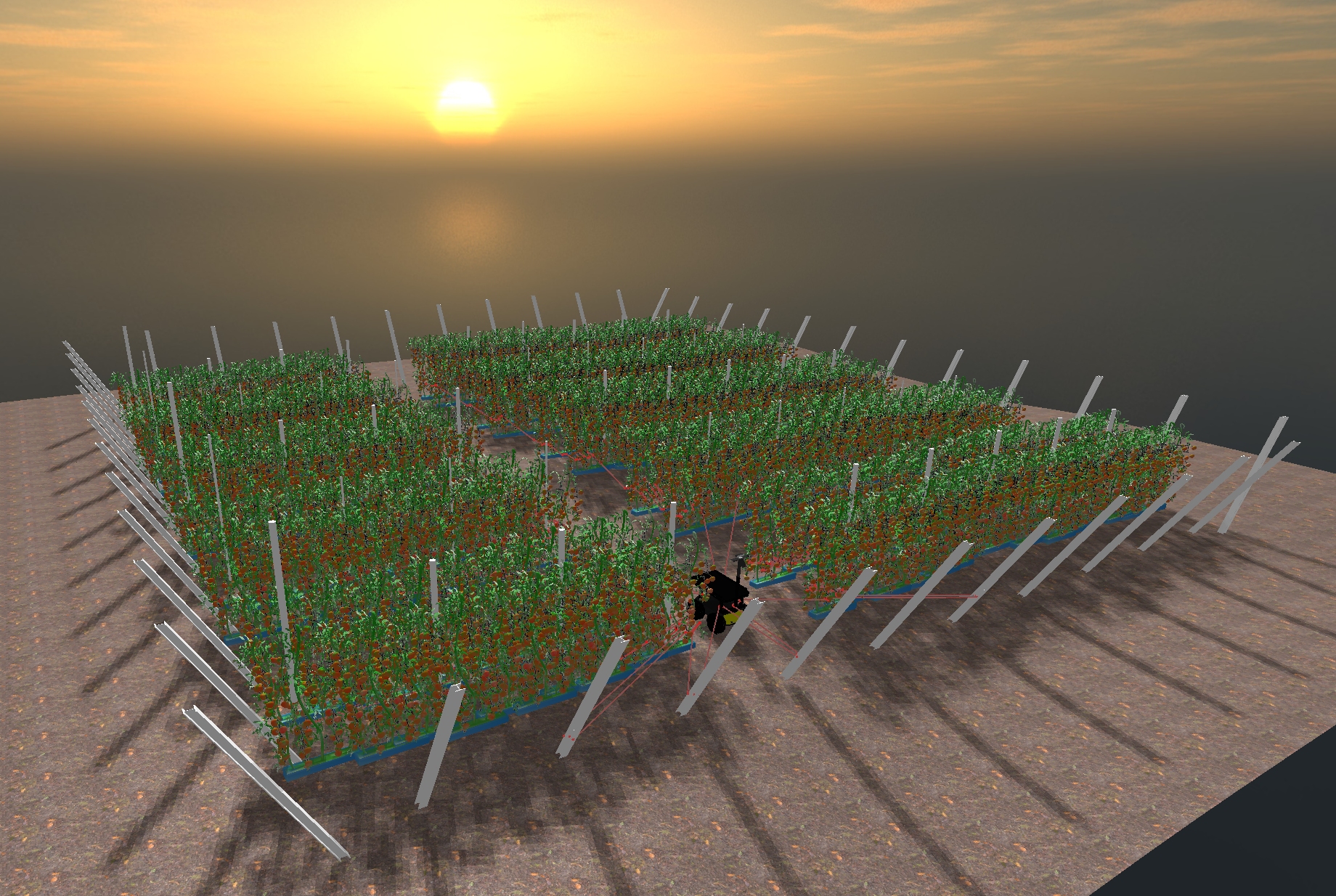
The paper presents an adaptive control architecture for mobile robots navigating greenhouse terrains with varying slopes and textures. A cascade scheme with MPC in the outer loop and PI in the inner loop is combined with an adaptive feedforward via gain scheduling, based on IMU slope measurement and experimental terrain characterization. Simulations show significant improvements in trajectory tracking error and control effort robustness.
中文摘要: 本文提出了一种用于地中海温室中自主导航移动机器人的自适应控制架构,以应对不同坡度和土壤类型带来的扰动。通过实验表征典型温室土壤(混凝土、压实沙地、沙砾)并利用IMU直接测量地形坡度,设计基于增益调度的自适应前馈控制器,同时结合外环模型预测控制(MPC)与内环PI控制器的级联轨迹跟踪方案。自适应前馈能够根据坡度和地形类型实时调整控制输入,以补偿地形变化引起的扰动。仿真结果表明,该方法在误差指标和控制信号效率上均优于传统固定增益控制,显著提升了轨迹跟踪精度和鲁棒性。该工作为复杂地形下移动机器人的自适应运动控制提供了有效的解决方案。
💬 Directly addresses terrain-aware compensation and MPC for mobile robots, applicable to legged platforms with variable ground contact.
💬 直接针对移动机器人的地形感知补偿和MPC,适用于具有可变地面接触的腿部平台。
Why read it / 推荐理由: Demonstrates a practical adaptive MPC scheme with terrain characterization, which can inspire traversability-aware control for modular legged robots. 展示了一种实用的自适应MPC和地形表征方案,可为模块化腿部机器人的可穿越性感知控制提供启发。
2. Real-Time Shape Control of Multi-Segment Soft Robotic Arms Using Koopman Operators with Global and Local Observables
基于全局与局部可观测量的Koopman算子多段软体机械臂实时形状控制
Authors / 作者: Jiahe Wang, Eron Ristich, Sultan Haidar Ali, Eric weissman, Lei Zhang, Wanxin Jin et al.
arXiv: 2609.03175 · PDF
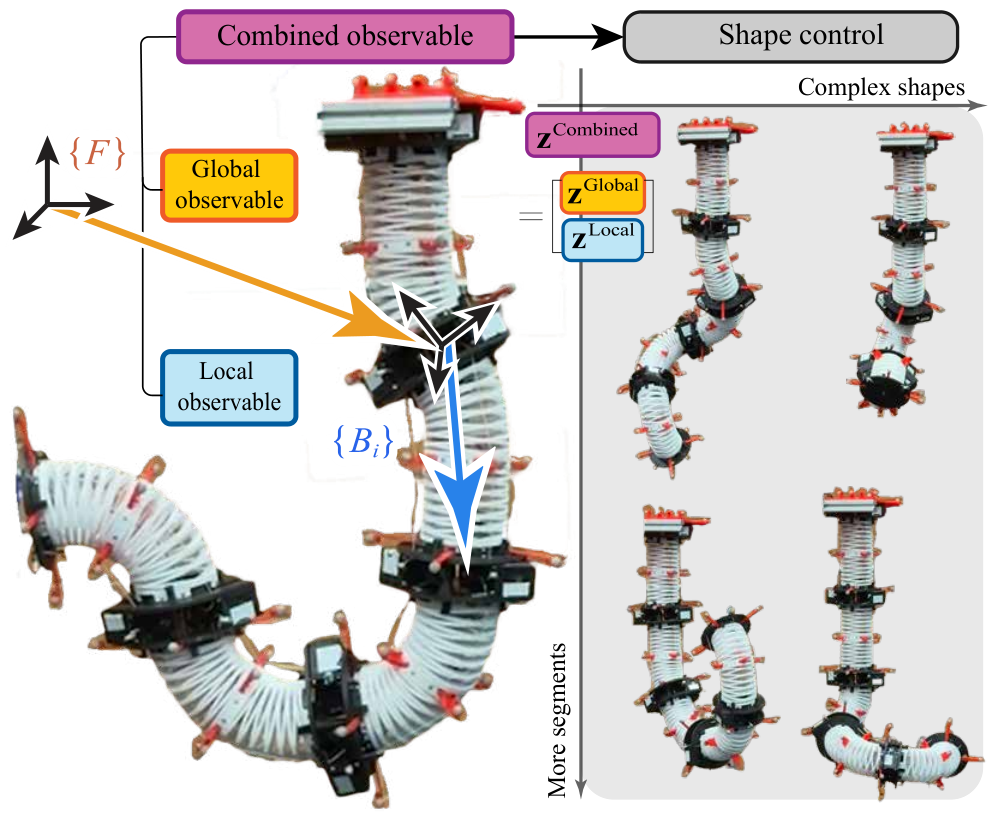
This work presents a Koopman-based model predictive control framework for real-time shape control of multi-segment soft robotic arms. By combining global and local observables, the framework captures coupling and gravity effects, and is validated through numerical experiments up to 10 segments and physical experiments on 3- and 5-segment arms with tip speeds up to 0.6 m/s and payloads up to 400 g, showing robust tracking without retraining.
中文摘要: 本文提出了一种基于Koopman算子的模型预测控制框架,用于多段软体机械臂的实时形状控制。针对连续变形所导致的高维非线性动力学和段间耦合问题,作者将全局形状误差与局部可观测变量引入Koopman线性化表示,构建了更具表达力的预测模型。在模型预测控制中,该框架同时优化全局形状和局部段间相互作用,显著提升了控制精度。数值实验表明,该控制器可扩展到10个独立驱动段;物理实验验证了在3段和5段机械臂上能够实现最高0.6 m/s的末端速度跟踪,并在高达400 g负载的情况下保持鲁棒性,且无需重新训练。该方法展示了Koopman算子在高维机器人实时形状控制中的潜力。
💬 Real-time Koopman MPC on a physical multi-segment robot offers a transferable method for controlling high-DOF modular legged robots.
💬 在物理多段机器人上实现实时Koopman MPC,为控制高自由度模块化腿部机器人提供了可迁移的方法。
Why read it / 推荐理由: Relevant for whole-body control of modular legged robots where segmented structure and real-time constraints are central. 在模块化腿部机器人的整体控制中,分段结构和实时约束是核心,因此本文值得关注。
3. Physics-based Online Adaptive Koopman Model Predictive Attitude Control for Combined Spacecraft with Dynamic Uncertainties
面向动态不确定组合航天器的基于物理的在线自适应Koopman模型预测姿态控制
Authors / 作者: Yicheng Sun, Yueyong Lyu, Yuhan Liu, Yanning Guo, Wei Pan
arXiv: 2609.02534 · PDF
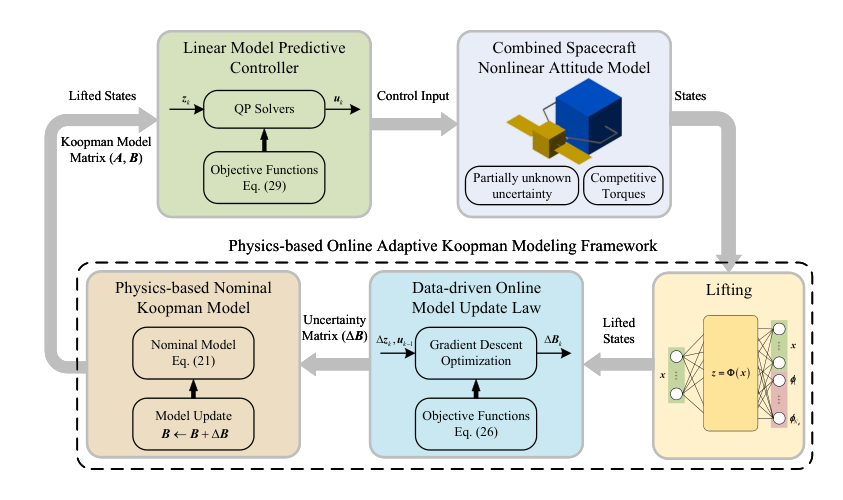
The paper proposes a physics-based adaptive Koopman MPC strategy for combined spacecraft attitude control under inertia uncertainties. Using quaternion-derived lifting functions, it builds a compact linear Koopman model, and a gradient descent law identifies time-varying inertia online. The adaptive linear model is integrated into MPC, resulting in a QP suitable for real-time implementation, with formal guarantees of recursive feasibility and regional input-to-state stability. Simulations in a high-fidelity 3D simulator demonstrate its effectiveness.
中文摘要: 本文针对组合航天器在惯性不确定性和目标主动机动条件下的姿态稳定问题,提出了一种基于物理的自适应Koopman模型预测控制策略。通过从四元数运动学解析推导提升函数,构建了紧致且具有物理可解释性的Koopman线性模型,相比传统黑箱EDMD和更高维的DCM模型,该模型更具优势。为实时辨识时变的惯性参数,设计了基于梯度下降的自适应更新律。将自适应线性模型集成到模型预测控制框架中,把最优控制问题转化为计算高效的二次规划(QP)问题,从而显著降低在线计算量。文中通过设计终端要素严格证明了递归可行性和区域输入-状态稳定性。高保真三维仿真结果验证了所提策略在姿态稳定任务中的有效性和优越性。该工作为复杂不确定系统的自适应MPC设计提供了新思路。
💬 Adaptive Koopman MPC with rigorous stability could handle inertia/payload changes in modular legged robots, enhancing robustness.
💬 具有严格稳定性的自适应Koopman MPC可处理模块化腿部机器人的惯性/负载变化,增强鲁棒性。
Why read it / 推荐理由: Offers a compact, online adaptive MPC formulation that can manage dynamic uncertainties common in reconfigurable legged platforms. 提供了一种紧凑的在线自适应MPC公式,能够处理可重构腿部平台常见的动态不确定性。
4. Taylor-Informed Indirect Adaptive Predictive Control Using Jacobian-Frozen Affine Predictors
基于雅可比冻结仿射预测器的Taylor信息间接自适应预测控制
Authors / 作者: Tam W. Nguyen
arXiv: 2609.03348 · PDF
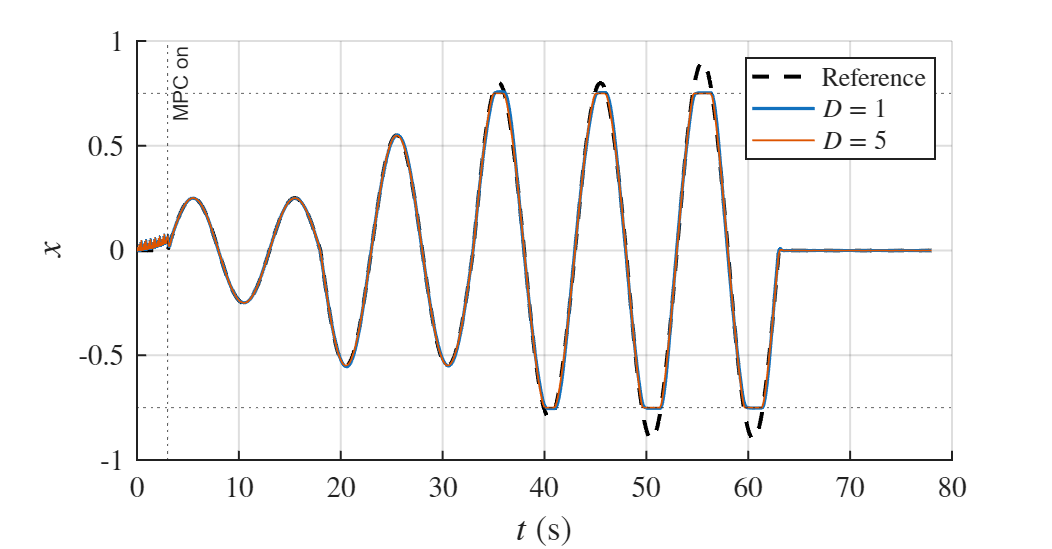
This paper develops an adaptive predictive control framework for nonlinear sampled-data systems using Taylor expansion and recursive least squares for online identification. The Jacobian is evaluated at the current operating point and frozen over the prediction horizon to form an affine predictor for MPC. Numerical simulations on an unstable nonlinear benchmark show that higher-order Taylor models improve tracking accuracy away from the expansion point while maintaining comparable control effort.
中文摘要: 本文提出了一种基于泰勒展开的自适应预测控制框架,用于非线性采样数据系统。该方法利用有限阶泰勒展开近似非线性动态,并通过递推最小二乘在线辨识多项式系数。在每个采样时刻,将辨识模型在当前工作点的雅可比矩阵计算并冻结于预测时域,从而得到仿射预测模型,用于模型预测控制。文中利用系统的奇对称性消除偶次多项式项,并结合前向欧拉结构进行字典裁剪,降低了模型复杂度。在不稳定非线性基准上进行了数值仿真,结果表明当工作点远离展开点时,高阶泰勒模型能够提高跟踪精度,而控制代价基本不变。该控制器的完整MATLAB实现已公开,便于复现和进一步测试。研究为非线性系统提供了计算效率与自适应性能平衡的预测控制方案。
💬 Introduces a tractable adaptive MPC variant for discrete-time nonlinear systems, potentially useful for embedded control of legged robots.
💬 提出了一种用于离散时间非线性系统的易处理自适应MPC变体,可能适用于腿部机器人的嵌入式控制。
Why read it / 推荐理由: The Jacobian-frozen affine prediction idea reduces computational complexity while maintaining adaptability, relevant for real-time MPC on legged robots. 雅可比冻结仿射预测思想在保持自适应性的同时降低了计算复杂度,与腿部机器人实时MPC相关。
5. Multi-step Proximal Policy Improvement in Offline Reinforcement Learning
离线强化学习中的多步近端策略改进
Authors / 作者: Soohyun Choi, Seonvin Cho, Songnam Hong
arXiv: 2609.03842 · PDF
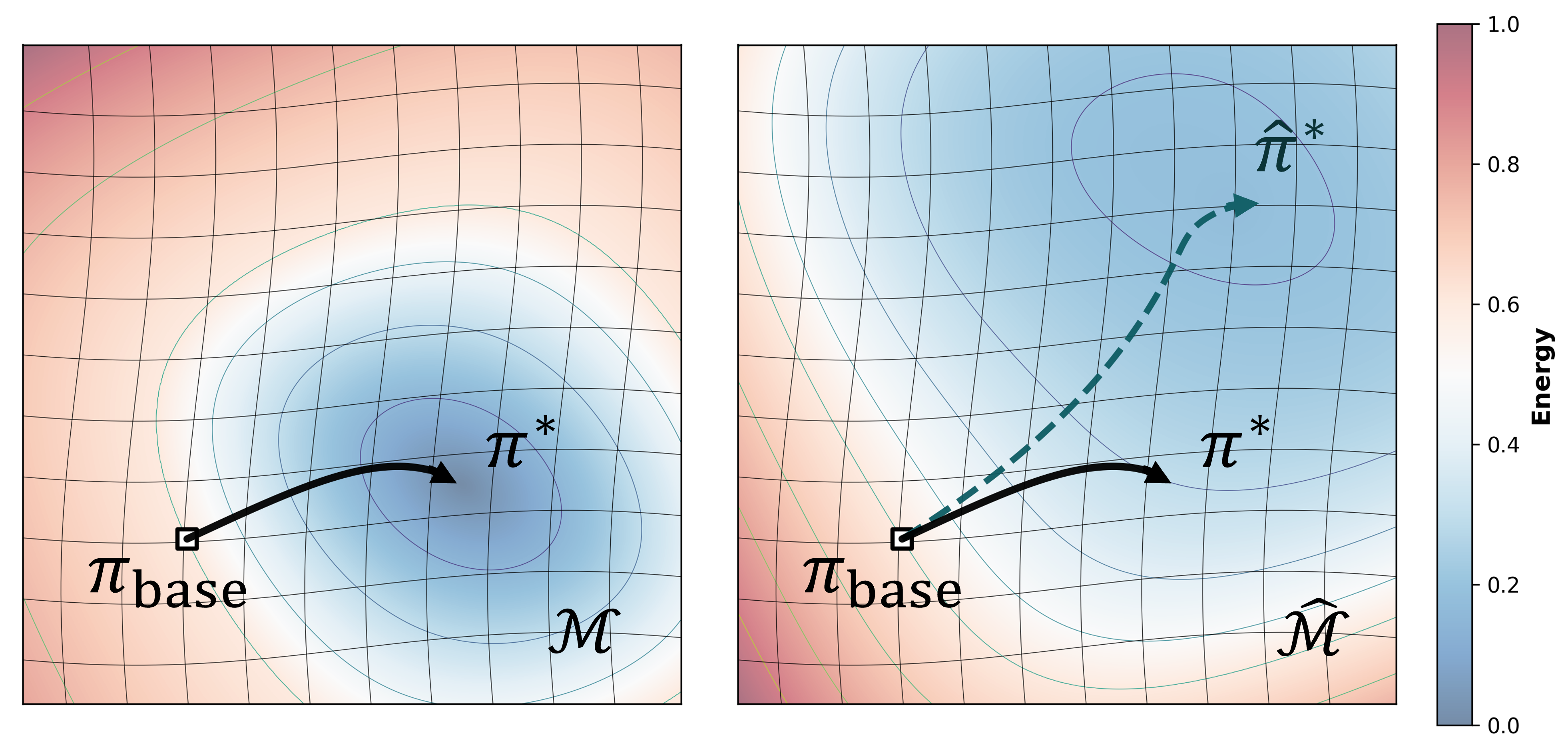
This paper presents a geometric view of offline RL actor updates, interpreting them as proximal policy improvement steps on a policy manifold. The proposed Multi-step Proximal Policy Improvement (MPI) composes sequential re-centered proximal steps, enabling controlled policy improvement beyond dataset support while maintaining proximal constraints. Experiments on D4RL show MPI improves strong baselines such as TD3+BC, ReBRAC, and IQL on many tasks.
中文摘要: 离线强化学习需要在保持价值估计可靠性和超越行为分布之间取得平衡。本文将策略视为概率流形上的点,将多种Actor更新统一解释为基于评判器能量的近端策略改进步骤。在此基础上,提出了多步近端策略改进(MPI)方法,通过连续执行重新居中的近端步骤,使策略能够在受控情况下超越数据集支持的范围,同时保留每一步的近端约束。MPI作为一种即插即用机制,适用于确定性和对角高斯策略,并且不依赖特定的策略几何结构。在D4RL基准实验上,少量MPI迭代即可显著提升TD3+BC、ReBRAC和IQL等强基线的性能,证明了其在多种任务上的有效性。此外,诊断实验表明重新居中的多步更新优于固定目标更新,并分析了在评论家误差下的局限性。
💬 An elegant offline RL method for iterative policy refinement, which can stabilize learning for locomotion policies from limited datasets.
💬 一种优雅的离线RL迭代策略改进方法,可稳定地从有限数据集学习运动策略。
Why read it / 推荐理由: Provides a plug-in improvement mechanism for offline RL that could boost sim-to-real transfer of legged locomotion controllers. 为离线RL提供了一种即插即用的改进机制,可增强腿部运动控制器的sim-to-real迁移。