机器人日报
机器人论文日报 — 2026-09-02
🤖 Scanned 341 new arXiv papers (cs.RO / eess.SY / cs.LG, last 48 h), picked 5 for modular & legged robotics — summarized by DeepSeek.
🤖 扫描了近 48 小时 arXiv(cs.RO / eess.SY / cs.LG)的 341 篇新论文,围绕模块化与足式机器人精选 5 篇 — 由 DeepSeek 生成双语摘要。
1. Exploring Nonlinear Body Oscillations for Natural Quadruped Gaits
探索非线性身体振荡以实现自然四足步态
Authors / 作者: Annika Schmidt, Davide Calzolari, Florian Loeffl, Arne Sachtler, Daniel Seidel, Milan Herrmann et al.
arXiv: 2609.00539 · PDF
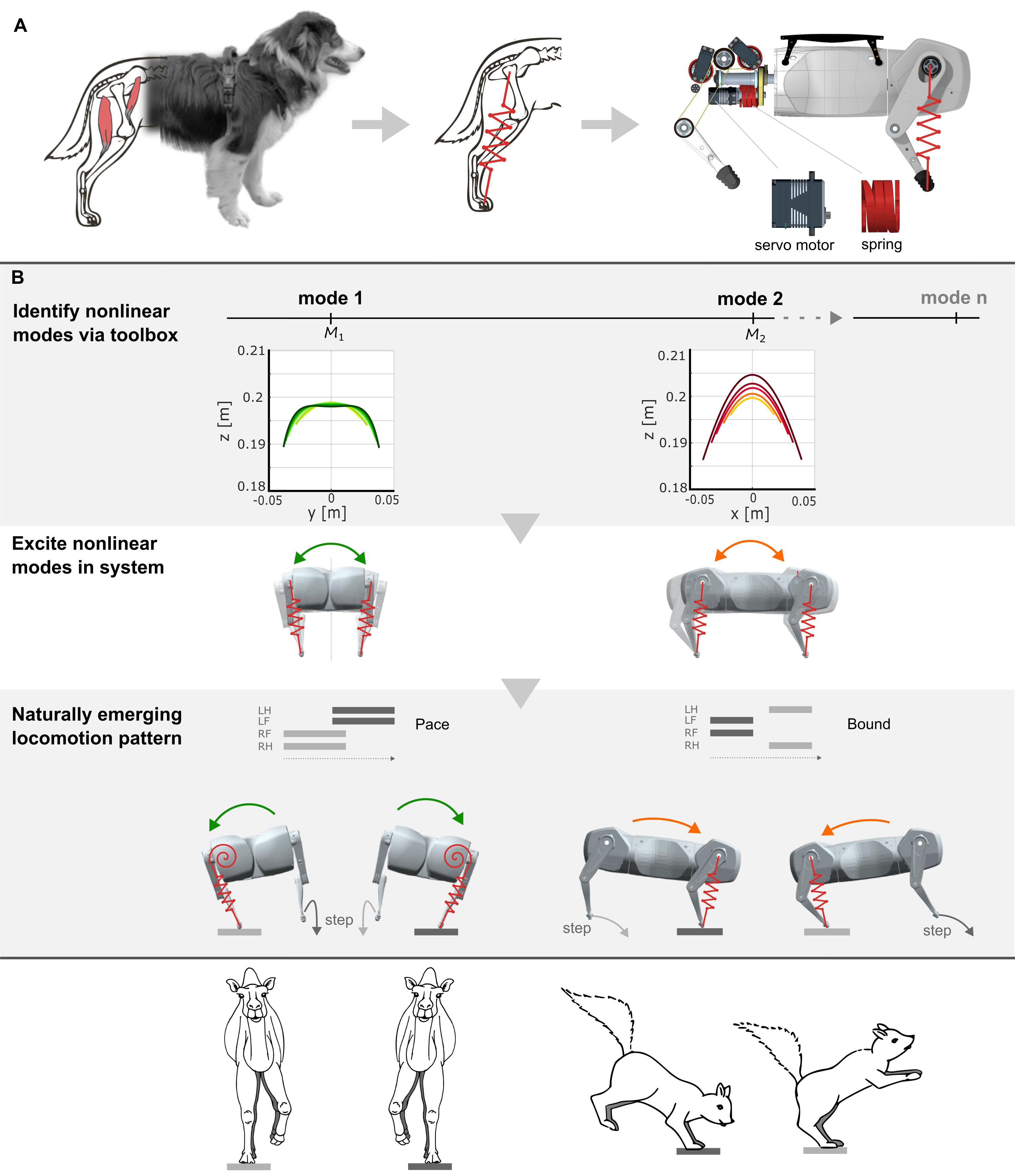
The authors present a framework that makes the nonlinear dynamics of compliant quadruped robots predictable, and show that multiple gaits can emerge from nonlinear normal modes (NNMs) without dedicated locomotion controllers. They identify six NNMs on the highly compliant robot eBert, optimize step length with black-box optimization, and validate that each NNM leads to a distinct gait in simulation and hardware, demonstrating embodied intelligence for agile, efficient locomotion.
中文摘要: 本文提出一个框架,使高柔顺四足机器人的非线性动力学在设计过程中可预测,并证明多种步态可以由非线性模态(NNMs)自然涌现,而无需专门的步态控制器。作者在机器人eBert上识别出六种NNM,利用黑箱优化确定步长,仿真显示每个NNM会发展为不同速度的步态,并成功迁移到硬件。实验表明eBert可利用其本体力学生成任务相关运动,为设计利用具身智能的新一代敏捷高效四足机器人奠定基础。文章强调利用机械共振与被动动力学可以降低控制负担,为多足机器人的形态与控制协同设计提供新思路。
💬 This paper is a direct embodiment-design and locomotion study, perfectly matching the reader’s focus on quadruped platform design and gait generation.
💬 本文直接面向四足平台设计与步态生成,与读者的研究核心高度吻合。
Why read it / 推荐理由: Provides a principled approach to make nonlinear body dynamics predictable, enabling gait emergence from mechanics rather than complex controllers. 提供了一种使非线性身体动力学可预测的原则性方法,使步态从力学中自然涌现而非依赖复杂控制器。
2. A System for Fast, Resilient, and Adaptable Loco-Manipulation Behaviors on Humanoid Robots
一种实现人形机器人快速、鲁棒且可适应行走操作行为的系统
Authors / 作者: Duncan Calvert, Luigi Penco, Dexton Anderson, Tomasz Bialek, Arghya Chatterjee, Beomyeong Park et al.
arXiv: 2609.01518 · PDF
The paper presents a runtime-editable behavior authoring and execution system for humanoid loco-manipulation, combining object-centric affordance templates, a behavior scene, and action primitives executed by a whole-body controller. The system supports concurrent body motion and walking, with an operator interface that enables fast creation, adaptation, and repair of behaviors. Demos on Unitree H1-2 and Alex include door traversal and sorting tasks, with scratch authoring in hours.
中文摘要: 本文提出一种运行时可编辑的人形机器人行走操作(loco-manipulation)行为编写与执行系统。该系统整合以对象为中心的可供性模板(Affordance Templates)、行为场景图和通过全身控制器执行的动作原语,支持操作员实时监控和修改。在Unitree H1-2和Alex机器人上演示了推门穿越和按颜色分拣等任务,展示了快速创建与调整复杂行为的能力。系统强调行为架构和运行时可编辑性对提升机器人速度、可靠性和适应性的关键作用,并可与已有的全身控制、感知和接触力控制结合。其设计思想和模块化组织对多足机器人的任务级控制与管理具有借鉴意义。
💬 Although the platform is a humanoid, the runtime-editable behavior architecture and whole-body controller integration are highly relevant to controlling complex legged robots.
💬 虽然平台是人形机器人,但其运行时行为架构和全身控制器集成对复杂腿足机器人控制有很强参考价值。
Why read it / 推荐理由: Offers a structured way to combine whole-body control with high-level behavior adaptation, useful for multi-legged platforms operating in unstructured environments. 提供了一种将全身控制与高层行为调整相结合的结构化方法,对非结构化环境中的多足平台有用。
3. Accelerating Reinforcement Learning via MPC Solver-Gradient Guidance for Weights-varying MPC
基于MPC求解器梯度引导的权重自适应MPC加速强化学习
Authors / 作者: Baha Zarrouki, Arslan Thobani, Jasper Hoffmann, Mattia Piccinini, Rudolf Reiter, Felix Jahncke et al.
arXiv: 2609.01061 · PDF
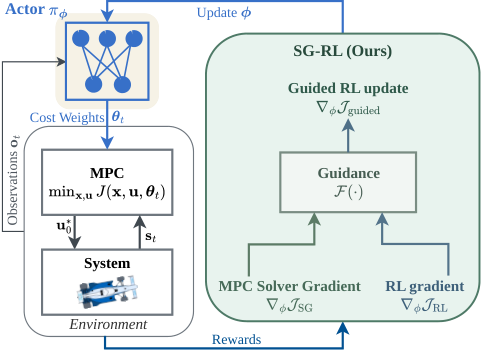
The paper proposes Solver-Gradient Guided Reinforcement Learning (SG-RL), which augments RL with bounded solver-derived gradients from differentiable MPC to improve sample efficiency while optimizing realized closed-loop return. SG-RL is instantiated in PPO with four mechanisms injecting gradient information into actor updates, policy loss, advantage estimation, and value function learning. Full-scale racing experiments with model mismatch show faster convergence and better closed-loop performance than standard PPO.
中文摘要: 针对MPC中代价函数权重需要在线自适应的问题,本文提出求解器梯度引导强化学习(SG-RL)。该方法在强化学习优化目标(实际闭环回报)中引入来自可微分MPC的有界求解器梯度作为辅助指导,在保持无偏目标的同时提升样本效率并增强稳定性。作者将SG-RL实例化为基于PPO的四种算法注入机制,分别作用于动作更新缩放、策略损失、优势估计与价值函数学习。在具有模型失配的两个自动驾驶平台实验中,SG-RL显著加速收敛并取得更好的闭环表现。这项研究为MPC与RL的深度融合提供了新范式,有望用于腿足机器人的步态与全身控制参数在线自适应。
💬 A methodologically novel way to combine differentiable MPC with RL, applicable to online MPC weight adaptation for locomotion controllers.
💬 一种将可微分MPC与RL结合的新方法,可用于运动控制器的在线MPC权重自适应。
Why read it / 推荐理由: Directly relevant to the reader’s MPC/RL research, offering solver-gradient guidance to accelerate policy learning for adaptive control. 与读者的MPC/RL研究直接相关,提供求解器梯度引导以加速自适应控制的策略学习。
4. ADAPT: Agile Diffusion Action Priors for Robust and Steerable Online Text-Driven Humanoid Control
ADAPT:面向鲁棒且可控的在线文本驱动人形机器人控制的敏捷扩散动作先验
Authors / 作者: Yan Wu, Chenhao Li, Kaifeng Zhao, Gen Li, Marco Hutter, Siyu Tang
arXiv: 2609.00677 · PDF
ADAPT is an end-to-end closed-loop framework for text-conditioned whole-body control of humanoid robots, learning a diffusion-based action prior from text-labeled state-action trajectories. A lightweight residual RL policy is trained on top of the frozen diffusion policy to improve long-horizon robustness and smooth prompt switching. The same prior can be reused as a steerable motion prior for downstream task adaptation, demonstrating robust skill execution and style-preserving control.
中文摘要: 本文提出ADAPT,一种端到端闭环框架,用于人形机器人的文本条件全身控制。框架从带文本标注的状态-动作轨迹中学习扩散动作先验,使多种运动技能可直接由语言指令执行。为了改善长时程鲁棒性和顺畅的指令切换,作者在冻结的扩散策略之上训练轻量级残差强化学习策略。此外,该扩散先验可复用作为可引导的运动先验以支持下游任务适应。实验验证了语言基础的技能执行、平滑的交互切换及保持风格的下游控制。该方法展示了生成模型与RL结合用于全身运动控制的潜力,对腿足机器人的指令控制与技能复用具有启示。
💬 This work demonstrates how diffusion priors plus RL can enable reactive and steerable whole-body control, a promising direction for language/command-driven legged robots.
💬 该工作展示了扩散先验与RL结合实现响应式、可控全身控制,对语言/指令驱动的腿足机器人具有借鉴意义。
Why read it / 推荐理由: Relevant for the reader’s RL-based motion control interests, especially when combining learned motion priors with online closed-loop control. 与读者基于RL的运动控制研究方向相关,尤其适合学习运动先验与在线闭环控制的结合。
5. ProxPI: Proximal Prior Injection for Sampling-Based MPC under Learned-Prior Mismatch
ProxPI:学习先验失配下的采样MPC近端先验注入
Authors / 作者: Euncheol Im, Myotaeg Lim, Yisoo Lee
arXiv: 2609.00941 · PDF
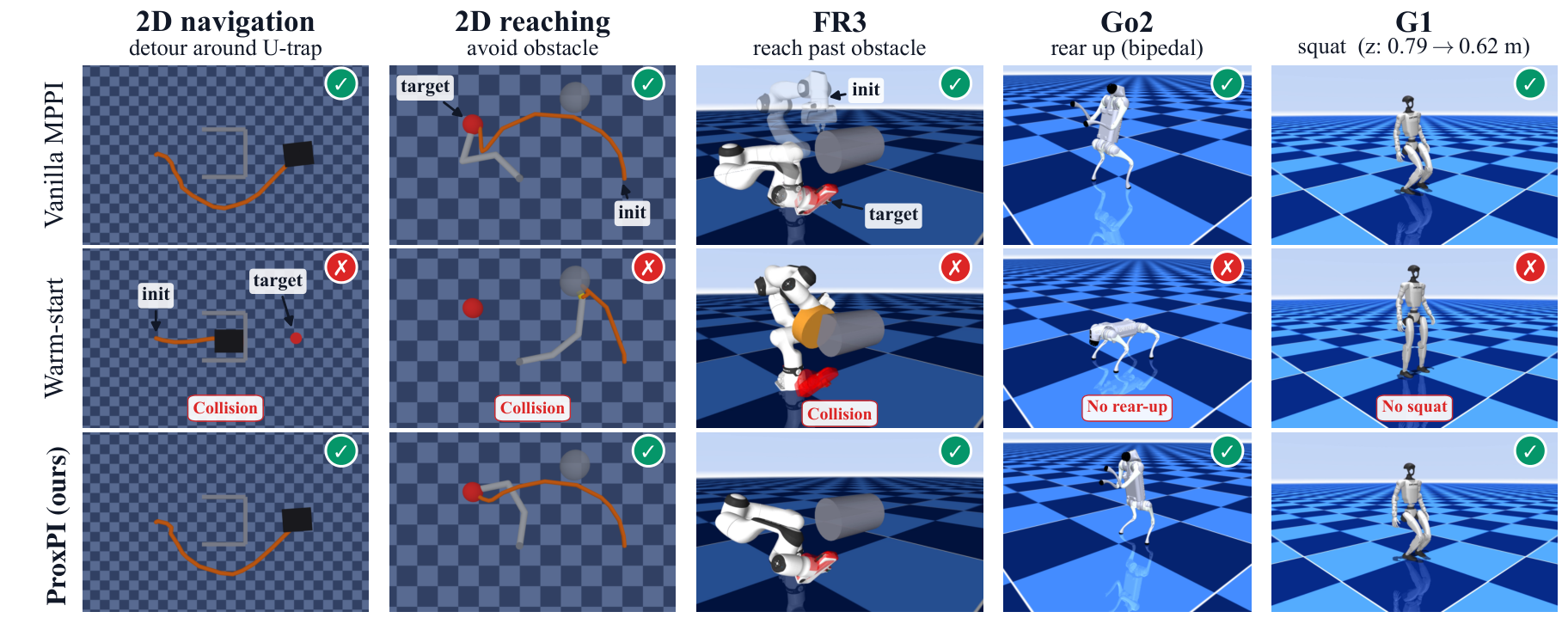
The paper addresses the failure of policy-guided sampling-based MPC when the learned prior is out-of-distribution. Instead of centering sampling around the policy output, ProxPI retains nominal-centered MPPI sampling and injects the prior through a soft proximity cost. This matches in-distribution performance while enabling recovery from inaccurate priors to nominal MPC performance, with theoretical analysis and real-robot demos.
中文摘要: 本文研究基于学习的策略与采样型MPC结合时,当学习先验分布失配会导致性能下降的问题。现有方法将采样分布中心放在策略输出上,限制了优化器逃离次优解的能力。作者提出近端先验注入(ProxPI),保留以标称值为中心的MPPI采样,并通过软近端代价引入策略先验,从而保持策略分布内性能,同时能在先验不准时恢复至普通MPPI的性能。理论分析与仿真及真实机器人实验验证了方法的鲁棒性。该工作对于腿足机器人与学习模型结合时的可靠MPC控制有直接参考价值,尤其适合处理预测模型与真实环境失配的问题。
💬 A robust method to combine learned priors with sampling-based MPC, directly relevant to the reader’s MPC research on legged robots.
💬 一种将学习先验与采样型MPC结合的鲁棒方法,与读者在腿足机器人上的MPC研究直接相关。
Why read it / 推荐理由: Provides a mechanism to avoid performance collapse under prior mismatch, important for real-world deployment of learned MPC pipelines. 提供了一种在先验失配时避免性能崩溃的机制,对于学习型MPC实际部署十分重要。