机器人日报
机器人论文日报 — 2026-08-22
🤖 Scanned 108 new arXiv papers (cs.RO / eess.SY / cs.LG, last 48 h), picked 5 for modular & legged robotics — summarized by DeepSeek.
🤖 扫描了近 48 小时 arXiv(cs.RO / eess.SY / cs.LG)的 108 篇新论文,围绕模块化与足式机器人精选 5 篇 — 由 DeepSeek 生成双语摘要。
1. Towards Professional Tennis Styles for Humanoid Robots with Adaptive Motion Planning and Tracking
面向人形机器人专业网球风格的适应性运动规划与跟踪
Authors / 作者: Tao Huang, Ruofei Liu, Xuchen Tang, Xinyin Zhang, Junli Ren, Huayi Wang et al.
arXiv: 2608.20087 · PDF
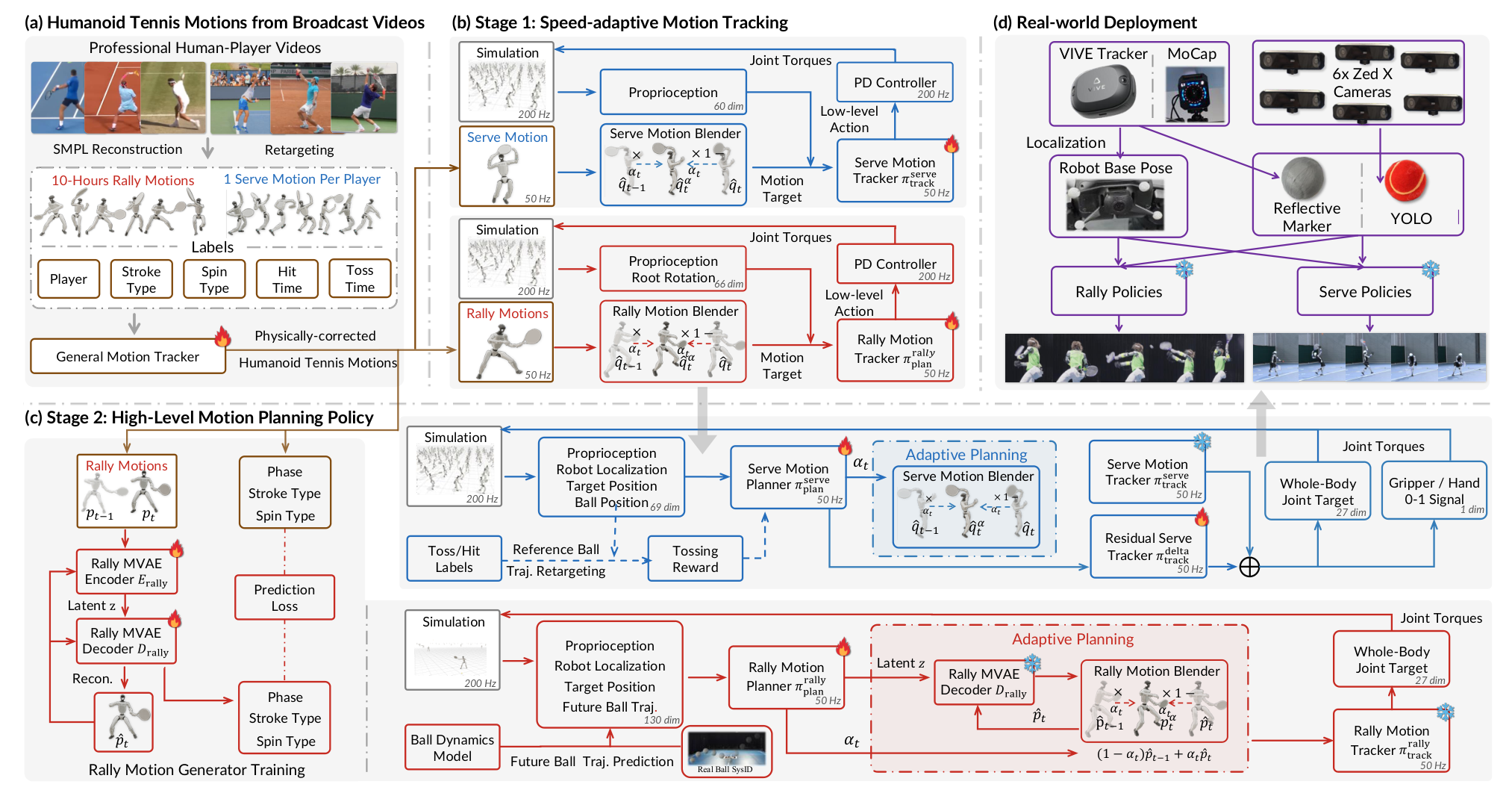
AdaPT is a hierarchical framework that learns professional tennis serving and rally styles directly from broadcast videos, with a planner generating stylistic kinematic motions and a tracker executing them with minimal interference. To close the sim-to-real gap, the tracker learns to follow randomized execution speeds while a motion-speed adapter conditions the planner to avoid compounding errors. Real-world experiments on the Unitree G1 and the full-size Dobot Atom humanoid demonstrate effective in-the-wild serving without motion capture.
中文摘要: AdaPT提出自适应运动规划与跟踪框架,直接从转播视频学习专业网球发球与对打风格。层级设计的关键在于:规划器生成风格化运动学轨迹,跟踪器以最小干涉方式执行这些轨迹。为弥合仿真到真实差距,该机制通过随机化执行速度训练提升跟踪鲁棒性,同时利用学习到的运动速度适配器调节规划器,缓解自回归规划误差累积。在Unitree G1上的真实实验验证了适应机制的有效性,并进一步部署到全尺寸Dobot Atom人形机器人(1.7米)上,实现了无需动作捕捉的野外发球。研究还揭示了算法与工程层面的问题,为人形机器人动态技能从仿真到真实迁移提供了完整的层级规划-跟踪与自适应范式,对腿式机器人的全身运动控制和风格化技能部署具有重要参考价值。
💬 Strong sim-to-real adaptation for legged humanoid skills, though not modular or multi-legged.
💬 虽然不涉及模块化或多足构型,但在腿式人形技能上的仿真到真实适应具有较强参考价值。
Why read it / 推荐理由: Demonstrates a practical hierarchical planner/tracker plus adaptation scheme for deploying stylized dynamic leg-body skills on real humanoids. 展示了一套实用的层级规划/跟踪加适应机制,用于在真实人形(腿式)机器人上部署风格化动态全身技能。
2. Learning Hierarchical Skill Policies with Offline Quality-Diversity Reinforcement Learning
基于离线质量-多样性强化学习的层级技能策略学习
Authors / 作者: Tanachai Anakewat, Takayuki Osa, Tatsuya Harada
arXiv: 2608.19684 · PDF
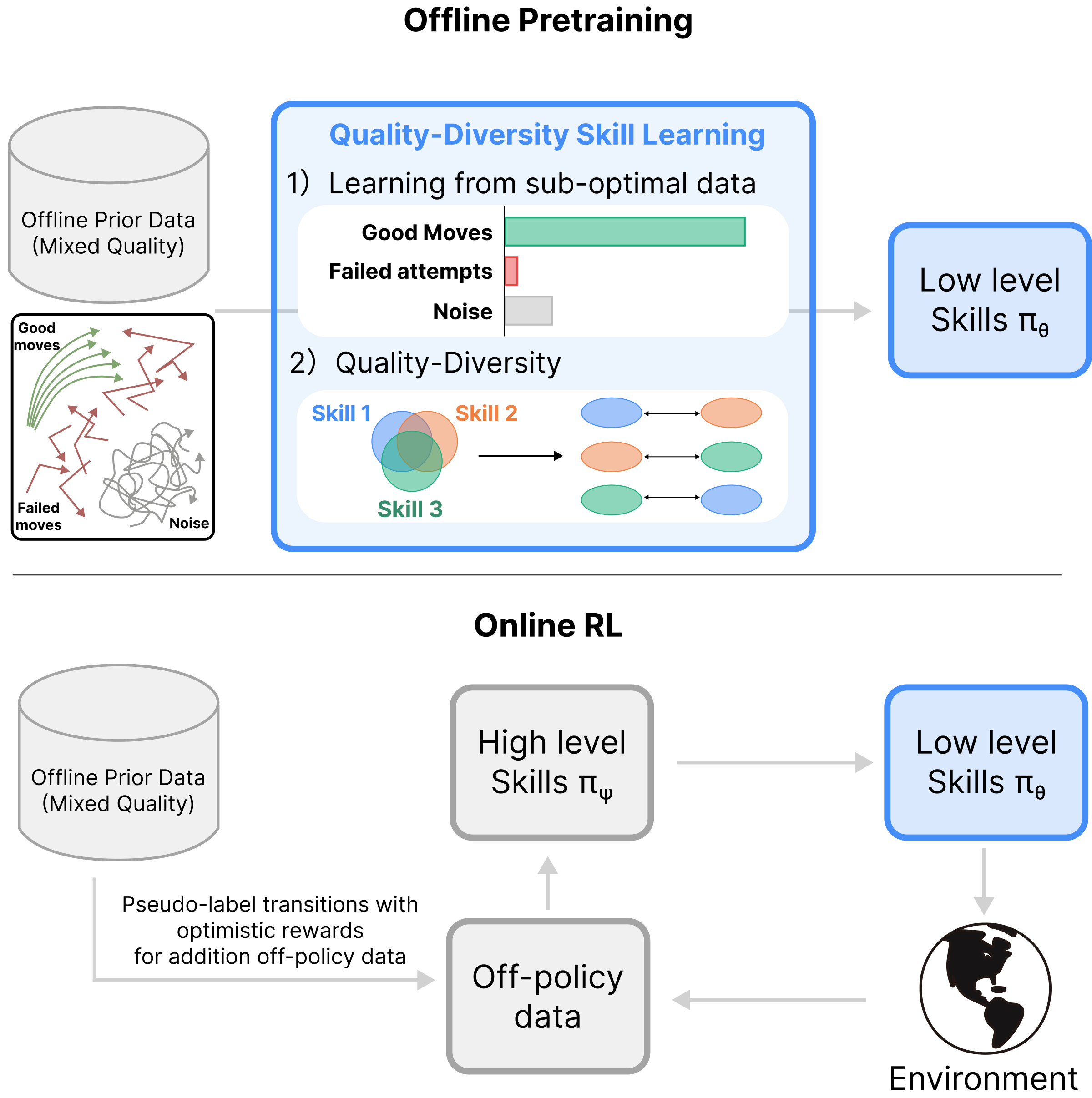
QDOS is a unified offline-to-online skill learning pipeline that uses an Advantage-Weighted Quality-Diversity pretraining objective to weight skill extraction and diversity by the estimated advantage of each trajectory segment. This yields diverse, high-value low-level skills, from which a high-level policy is trained for a specific downstream task. A dual dataset reuse strategy further uses offline data both for skill pretraining and for populating the online replay buffer via pseudo-labeling, improving sample efficiency and downstream performance.
中文摘要: QDOS提出统一的离线到在线技能学习流程,采用优势加权质量-多样性预训练目标,通过每个轨迹段的估计优势来加权技能提取与多样性目标,从而从数据集中提取多样且高价值的低层技能。高层策略在预训练的低层技能空间上训练以解决具体任务。双重数据集复用策略将离线数据同时用于技能预训练和通过伪标签填充在线回放缓冲区。实验表明该方法提升了技能质量与下游任务性能。该框架为腿式机器人从离线数据集学习可复用运动技能、再在线微调以完成下游任务提供了适用方案,尤其适用于模块化多足平台的步态库构建与任务级调度。
💬 Skill-hierarchy and offline-to-online RL method that can underpin reusable locomotion primitives, but no legged application shown.
💬 技能层级与离线到在线强化学习方法可为可复用运动原语提供基础,但未展示腿式应用。
Why read it / 推荐理由: Reusable skill extraction and transfer are directly applicable to modular legged gaits, where prior data can seed a low-level locomotion skill library. 可复用技能提取与迁移直接适用于模块化腿式步态:离线数据可为低层运动技能库提供初始化。
3. Adaptive Probabilistic Shielding by Learning MDPs for Safe Reinforcement Learning
通过学习MDP进行自适应概率屏蔽以实现安全强化学习
Authors / 作者: Astrid Horn Brorholt, Maris F. L. Galesloot, Nils Jansen, Kim Guldstrand Larsen, Christian Schilling
arXiv: 2608.19836 · PDF
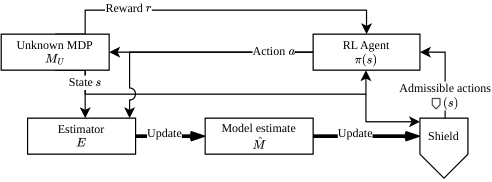
This paper extends probabilistic shielding to settings where the MDP transition graph is known but transition probabilities are unknown. As the RL agent explores, the algorithm estimates transition probabilities and recomputes the shield, so conservatism decreases as the model becomes more precise. The authors study when to recompute the shield and how to balance exploration and safety, and empirically evaluate several variants across multiple environments.
中文摘要: 该工作针对转移概率未知但转移图已知的马尔可夫决策过程,提出自适应概率屏蔽方法。在RL智能体探索过程中在线估计转移概率,并根据估计结果计算屏蔽;初始屏蔽可能保守,但随着模型估计逐渐精确而自适应调整。作者讨论了屏蔽重新计算时机及探索与安全之间的平衡,并在多个环境中评估了多种算法变体。这种方法对腿式机器人的安全强化学习训练尤为重要:在学习步态或操作技能时,屏蔽可以防止机器人进入危险状态,同时随着模型越来越准确,屏蔽逐渐放宽,使策略更高效地探索。该工作为在物理模块化腿式机器人上部署基于RL的控制器提供了一种有前景的安全保障机制。
💬 Generic safe-RL methodology that could be coupled with locomotion MDP abstractions to enforce safety during legged skill learning.
💬 通用的安全强化学习方法,可与运动MDP抽象结合,在腿式技能学习期间强制安全性。
Why read it / 推荐理由: Safety shielding with learned models addresses a critical bottleneck in deploying RL-based controllers on physical modular legged robots. 基于学习模型的安全屏蔽解决了在物理模块化腿式机器人上部署RL控制器的关键瓶颈。
4. World-Model-Grounded LLM Planning for AUV and ASV Navigation Near Offshore Wind Farms
基于世界模型的LLM规划:海上风电场附近AUV与ASV导航
Authors / 作者: Markus Buchholz, Ignacio Carlucho, Yvan R. Petillot
arXiv: 2608.19661 · PDF
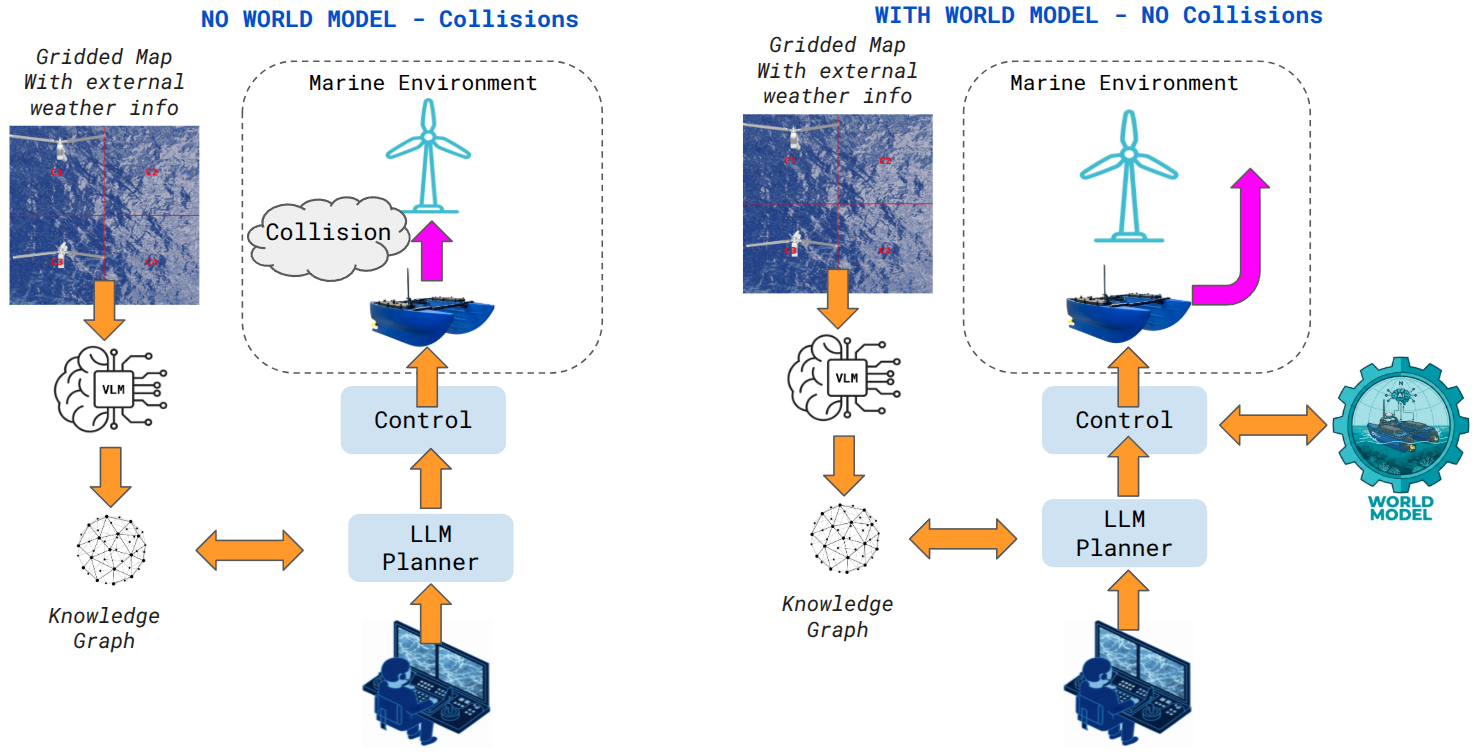
The authors ground LLM-based planning in a physics-grounded neural world model, where the LLM decides what to do, and the world model plus a gradient-based trajectory optimizer determine how long to execute each action. A Model Predictive Controller (MPC)-style closed-loop replanner with a trust-region guard maintains feasibility. For a 6-DOF AUV and a 3-DOF ASV near offshore wind farms, all benchmark missions are completed with zero predicted collisions, and GazeboSim transfer cuts goal-distance error by 70-93% versus the ungrounded baseline.
中文摘要: 该文提出用世界模型增强大语言模型规划器:LLM决定任务级动作序列,物理约束的神经世界模型与基于梯度的三段轨迹优化器决定动作持续时间,并配合带置信域守卫的MPC式闭环重规划。针对海上风电场附近的6自由度AUV和3自由度差速ASV,在每平台5个基准任务中均达到目标且预测碰撞为零;在含海流、波浪和推进器动力学的GazeboSim中转移后,保持无碰撞并相比无世界模型基线将目标距离误差降低70-93%(ASV)和约93%(AUV)。该框架展示了将语言模型的语义决策与模型预测控制、仿真到现实迁移相结合的通用范式,对腿式机器人的任务级规划、地形感知路径规划和闭环步态调度具有方法论借鉴意义。
💬 Strong integration of LLM semantic planning with world-model/MPC closed-loop control, but demonstrated on marine not legged platforms.
💬 将LLM语义规划与世界模型/MPC闭环控制紧密结合,但展示平台为海洋机器人而非腿式机器人。
Why read it / 推荐理由: The world-model-grounded replanning architecture is directly transferable to terrain-aware traversal planning and closed-loop gait scheduling for modular legged robots. 其世界模型接地重规划架构可直接迁移到模块化腿式机器人的地形感知通过规划与闭环步态调度。
5. Learning piecewise-smooth dynamical systems
学习分段光滑动力系统
Authors / 作者: Davide Murari, Erik Jansson, Chris Budd OBE, Carola-Bibiane Schönlieb
arXiv: 2608.19785 · PDF
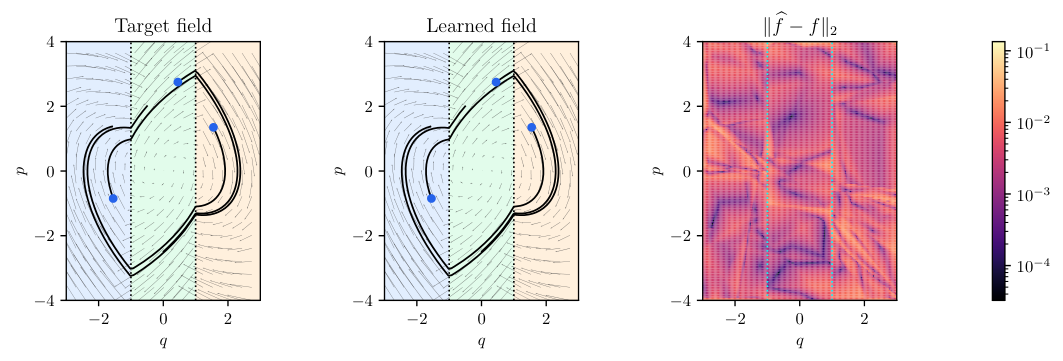
This paper presents a modular framework for discovering piecewise-smooth dynamical systems directly from trajectory data. It estimates switching hyperplanes that separate dynamic regimes and learns smooth dynamics within each region using geometry-constrained neural networks, with theoretical analysis of identifiability and approximation properties. The method is tested on low-dimensional benchmarks including dry-friction oscillators and other hybrid systems.
中文摘要: 该文提出一个模块化框架,直接从轨迹数据中识别分段光滑动力系统:先从数据估计切换超平面,再利用几何约束神经网络在每个区域内学习光滑动力学。作者从统计角度分析不连续性的可辨识性和鲁棒性,并引入具有预设间断集的神经网络架构,给出逼近性质的理论分析。该方法在干摩擦振荡器等低维基准上取得了良好效果。腿式机器人步态本质上是接触事件引起的分段光滑/混杂系统,该框架可用于从实测运动数据中学习接触切换模型,辅助MPC或基于模型的控制器设计,并为模块化腿式机器人地面反作用力、摩擦锥和步态相位切换提供数据驱动的建模手段。
💬 Important for modeling contact-driven hybrid dynamics in legged locomotion, though it remains a low-dimensional benchmark study.
💬 对腿式运动中接触驱动的混杂动力学建模很重要,但目前仅为低维基准研究。
Why read it / 推荐理由: Switching hyperplanes and region-wise dynamics are exactly the structure needed for data-driven contact models of modular legged robots. 切换超平面与分区动力学正是模块化腿式机器人数据驱动接触模型所需的结构。