机器人日报
机器人论文日报 — 2026-08-20
🤖 Scanned 313 new arXiv papers (cs.RO / eess.SY / cs.LG, last 48 h), picked 5 for modular & legged robotics — summarized by DeepSeek.
🤖 扫描了近 48 小时 arXiv(cs.RO / eess.SY / cs.LG)的 313 篇新论文,围绕模块化与足式机器人精选 5 篇 — 由 DeepSeek 生成双语摘要。
1. Real-Time Control-Constrained DDP for Underactuated Balancing of Legged Robots
腿足机器人欠驱动平衡的实时控制约束差分动态规划
Authors / 作者: SeongWon Nam, Hyunyong Lee, Hansol Kang, Jiman Park, Yeongwoo Son, Bumsu Yi et al.
arXiv: 2608.18552 · PDF
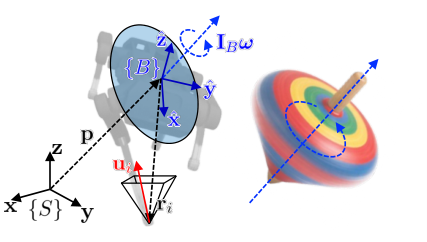
This paper proposes ABC-DDP, an accelerated projected gradient based control-constrained DDP algorithm, integrated with a virtual constraint inside a feasibility-driven multiple-shooting framework. It enables real-time MPC with short horizons for underactuated legged robots, demonstrating static two-leg standing, slow catwalk, upright walking, and high-speed running within a unified MPC framework. The authors report the first real-time finite-horizon MPC achieving static two-leg standing of a quadruped robot.
中文摘要: 针对经典差分动态规划(DDP)难以处理控制约束的问题,本文提出基于加速投影梯度的控制约束DDP方法(ABC-DDP)。该方法通过加速投影梯度高效求解约束优化并识别起作用集,无需反复进行KKT矩阵求逆。引入虚拟约束,将控制约束融入可行性驱动的多打靶框架,即使从动态不可行初值出发也能保持稳定优化。支持在强欠驱动条件下进行短时域实时模型预测控制(MPC)。仿真实验在统一MPC框架下展示了静态双腿站立、慢速猫步、直立行走和高速奔跑等多种运动。据作者所知,这是首次利用实时有限时域MPC实现四足机器人静态双腿站立。
💬 A strong methodological contribution to real-time constrained DDP for legged MPC, with efficient active-set handling that avoids KKT inversions.
💬 对腿足机器人MPC的实时约束DDP方法贡献突出,通过无需KKT求逆的起作用集识别实现高效求解。
Why read it / 推荐理由: Directly relevant to MPC-based balancing and locomotion for legged robots, presenting a novel constrained DDP formulation with demonstrated quadruped dynamic motions. 直接面向腿足机器人基于MPC的平衡与运动控制,提出一种新的约束DDP求解框架并展示了四足动态运动。
2. GigaBrain-WBC-0.5: A Behavior World Model for Robust Whole-Body Control with Environment Interaction
GigaBrain-WBC-0.5:一种用于环境交互鲁棒全身控制的行为世界模型
Authors / 作者: Ziyang Cheng, Tianshu Tang, Jinxin Lan, Xinze Chen, Yuhan Gong, Zhichao Liu et al.
arXiv: 2608.18234 · PDF
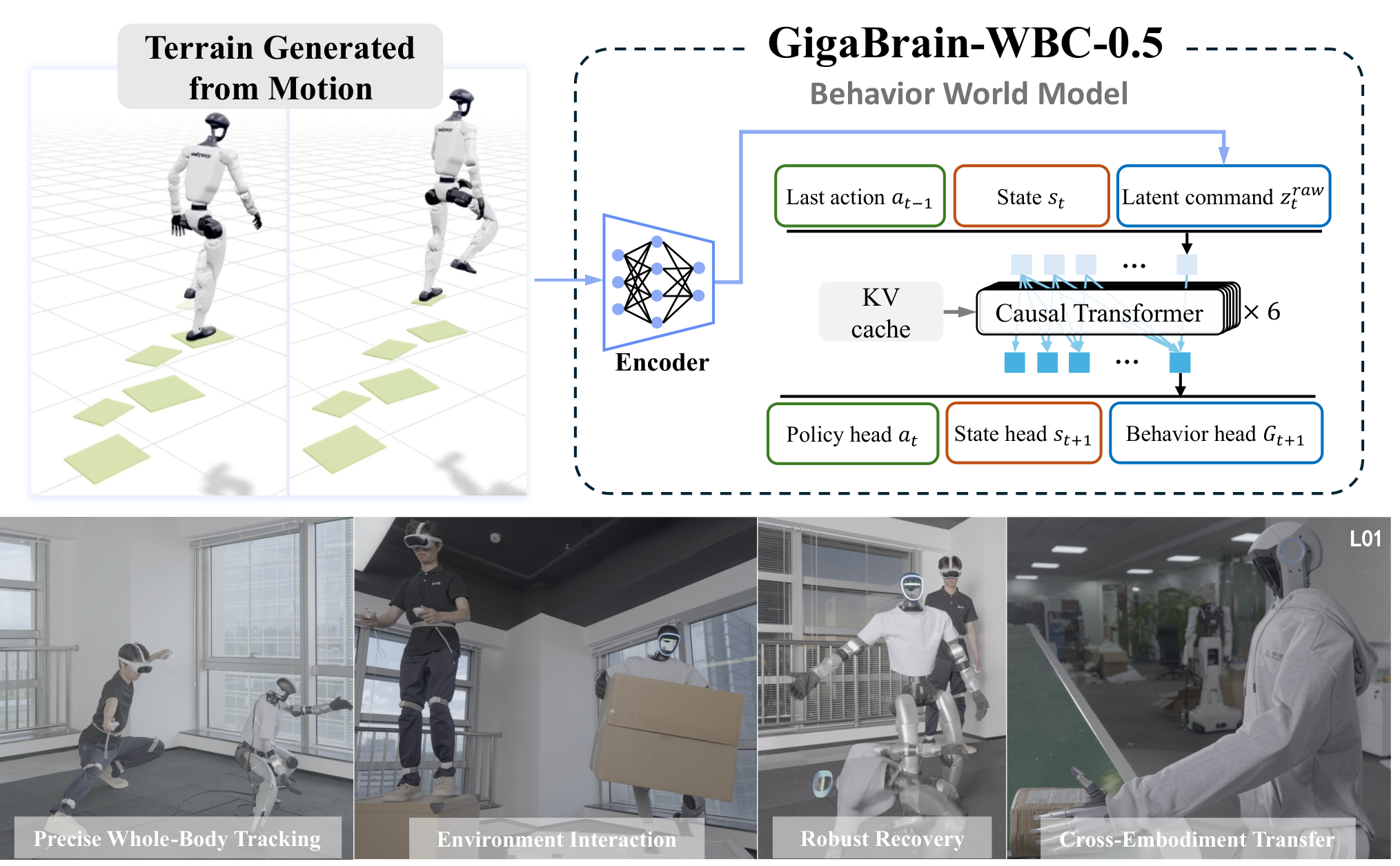
This paper presents GigaBrain-WBC-0.5, the first Behavior World Model for humanoid whole-body control. A causal Transformer jointly predicts the next action, next state, and distribution over the next latent behavior command, so the acting network also models how the environment shapes future feasible behavior. An automatic terrain-annotation pipeline recovers full 3D contact geometry from retargeted motion, and the predicted command distribution is reused at deployment to detect and retract implausible commands, enabling best-effort task execution.
中文摘要: 本文提出面向人形机器人全身控制的首个行为世界模型(BWM)GigaBrain-WBC-0.5。与纯反应式跟踪器不同,该方法训练一个因果Transformer,联合预测下一动作、下一状态以及下一个潜在行为命令的分布,使得执行动作的网络同时建模环境对后续可行行为的影响。自动地形标注流程从重定向动作中恢复完整三维接触几何,使地形标注可扩展到现有运动数据集规模。部署时复用预测的命令分布,在线检测不可行命令并将其回退到已学习行为,从而以“尽力而为”方式完成任务。该统一策略可实现实时命令输入和鲁棒的环境交互。
💬 Relevant to whole-body control and terrain-aware behavior models, though evaluated on humanoid rather than modular legged platforms; the behavior world model idea is valuable for legged robots.
💬 与全身控制和地形感知行为模型高度相关,虽以人形机器人为对象,但“行为世界模型”的思想对模块化腿足机器人有借鉴意义。
Why read it / 推荐理由: For WBC of legged robots, jointly predicting action/state/behavior distribution offers a new way to handle environment-dependent feasibility and robust command execution. 在腿足机器人全身控制中,联合预测动作/状态/行为分布为处理环境相关可行性与鲁棒命令执行提供了新思路。
3. MLREF: Efficient Module Reuse for Reward Design in Reinforcement Learning via Large Language Models
MLREF:基于大语言模型的强化学习奖励设计中的高效模块复用
Authors / 作者: Chenglin Liu, Xun Wang, Ruishuo Chen, Zhuoran Li, Longbo Huang
arXiv: 2608.18827 · PDF
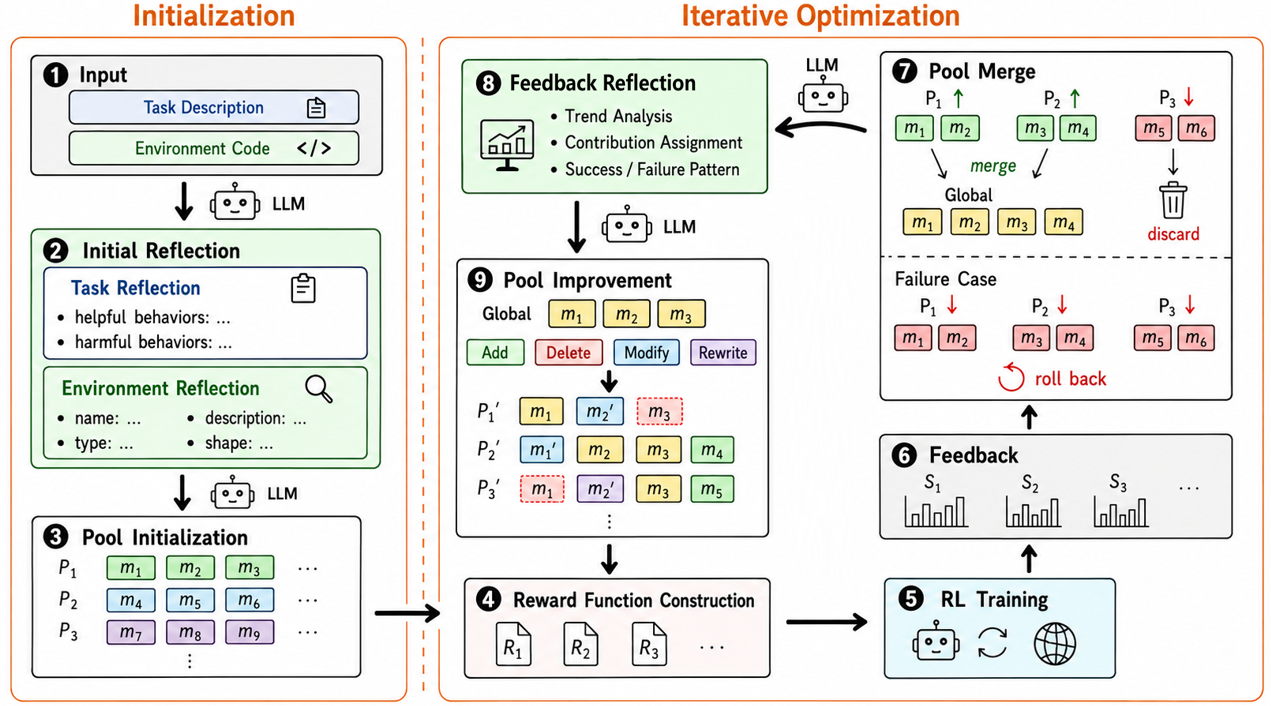
MLREF is a Module Level Reward Evolution Framework that keeps a persistent module pool of reusable reward components. It treats the module pool as the optimization target, evolving it via reflection-based refinement, hybrid credit assignment, and a merge strategy with rollback, while reward functions are linear combinations of modules drawn from the pool. Across 17 tasks, MLREF outperforms strong baselines by 25.2% in locomotion and 6.6% in manipulation, with more stable optimization dynamics.
中文摘要: 奖励函数设计是强化学习中的关键瓶颈。针对大语言模型生成的奖励函数往往作为整体程序难以保留和复用有效组件的问题,本文提出模块级奖励演化框架MLREF。其核心是一个持久化的可复用奖励组件模块池,将模块池作为主要优化对象:通过反思式改进、混合信用分配和带回滚的合并策略,在不同迭代中累积成功模块、修正欠佳模块并复用已验证组件。奖励函数由从模块池中抽取的模块线性组合而成。在17个任务上的实验表明,MLREF在运动任务上平均提升25.2%,在操作任务上提升6.6%,并具有更稳定的优化动态。
💬 Useful for RL-based legged locomotion control by making reward design reusable and stable, reducing the iteration burden of RL training.
💬 对基于强化学习的腿足运动控制很有价值,使奖励设计可复用且更稳定,降低RL训练的迭代成本。
Why read it / 推荐理由: Reward engineering is a critical bottleneck in legged RL; this framework makes effective reward components reusable across tasks and iterations. 奖励工程是腿足强化学习的关键瓶颈,该框架使有效奖励组件可跨任务、跨迭代复用。
4. Optimal control of a swimming robot based on Purcell’s microswimmer model
基于Purcell微游泳者模型的水下游泳机器人最优控制
Authors / 作者: Noam Berkovich Lahav, Oren Wiezel, Yizhar Or
arXiv: 2608.17455 · PDF
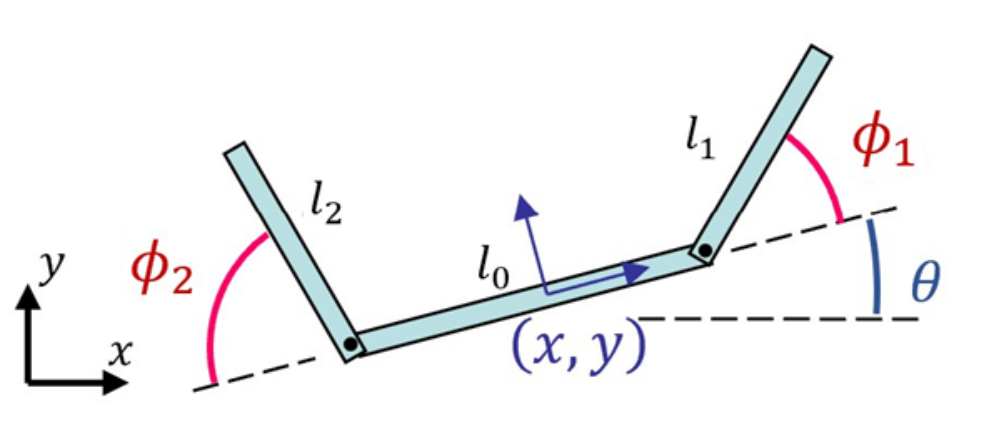
This work presents a macro-scale robotic realization of Purcell’s three-link swimmer moving in a highly viscous fluid, and calibrates a model with non-slender links and a central rigid sphere to match experiments. It applies Pontryagin’s Maximum Principle to compute optimal gaits maximizing displacement per cycle under joint-angle bounds, and uses a differential geometric transformation to visualize gaits as enclosed areas in the joint-angle plane. A boundary-value problem formulation is also solved for efficiency-optimal gaits based on Lighthill’s energy efficiency.
中文摘要: 本文基于Purcell三连杆微游泳者模型,设计并实现了一种宏观尺度的游泳机器人,在高粘性流体中运动,并通过引入非细长连杆和中心刚性球改进了理论模型,使其与实验数据吻合。随后采用Pontryagin极大值原理,在关节角约束下求解最大化每周期位移的最优步态。借助微分几何方法将步态优化转化为关节角平面内封闭曲线包围面积的最大化,从而直观解释最优步态随关节角约束变化的拓扑结构。进一步将Lighthill能量效率最大化问题转化为边界值问题,求解效率最优步态。工作展示了最优控制和几何方法在机器人周期步态设计中的有效性。
💬 Despite the fluid-locomotion domain, the gait optimization and optimal-control methodology transfers well to modular legged gait generation.
💬 尽管属于流体运动领域,但其步态优化与最优控制方法对模块化腿足机器人步态生成有良好借鉴意义。
Why read it / 推荐理由: Offers a rigorous optimal-control and geometric view of periodic gait optimization that can inspire legged gait design and energy efficiency analysis. 提供了严格的周期步态优化最优控制与几何视角,可启发腿足步态设计与能效分析。
5. Decision-Metric Alignment in Latent World Models: Diagnostics and Action-Conditioned Objectives for MPC Planning
潜空间世界模型中的决策-度量对齐:面向MPC规划的诊断与动作条件目标
Authors / 作者: Jiawei Wang, Ke Rui, Yushen Zuo, Yichun Feng, Minglei Li
arXiv: 2608.18746 · PDF
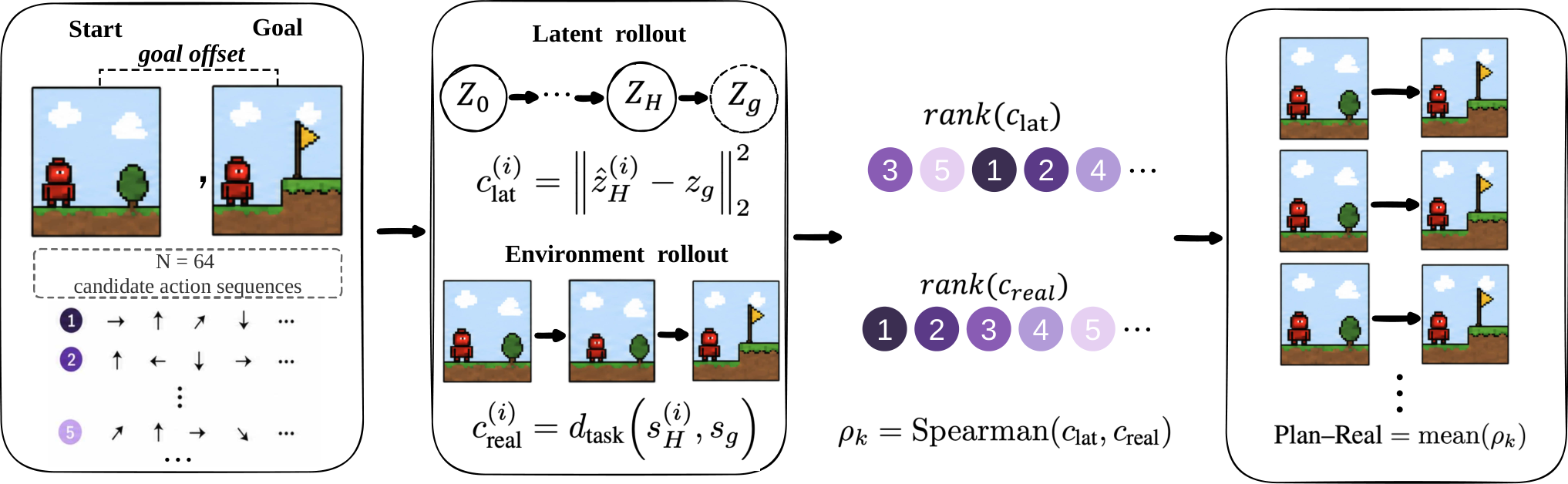
This paper identifies the decision-metric alignment problem in latent world model MPC: strong decoding of task variables does not guarantee that latent Euclidean distance ranks candidate action sequences by true progress. It introduces Plan-Real Spearman and CEM-stage Spearman diagnostics, analyzes sufficient conditions, and proposes DA-LeWM, which augments LeWM with inverse-dynamics and demonstration-conditioned goal-action heads. DA-LeWM converges faster and achieves higher online success than LeWM in experiments while maintaining similar probe scores.
中文摘要: 在JEPA风格的潜空间世界模型中,常以到目标潜变量的欧氏距离作为模型预测控制(MPC)的代价。然而,对任务变量的强解码能力并不能保证该距离对候选动作序列的排序与真实任务进展一致,本文将这一性质称为“决策-度量对齐”。为此提出Plan-Real Spearman和CEM-stage Spearman两个诊断指标,分别衡量随机规划和CEM搜索聚焦阶段的潜-实排序一致性。通过分析编码器畸变、终端滚动误差和候选裕度等充分条件,提出DA-LeWM,在LeWM基础上增加逆动力学头和示范条件目标动作头。实验表明DA-LeWM收敛更快、在线成功率更高,同时探针分数相近,改善了欧氏代价CEM潜空间MPC的几何结构。
💬 Relevant to MPC with learned latent models; the proposed diagnostics help build cost functions that align better with task success for legged locomotion planning.
💬 与基于学习潜模型的MPC相关,所提出的诊断方法有助于构造与任务成功更一致的代价函数,适用于腿足运动规划。
Why read it / 推荐理由: Provides principled diagnostics and fixes for latent-space MPC, a promising direction for learning-based legged locomotion control. 为潜空间MPC提供了原理性诊断与改进方法,是学习型腿足运动控制的有前景方向。