机器人日报
机器人论文日报 — 2026-08-19
🤖 Scanned 332 new arXiv papers (cs.RO / eess.SY / cs.LG, last 48 h), picked 5 for modular & legged robotics — summarized by DeepSeek.
🤖 扫描了近 48 小时 arXiv(cs.RO / eess.SY / cs.LG)的 332 篇新论文,围绕模块化与足式机器人精选 5 篇 — 由 DeepSeek 生成双语摘要。
1. Reconfiguration-Complete Motion Primitives with Constructive Planning for Deformable Planar Modular Robots
面向可变形平面模块化机器人的重构完备运动原语与构造性规划
Authors / 作者: Jie Gu, Tingting Wang, Hongrun Gao, Yirun Sun, Zhihao Xia, Chunxu Tian et al.
arXiv: 2608.17324 · PDF
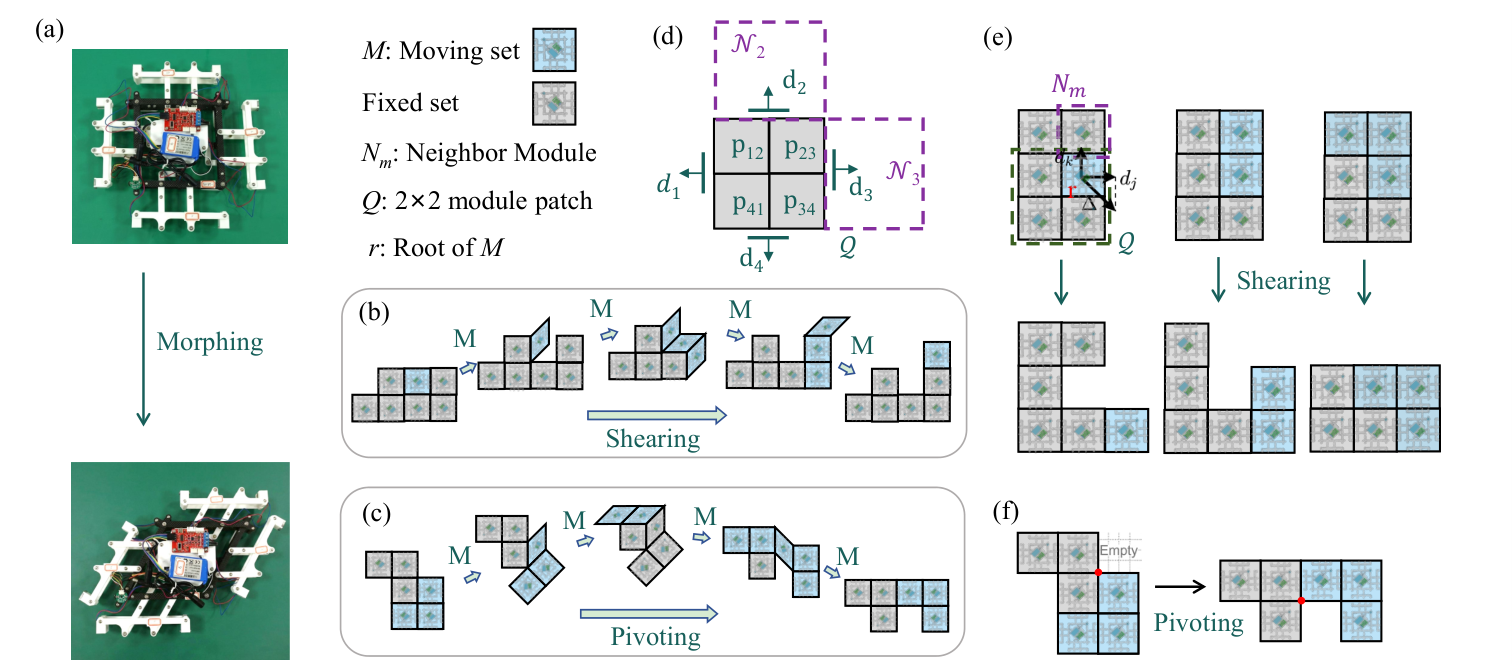
This paper introduces a square-cell abstraction for deformable rhombus modules, enabling a fixed representation for reconfiguration planning. It proves that any non-straight edge-connected configuration with N≥7 can be transformed to a canonical staircase using pivoting and shearing primitives, and since motions are reversible, any two configurations are mutually reconfigurable. A constructive staircase-canonicalization planner with a boundary-to-delivery lookahead selector reduces planning time while preserving completeness, as demonstrated in experiments.
中文摘要: 本文针对可变形平面模块化机器人,提出一种方形单元抽象方法,将可变形菱形模块映射为固定尺寸的网格单元,同时保留两种物理可解释的局部运动原语:枢转和剪切。在此抽象下,作者证明任何非直线边连接且模块数N≥7的构型均可通过合法运动原语变换到固定规范阶梯构型。由于运动可逆,该类构型中任意两者均可互相重构。证明是构造性的,直接产生一种阶梯规范化规划器,该规划器在保持连通性的同时运输可移除边界模块。进一步引入边界到交付的前瞻选择器,在不影响完备性的前提下极大减少了规划时间。实验验证了构造性重配置过程,并与先前框架对比显示规划时间更低。
💬 This paper provides a completeness-guaranteed reconfiguration planner for planar modular robots, offering a solid theoretical foundation for modular self-reconfiguration.
💬 本文为平面模块化机器人提供了具有完备性保证的重构规划器,为模块化自重构奠定了坚实的理论基础。
Why read it / 推荐理由: If you design reconfigurable leg modules, you need to understand reconfiguration planning guarantees; this paper delivers them with a constructive planner. 如果你设计可重构腿部模块,你需要理解重构规划的完备性保证;本文通过构造性规划器提供了这一点。
2. FetchMan: Learning Visual Humanoid Loco-Manipulation Policies from Simulated Experiences
FetchMan:从仿真经验学习视觉人形移动操作策略
Authors / 作者: Omar Rayyan, Zhi Li, Max Argus, Yuxin Jiang, Chang Yu, Chenfanfu Jiang et al.
arXiv: 2608.17027 · PDF
FetchMan proposes an end-to-end sim-to-real pipeline for visual loco-manipulation, combining synthetic behavior cloning and Flow-GRPO reinforcement learning with a sparse reward to surpass the performance ceiling of cloning. Trained across more than 150,000 scenes, the pipeline is evaluated in simulation (FetchMan-Bench) and deployed zero-shot on a real Unitree G1, achieving 73.3% success on single-object reach-and-pick tasks in unseen scenes. The work extends to multi-object training, toward generalist loco-manipulation policies.
中文摘要: 本文提出一种端到端的视觉移动操作sim-to-real流水线,将合成行为克隆与基于Flow-GRPO的强化学习及单一稀疏奖励相结合,突破了克隆的性能上限。该流水线在超过15万个场景中训练,在仿真基准FetchMan-Bench上评估,并零样本部署到真实的Unitree G1人形机器人上,在未见场景中单目标到达-抓取任务成功率达73.3%。此外,还将该方法扩展至多目标训练,向通用移动操作策略迈出一步。研究验证了从仿真数据学习人形机器人移动操作策略的可行性,并展示了大规模仿真训练对真实世界泛化的价值。
💬 A strong example of RL-based whole-body controller with sparse rewards, showing sim-to-real transfer on a real humanoid.
💬 这是基于稀疏奖励的RL全身控制器的典范,展示了在真实人形上的sim-to-real迁移。
Why read it / 推荐理由: This paper demonstrates a scalable sim-to-real recipe for legged loco-manipulation, directly applicable to learning whole-body policies for modular legged robots. 本文展示了一种可扩展的sim-to-real方法用于腿部移动操作,直接适用于模块化腿部机器人的全身策略学习。
3. Terrain-Aware Local Path Planning with Global DEM Data Integration for Autonomous UGV Navigation
融合全球DEM数据的自主UGV导航地形感知局部路径规划
Authors / 作者: Devender Singh, Issah Nazif Suleiman, Paul Mitten, Glenn Cutler, Vinicius Prado da Fonseca, Matthew Hamilton
arXiv: 2608.17038 · PDF
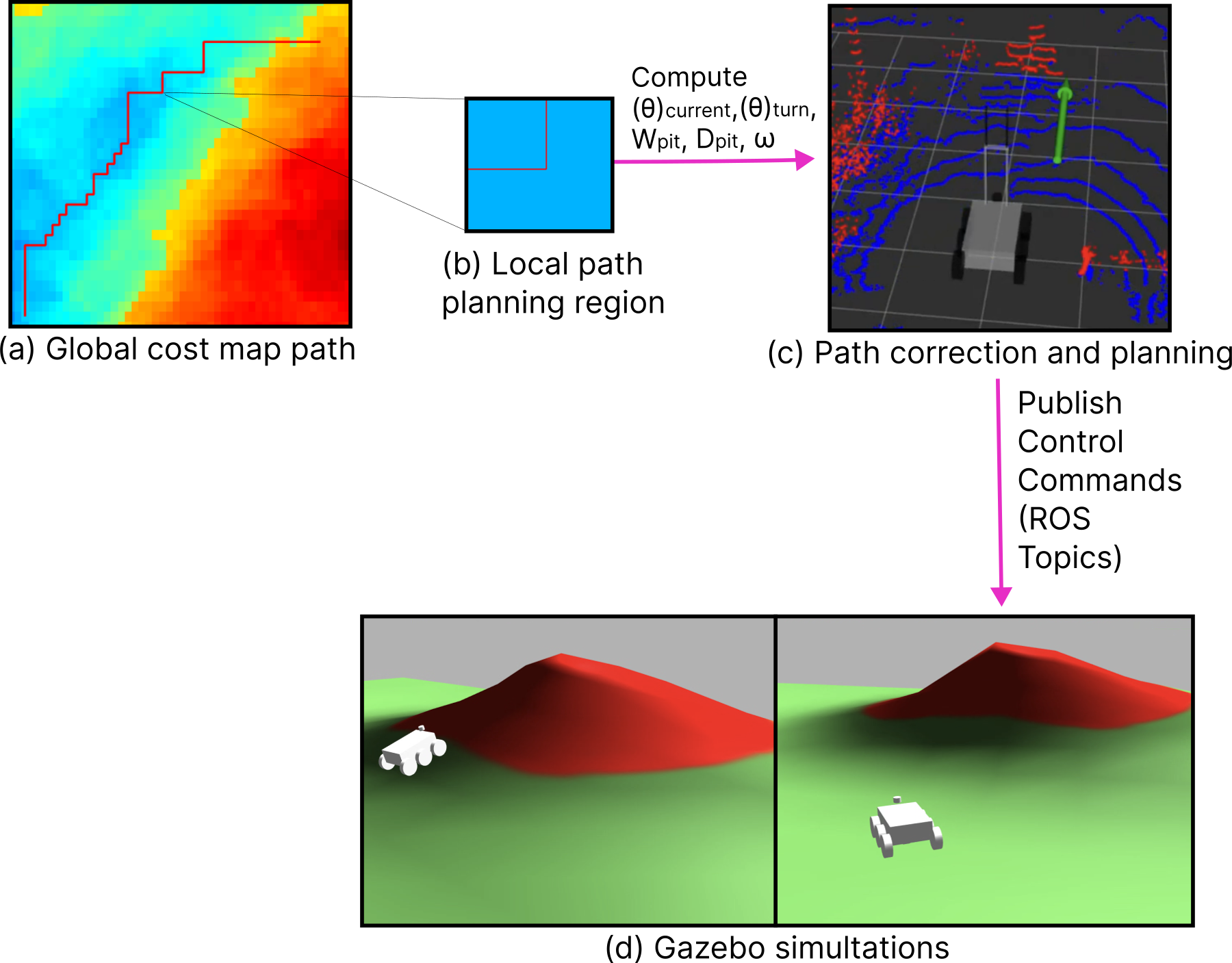
This work presents a hybrid path planning framework for UGVs that combines low-resolution Digital Elevation Model (DEM) data with real-time LiDAR-based obstacle detection and terrain analysis. A global path is computed with DEM-based A*, then local sensor data drives adaptive correction, enabling negotiation of sudden environmental changes. Gazebo simulations demonstrate a 95% obstacle avoidance rate and reduction of average encountered slope from 8° to 2.7°, improving path efficiency and terrain traversability.
中文摘要: 本文提出一种用于无人地面车辆(UGV)的混合路径规划框架,融合低分辨率数字高程模型(DEM)数据与基于LiDAR的实时障碍物检测和地形分析。首先利用基于DEM的A*算法计算全局路径,随后局部传感器数据驱动自适应路径修正,使UGV能够应对突发环境变化,同时保持安全与效率。在Gazebo仿真中,该方法相比基线显著改进,实现了95%的障碍物避碰率,并将平均遭遇坡度从8°降至2.7°。该集成增强了路径效率和地形可通过性,支持鲁棒的实时适应,为动态户外环境中的可靠自主导航铺平道路。
💬 The integration of global DEM with local LiDAR for terrain-aware planning is highly relevant to traversability-aware navigation for legged platforms.
💬 将全局DEM与局部LiDAR融合用于地形感知规划,对腿部平台的可通过性感知导航高度相关。
Why read it / 推荐理由: This paper offers a practical hybrid planning strategy that can be adapted for legged robots to avoid high-slope regions and improve traversal capability. 本文提供了一种实用的混合规划策略,可适应腿部机器人,避免高坡度区域并提高穿越能力。
4. Robust Brachiation on a Life-Sized Dual-Arm Robot Using Waypoint-Guided Reinforcement Learning
基于航点引导强化学习的生命大小双臂机器人鲁棒摆荡
Authors / 作者: Ayumu Iwata, Kento Kawaharazuka, Keita Yoneda, Takahiro Hattori, Kei Okada
arXiv: 2608.17320 · PDF
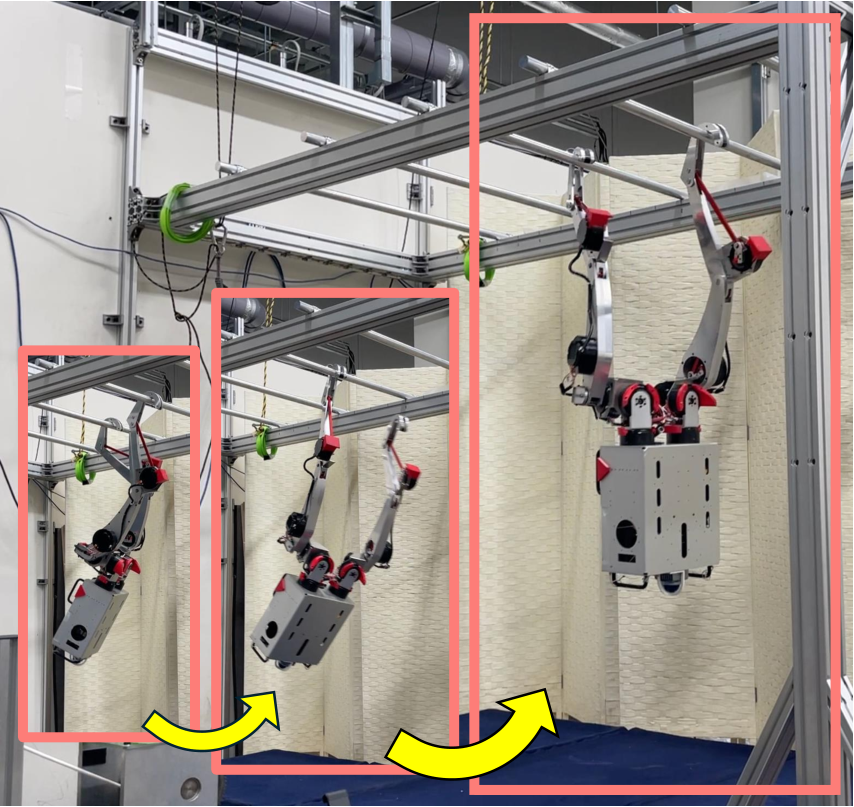
This paper presents Waypoint-Guided Reinforcement Learning (WGRL) for realizing robust brachiation on a life-sized dual-arm robot. WGRL sparsely specifies end-effector waypoints and generates whole-body motion via RL, integrating waypoint-following guidance with task-success and mechanical-energy rewards. Training in a sim-to-real environment, the robot achieves robust brachiation including failure recovery, validated via Sim-to-Sim and hardware experiments under varying monkey-bar geometries.
中文摘要: 本文提出航点引导强化学习(WGRL)方法,在生命大小的双臂机器人上实现鲁棒摆荡运动。WGRL通过稀疏指定末端执行器航点,并利用强化学习生成全身运动,将航点跟随引导与任务成功和机械能奖励相结合。在面向sim-to-real迁移的环境中训练,机器人实现了鲁棒的摆荡行为,包括失败恢复。通过在具有几何变化的猴杆环境下的Sim-to-Sim实验和硬件实验,验证了所提方法的有效性和稳定性。该研究为难以获得模仿学习数据的复杂非线性运动提供了有效的学习设计指南。
💬 Waypoint-guided RL offers a clever way to induce complex locomotion behaviors without expert demonstrations, applicable to gait generation.
💬 航点引导RL为无需专家示范的复杂运动行为诱导提供巧妙方法,可应用于步态生成。
Why read it / 推荐理由: The waypoint guidance framework is directly transferable to learning dynamic gaits (e.g., jumping or leaping) on legged modular robots. 航点引导框架可直接迁移到模块化腿部机器人上学习动态步态(如跳跃或腾跃)。
5. A Hybrid End-to-End and Modular Control Architecture Toward Safe Vehicle Lateral Control: Combining Soft Actor-Critic with Model Predictive Control
一种面向安全车辆横向控制的端到端与模块化混合控制架构:软演员-评论家与模型预测控制结合
Authors / 作者: Farzaneh Tatari
arXiv: 2608.17258 · PDF
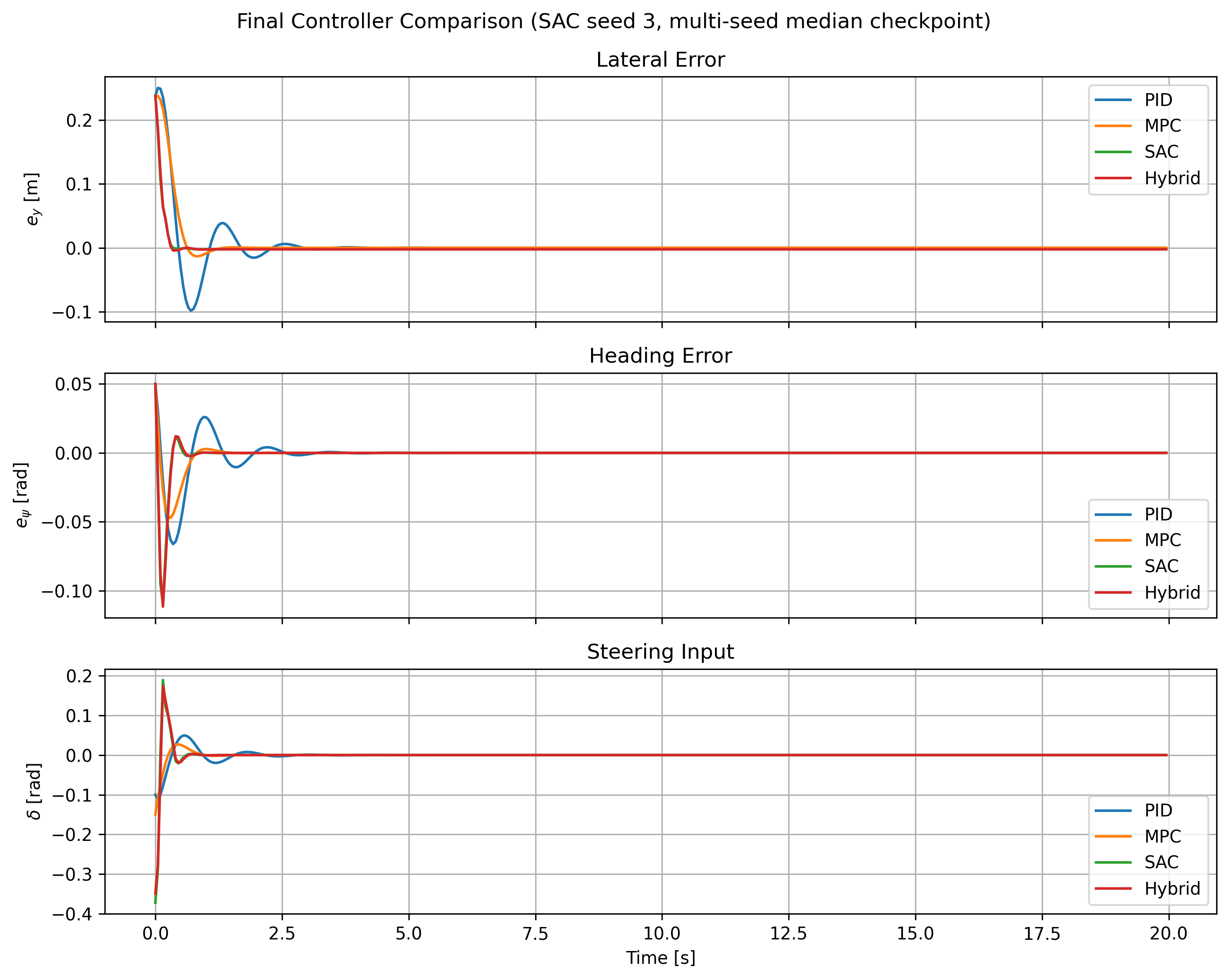
This paper proposes a hybrid architecture that blends an end-to-end Soft Actor-Critic (SAC) policy with a constrained linear MPC, using the MPC’s first-step optimum as a model-based anchor and a monotone blending coefficient. The hybrid retains SAC’s tracking quality while staying within the MPC’s actuator envelope, providing an actuator-envelope guarantee by construction. Evaluation on a linearized bicycle model shows improved robustness over PID, MPC, and standalone SAC.
中文摘要: 本文提出一种混合控制架构,将端到端Soft Actor-Critic (SAC)策略与约束线性MPC相结合,利用MPC第一步最优解作为基于模型的锚点,并引入单调混合系数在两种范式间插值。该架构在保持SAC跟踪质量的同时,确保控制指令不超出MPC的执行器包络,通过构造提供执行器包络保证。在线性化自行车模型上,与PID、调优MPC和单独SAC相比,混合方法在标称、鲁棒性和多初始条件实验中均表现出更好的综合性能。该工作为在安全关键系统中结合RL的适应性与MPC的约束处理能力提供了新思路。
💬 This hybrid SAC-MPC architecture demonstrates a principled way to fuse learning-based and model-based control, relevant to safe legged locomotion.
💬 这种SAC-MPC混合架构展示了融合学习与控制与模型控制的原则性方法,与安全腿部运动相关。
Why read it / 推荐理由: For legged robots, combining RL policies with MPC constraints is an ongoing challenge; this paper offers a simple and effective blending mechanism. 对腿部机器人而言,结合RL策略与MPC约束是一个持续挑战;本文提供了一种简单有效的混合机制。