机器人日报
机器人论文日报 — 2026-08-09
🤖 Scanned 296 new arXiv papers (cs.RO / eess.SY / cs.LG, last 96 h), picked 4 for modular & legged robotics — summarized by DeepSeek.
🤖 扫描了近 96 小时 arXiv(cs.RO / eess.SY / cs.LG)的 296 篇新论文,围绕模块化与足式机器人精选 4 篇 — 由 DeepSeek 生成双语摘要。
1. Transcutaneous Spinal Cord Stimulation Disrupts Conscious Ankle Proprioception and Produces a More Constrained Locomotor Pattern in Unimpaired Adults
经皮脊髓电刺激干扰无损伤成人有意识踝关节本体感觉并产生更受限的运动模式
Authors / 作者: Christopher A. Johnson, Andria J. Farrens, Parastoo Ali Pour, Arjan Gillan, Hui Zhong, David J. Reinkensmeyer et al.
arXiv: 2608.05635 · PDF
This study examines acute and training-related effects of transcutaneous spinal cord stimulation (tSCS) on ankle proprioception and gait in unimpaired adults. Results show that acute tSCS increases ankle proprioceptive error while gait becomes more constrained, with reduced step width and CoM excursion, and continued training under stimulation leads to progressive proprioceptive improvement that persists after stimulation ends.
中文摘要: 本研究探讨经皮脊髓电刺激(tSCS)对无损伤成人(n=14,对照组n=14)踝关节本体感觉和步态的急性效应与训练效应。使用双侧机器人评估动态踝关节定位能力,并测量正常和串联跑步机行走时的步态参数。结果显示,急性tSCS显著增加踝关节本体感觉误差(p<0.001),而背屈力量无变化;步态转向更受限的模式,表现为步宽和质心侧向摆动减少。在刺激下持续训练后,本体感觉误差下降,且与对照组不同,tSCS组表现出渐进性改善并在刺激结束后持续。步态中矢状面参数恢复,但侧向控制仍受影响。这些发现揭示了脊髓刺激对本体感觉和运动控制的影响机制,为神经调控和康复机器人提供了参考。
💬 Provides causal evidence that proprioceptive perturbation constrains gait variability, offering design insights for ankle sensing and compliance in legged robots.
💬 提供了本体感觉扰动限制步态变异性的因果证据,对腿足机器人踝部感知和柔顺设计有启示。
Why read it / 推荐理由: Critical for understanding how sensor quality affects locomotion stability and adaptability. 对理解传感器质量如何影响运动稳定性和适应性至关重要。
2. Search-Aided Joint Agent-Environment Reinforcement Learning for Robust Lifelong Multi-Agent Path Finding with Rotations
搜索辅助的智能体-环境联合强化学习用于带旋转的鲁棒终生多智能体路径规划
Authors / 作者: He Jiang, Jingtian Yan, Yulun Zhang, Yimin Tang, Tanishq Duhan, Rishi Veerapaneni et al.
arXiv: 2608.05588 · PDF
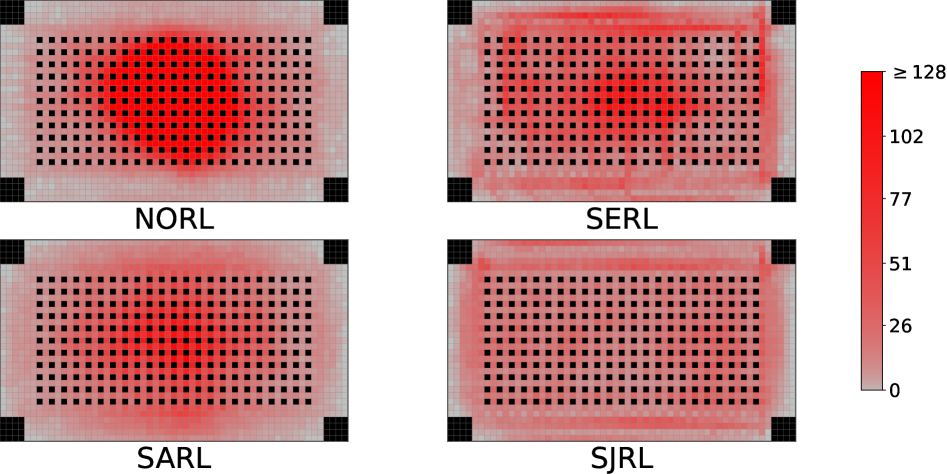
This paper introduces LMAPF-R2, a realistic multi-agent path finding model with robust safety and in-place rotation constraints. The proposed SJRL method combines Causal PIBT with joint agent-environment RL, demonstrating significant improvements over strong baselines in high-density maps, validated with 8 physical robots.
中文摘要: 本文提出了一种真实的终生多智能体路径规划模型LMAPF-R2,考虑了鲁棒安全约束和原地旋转约束,这些约束增加了协调难度。作者提出搜索辅助的联合强化学习(SJRL),首先用单步搜索规划器Causal-PIBT增强神经策略,以解决碰撞并传播意图;然后通过统一RL公式联合优化智能体和环境策略,环境策略学习图边代价以提供全局运动指导。在多个高密度地图上,SJRL相比强搜索基线Causal-PIBT有显著改进,并在包含8台物理机器人和248个虚拟机器人的混合现实仓库环境中验证了鲁棒性。该方法展示了搜索与学习结合处理复杂多智能体协调的潜力。
💬 Combines search-based planning with joint agent-environment RL, validated on real robots, directly relevant to coordinating modular legged teams.
💬 将基于搜索的规划与智能体-环境联合RL结合,并在实机上验证,与协调模块化腿足机器人团队直接相关。
Why read it / 推荐理由: Demonstrates a scalable coordination method that handles kinematic constraints like rotation, essential for multi-legged systems. 展示了一种可扩展的协调方法,处理旋转等运动学约束,对多腿系统至关重要。
3. RORA: Realistic Object Reconstruction with Articulation
RORA:具有关节的真实物体重建
Authors / 作者: Hyesung Lee, Youngseon Lee, Kyutae Lee, Dongjun Lee, Yongseok Lee
arXiv: 2608.04842 · PDF
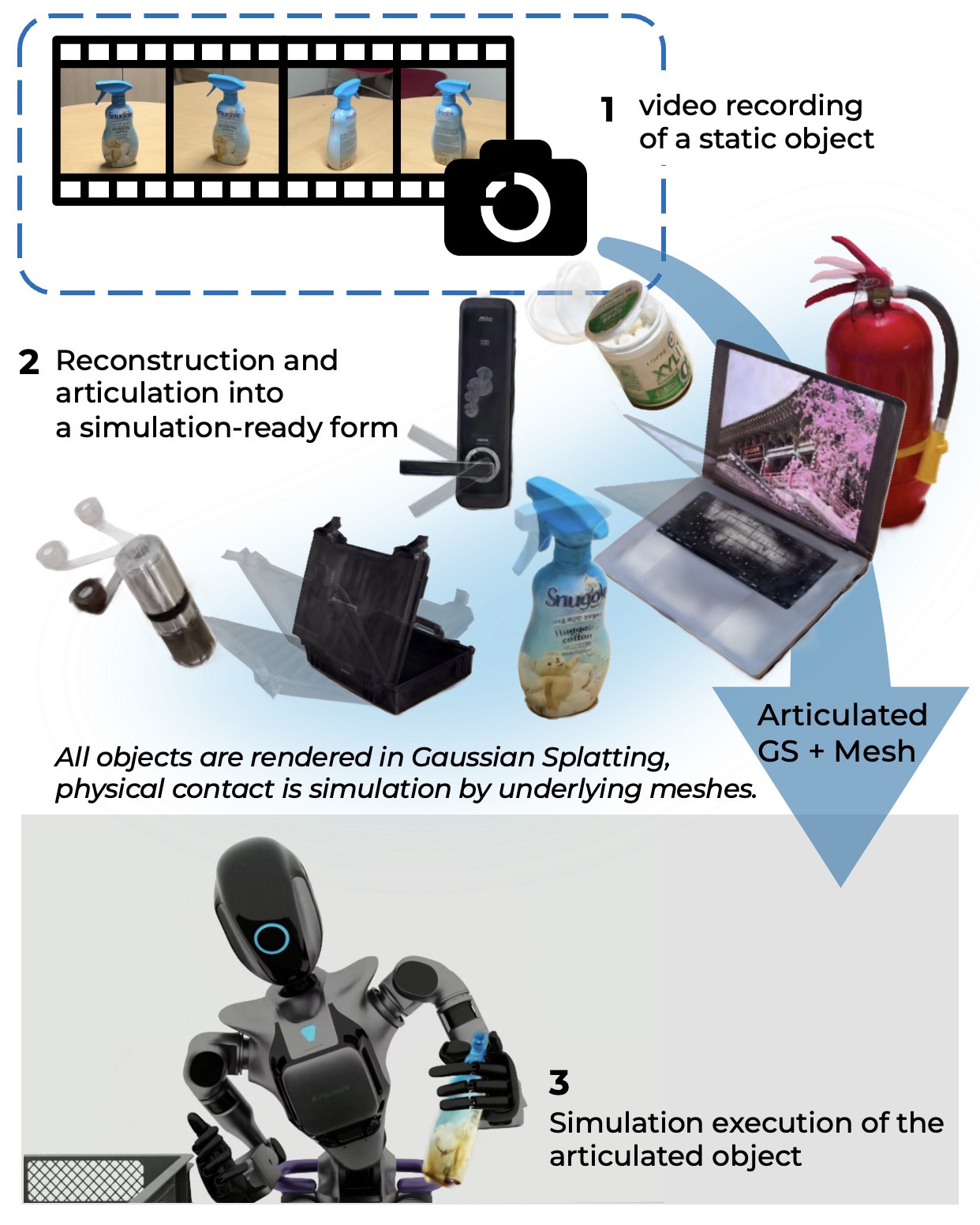
RORA is an end-to-end pipeline that reconstructs simulation-ready assets with accurate articulation from a single static video. It combines 3D Gaussian Splatting for photorealistic rendering and mesh-based geometry for physics, using an Automatic Joint Suggestion Algorithm to propose joints.
中文摘要: RORA提出了一种从单个静态物体视频重建具有准确关节的仿真就绪资产的端到端流水线。该流水线采用混合表示,结合3D高斯泼溅进行真实感渲染和基于网格的几何进行物理交互。重建过程中,首先进行凸分解,然后用户分组进行直观部件分割,再将3D高斯绑定到对应网格部件。自动关节建议算法从局部边界几何计算候选关节轴,供用户高效构建关节资产。该方法在多种物体上展示了精确的关节重建结果,可大幅简化仿真环境创建,为机器人学习提供真实感且物理正确的训练数据,特别是对于需要与复杂关节物体交互的任务。
💬 A practical real-to-sim pipeline that creates articulated simulation assets, easing the sim-to-real transfer for legged robots in complex environments.
💬 一种实用的真实到仿真流水线,创建关节仿真资产,简化腿足机器人在复杂环境中的sim-to-real迁移。
Why read it / 推荐理由: Directly addresses the gap in simulating articulated objects, a key challenge for training legged robot controllers. 直接解决关节物体仿真缺口,是训练腿足机器人控制器的关键挑战。
4. Unified Planning-Learning Framework for Robust UUV Navigation Under Partial Observability
部分可观测下鲁棒UUV导航的统一规划-学习框架
Authors / 作者: Md Ether Deowan, Eleni Kelasidi
arXiv: 2608.05365 · PDF
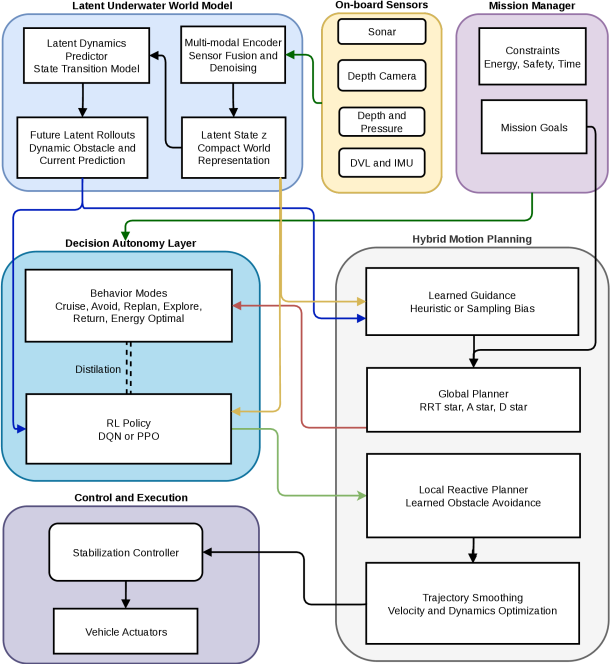
This paper presents an observation-only autonomy framework for UUVs combining persistent occupancy mapping, clearance-aware global planning, and RL-based local control. It uses behavior tree distillation with uncertainty calibration to train a robust local policy, evaluated in high-fidelity simulation.
中文摘要: 本文提出了一个仅基于观测的UUV自主导航框架,集成持续占据映射、间隙感知全局规划和风险感知局部控制。系统仅从声纳和深度图像构建占据地图,采用间隙约束的全局规划器提供长时程结构,并通过强化学习策略处理短距离跟踪和反应式避障。为支持部分可观测下的决策,学习紧凑的潜在状态表示以编码环境结构、障碍物动态和不确定性。引入行为树蒸馏和不确定性校准机制,用潜在模型不确定性重新加权教师指导,突出关键区域。在高保真GPU仿真中评估,相比BT-only和标准RL基线有显著改进。该框架可迁移到腿足机器人导航。
💬 The hybrid planning-learning framework under uncertainty is directly transferable to legged robot navigation with traversability awareness.
💬 不确定条件下的混合规划-学习框架可直接迁移到具有可通过性感知的腿足机器人导航。
Why read it / 推荐理由: Relevant for traverse-capability-aware path planning and RL-based local control in legged robots. 与腿足机器人的可通过性路径规划和基于RL的局部控制相关。