机器人日报
机器人论文日报 — 2026-08-07
🤖 Scanned 304 new arXiv papers (cs.RO / eess.SY / cs.LG, last 48 h), picked 5 for modular & legged robotics — summarized by DeepSeek.
🤖 扫描了近 48 小时 arXiv(cs.RO / eess.SY / cs.LG)的 304 篇新论文,围绕模块化与足式机器人精选 5 篇 — 由 DeepSeek 生成双语摘要。
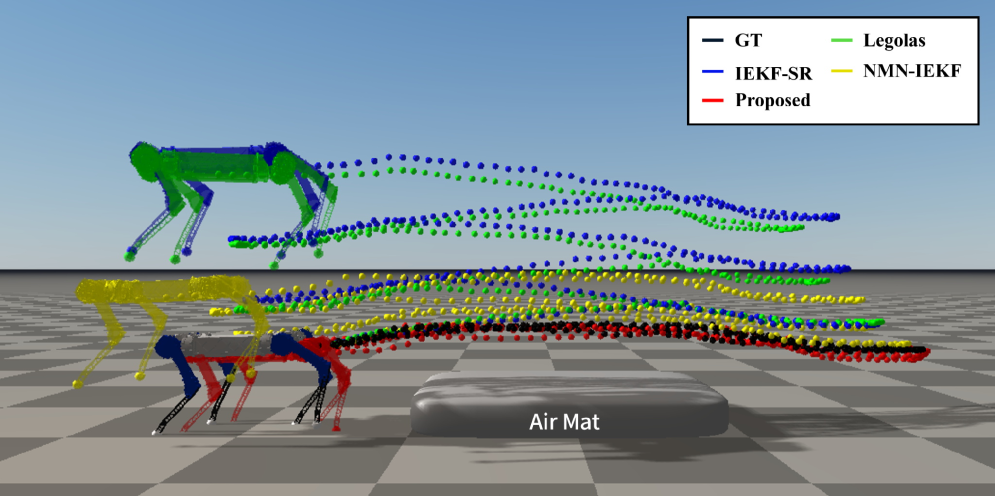
1. TRACE: Learned Proprioceptive Odometry for Legged Robots under Unreliable Contact Conditions
TRACE:不可靠接触条件下腿式机器人的学习式本体感受里程计
Authors / 作者: Taehyeon Kong, Woojin Kim, Jemin Hwangbo
arXiv: 2608.05975 · PDF
TRACE learns end-to-end proprioceptive odometry from IMU and joint measurements, using a foot-aware cross-attention module to adaptively weight leg information without explicit contact/slip thresholds. Training combines direct supervision, physics-inspired auxiliary losses, policy randomization, and partial real-world fine-tuning. It reduces position drift on diverse terrains versus classical filtering, hybrid, and learning baselines, especially under unreliable contacts and sim-to-real gap.
中文摘要: TRACE 提出一种端到端学习的腿式机器人本体感受里程计方法,直接从 IMU 与关节编码器的历史观测预测相对位移、相对旋转和机体速度。针对接触不可靠场景,设计了足部感知交叉注意力模块,在不依赖人工定义接触/打滑阈值的情况下,自适应地加权 IMU 与腿部运动学信息。训练过程结合直接监督与两种物理启发的辅助损失,以增强运动学一致性和腿部信息的可靠利用;同时通过策略随机化和部分真机微调来降低策略过拟合、改善 sim-to-real 迁移。在多种室内外地形上的实验表明,与经典滤波、混合方法及纯学习方法相比,TRACE 持续降低位置漂移;消融实验进一步验证了训练目标、策略随机化和真机微调在不可靠接触与 sim-to-real 失配场景下的贡献。
💬 Robust learning-based odometry with foot-aware attention and sim-to-real fine-tuning, highly relevant to legged state estimation and locomotion control.
💬 基于足部注意力与 sim-to-real 微调的鲁棒学习里程计,与腿式机器人状态估计和运动控制高度相关。
Why read it / 推荐理由: Directly addresses contact-unreliable legged odometry and sim-to-real robustness, a common practical bottleneck in legged locomotion. 直接解决接触不可靠时的腿式里程计与 sim-to-real 鲁棒性问题,是腿式运动控制的常见实际瓶颈。
2. Nonvisual Classification of Ground-Condition by Artificial Proprioception in an Amoeba-Inspired Autonomous Walking Robot
基于人工本体感受的变形虫启发自主步行机器人地面条件非视觉分类
Authors / 作者: Hyoto Yamaguchi, Zenji Yatabe, Seiya Kasai
arXiv: 2608.05684 · PDF
This paper classifies ground condition (flat vs rough) for a four-legged amoeba-inspired walking robot using only proprioceptive signals from a tri-axis accelerometer and eight foot pressure sensors processed by reservoir computing. The system achieves high classification accuracy despite large sensor fluctuations during dynamic walking and demonstrates on-site gait switching based on the classified ground condition. Sensor contribution analysis is also provided.
中文摘要: 本文研究了一种基于多模态本体感知的变形虫启发式自主步行机器人地面条件非视觉分类方法。系统不依赖图像传感与处理,而是集成三轴加速度计、八只足底压力传感器和储备池计算实现人工本体感觉,从而区分平坦与粗糙地面。在四足机器人动态行走导致传感器输出大幅波动的条件下,该方法仍能实现高精度分类,并展示了根据地面条件在线切换行走步态的能力。文中还分析了各传感器对分类结果的贡献。这项工作为无视觉环境下腿式机器人的地形感知与步态自适应提供了一种轻量级、可在线部署的解决方案。
💬 A lightweight proprioceptive terrain classifier with reservoir computing and real gait switching on a quadruped, directly relevant to modular legged gait generation.
💬 一种基于储备池计算的轻量级本体感觉地形分类器,在四足机器人上实现了真实步态切换,与模块化腿式步态生成直接相关。
Why read it / 推荐理由: Shows how pure proprioception can drive terrain-adaptive gait switching, a key capability for modular legged platforms in unstructured environments. 展示了纯本体感觉如何驱动地形自适应步态切换,是模块化腿式平台在非结构化环境中的关键能力。
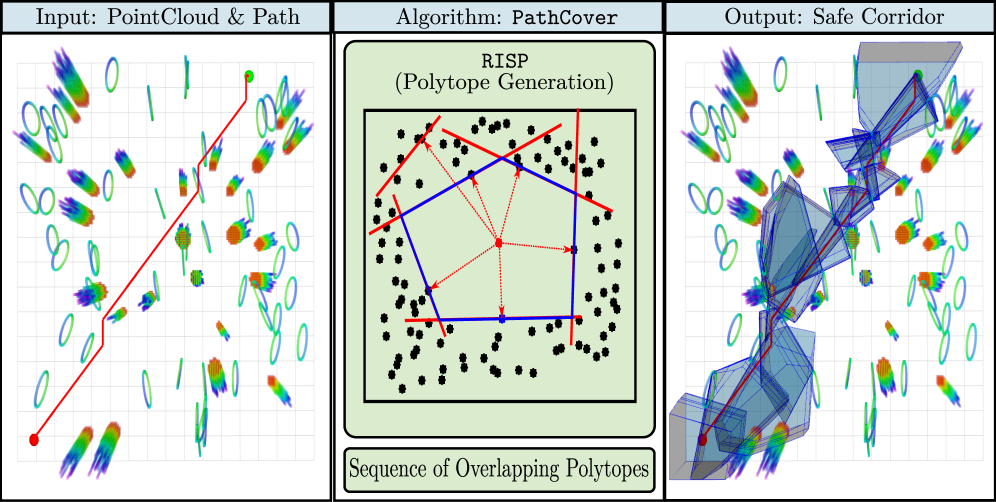
3. PathCover: A Fast Convex Decomposition along a Path via Randomized Iterative Space Partitioning (RISP) on Point Clouds
PathCover:基于点云随机迭代空间划分的路径快速凸分解
Authors / 作者: Kunal S. Narkhede, Abhijeet M. Kulkarni, Guoquan Huang, Ioannis Poulakakis
arXiv: 2608.05586 · PDF
PathCover generates obstacle-free convex polytopes directly from raw point clouds using Randomized Iterative Space Partitioning, running in expected linear time and provably progressing along obstacle-free reference paths. It provides fast safety corridors for downstream MPC and trajectory optimization, with order-of-magnitude speedups over prior corridor generators. Validation includes high-fidelity quadrotor simulations and physical deployment on a quadrupedal robot navigating with live LiDAR.
中文摘要: PathCover 提出一种从原始点云直接构造无碰撞凸多面体安全走廊的快速分解框架,核心是随机迭代空间划分方法,在温和的概率消去条件下达到期望线性时间复杂度,并数学保证沿无障碍参考路径有限步终止且持续推进。生成的相互重叠、无碰撞凸多面体可为下游 MPC 与轨迹优化提供安全约束。在合成与真实 LiDAR 数据集上的大规模基准测试表明,相比现有方法实现了约一个数量级的加速且走廊体积相当;该方法在四轴飞行器高保真仿真中验证,并在使用实时 LiDAR 感知的四足机器人上完成物理部署,证明其适合需要实时、传感器速率下计算约束的自主导航。
💬 Fast convex corridor generation directly used for quadruped MPC navigation, bridging perception and whole-body trajectory planning.
💬 面向四足机器人 MPC 导航的快速凸走廊生成方法,连接感知与全身轨迹规划。
Why read it / 推荐理由: Provides a practical, real-time corridor generation pipeline validated on a quadruped, directly useful for MPC-based legged navigation. 提供了在四足机器人上验证的实时走廊生成流程,直接适用于基于 MPC 的腿式导航。
4. $ω$-0: A Latent Predictive World Action Model for Concurrent Humanoid Loco-Manipulation
$ω$-0:面向人形机器人并发移动操作的情境预测世界动作模型
Authors / 作者: Zhe Li, Zhenzhe Zhang, Yangyang Wei, Wenjie Zhang, Xichen Yuan, Peiyuan Zhi et al.
arXiv: 2608.06375 · PDF
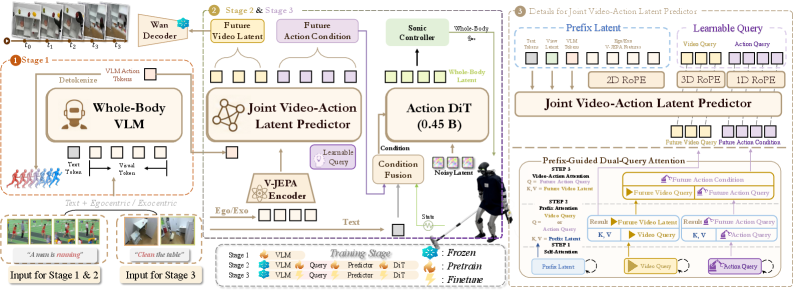
ω-0 is a latent predictive whole-body world-action model that generates controller-compatible whole-body action latents from language, visual observation, and proprioception for humanoid concurrent loco-manipulation. It learns future observation embeddings instead of reconstructing videos, couples latent visual foresight with diffusion-based action generation, and uses controller-based simulation replay to ground human/public priors. Real-world experiments across 11 household tasks produce smooth manipulate-while-moving behaviors.
中文摘要: $ω$-0 是一种面向真实世界人形机器人并发移动操作的情境预测全身世界动作模型。给定语言指令、当前视觉观测和本体感受状态,模型直接预测控制器可执行的全身动作潜变量,无需重建未来视频;通过轻量化的未来观测嵌入作为预测目标,将潜在视觉预见与基于扩散的全身动作生成相结合。该模型支持第一视角 RGB、外部视角 RGB 和深度输入,并利用基于控制器的仿真回放将人类/公开视觉运动先验转化为机器人可执行动作潜变量。作者还收集了超过 40 小时的 $ω$-HOME 家庭场景多视角数据集,包含同步多视角观测、全身 SMPL 运动、机器人与动作状态。在 11 项家庭任务上的真机实验表明,单一模型能够产生平滑的“边移动边操作”行为,体现了全身协调控制与 sim-to-real 迁移的潜力。
💬 A whole-body world-action model for concurrent loco-manipulation, showcasing WBC-style action generation with promising real-robot results.
💬 面向并发移动操作的全身世界动作模型,展示了类似全身控制的动作生成与真机部署潜力。
Why read it / 推荐理由: Although humanoid-focused, its latent whole-body action prediction and sim-to-real grounding are relevant to legged whole-body control and RL motion generation. 虽然面向人形机器人,但其全身动作预测与 sim-to-real 接地对腿式全身控制和 RL 运动生成具有参考价值。
5. KILVO: Kinematic-Inertial-LiDAR-Visual Odometry with Robust Multimodal Adaptation for Humanoid Robots
KILVO:面向人形机器人的运动-惯性-激光-视觉里程计及其鲁棒多模态自适应
Authors / 作者: Jixin Gao, Fucheng Liu, Teng Zhang, Fusheng Zha
arXiv: 2608.05647 · PDF
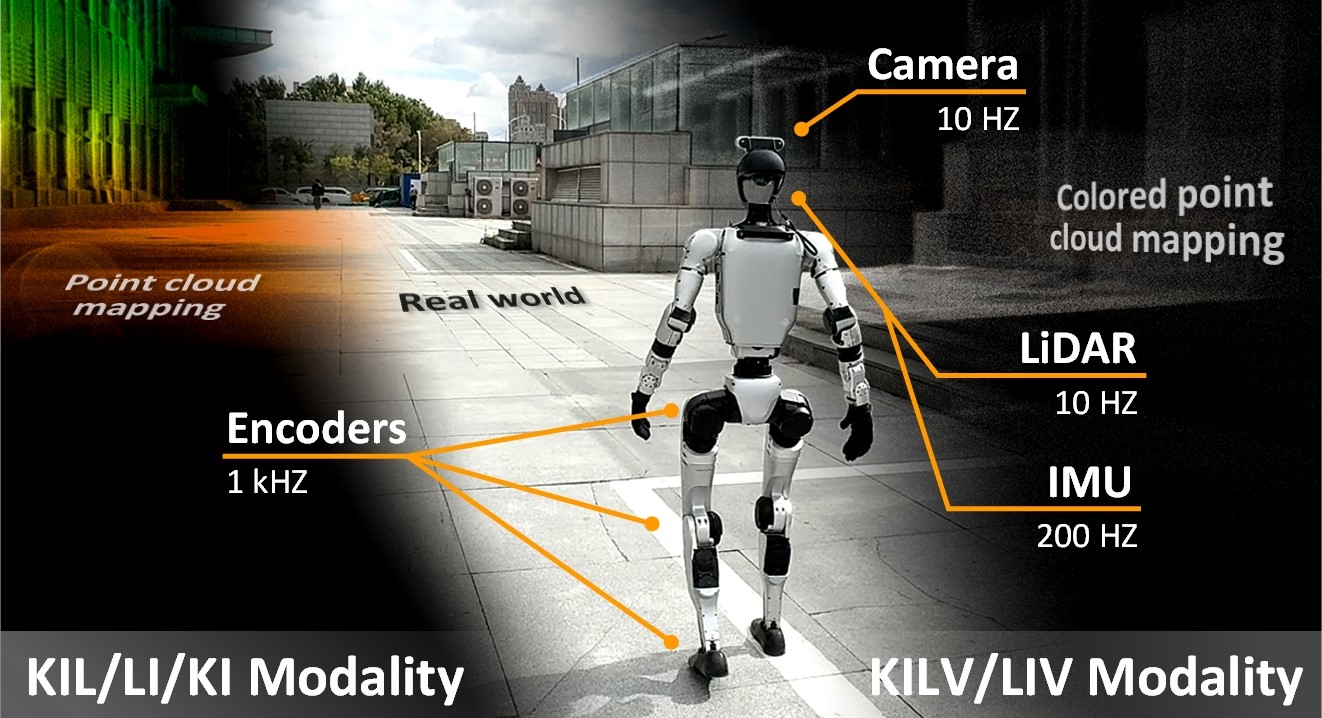
KILVO is a kinematic-inertial-LiDAR-visual odometry framework for humanoid robots based on an asynchronous-sequential hybrid error-state iterated Kalman filter. It fuses joint encoders, IMU, LiDAR, and camera with asynchronous leg kinematics and sequential exteroceptive updates, plus a compact contact estimation module and multimodal adaptation for sensor failures. Extensive experiments on public datasets and multiple real humanoids show competitive accuracy, efficiency, and robustness against sensor degradation.
中文摘要: KILVO 提出一种面向人形机器人的运动-惯性-激光-视觉融合里程计框架,采用异步-顺序混合误差状态迭代卡尔曼滤波器。惯性数据用于预测,腿部运动学以高频异步处理并提供本体感受约束,外部感知依次通过 LiDAR 点云注册与视觉光度误差更新;框架还设计紧凑的接触估计模块,并与状态估计共享信息,同时具备多模态自适应能力以应对传感器失效。在公开数据集和多种真实人形机器人、步态与场景上的实验表明,KILVO 在精度、效率和输出频率上具有竞争力,且对传感器退化与故障表现出强鲁棒性,比现有融合方法更适合人形机器人。代码与数据集已开源。
💬 A robust multi-sensor fusion odometry tailored to legged platforms, with explicit handling of leg kinematics and contacts.
💬 面向腿式平台的多传感器融合里程计,显式处理腿部运动学与接触信息。
Why read it / 推荐理由: Offers a strong state-estimation baseline for legged/humanoid robots under sensor degradation, complementing proprioceptive locomotion control stacks. 为传感器退化下的腿/人形机器人提供强状态估计基线,可补充本体感受运动控制栈。