机器人日报
机器人论文日报 — 2026-08-04
🤖 Scanned 286 new arXiv papers (cs.RO / eess.SY / cs.LG, last 48 h), picked 5 for modular & legged robotics — summarized by DeepSeek.
🤖 扫描了近 48 小时 arXiv(cs.RO / eess.SY / cs.LG)的 286 篇新论文,围绕模块化与足式机器人精选 5 篇 — 由 DeepSeek 生成双语摘要。
1. Open-DiffLoco: Open-Source Differentiable Learning for Deployable Blind Quadruped Locomotion
Open-DiffLoco:开源可微学习实现可部署的盲态四足运动
Authors / 作者: Martin Opat
arXiv: 2608.02069 · PDF
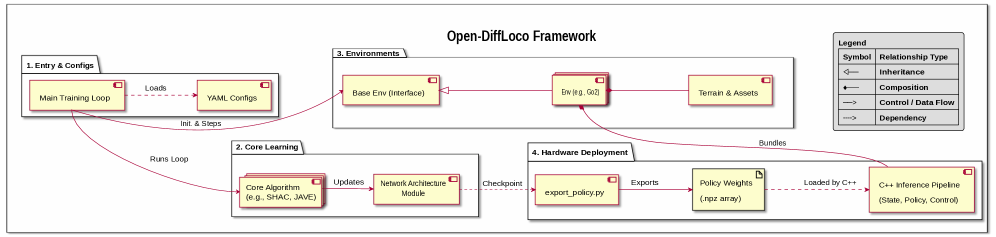
This paper presents Open-DiffLoco, an open-source framework that trains deployable blind quadruped locomotion policies using differentiable simulation, implementing the Short-Horizon Actor-Critic (SHAC) algorithm in MuJoCo XLA (MJX). The policy uses a simplified reward function, removes privileged observations, and transfers to a real Unitree Go2, tracking velocity commands with RMSE below 0.2 m/s and speeds over 1 m/s. Training uses under 6 GB VRAM on a single RTX 5080 GPU.
中文摘要: 本文提出Open-DiffLoco,一个开源框架,通过可微仿真训练可部署的盲态四足运动策略。与需要复杂奖励设计和长时间训练的传统强化学习相比,可微仿真提供了高效替代方案。该框架在MuJoCo XLA (MJX)中实现了Short-Horizon Actor-Critic (SHAC)算法,策略仅使用本体感觉,无需参考轨迹和复杂的辅助奖励。在Unitree Go2物理机器人上,该策略能以低于0.2 m/s的均方根误差跟踪全向速度指令,并达到1 m/s以上的速度,对不平地形和外部推挤等干扰具有鲁棒性。训练在单块NVIDIA RTX 5080 GPU上使用不到6 GB显存完成,展示了可微仿真在真实四足运动学习中的实用性。
💬 Directly relevant to RL-based quadruped locomotion and sim-to-real transfer, with open-source code and real-robot deployment.
💬 与基于强化学习的四足运动及sim-to-real迁移直接相关,提供开源代码和真机验证。
Why read it / 推荐理由: Provides a reproducible, low-VRAM differentiable-simulation baseline for training deployable blind quadruped policies, useful for benchmarking the reader’s own locomotion controllers. 为训练可部署盲态四足策略提供了可复现、低显存占用的可微仿真基线,可用于读者自身运动控制器的基准测试。
2. Rapid Embodiment Adaptation for Quadrupedal Locomotion
四足运动的快速机体形态适应
Authors / 作者: Dichen Li, Bo Ai, Nico Bohlinger, Jan Peters, Hao Su, Henrik I. Christensen
arXiv: 2608.01506 · PDF
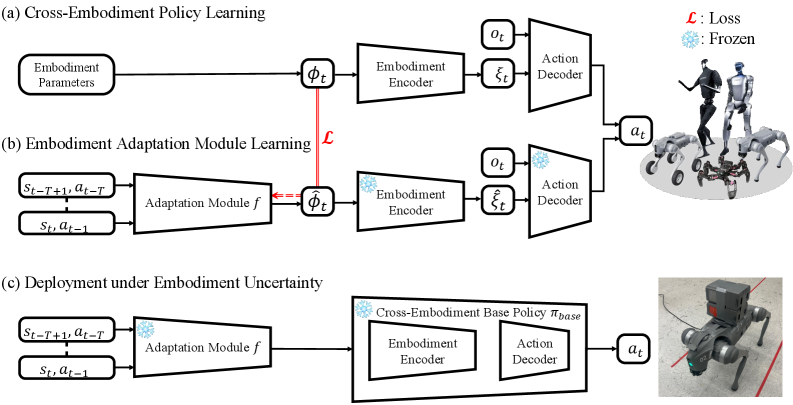
This paper introduces an online embodiment adaptation framework for quadrupedal locomotion that infers physical parameters (joint-range constraints and trunk-mass changes) from short interaction histories, using a generalist policy trained under embodiment randomization plus a lightweight adaptation module. In simulation it accurately estimates changes within half a second, and on a real Unitree Go2 it maintains stable locomotion under a fully locked leg and a 5 kg payload, where non-adaptive baselines fail.
中文摘要: 本文提出一种面向四足运动的在线机体形态适应框架,从短暂交互历史中推断物理参数(如关节运动范围受限和躯干质量变化),并通过一个在机体形态随机化下训练的通才策略与轻量级适应模块相结合来控制运动。该模块可在半秒内识别物理变化。在仿真中,该方法能准确估计这些变化,并实现明显优于直接基于交互历史的闭环控制。在真实Unitree Go2机器人上,系统在严重故障(包括完全锁死的腿和5kg负载)下仍能保持稳定运动,而非自适应方法则失败。这些结果证明了显式在线机体形态识别对于快速适应关节限位和负载质量变化的实用性,并为处理更广泛的不确定、退化或变化的机器人硬件迈出了一步。
💬 Highly relevant to modular legged robots, as it explicitly addresses rapid adaptation to hardware changes (locked leg, payload), a key challenge for reconfigurable systems.
💬 与模块化腿足机器人高度相关,因为它明确处理了对硬件变化(锁腿、负载)的快速适应,是可重构系统的关键挑战。
Why read it / 推荐理由: Offers a practical method for detecting and adapting to leg joint or mass changes on hardware, directly applicable to the reader’s modular legged platform. 提供了一种在硬件上检测并适应腿关节或质量变化的实用方法,可直接应用于读者的模块化腿足平台。
3. Bridging the Sim-to-Real Gap in Parallel-Link Leg Mechanisms via Simulator-Side Dynamics Normalization
通过仿真器侧动力学归一化弥合并联连杆腿机构的Sim-to-Real差距
Authors / 作者: Jinsong Hong, Jangho Kim, Jihwan Lee, Donghyun Kim, Sehoon Oh
arXiv: 2608.01697 · PDF
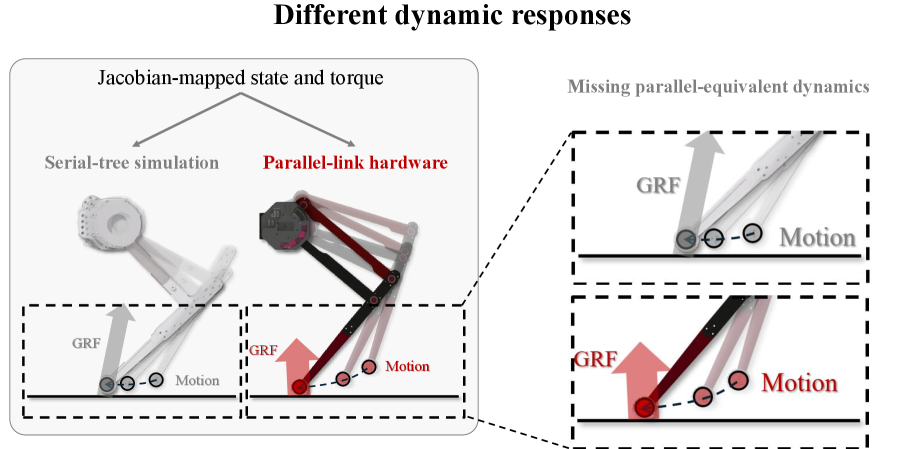
This paper proposes Simulator-Side System Normalization (S3N) to reduce the sim-to-real gap when parallel-link leg mechanisms are modeled as serial-tree surrogates in simulation. S3N-Act incorporates actuator inertia/damping, while S3N-Full restores residual linkage inertia via identification of actuator- and leg-level frequency responses. Experiments show reductions of 80.9% in joint-position and 82.1% in torque RMSE, and a decrease of the command-normalized sim-to-real gap from 17.3% to 9.9% in circular locomotion.
中文摘要: 本文针对并联连杆腿机构在仿真中被表示为串行树替身时产生的sim-to-real动力学差距,提出仿真器侧系统归一化(S3N)方法。S3N-Act通过坐标变换将执行器惯量和阻尼并入串行坐标动力学;S3N-Full则通过分别辨识执行器与腿部频率响应来恢复残余连杆惯量。在2自由度验证中,S3N-Full相较于Jacobian映射基线将关节位置和力矩RMSE分别降低80.9%和82.1%。在pitch-in-place运动中,S3N-Act和S3N-Full将地面反作用力范数RMSE分别降低65.1%和62.4%;在圆周运动中,S3N-Full将命令归一化的sim-to-real差距从17.3%降至9.9%。结果表明,仿真器侧归一化能改善运动与力层面的仿真一致性,并支持在串行树仿真中训练策略。
💬 Addresses a critical issue for simulating parallel-link leg mechanisms, which are common in modular legged platforms, and provides a clear methodology with strong quantitative improvements.
💬 解决了并联连杆腿机构仿真中的关键问题,这类机构常见于模块化腿足平台,并提供了具有显著量化改进的清晰方法。
Why read it / 推荐理由: Important for the reader’s sim-to-real work if their modular legs use parallel linkages, as it offers a way to achieve high-fidelity dynamics without changing the simulation topology. 如果读者的模块化腿部使用并联机构,该文对sim-to-real工作很重要,它提供了一种在不改变仿真拓扑的情况下获得高保真动力学的方法。
4. Residual-Based Adaptive Kalman Filtering for Legged Robot State Estimation
基于残差的自适应卡尔曼滤波用于腿足机器人状态估计
Authors / 作者: Mihaela Popescu, Dennis Mronga, Shivesh Kumar, Frank Kirchner
arXiv: 2608.02316 · PDF
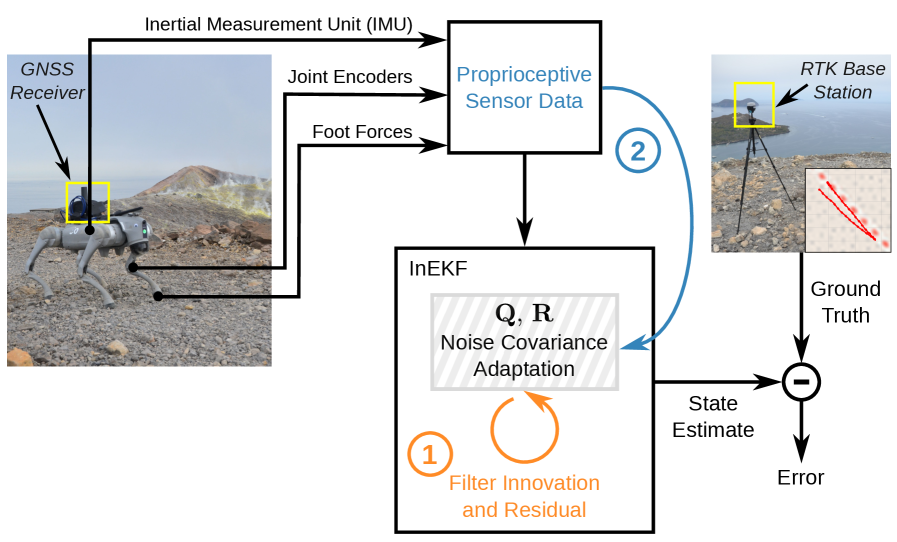
This paper proposes an online adaptation strategy for the process and measurement noise covariance matrices in a Kalman filter for legged robot state estimation, using a filter residual and innovation-based covariance adaptation. Implemented in an Invariant Extended Kalman Filter (InEKF) fusing IMU and leg kinematics, it improves trotting gait accuracy by 25% over a fixed-tuned InEKF on indoor/outdoor datasets with a Unitree Go2, without requiring foot force measurements.
中文摘要: 状态估计是步行机器人模型控制的关键组成部分,卡尔曼滤波广泛应用于融合多种传感模态来估计浮动基座的位置和速度。然而,噪声参数的调整具有挑战性且需要专业知识,固定噪声参数也不适应不同步态和环境。本文提出一种基于滤波残差和创新的协方差自适应方法,在线调整过程噪声协方差Q和测量噪声协方差R,并在融合IMU与腿部运动学的不变扩展卡尔曼滤波(InEKF)中实现。在Unitree Go2四足机器人的室内外数据集上的实验表明,仅适应R即可在trot步态下比固定调参的InEKF提高25%的精度,且无需足力传感器测量或额外参数调整,性能优于基线。
💬 Provides a tuning-free state estimation method that improves accuracy on real quadruped data, useful for any model-based controller relying on accurate floating-base estimates.
💬 提供了一种无需调参的状态估计方法,在真实四足数据上提高了精度,对依赖精确浮动基座估计的模型控制器很有用。
Why read it / 推荐理由: Accurate state estimation is a prerequisite for MPC/WBC; this method removes manual tuning and adapts online to different gaits, complementing the reader’s locomotion control stack. 精确的状态估计是MPC/WBC的前提;该方法无需手动调参并能在线适应不同步态,可补充读者的运动控制栈。
5. Situation Aware Frontier Prioritization for Quadruped Search and Rescue
面向四足搜索救援的情境感知前沿优先级排序
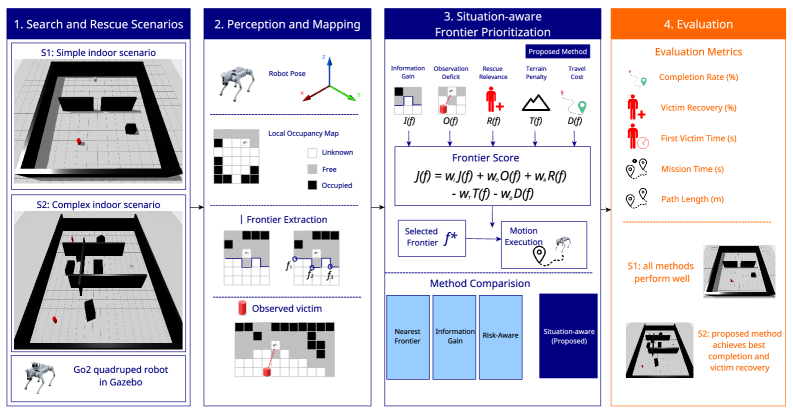
Authors / 作者: Kevin Farias, Santiago Martin, Barbara Flores, Vinicio Melgar, Igor Nunes, Hiago Sodre et al.
arXiv: 2608.02571 · PDF
This paper presents a situation-aware frontier prioritization method for single-robot quadruped search and rescue, extending frontier ranking with information gain, observation deficit, rescue relevance, terrain penalty, and travel cost. Evaluated in Gazebo with a quadruped in two indoor rescue scenarios, it achieves the highest completion rate and victim recovery in the complex scenario, showing benefits when frontier choice is nontrivial.
中文摘要: 四足机器人是搜索救援任务的理想平台,能够穿越对轮式系统而言受限的杂乱室内环境。然而,在未知救援场景中,自主探索必须在地图扩展与发现受害者的可能性之间取得平衡,而经典前沿选择策略并未明确考虑这一点。本文提出一种面向单机器人四足搜索救援的情境感知前沿优先级排序方法,保留前沿探索框架,但用信息增益、观测缺失、救援相关性、地形惩罚和行程成本扩展了前沿排序。在Gazebo仿真中的两个不同难度室内救援场景中,复杂场景下该方法取得了最高的完成率和受害者找回率,表明在前沿选择变得非平凡且需要平衡救援效用与通用探索目标时,情境感知前沿优先级排序是有益的。
💬 Relevant to the reader’s interest in traverse-capability-aware path planning, although focused on exploration rather than locomotion control.
💬 与读者对穿越能力感知路径规划的兴趣相关,但侧重于探索而非运动控制。
Why read it / 推荐理由: Demonstrates how to integrate terrain and rescue-utility costs into frontier selection for a quadruped, offering ideas for mission-aware path planning on modular legged platforms. 展示了如何将地形和救援效用成本集成到四足机器人的前沿选择中,为模块化腿足平台的任务感知路径规划提供了思路。