Field Robot Systems
EnRicH 2025: Air–Ground Robots for Nuclear Plant Inspection
A low-cost drone and ground vehicle team, built in three weeks and field-tested inside the Zwentendorf nuclear power plant at the European Robotics Hackathon.
- Period
- 2025
- Platform
- Custom quadrotor · Ackermann UGV · ROS 2
- Methods
- SLAM · Radiation Mapping · Mesh Networking
- With
- RAICAM doctoral network team
Overview
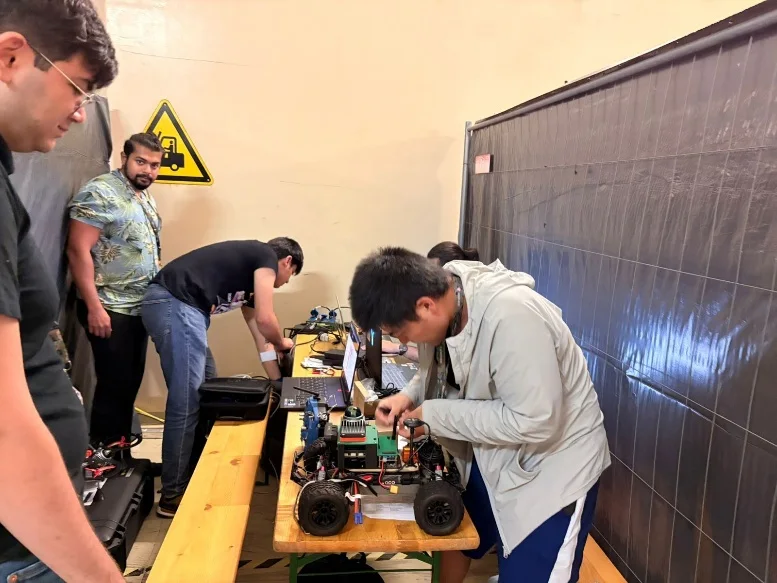
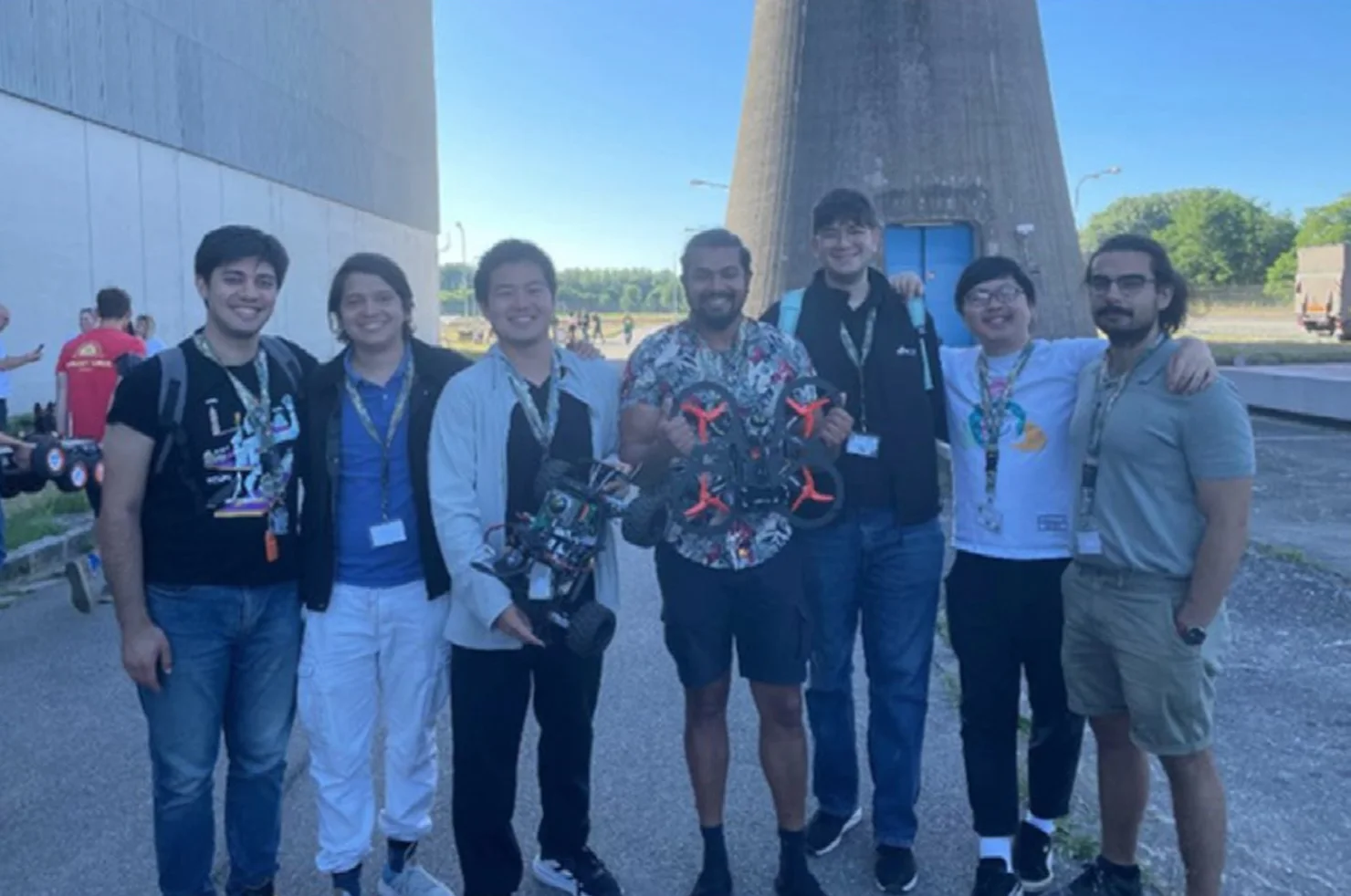
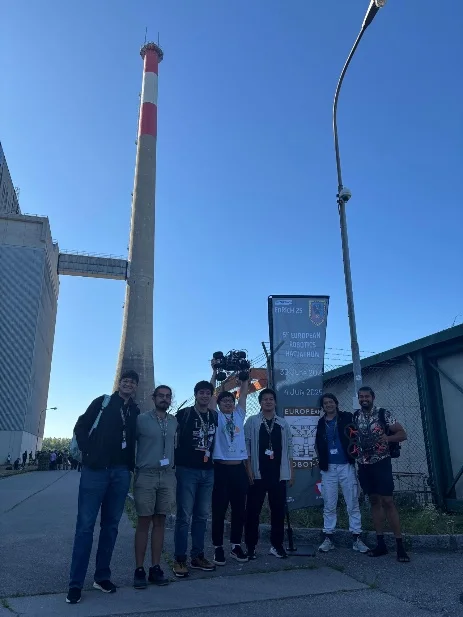
EnRicH — the European Robotics Hackathon — puts robots inside the never-commissioned Zwentendorf nuclear power plant in Austria and asks teams to inspect, map, and find radiation sources in a real, GNSS-denied industrial environment. For the 2025 edition, our RAICAM team built a complete heterogeneous system — an aerial drone plus a ground vehicle — in roughly three weeks, prioritizing low cost, off-the-shelf components, and open-source software.
The system
- Aerial: a quadrotor with a 3D-printed airframe for fast iteration.
- Ground: an Ackermann-steering UGV carrying LiDAR, IMU, and radiation detection modules.
- Autonomy: ROS 2 throughout, with SLAM and a hybrid autonomy paradigm to cope with GNSS denial inside the containment structures.
- Communication: a modular mesh network with signal repeaters to punch through the plant’s heavily shielded interior.
The mission
One of the hackathon missions was 3D-mapping the facility — a massive structure over 100 m long and 120 m wide, with two levels separated by more than 15 m in height. Field trials demonstrated robust localization, reliable communication despite severe attenuation, and real-time radiation monitoring.
Outcome
The full system — mechanical designs, bills of materials, firmware, and the ROS 2 software stack — was released open source, and the work was published at IEEE SSRR 2025. For me, it was field robotics at its most honest: a hard deadline, a real plant, and no second chances on integration.
Publications
- Low-Cost Rapid-Development Air-Ground Robotic Solution for Nuclear Power Plant Inspection. Changda Tian et al. IEEE SSRR 2025, pp. 84–89. DOI