Robotics Digest
Robotics Paper Digest — 2026-11-23
🤖 Scanned 276 papers from today’s arXiv announcement (cs.RO / eess.SY / cs.LG), picked 5 for modular & legged robotics — summarized by DeepSeek.
🤖 从今日 arXiv 新论文(cs.RO / eess.SY / cs.LG)中扫描 276 篇,围绕模块化与足式机器人精选 5 篇 — 由 DeepSeek 生成双语摘要。
1. PACE: Policy Augmentation and Compensation With Explicit Disturbance Estimation for Robust Locomotion
PACE:基于显式扰动估计的策略增强与补偿,实现鲁棒运动
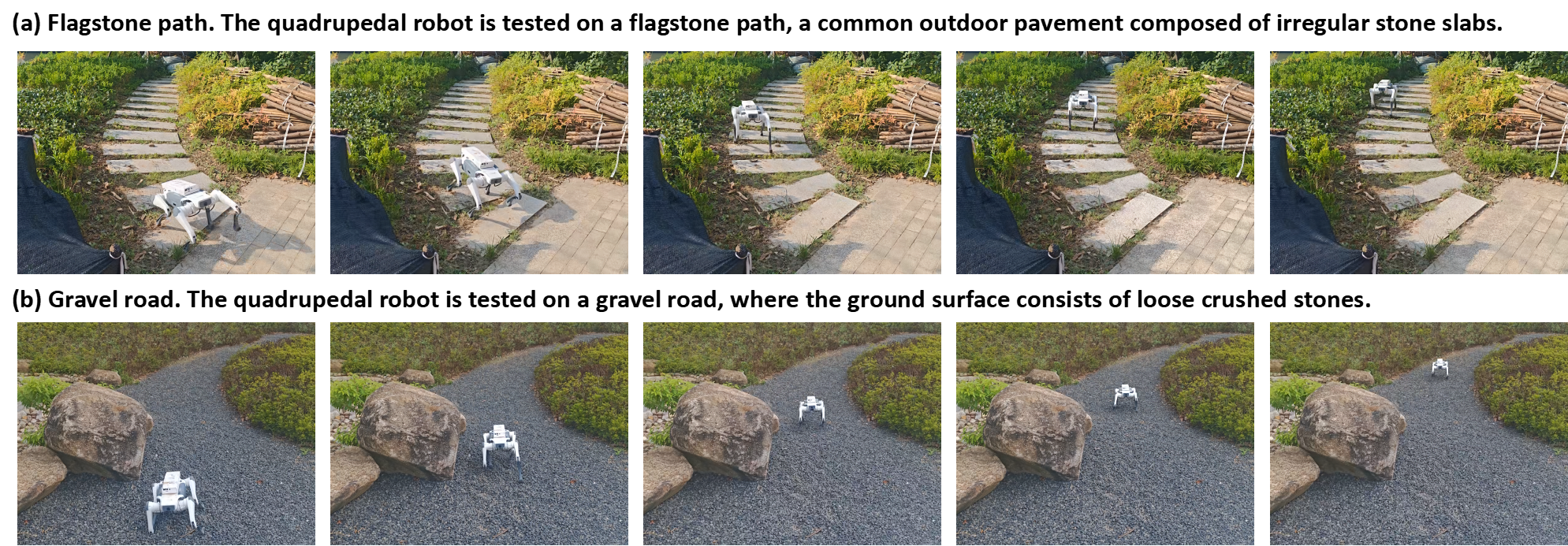
Authors / 作者: Shixuan Han, Yuyang Wang, Jingting Jia, Zeshuai Chen, Jindou Jia, Kexin Guo et al.
arXiv: 2611.27061 · PDF
PACE introduces a joint-space disturbance observer that lumps payload changes, CoM shifts, actuator degradation, and external forces, then feeds the estimate back both as feedforward torque compensation and as an augmented policy observation. An analytical contact estimator using only joint and inertial measurements avoids force sensors. Across eleven simulated dynamics conditions, PACE reduces velocity-tracking error by 18.1% to 57.0% compared to state-of-the-art baselines.
中文摘要: PACE提出一种联合空间扰动观测器,将负载变化、质心偏移、执行器退化与外力统一建模为集总扰动,并将估计值同时用于前馈力矩补偿和策略观测增强,从而缓解域随机化中跟踪精度与泛化性的折衷。此外,作者基于关节与惯性测量设计了无需力传感器的解析接触估计方法,以应对快速变化的接触效应。在十一种仿真动力学条件下,PACE将速度跟踪误差相比最先进基线降低18.1%至57.0%。
💬 Elegant coupling of model-based disturbance estimation with RL policy augmentation; highly relevant for modular legged robots that must adapt to reconfiguration-induced dynamics changes.
💬 该方法优雅地将基于模型的扰动估计与强化学习策略增强相结合,对因模块重构而导致动力学变化的模块化足式机器人尤其具有参考价值。
Why read it / 推荐理由: It offers a principled way to handle payload and CoM variations—common when leg modules are added or reconfigured—without retraining from scratch. 它提供了一种原则性的方法,在增加或重构腿模块等导致负载和质心变化时无需从头重训即可保持鲁棒运动。
2. AELF: Active Terrain-Aware UAV Exploration Using a Lightweight Framework
AELF:基于轻量框架的主动地形感知无人机探索
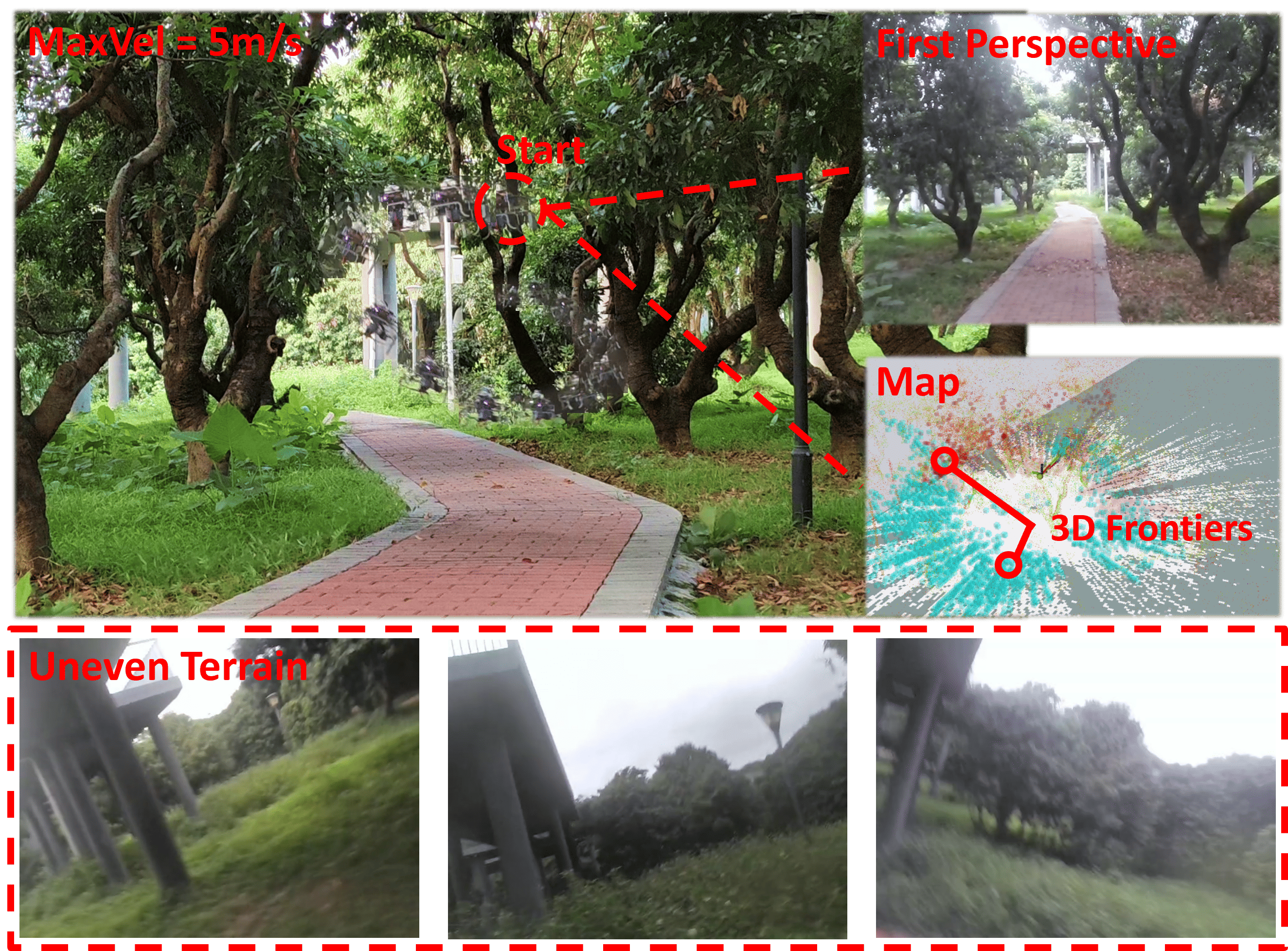
Authors / 作者: Mingyang Li, Xiao Cao, Yi Luo, Yuting Tao, Hongjie Huang, Bowen Xu et al.
arXiv: 2611.27263 · PDF
AELF replaces 3D voxel maps with a lightweight 2.5D map for autonomous aerial exploration, eliminating the blind-voxel problem and requiring no prior height information while actively adapting to terrain elevation. Path planning is performed in 2D on the 2.5D map and then lifted to 3D, evaluating viewpoint costs with terrain traversability to reduce altitude changes. Real-world experiments cover over 2000 m² of cluttered forest and sloped mountainous terrain with up to 10 m elevation changes at speeds up to 5 m/s.
中文摘要: AELF针对复杂环境中的自主空中探索,采用轻量级2.5D地图替代传统3D体素地图,在降低计算开销的同时系统性地消除了因遮挡和可见性受限导致的盲体素问题,且无需先验高度信息即可主动适应地形起伏。该方法在2.5D地图上进行二维路径规划,再提升至三维并结合地形可通行性评估视点间代价,从而减少频繁高度变化并实现更平滑的探索。在仿真和真实环境中,系统在超过2000平方米的杂乱森林和坡度达10米的山区以最高5米/秒的速度完成快速探索。
💬 Terrain-traversability-aware planning on a lightweight representation is directly transferable to legged robot traverse-capability-aware path planning, though the platform is aerial.
💬 基于轻量表示的地形可通行性感知规划可直接迁移到足式机器人的可通行能力感知路径规划,尽管其平台为无人机。
Why read it / 推荐理由: The 2.5D traversability-cost formulation and 2D-to-3D planning lift mirror challenges in traverse-capability-aware legged path planning. 其2.5D可通行性代价公式与二维到三维的规划提升,与足式机器人可通行能力感知路径规划中的问题高度相似。
3. Search-Informed MPPI for Kinodynamic Motion Planning via Monte Carlo Tree Expansion
基于蒙特卡洛树扩展的搜索引导MPPI动力学运动规划
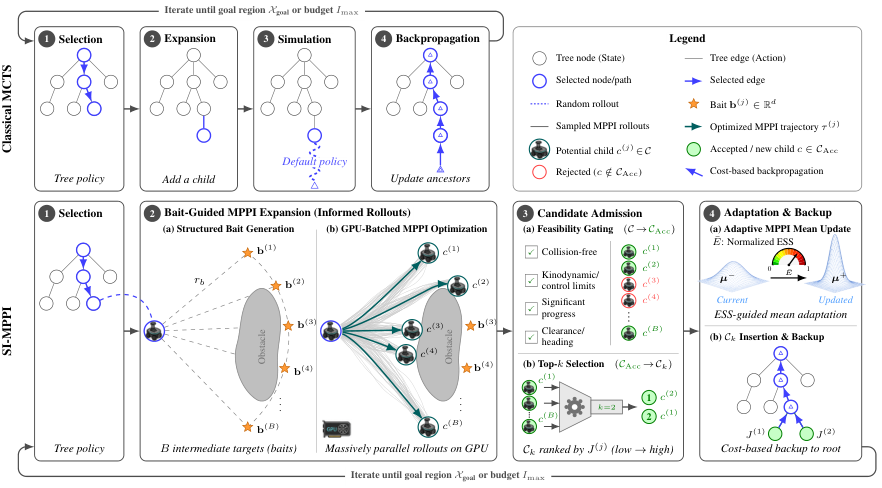
Authors / 作者: Ihab S. Mohamed, Lantao Liu
arXiv: 2611.26763 · PDF
SI-MPPI embeds GPU-batched MPPI trajectory optimization within MCTS tree search, fusing MCTS expansion and default-policy simulation into a single MPPI stage guided by structured intermediate targets called baits. Feasibility gating checks collision safety and progress, top-k selection yields sparse directed tree growth, and ESS-guided adaptation warm-starts subsequent expansions. This addresses MPPI’s local-minima susceptibility and MCTS’s large branching factor in continuous control.
中文摘要: SI-MPPI将GPU批量MPPI轨迹优化嵌入蒙特卡洛树搜索的扩展框架中,把MCTS的扩展与默认策略仿真融合为单一MPPI扩展阶段,并由称为“诱饵”的结构化中间目标引导。每次扩展中,自适应诱饵处理规则保留几何有效的诱饵作为局部目标,经可行性门控检查碰撞安全与进度后,选取代价最低的top-k候选作为树边,实现稀疏有向的树生长;基于有效样本量的自适应机制为后续扩展提供热启动。该方法缓解了MPPI易陷入局部极小和MCTS在连续控制空间中分支因子过大的问题。
💬 A well-engineered hybrid of sampling-based MPC and tree search that could inspire MPC formulations for legged locomotion over uneven terrain with obstacle-induced local minima.
💬 该方法将采样型MPC与树搜索良好结合,可为足式机器人在非平整地形上克服障碍诱导局部极小的MPC建模提供启发。
Why read it / 推荐理由: It provides a concrete recipe for escaping local minima in long-horizon kinodynamic planning, relevant to MPC-based legged locomotion over cluttered terrain. 它为长时域动力学规划中逃离局部极小提供了具体方案,与基于MPC的足式机器人在杂乱地形中的运动控制相关。
4. What Must a Model Tell a Planner? Outcome Interfaces for Risk-Aware Planning After Robot Damage
模型必须告诉规划器什么?机器人损伤后风险感知规划的结果接口
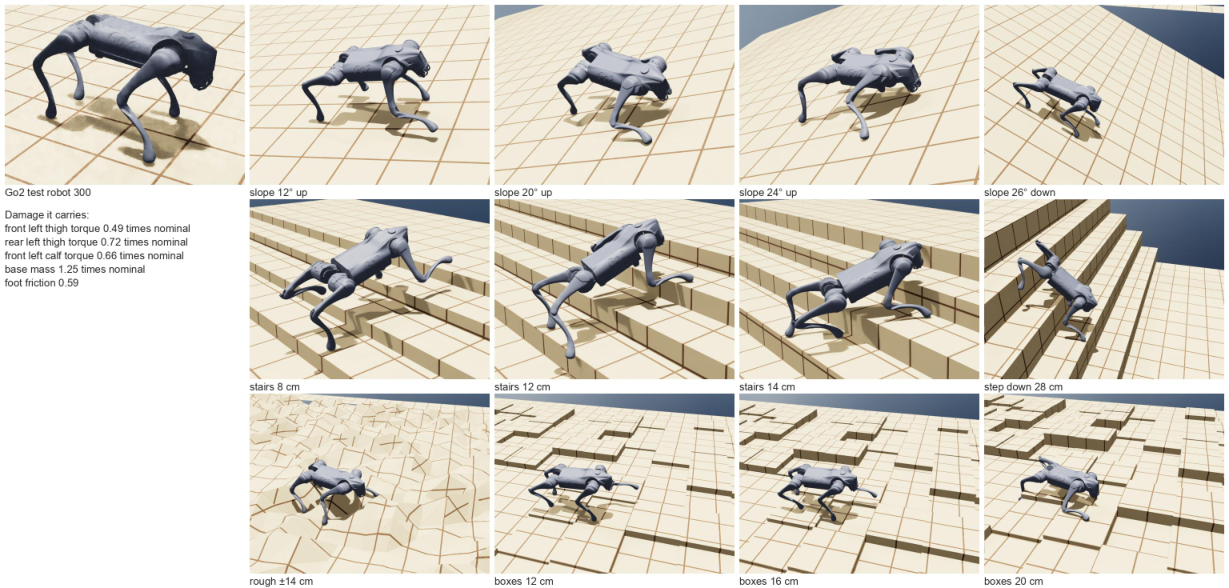
Authors / 作者: Hassan Iqbal, Krishna Kumar
arXiv: 2611.27939 · PDF
The paper studies what a learned model should hand to a planner after robot damage, comparing a decision policy, a penalty-trained policy, an outcome model predicting route feasibility and travel time, and a capability contract composing per-terrain success probability and time along routes. Using simulated Unitree Go2 quadrupeds and H1 humanoids with weakened motors, payloads, or reduced friction, outcome models with a calibrated 5% infeasibility limit cut declined missions from about 32% to 7–8% on Go2 and from 57% to 35–36% on H1.
中文摘要: 该研究探讨机器人损伤后学习模型应向规划器传递何种信息,比较了四种接口:决策策略、带固定惩罚训练的决策策略、预测每条路线可行性与通行时间的结果模型,以及将各地形成功概率与通行时间沿路线组合的“能力契约”。实验在电机减弱、附加负载或足底摩擦降低的仿真Unitree Go2四足和H1人形上进行;在标定的5%不可行路线选择限制下,结果模型将Go2的拒止任务率从约32%降至7-8%,H1从57%降至35-36%。
💬 Directly addresses risk-aware planning under actuator degradation, which is central to modular robots whose capability envelope changes when modules fail or are swapped.
💬 该工作直接研究执行器退化下的风险感知规划,这对模块失效或更换时能力包络发生变化的模块化机器人至关重要。
Why read it / 推荐理由: It formalizes the planner-model interface for capability-aware routing, a key ingredient for modular legged robots that must plan within a recomputed capability envelope. 它将能力感知路径规划中的规划器-模型接口形式化,是模块化足式机器人在重算能力包络内进行规划的关键要素。
5. S-BFM: A Behavioral Foundation Model for Humanoid Control from Sparse Spatiotemporal Goals
S-BFM:面向稀疏时空目标人形控制的行为基础模型
Authors / 作者: Kun Yang, Xuanyu Chen, Jing Tan, Yanjing Liu, Yubo Zhao, Renjing Xu et al.
arXiv: 2611.27552 · PDF
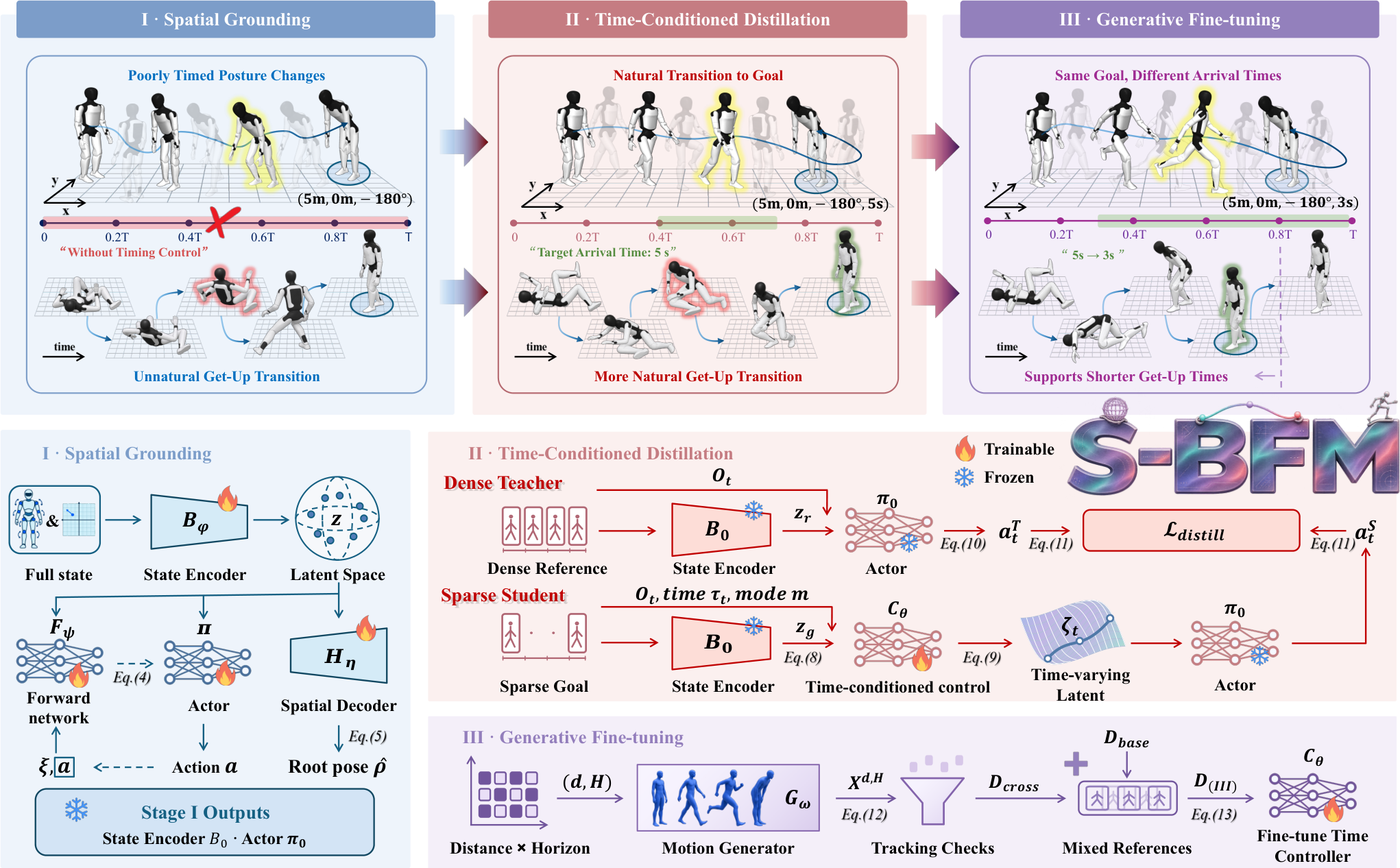
S-BFM is a whole-body behavioral foundation model that generates transitions from target postures, poses, and arrival times alone, without dense reference trajectories. It combines Spatial Grounding for world-frame position and heading, Time-Conditioned Distillation from a dense-reference teacher, and Generative Fine-Tuning to broaden covered distances and arrival times. In simulation it lowers global joint-position error by over 32% and raises fixed-goal reach from 43.5% to 74.6%, and is deployed on the full-size AGIBOT A3 humanoid.
中文摘要: S-BFM是一种全身行为基础模型,仅需目标姿态、位姿和到达时间即可自主组织中间运动及其节奏,无需稠密参考轨迹。方法包含三部分:空间接地通过空间重建为前向-后向行为表示加入世界坐标系位置与朝向;时间条件蒸馏通过闭环模仿稠密参考教师学习过渡与节奏;生成式微调则利用蒸馏运动生成器扩展覆盖的距离与到达时间范围。仿真中全局关节位置误差相比最佳基线降低超过32%,固定目标到达率从43.5%提升至74.6%,并在全尺寸AGIBOT A3人形上完成部署。
💬 Sparse-goal whole-body tracking with time conditioning is a promising direction for modular platforms where the goal space changes with configuration, though validation is humanoid-specific.
💬 带时间条件的稀疏目标全身跟踪对目标空间随构型变化的模块化平台具有前景,尽管验证仅限人形平台。
Why read it / 推荐理由: It shows how a low-level controller can autonomously organize whole-body motion from sparse spatiotemporal specs, an idea adaptable to multi-legged modular gait generation. 它展示了底层控制器如何从稀疏时空规格自主组织全身运动,这一思路可迁移到多足模块化步态生成。