Robotics Digest
Robotics Paper Digest — 2026-11-21
🤖 Scanned 200 papers from today’s arXiv announcement (cs.RO / eess.SY / cs.LG), picked 5 for modular & legged robotics — summarized by DeepSeek.
🤖 从今日 arXiv 新论文(cs.RO / eess.SY / cs.LG)中扫描 200 篇,围绕模块化与足式机器人精选 5 篇 — 由 DeepSeek 生成双语摘要。
1. Improving Imitation Policies for Multi-Phase Tasks through Residual Learning Allocation
通过残差学习分配改进多阶段任务的模仿策略
Authors / 作者: Clinton Enwerem, Saleh Kemal, John S. Baras, Calin Belta
arXiv: 2611.25320 · PDF
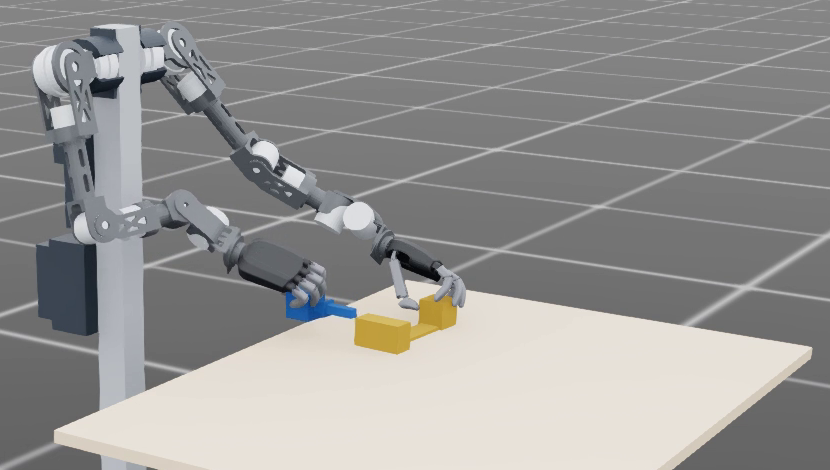
The paper formalizes the problem of allocating a limited residual-RL interaction budget across the phases of a multi-phase task by defining the ‘completion gain’ — the change in full-task success probability when a state-feedback residual controller replaces part of the imitation policy within one phase. It decomposes this gain into phase-reach probability and conditional phase improvement, estimates it from paired episodes, and uses the positive estimates to decide which action components to correct and how to distribute training episodes. In stochastic point-mass docking and simulated bimanual robotic assembly, gain-based allocation outperformed failure-proportional and uniform allocation, with the largest gains occurring in phases that were not the most failure-prone.
中文摘要: 本文研究如何在多阶段任务中把有限的残差强化学习交互预算分配到各阶段。作者提出“完成增益”概念,即在某单一阶段用状态反馈控制器替换模仿策略的部分动作分量时,全任务成功概率的变化,并将其分解为到达该阶段的概率与该阶段内条件完成概率的提升两部分,通过成对回合估计。正向增益估计决定残差策略修正哪些动作分量以及训练回合如何在各阶段间分配。在随机质点对接实验中,大多数失败发生在最后的对接阶段,但最大完成增益却出现在之前的通道阶段;基于增益的分配优于按失败数比例分配,在更长接近段的变体中也优于预算减半的均匀分配。在仿真双臂机器人装配任务中,增益估计仅在插入和释放阶段为正,尽管释放阶段失败很少,表明该方法能识别真正值得投入纠正的阶段。
💬 A clean formulation of where to spend residual-RL corrections in phased manipulation tasks; the gain-based budget allocation idea is directly transferable to allocating RL fine-tuning effort across gait phases in legged locomotion.
💬 该文清晰刻画了在分阶段操作任务中应把残差强化学习纠正投入何处;其基于增益的预算分配思想可直接迁移到足式运动中跨步态相位分配RL微调资源。
Why read it / 推荐理由: The phase-wise completion-gain decomposition offers a principled recipe for deciding when to correct a learned gait/controller vs. when to leave it alone, which maps naturally onto leg-phase scheduling in modular legged systems. 按阶段的完成增益分解为“何时纠正已学习步态/控制器、何时保持不动”提供了原则性方法,可自然映射到模块化足式系统的腿相位调度。
2. The Stability Gap in Continual Reinforcement Learning
持续强化学习中的稳定性差距
Authors / 作者: Sebastian Pusch, Matthia Sabatelli, Gido M. van de Ven
arXiv: 2611.26252 · PDF
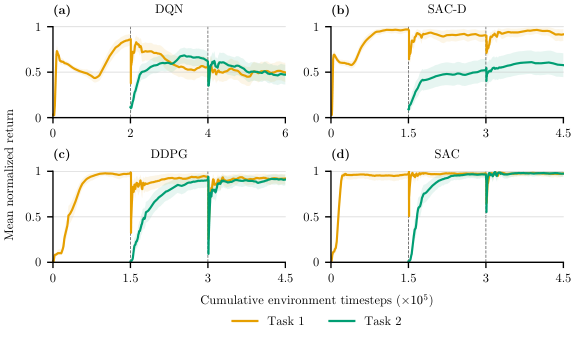
The paper introduces a minimal continual-RL benchmark that varies only observation representations while keeping environment dynamics and rewards fixed, enabling cheap and reproducible sanity checks. Using it, the authors demonstrate a ‘stability gap’: a substantial drop in prior-task performance immediately after new tasks are introduced, followed by partial or complete recovery, occurring even when the agent has full access to past tasks. The result highlights that final aggregate metrics can mask transient catastrophic forgetting during adaptation.
中文摘要: 本文提出一个极简的持续强化学习基准,仅改变观测表示而保持环境动力学与奖励不变,从而支持低成本、可复现的验证实验。借助该基准,作者揭示了“稳定性差距”现象:在新任务引入后,智能体在旧任务上的性能会显著下降,随后部分或完全恢复,即便智能体能够完全访问过去的任务数据。该现象表明,仅依赖最终聚合指标会掩盖适应过程中暂时的灾难性遗忘,对持续学习智能体的评估提出了更细粒度的要求。
💬 A useful cautionary benchmark: it argues that online adaptation during deployment can transiently destroy locomotion policies, so evaluation should track performance trajectories rather than final averages.
💬 这是一个有价值的警示性基准:它指出部署期间的在线适应可能暂时破坏运动策略,因此评估应跟踪性能轨迹而非仅看最终平均值。
Why read it / 推荐理由: For a legged-robot researcher planning continual or on-robot adaptation of gait policies, this work quantifies the transient forgetting risk that final-metric reporting hides. 对于计划在足式机器人上做持续或在线步态适应的研究者,该工作量化了最终指标报告所掩盖的暂时遗忘风险。
3. Separating Interpretability and Reconstruction in Sparse Autoencoders
在稀疏自编码器中分离可解释性与重建
Authors / 作者: Anh Tien Nguyen, Dimitris Samaras, Mahdi S. Hosseini
arXiv: 2611.25165 · PDF
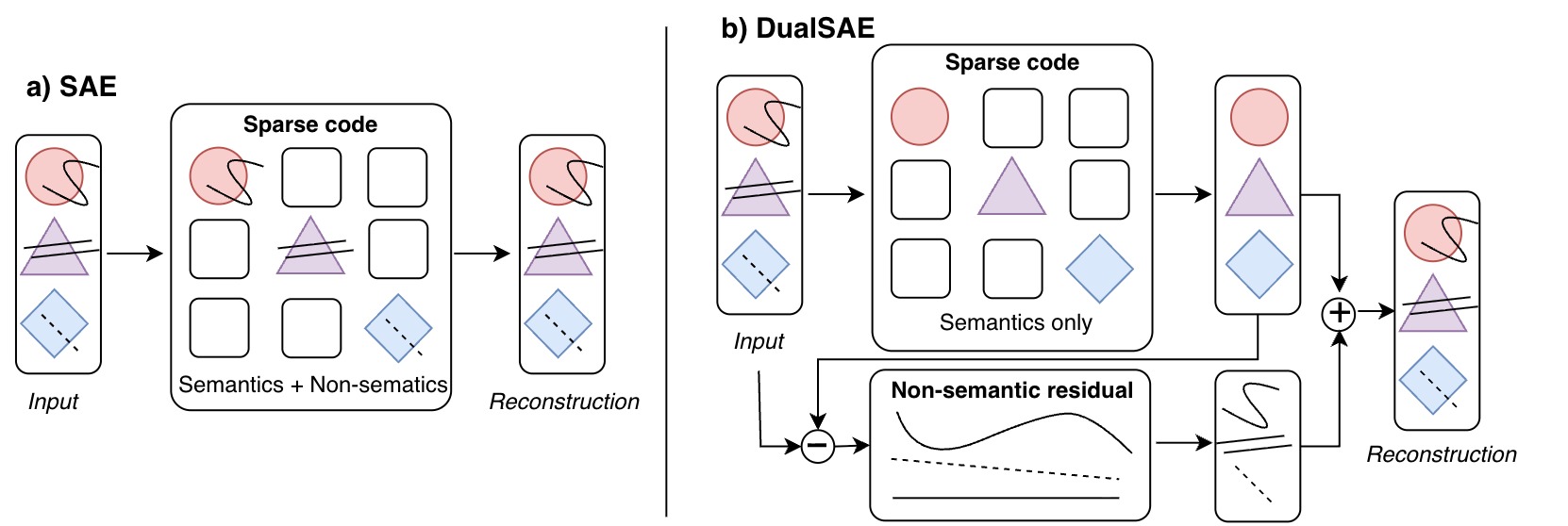
DualSAE augments a standard sparse autoencoder with a plug-in Residual Branch so that reconstruction fidelity and interpretability are handled by separate modules, enforced by a decorrelation loss and a two-stage training strategy. Across encoder-SAE configurations on two vision datasets and two language corpora, it improves reconstruction fidelity by about 29% and monosemanticity-based interpretability by about 34%, and yields downstream gains in topic modeling, hypothesis generation, and LLM steering.
中文摘要: 本文提出DualSAE,在标准稀疏自编码器上增加一个可插拔的残差分支,使重建保真度与可解释性由不同模块分别承担,并通过去相关损失和两阶段训练策略减少二者贡献的重叠。在两视觉数据集和两语言语料上的多种编码器-SAE配置中,DualSAE在重建保真度上平均相对提升约29%,在基于单义性评分的可解释性上提升约34%,并在主题建模、假设生成和LLM引导等下游任务中取得一致增益。定性分析进一步表明分离后的稀疏码更趋单义。
💬 Methodologically sound but in the LLM-interpretability space; its residual-branch decomposition is only loosely analogous to module-level decomposition in robot control.
💬 方法上扎实,但属于大模型可解释性领域;其残差分支分解与机器人控制中的模块级分解仅是松散类比。
Why read it / 推荐理由: Only if the reader is curious about representation-decomposition ideas that might inspire separable module-level latent representations, not for locomotion control itself. 仅在读者对可能启发可分离模块级潜在表示的分解思想感兴趣时值得一读,对运动控制本身价值有限。
4. Grid Cells as Spectral Successor Features: A Reusable Basis for Continual Reinforcement Learning
网格细胞作为谱后继特征:持续强化学习的可复用基
Authors / 作者: Élodie Côté-Gauthier, Doina Precup, Isabeau Prémont-Schwarz
arXiv: 2611.26504 · PDF
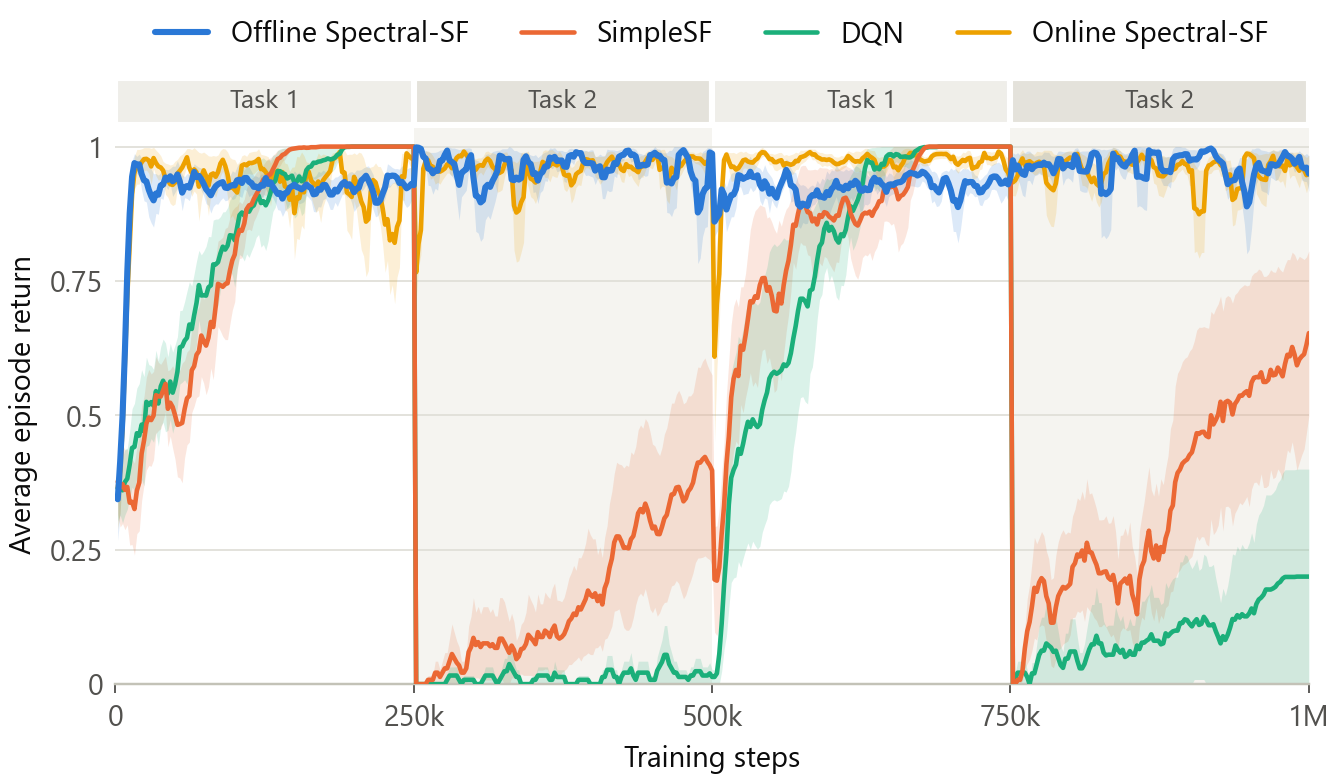
Building on the identification of grid cells with eigenvectors of the successor representation, the authors construct base features from eigenvectors of the transition matrix of a fixed reference policy, giving successor features as a closed-form linear combination of base features at the same state-action pair. This removes the need for a successor-feature network or replay buffer and reduces task adaptation to linear regression on the reward, with greedy action values amounting to one policy-improvement step. In a two-goal gridworld, agents maintain near-maximal return across goal changes.
中文摘要: 本文基于网格细胞与后继表示特征向量的对应关系,利用固定参考策略转移矩阵的特征向量构造基特征,使状态-动作对的后继特征成为同一点基特征的闭式线性组合,系数为1/(1-γλ_i)。因此长期回报可直接由即时奖励所用的同一组特征预测,无需后继特征网络或回放缓冲,适应新任务只需在奖励上做线性回归,贪心动作值相当于一次策略改进。在双目标网格世界中,以均匀随机游走为参考策略(其特征向量为低频拉普拉斯特征向量),该方法在每次目标变化后都能维持接近最优的回报。
💬 Elegant theory linking grid-cell representations to spectral successor features, but demonstrated only on toy gridworlds and with a fixed reference policy; relevance to real robot control is speculative.
💬 该文优雅地将网格细胞表示与谱后继特征联系起来,但仅在玩具网格世界和固定参考策略下验证,对真实机器人控制的相关性仍属推测。
Why read it / 推荐理由: Worth reading for the closed-form successor-feature construction, which could inspire cheap reward-adaptation bases for multi-gait or multi-task locomotion policies. 其闭式后继特征构造值得一读,可能启发用于多步态或多任务运动策略的低成本奖励适应基。
5. Budget Internalization: Fixed-Budget RLVR Trades Test-Time Scaling for In-Budget Accuracy
预算内化:固定预算RLVR以测试时扩展换取预算内精度
Authors / 作者: Ilia Zavidnyi, Alexander Kovrigin, Arina Puchkova, Kirill Gelvan, Sergey Titov
arXiv: 2611.26172 · PDF
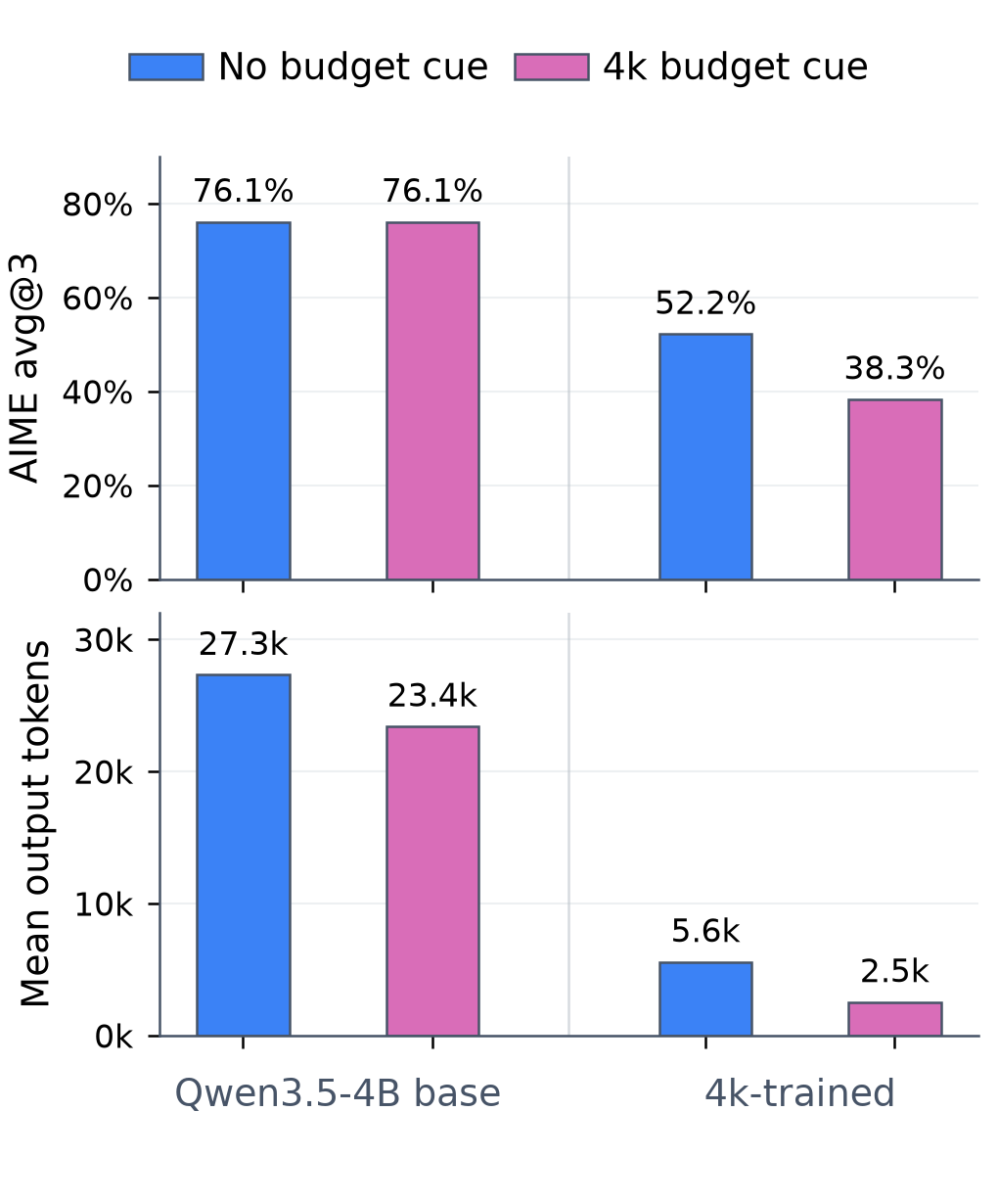
The paper shows that training reasoning models with RLVR under a fixed rollout cap induces ‘budget internalization’: after training, models use few tokens beyond the training budget, outperform base models near that budget but stop improving and eventually fall below them at larger budgets. The effect is observed across several models and tasks, transfers from math to science and coding, and is partially mitigated by stronger KL regularization or forcing answers on truncated rollouts, at the cost of reduced in-budget gains.
中文摘要: 本文发现,在固定 rollout 上限下用可验证奖励强化学习(RLVR)训练推理模型会导致“预算内化”:训练后模型很少使用超过训练预算的 token,在该预算附近优于基座模型,但在更大预算下精度停止提升并最终低于基座模型。该效应在 Qwen3.5-4B、Gemma4-E2B、Nemotron-3-Nano-4B 及数学推理和程序化生成问题上均出现,并从数学迁移到科学与编程任务。训练目标层面的消融表明,更强的 KL 正则和更低的数据截断可保留更多测试时扩展能力,但更强 KL 会降低预算内精度;对截断 rollout 强制给出答案可基本消除内化,但也损失大部分预算内增益。
💬 A relevant warning for RL-based motion control: computational or timeout caps baked into rollout collection can silently shape the learned policy’s scaling behavior, not just training cost.
💬 这对基于RL的运动控制是一个相关警示:rollout采集中内置的计算或超时上限会悄然塑造所学策略的扩展行为,而不只是训练成本。
Why read it / 推荐理由: If the reader trains locomotion policies with fixed-horizon or fixed-budget rollouts, this work explains how such caps can become learned constraints that limit policy improvement. 若读者使用固定时域或固定预算的rollout训练运动策略,该文解释了这些上限如何变成限制策略改进的学习约束。