Robotics Digest
Robotics Paper Digest — 2026-11-19
🤖 Scanned 342 papers from today’s arXiv announcement (cs.RO / eess.SY / cs.LG), picked 5 for modular & legged robotics — summarized by DeepSeek.
🤖 从今日 arXiv 新论文(cs.RO / eess.SY / cs.LG)中扫描 342 篇,围绕模块化与足式机器人精选 5 篇 — 由 DeepSeek 生成双语摘要。
1. Proprioceptive Simultaneous Base and Terrain Elevation Estimation for Legged Robot Locomotion
面向足式机器人运动的本体感知同时基座与地形高程估计
Authors / 作者: Michael Maravgakis, Stylianos Piperakis, Panos Trahanias
arXiv: 2611.24310 · PDF
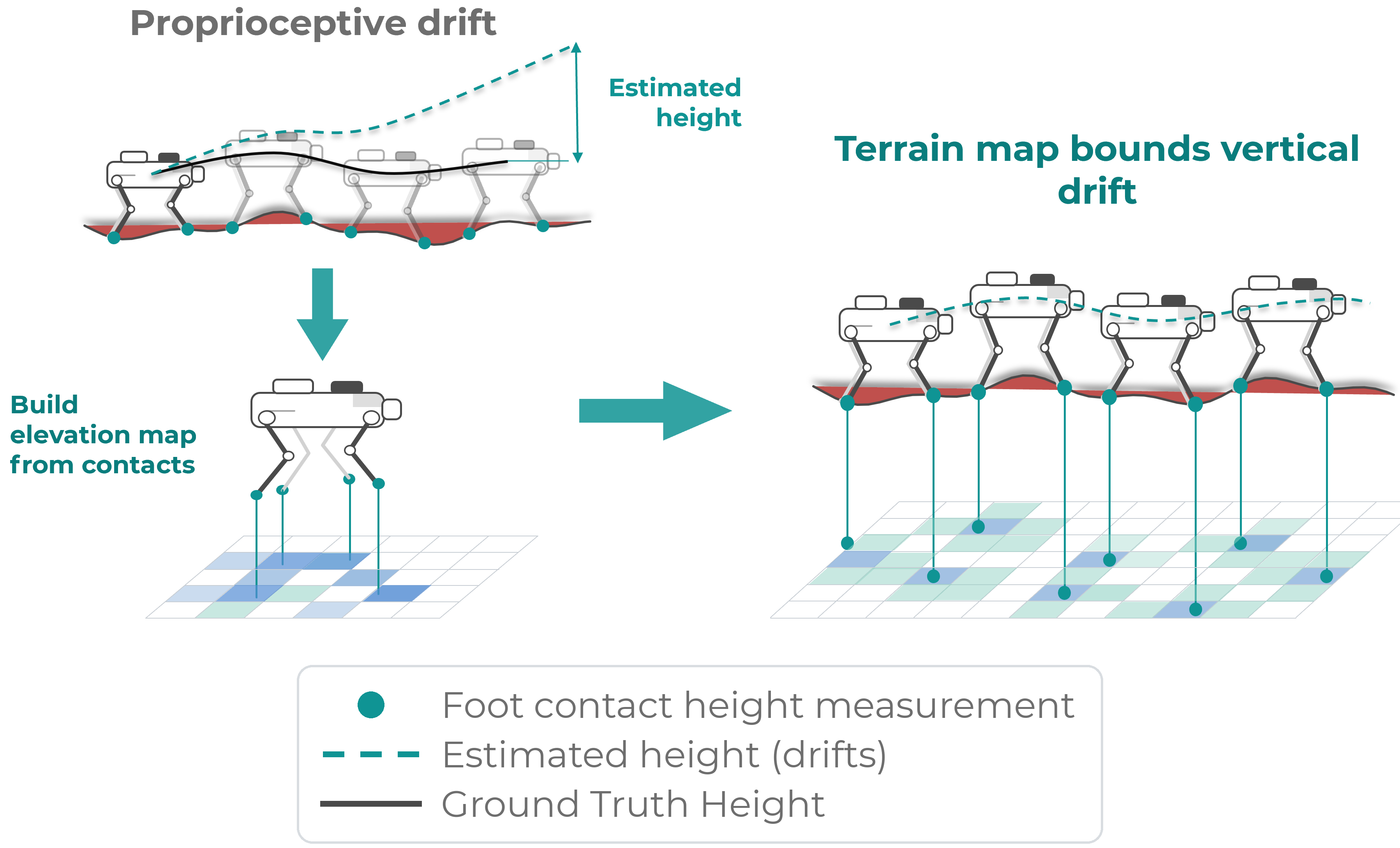
The paper proposes SBEE, a real-time open-source framework coupling a Left-Invariant Extended Kalman Filter for floating-base estimation with a grid-based elevation map in a bidirectional loop, treating foot contacts as uncertainty-aware height samples and mapped cells as pseudo-loop closures. Unlike contact-aided invariant filters, the filter uses a kinematic velocity measurement so its state dimension is independent of the number of legs. On quadrupedal and bipedal MuJoCo platforms and the ANYmal-D GrandTour dataset (296 m), it reduces absolute trajectory error by 22.1% over the best of three state-of-the-art baselines.
中文摘要: 本文提出SBEE实时开源框架,将左不变扩展卡尔曼滤波(LI-EKF)的浮动基座估计与栅格高程图双向耦合,模仿以地形高程替代路标的SLAM。稳定足端接触把带不确定性的高度样本插入地图,已建图栅格再作为不确定性加权的高程伪观测反馈,起类似回环检测的作用。与接触辅助的不变滤波不同,LI-EKF只接收运动学速度测量而不逐腿增广接触状态,故状态维数与腿数无关。在MuJoCo的四足与双足平台以及ANYmal-D GrandTour数据集(296米)上评估,绝对轨迹误差相较三种先进方法中最佳者降低22.1%。
💬 A clean, leg-count-independent proprioceptive state estimator with an open-source implementation that directly benefits modular multi-legged platforms where leg count changes.
💬 一种简洁、与腿数无关的本体感知状态估计器,且开源实现可直接惠及腿数会变化的模块化多足平台。
Why read it / 推荐理由: It offers a practical, leg-count-agnostic vertical-drift correction scheme that is directly applicable to reconfigurable multi-legged robots operating without vision. 它提供了与腿数无关、可直接用于无视觉条件下可重构多足机器人的垂直漂移校正方案。
2. WAM-Policy: World Action Models with On-Policy Distillation for Quadrupedal Loco-Manipulation
WAM-Policy:基于在策略蒸馏的世界动作模型用于四足移动操作
Authors / 作者: Junlin Long, Xu Deng, Yiran Wang, Yue Yang, Yang Zhao, Zeyu Zhang
arXiv: 2611.24011 · PDF
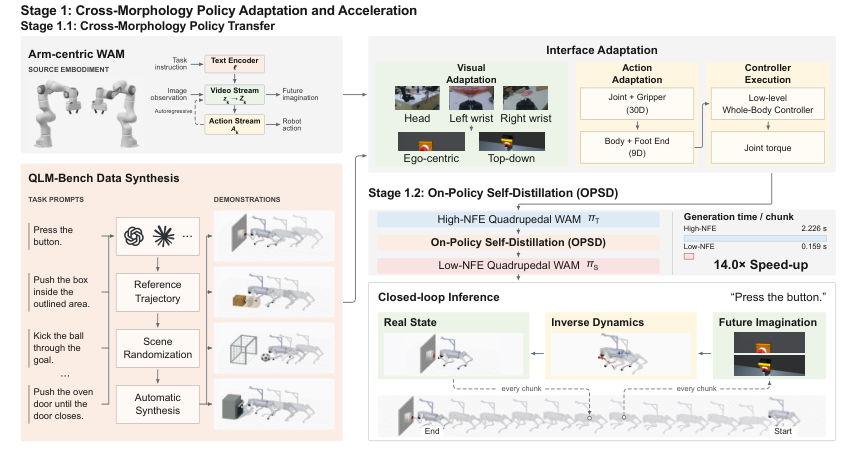
WAM-Policy converts an arm-centric world action model into a language-conditioned quadrupedal loco-manipulation policy in two stages: cross-morphology adaptation with on-policy self-distillation into a fast few-step student, followed by task-specific RL fine-tuning and multi-teacher on-policy distillation merging specialists. On QLM-Bench it reaches 85.0% success and deploys on a real Unitree Go2 Air at a fraction of the inference cost.
中文摘要: 本文将面向机械臂的世界动作模型(WAM)转化为语言条件四足移动操作策略,分两阶段:首先进行跨形态策略适配,并通过在策略自蒸馏(OPSD)把迁移策略蒸馏为只需一次视频与两次动作步的快速学生策略;随后用强化学习微调教师,并用多教师在策略蒸馏(M-OPD)将多个慢速专家合并为一个少步学生。在QLM-Bench十个仿真任务(1000条无需遥操作的演示)上,迁移策略达77.0%,OPSD学生保持76.7%而采样快14倍,经RL与M-OPD提升至85.0%,并在真实Unitree Go2 Air上部署。
💬 Demonstrates language-conditioned three-legged loco-manipulation on a real quadruped, combining distillation and RL in a way relevant to legged whole-body policy design.
💬 在真实四足上展示了语言条件的三足移动操作,将蒸馏与强化学习结合,对足式全身策略设计有参考价值。
Why read it / 推荐理由: It shows a concrete pipeline for real-robot legged loco-manipulation policies with efficient inference, useful for extending legged control toward manipulation tasks. 它给出了真实机器人足式移动操作策略的具体流程与高效推理,有助于把足式控制扩展到操作任务。
3. Sample-Efficient Model Predictive Control via Proximal Policy Optimization
基于近端策略优化的样本高效模型预测控制
Authors / 作者: Jiarui Wang, Sina Sharifi, Mahyar Fazlyab
arXiv: 2611.23544 · PDF
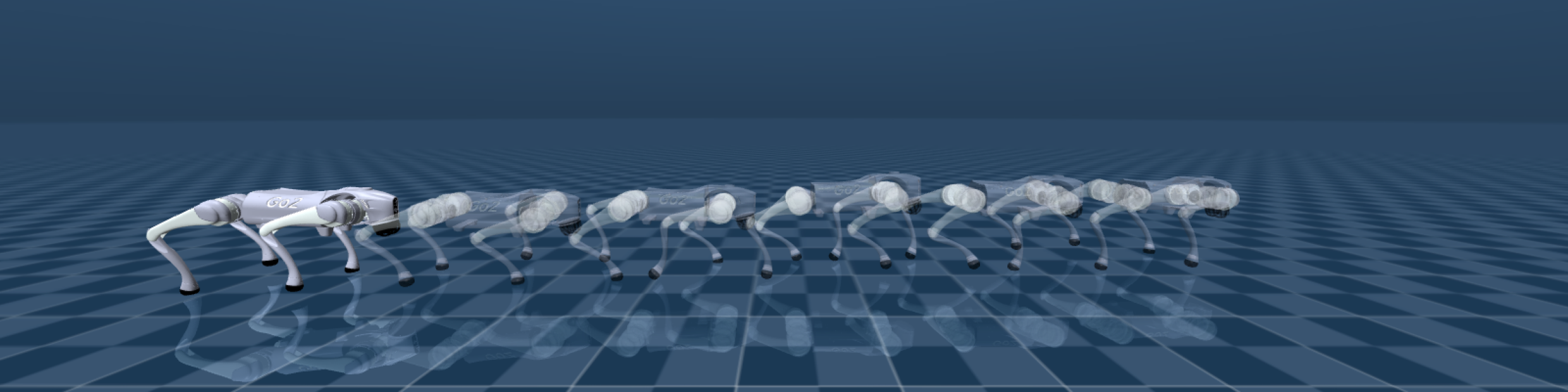
Starting from a KL-regularized distributional trajectory optimization, the authors derive an exact performance-difference identity with a signed exponential advantage and use it to adapt PPO techniques to sampling-based MPC, yielding PPO-MPPI and SPO-MPPI that reuse previously evaluated trajectories without extra forward simulations. They prove monotonic improvement and first-order stationarity, and show competitive quadruped velocity tracking and quadrotor path tracking at much lower computational cost than multi-stage sampling.
中文摘要: 本文从KL正则化的分布轨迹优化出发,基于带符号指数优势函数推导出精确的性能差恒等式,并据此把PPO技巧迁移到采样型MPC,提出PPO-MPPI与SPO-MPPI,可在不增加前向仿真的情况下复用已评估轨迹做多次更新。作者证明了种群层面的单调改进以及PPO-MPPI的一阶平稳收敛性。在四足速度跟踪与四旋翼路径跟踪实验中,以远低于多阶段采样方法的计算代价取得有竞争力的控制性能,建立了策略优化与采样MPC之间的原理性联系。
💬 A principled bridge between PPO and sampling-based MPC that cuts computation via trajectory reuse, directly relevant to real-time legged MPC.
💬 在PPO与采样型MPC之间建立了原理性联系,并通过轨迹复用来降低计算量,与实时足式MPC直接相关。
Why read it / 推荐理由: It gives a theoretically grounded, sample-efficient alternative to standard MPPI that could lower the compute budget of MPC on modular legged robots. 它提供了有理论保证、样本高效的MPPI替代方案,可降低模块化足式机器人MPC的计算开销。
4. BEV-Diffusion: Camera-Only Traversability Navigation with BEV Memory and Efficient Cross-Robot Adaptation
BEV-Diffusion:基于BEV记忆与高效跨机器人适配的纯视觉可通行性导航
Authors / 作者: Iana Zhura, Timofei Kozlov, Dmitrii Plotnikov, Ivan Valuev, Miguel Altamirano Cabrera, Dzmitry Tsetserukou
arXiv: 2611.24155 · PDF
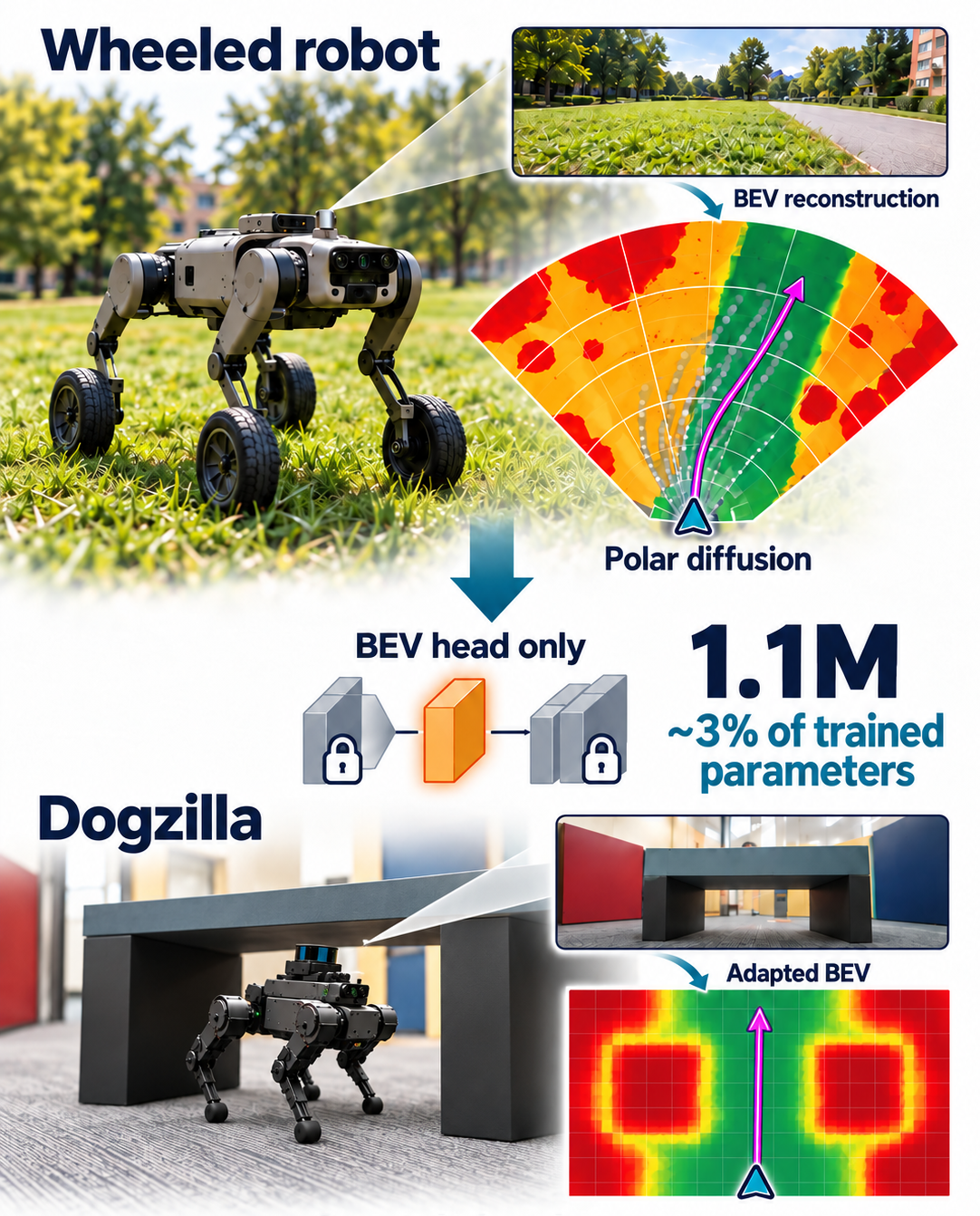
BEV-Diffusion is a camera-only model that jointly learns a bird’s-eye-view traversability map, its uncertainty, and a path in a single network: a frozen DINOv2 backbone builds a Bayesian-fused BEV with a ranking loss keeping traversability graded, and a transformer denoiser generates polar waypoints with uncertainty-aware guidance, plus a metric BEV memory for deployment. On a wheeled-legged robot it completed 120 m with 96% of the route without intervention versus 75-88% for baselines, and succeeded after sunset by retraining only the BEV head.
中文摘要: BEV-Diffusion是纯视觉模型,在单一网络中联合学习鸟瞰图(BEV)可通行性地图、其不确定性以及路径。冻结的DINOv2主干编码连续RGB帧,经逆透视映射与贝叶斯融合提升到BEV,排序损失使室外可通行性保持分级而非二值(沥青与草地中位数0.94对0.75)。在BEV上,Transformer去噪器经少量DDIM步生成极坐标路点,不确定性感知引导精化路径并在不可靠处终止;部署时用度量BEV记忆保留离开视野的障碍并以自运动补偿的上一路径热启动。在未见庭院中,轮足机器人自主行进120米,96%路线无需干预,基线为75-88%,日落后仍无干预完成,仅需重训BEV头即可跨机器人适配。
💬 A traversability-aware, uncertainty-guided navigation stack that adapts cheaply across robots, directly matching the reader’s traverse-capability-aware path planning interest.
💬 一个可通行性感知、不确定性引导的导航系统,能以低成本跨机器人适配,与读者关注的可通行能力感知路径规划直接契合。
Why read it / 推荐理由: It provides a real-robot camera-only traversability navigation method with cross-robot adaptation, valuable for extending legged platforms to terrain-aware autonomy. 它提供了真实机器人上纯视觉可通行性导航与跨机器人适配方法,对把足式平台扩展到地形感知自主性很有价值。
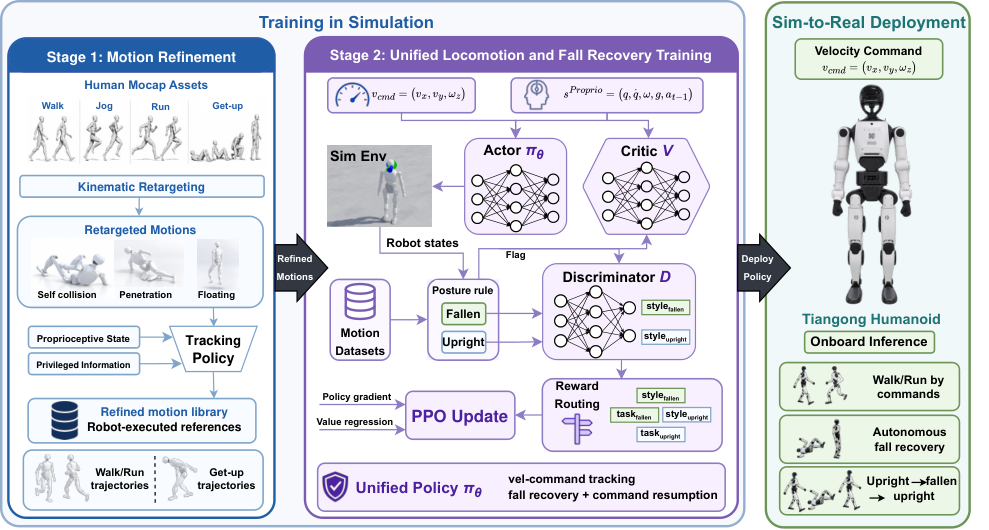
5. ReLoco: Unified Humanoid Locomotion and Fall Recovery via Behavior-Conditioned Motion Priors
ReLoco:基于行为条件运动先验的统一人形机器人运动与跌倒恢复
Authors / 作者: Lequn Fu, Yufeng Hu, Yijun Zhong, Jie Zhang, Xiao Li, Lingxiang Ji et al.
arXiv: 2611.23916 · PDF
ReLoco uses behavior-conditioned adversarial motion priors, where robot posture selects an expert pool and conditions a shared discriminator with behavior-specific outputs, to learn locomotion, get-up from arbitrary fallen postures, and command resumption within one proprioceptive policy. Ablations examine conditional supervision and reference quality, and deployment on the 64.5-kg Tiangong 3.0 humanoid shows walking, running, get-up, and post-fall locomotion resumption, with 96.8% get-up and 96.96% push-recovery success.
中文摘要: ReLoco采用行为条件对抗运动先验:训练时由机器人姿态选择专家池并对共享判别器施加行为相关输出条件,从而在单一本体感知策略中学习运动、从任意跌倒姿态起身以及指令恢复。任务奖励与共享正则支持指令跟踪与恢复,临时辅助促进探索,仿真精化阶段提供机器人执行的运动参考。消融实验考察条件监督、输出分离与参考质量;在64.5kg天工3.0人形上部署,展示行走、奔跑、起身与跌倒后运动恢复,起身成功率96.80%、抗推恢复成功率96.96%,躯干平面速度RMSE为0.1266 m/s,较单输出条件变体降低14.7%。
💬 A single proprioceptive policy achieving fall recovery and command resumption, with strong real-humanoid results and useful ablation on behavior-conditioned priors.
💬 单一本体感知策略实现跌倒恢复与指令恢复,在真实人形上结果扎实,并对行为条件先验做了有价值的消融。
Why read it / 推荐理由: Its behavior-conditioned motion-prior recipe and fall-recovery framework are transferable to robust RL motion control for modular legged platforms. 其行为条件运动先验方法与跌倒恢复框架可迁移到模块化足式平台的鲁棒强化学习运动控制。