Robotics Digest
Robotics Paper Digest — 2026-11-18
🤖 Scanned 315 papers from today’s arXiv announcement (cs.RO / eess.SY / cs.LG), picked 5 for modular & legged robotics — summarized by DeepSeek.
🤖 从今日 arXiv 新论文(cs.RO / eess.SY / cs.LG)中扫描 315 篇,围绕模块化与足式机器人精选 5 篇 — 由 DeepSeek 生成双语摘要。
1. CADENCE: Learning Acyclic Gaits for Model-Based Quadruped Locomotion
CADENCE:为基于模型的四足运动学习非周期步态
Authors / 作者: Owen Sullivan, Sourav Selvaraj, Mahdi Agheli
arXiv: 2611.23102 · PDF
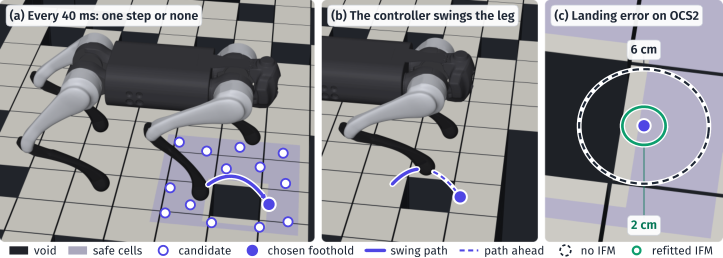
CADENCE learns a discrete step planner on top of a convex MPC, choosing every 40 ms among at most 65 actions (no step or one leg stepping to a safe foothold) plus a predicted swing time, with no gait schedule or gait reward. The resulting policy develops an acyclic gait and, deployed frozen on OCS2’s nonlinear MPC with a refitted inverse footstep model, achieves 85.1% success versus 67.8% for OCS2-Trot and 72.9% versus 43.0% at 49% terrain voids.
中文摘要: 传统基于模型的四足控制器通常按固定周期、固定抬腿顺序执行循环步态,而忽略安全落足点。本文提出CADENCE,一个具有小动作空间的学习型落足规划器:每40 ms在至多65个离散动作中选择(不迈步或某条腿迈至安全落足点),并预测摆动时间。该策略在凸模型预测控制(MPC)之上通过强化学习训练,既无步态时序表,奖励中也没有步态项,仅含每步代价,唯一结构约束是至多两腿同时摆动。分析表明策略自发形成非周期步态,无固定周期与迈步顺序,但仍保持对角腿配对。将离线拟合的逆落足模型(IFM)接入OCS2非线性MPC后,冻结策略即可运行。在空隙率26%–49%、速度0.1与0.2 m/s的仿真中,五个随机种子平均成功率达85.1%,优于OCS2-Trot的67.8%与OCS2-Single的65.5%,静态行走消融仅39.6%;在49%空隙率下达72.9%,而OCS2-Trot仅43.0%。
💬 Convincingly shows that learning only the discrete foothold/timing decision, while keeping a convex MPC for the low-level tracking, yields terrain-adaptive acyclic gaits that clearly beat fixed trot and single-leg schedules.
💬 该工作有力地证明了仅学习离散落足与摆动时机决策、底层仍用凸MPC跟踪,即可产生适应地形的非周期步态,并显著优于固定trot与单腿时序方案。
Why read it / 推荐理由: Directly relevant to gait generation and MPC-based legged control, with a clean hybrid learned-planner/MPC architecture and strong terrain-void ablations. 与步态生成及基于MPC的足式控制直接相关,给出清晰的“学习规划器+MPC”混合架构,并有扎实的地形空隙消融实验。
2. From Temperature-Limited to Battery-Limited Legged Locomotion
从受温度限制到受电池限制的足式运动
Authors / 作者: Raphaël Ségas, Balázs Opra, Léo Ghafari, Thomas Stewart
arXiv: 2611.22231 · PDF
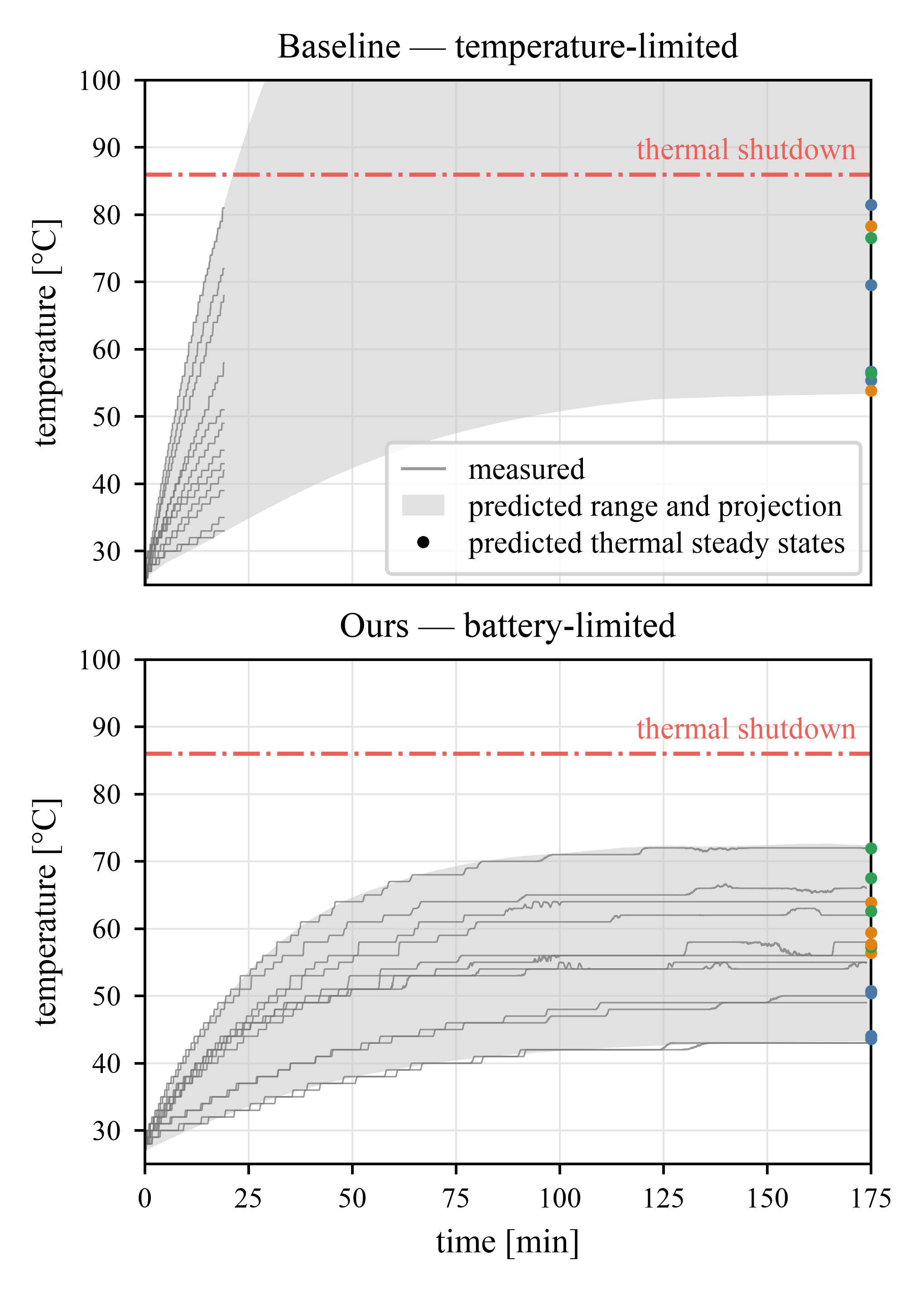
The authors fit a 13-node lumped RC thermal network that predicts all twelve Go2 motor temperatures within 1°C RMSE, and derive asymptote-based rewards from gait-averaged squared torques and joint speeds. The RL policy, which never observes temperature, keeps motors cooler and extends sustained locomotion at 1 m/s with 5 kg payload from ~19 minutes to full battery depletion.
中文摘要: 足式机器人持续行走常因少数关节电机过热而热停机,远早于电池耗尽。作者在Unitree Go2上辨识出一个13节点集总RC热网络,用两次单机运行数据拟合并以实测电功率校准,可在不同机器人个体、步态、负载与速度下以低于1°C的平均RMSE预测全部十二个电机温度。他们进一步指出,稳定步态下电机稳态温度可由步态平均的力矩平方与关节速度直接推出。核心贡献是一种无需温度观测的强化学习奖励,直接压低最热节点的预测渐近温度:由于热时间常数远超强化学习的信用分配时域,而预测渐近值在一个步态周期内即响应力矩与速度,策略得以学会降低并分散发热。实机上该策略将持续运动从热限制转为电池限制:5 kg负载、1 m/s下基线约19分钟(1.1 km)热停机,而该策略可跑至电池耗尽。
💬 A neat reformulation of thermal management as shaping asymptote temperatures instead of penalizing instantaneous heat, enabling horizon-compatible thermal-aware RL on a real quadruped.
💬 该文巧妙地将热管理重构为塑形渐近温度而非惩罚瞬时发热,使热感知强化学习与信用分配时域相匹配,并在真实四足上验证。
Why read it / 推荐理由: Useful for anyone deploying RL locomotion policies on real quadrupeds where actuator thermal limits, not battery or control, dominate sustained operation. 对在真实四足上部署RL运动策略者很有价值——实际持续运行的瓶颈往往不是电池或控制,而是执行器热限制。
3. Auditing a Learned Simulator for Legged Robots: The Robotic World Model on ANYmal D
对足式机器人学习型仿真器的审计:ANYmal D上的机器人世界模型
Authors / 作者: Joyjeet Singh
arXiv: 2611.23118 · PDF
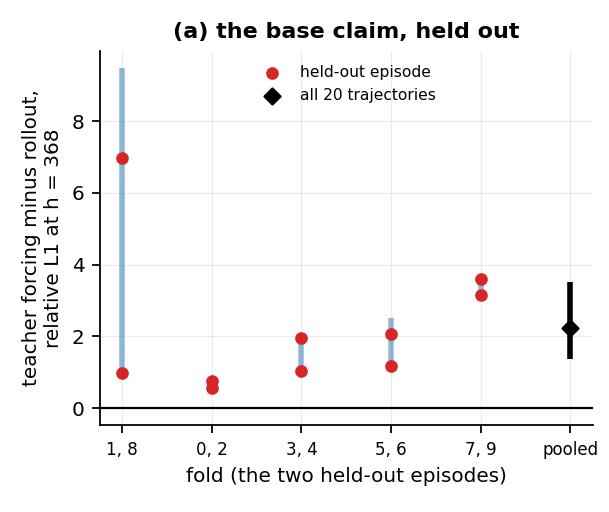
This paper audits the Robotic World Model (and its uncertainty variant) for ANYmal D by re-implementing it bit-exactly and training many simulators, showing multi-step rollout training beats one-step training at long horizons while one-step checks misjudge design choices such as pruning. It also finds ensemble disagreement ranks rollout error well (Spearman +0.90 at 100 steps) but is severely under-calibrated, covering only 4.6% of outcomes at one sigma versus 68% for a calibrated estimate.
中文摘要: 学习型仿真器(神经网络预测下一状态并自回归推演)通常仅做单步训练与验证,而策略实际要推演上百步。本文在不使用GPU的条件下端到端审计已发表的Robotic World Model(RWM)及其后续RWM-U的不确定性估计,针对ANYmal D四足机器人,精确复现官方代码的输出、损失与梯度,测量了101个训练仿真器、200个压缩副本及三种其他架构的38个仿真器,并在MuJoCo手建模型上测试仿真器内训练的策略。结果表明:在全部十个留出片段上,基于自身rollout的多步训练在368步处优于单步训练,尽管单步预测更差;因此单步检验会误判设计选择——剪枝30%权重在单步下保留90%能力,但在2秒处仅39%。集成分歧对rollout误差排序良好(100步处Spearman +0.90),但一σ区间仅覆盖4.6%结果,远低于校准估计的68%,因各网络自身方差在所用损失下坍缩。
💬 A rare, rigorous multi-step audit of a learned legged-robot simulator that exposes how one-step validation and naive ensemble uncertainty badly mislead sim-to-real design decisions.
💬 这是对足式机器人学习型仿真器少见的严格多步审计,揭示了单步验证与朴素集成不确定性如何严重误导sim-to-real设计决策。
Why read it / 推荐理由: Essential reading for sim-to-real work with learned dynamics models, since it quantifies why multi-step rollout validation and calibrated uncertainty matter. 对使用学习型动力学模型的sim-to-real研究是必读:它量化说明了为何多步rollout验证与校准不确定性至关重要。
4. Learning Accurate End-Effector Trajectory Tracking with Inertial Feedback for a Quadruped Manipulator
基于惯性反馈的四足机械臂末端轨迹精确跟踪学习
Authors / 作者: Dohyeon Kim, Seungyong Han, Yeongtae Jung
arXiv: 2611.22695 · PDF
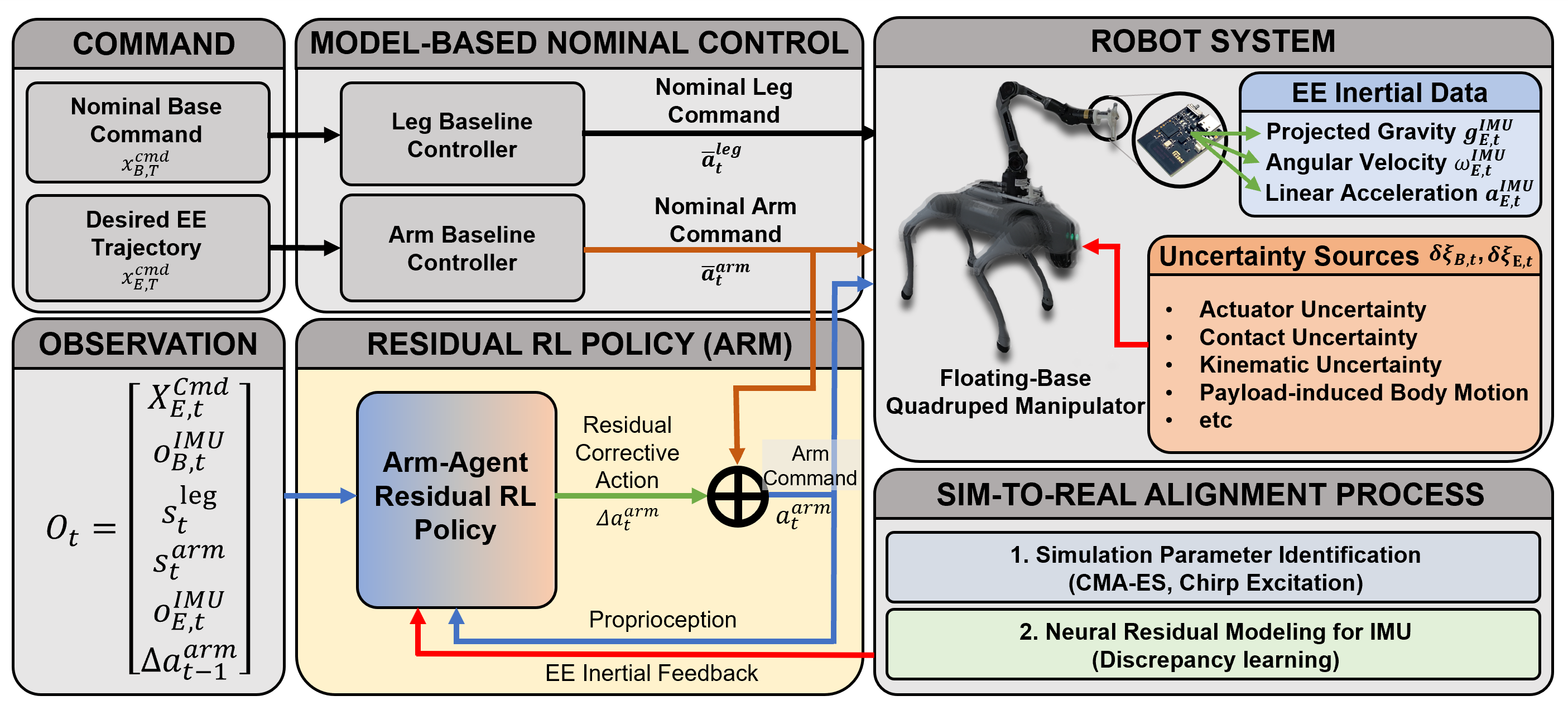
This work uses RL with end-effector inertial feedback to compensate leg-arm kinematic-chain uncertainties (backlash, dimensional errors, deformation) that joint encoders cannot observe, while holding a nominal body pose and support configuration. On real hardware it reduces MoCap-based RMSE by 17.3% and 28.0% over a nominal baseline and by a further 12.6% and 15.9% over a proprioception-only baseline under two in-distribution commands.
中文摘要: 四足机械臂的末端轨迹精确跟踪受执行器、足地接触与几何误差影响,这些误差沿腿-臂运动链传播,仅靠关节编码器无法观测(如齿隙、尺寸误差、结构变形)。本文提出一种带末端(EE)惯性反馈的强化学习框架,目标是在保持标称机身姿态与支撑构型、不主动移动机身或重新落足的前提下实现局部高精度操作。策略利用末端惯性测量补偿腿臂系统中无法由本体感觉推断的跟踪误差。仿真与真实连续末端轨迹跟踪实验显示,相较标称基线与仅本体感觉基线均有整体提升;在两组长尾分布指令下,实机Mocap测得RMSE较标称基线分别降低17.3%与28.0%,并在此基础上再降低12.6%与15.9%。
💬 Demonstrates that adding an IMU at the end-effector supplies the unobservable error signal needed for precise quadruped-manipulator tracking without disturbing the standing support configuration.
💬 该工作表明在末端加装IMU可提供精确四足机械臂跟踪所需、原本不可观测的误差信号,且无需改变站立支撑构型。
Why read it / 推荐理由: Relevant for whole-body control of legged manipulators where base stability and arm accuracy must be reconciled under unmodeled leg-arm errors. 对腿臂式机器人的全身控制有参考价值:在腿臂未建模误差下需兼顾机身稳定与机械臂精度。
5. On the recursive feasibility and stability of MPC without terminal constraints
论无终端约束MPC的递归可行性与稳定性
Authors / 作者: Mara Perez, Ignacio Sanchez, Filiberto Fele, Daniel Limon
arXiv: 2611.23017 · PDF
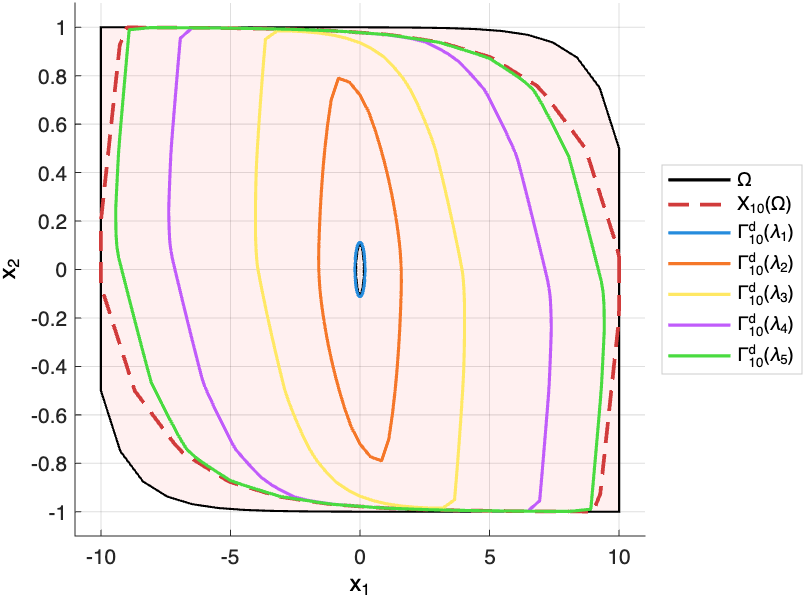
The paper analyzes an MPC scheme without terminal ingredients, instead augmenting the cost with an online-optimized weighted finite tail that acts as a stabilizing terminal cost under a relaxed local dynamic-programming condition. It certifies families of regions, parameterized by the tail weight, on which the problem is recursively feasible and the origin asymptotically stable, and bounds closed-loop suboptimality relative to the infinite-horizon optimum.
中文摘要: 本文分析一种不依赖终端要素(终端约束或基于终端控制器的终端代价)的模型预测控制方案的稳定性与递归可行性。所提形式在代价函数中增加一个在线优化的加权有限时域尾部,并证明其起到稳定终端代价的作用。在尾部满足一个放宽的局部动态规划条件下,作者证明存在一族由尾部权重参数化的区域,在该区域内问题递归可行且原点渐近稳定;权重越大区域越大,特别地,任何能在控制时域内被引导至原点某预定义邻域的状态,都属于足够大权重下的可认证区域。最后刻画了认证区域上的闭环性能,给出闭环相对无穷时域最优代价的次优性界,并用简单数值算例说明结果。
💬 Provides clean theoretical guarantees for terminal-cost-free MPC, which is practically attractive when designing MPC for reconfigurable modular legged platforms with changing models and constraints.
💬 该文为无终端代价MPC提供了清晰的理论保证,对模型与约束频繁变化的可重构模块化足式平台的MPC设计尤具实用吸引力。
Why read it / 推荐理由: Theory that underpins simpler MPC formulations for modular robots, where terminal ingredients are hard to keep valid as the module configuration changes. 这是支撑模块化机器人简化MPC形式的理论基础——当模块构型变化时,终端要素难以始终保持有效。