Robotics Digest
Robotics Paper Digest — 2026-11-17
🤖 Scanned 40 papers from the last 3 days of arXiv announcements (cs.RO / eess.SY / cs.LG), picked 5 for modular & legged robotics — summarized by DeepSeek.
🤖 从近 3 天的 arXiv 新论文(cs.RO / eess.SY / cs.LG)中扫描 40 篇,围绕模块化与足式机器人精选 5 篇 — 由 DeepSeek 生成双语摘要。
1. Learning monotone game-theoretic linear MPC
学习单调博弈论线性模型预测控制
Authors / 作者: Alberto Bemporad, Tatiana Tatarenko
arXiv: 2611.17504 · PDF
This paper learns a game-theoretic MPC law by imitation from input-output data of a running multi-agent system, interpreting recorded inputs as first moves of game equilibria and enforcing strong monotonicity of the resulting generalized Nash equilibrium problem. Strong monotonicity guarantees existence, uniqueness, and almost-everywhere differentiability of the equilibrium, enabling efficient online evaluation via variational GNE-seeking algorithms and gradient-based optimization, with closed-loop stability promoted by a jointly learned quadratic Lyapunov penalty. A numerical example illustrates the approach.
中文摘要: 本文提出一种从运行中多智能体系统的输入输出数据模仿学习博弈论模型预测控制(GT-MPC)律的方法:将记录的输入解释为智能体博弈均衡的首次动作,从而在硬输入约束和软输出约束下学习GT-MPC权重,且无需智能体公开其目标函数。作者进一步约束所得广义纳什均衡(GNE)问题为强单调,以保证均衡的存在性、唯一性,使学习到的GT-MPC律良定义,并可通过线性二次博弈的变分GNE求解算法高效在线评估。强单调性还意味着均衡关于参考量与权重几乎处处可微,从而支持基于梯度的自动微分优化;此外,通过引入联合学习的二次Lyapunov函数惩罚项促进无约束均衡反馈的闭环稳定性。学习GT-MPC公式可用于解释智能体目标、在新场景中复现其行为、优化设定点、设计机制并施加额外约束。数值算例验证了该方法。
💬 A mathematically careful route to identifying and certifying MPC laws for interacting agents, with strong monotonicity doing the heavy lifting for online tractability.
💬 该工作为交互智能体的MPC律辨识与认证提供了一条数学严谨的路径,强单调性是其在线可解性的关键保障。
Why read it / 推荐理由: Directly relevant to learning-based MPC formulations with stability and constraint guarantees, transferable to multi-legged platforms where each leg or module can be modeled as a coupled agent. 与带稳定性与约束保证的学习型MPC公式直接相关,可迁移到多足平台中每条腿或每个模块被视为耦合智能体的场景。
2. Objectives as Policies: Vision-Language Model Cost Programs for Contact-Rich Manipulation
目标即策略:面向接触丰富操作的视觉语言模型代价程序
Authors / 作者: Zihao Lu, Trong Gia Hung Nguyen, Fuquan Wang, Yifan Zhu
arXiv: 2611.18298 · PDF
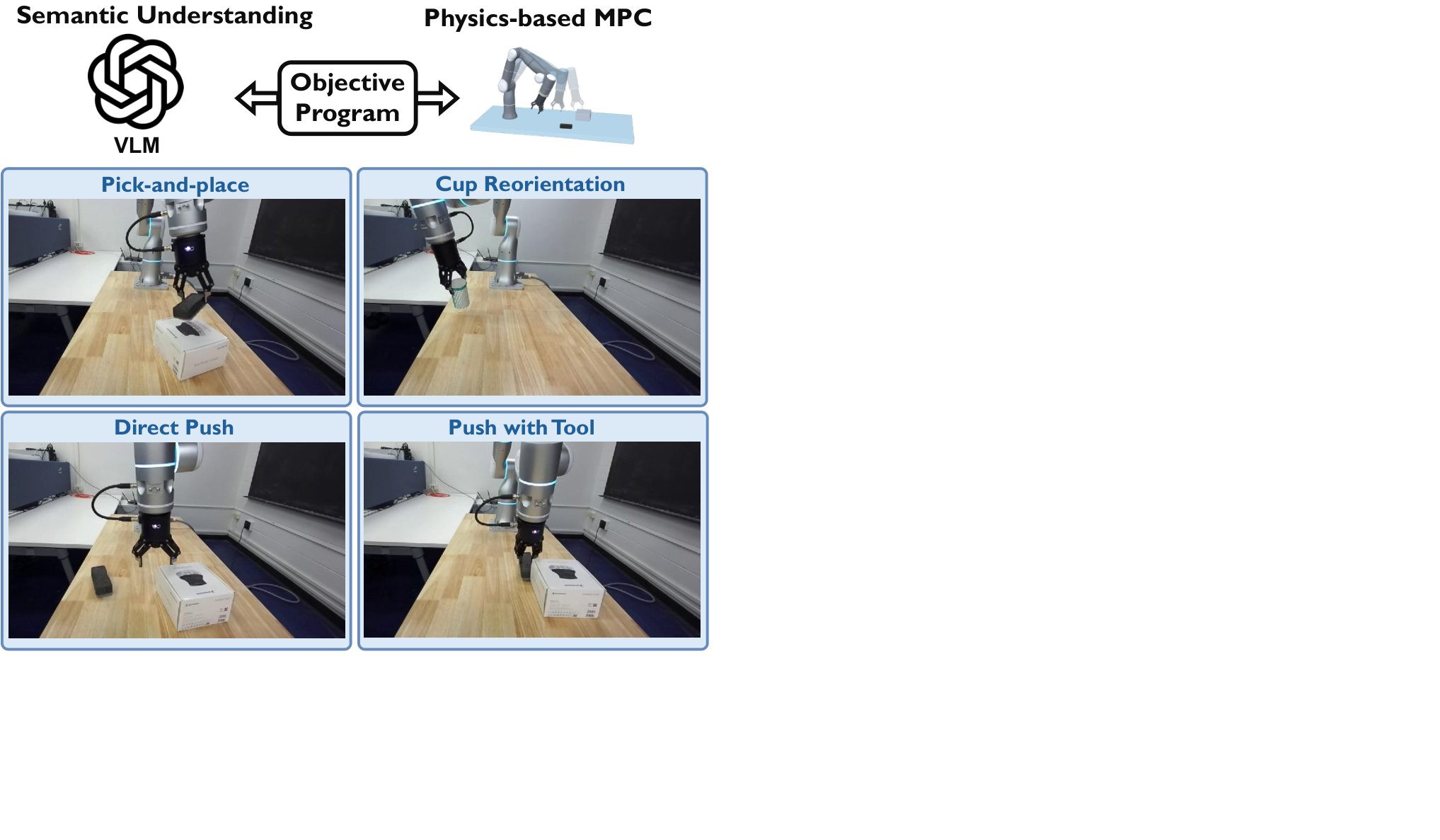
The authors introduce Objectives as Policies (OaP), which connects a pretrained VLM to a shared sampling-based MPC through an editable objective program composed of staged running and terminal costs from a cost library with stage-completion conditions. Given a language instruction and scene observation, a real-to-sim digital twin is built, the VLM generates an objective program executed by MPC in simulation and iteratively refines it from rollouts before real-world deployment. It outperforms strong baselines on four tabletop manipulation tasks in simulation and on a real robot.
中文摘要: 本文提出“目标即策略”(OaP)框架,将预训练视觉语言模型(VLM)与统一的采样型模型预测控制(MPC)通过可编辑的目标程序相连接;每个程序以来自代价库的运行代价与终端代价及阶段完成条件来描述任务的分阶段执行。给定自然语言指令与场景观测,系统通过实到仿(real-to-sim)构建基于仿真的数字孪生,由VLM生成目标程序并在仿真中交由MPC执行,再根据MPC滚动结果迭代更新程序,最后部署到真实世界。作者在仿真与真实世界的四个桌面操作任务上评估该框架,结果表明其优于强基线方法。该方法的关键在于用结构化、可编辑的代价程序作为VLM语义推理与基于物理的MPC规划之间的桥梁,使接触丰富的物理交互可被VLM推理与调节。
💬 A clean VLM-to-MPC interface via editable cost programs, with real-to-sim iteration before deployment that is conceptually close to sim-to-real pipelines for legged control.
💬 该工作通过可编辑代价程序构建了清晰的VLM到MPC接口,部署前的实到仿迭代与足式控制的sim-to-real流程在概念上相近。
Why read it / 推荐理由: Shows how high-level semantic reasoning can parameterize an MPC cost structure, an idea extendable to task-conditioned gait and whole-body cost selection for modular legged robots. 展示了高层语义推理如何参数化MPC代价结构,这一思路可扩展到模块化足式机器人的任务条件化步态与全身代价选择。
3. Joint World Action Models through Differentiable Trajectory Optimization
通过可微轨迹优化的联合世界-动作模型

Authors / 作者: Mintae Kim, Koushil Sreenath
arXiv: 2611.17626 · PDF
The authors propose World Action Trajectory Optimization (WATO), which trains a joint world-action model by using both generated actions and future states as references in a dynamics-constrained trajectory optimization problem and differentiating the task loss through the optimized trajectory, making generated trajectories task-aware and dynamics-consistent with trajectory optimization used only in training. At deployment, WATO directly generates candidate trajectories and ranks them with a world model, requiring no iterative optimization. Across seven visual control environments it raises average success from 79.9% to 91.7% while being 11.5x faster and using 600.5x fewer world-model evaluations than CEM.
中文摘要: 本文提出世界-动作轨迹优化(WATO),用于训练联合世界-动作模型(WAM)。该方法将生成的动作与未来状态同时作为参考,嵌入带动力学约束的轨迹优化问题,并将任务损失通过优化后的轨迹反向传播以训练生成器,从而使生成轨迹既具任务感知性又与动力学一致,而轨迹优化仅在训练阶段使用。部署阶段,WATO直接生成候选轨迹并利用世界模型对其排序,无需迭代轨迹优化。作者在7个视觉控制环境中评估,WATO将平均成功率从模仿式联合WAM的79.9%提升至91.7%,并优于强模型基、目标条件强化学习及生成式控制基线;与交叉熵方法(CEM)相比,平均快11.5倍,世界模型评估次数减少600.5倍。该工作为将可微优化嵌入学习型运动生成提供了范式。
💬 Embedding differentiable trajectory optimization inside world-action model training yields dynamics-consistent, task-effective policies with a cheap sampling-based deployment.
💬 将可微轨迹优化嵌入世界-动作模型训练,得到动力学一致且任务有效的策略,部署时仅需廉价的采样式排序。
Why read it / 推荐理由: Offers a principled way to fuse optimization priors into learned motion generators, a pattern directly applicable to RL-plus-MPC locomotion controllers and traverse-aware trajectory generation. 提供了将优化先验融入学习型运动生成器的原则性方法,可直接应用于RL加MPC的足式运动控制器与可通行性感知的轨迹生成。
4. Prediction-Error-Tightened MPC for Socially Compliant Crowd Navigation
面向社会合规人群导航的预测误差收紧模型预测控制
Authors / 作者: Alessandro Febbraro, Federico Rollo, Marcello Farina, Luca Bascetta, Navvab Kashiri
arXiv: 2611.15781 · PDF
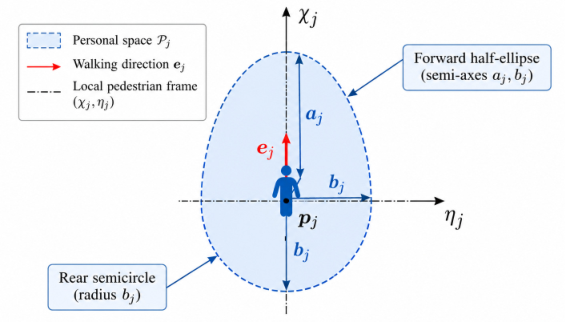
This work extends an MPC framework for crowd navigation by integrating obstacle and pedestrian detection, Koopman-based motion prediction, and online prediction-error estimation directly into the collision-avoidance mechanism, while aggregating nearby obstacles to reduce constraint complexity. In a paired 300-seed closed-loop comparison with a moving generic obstacle, Markov residual tightening reduces runs with physical contact from 10.0% to 1.33% at a mean travel-time cost of 0.68 s; a semantic ablation shows robot-footprint/personal-space overlap at 2.11% of time with pedestrian-aware handling versus 22.84% with generic-obstacle handling.
中文摘要: 本文扩展了此前的模型预测控制(MPC)框架,将障碍物与行人检测、基于Koopman算子的运动预测以及在线预测误差估计直接集成进避碰机制中,以在社会合规的前提下实现拥挤环境下的自主导航。为降低拥挤场景中避碰约束的复杂度,作者对邻近障碍物进行聚合,从而减少避碰约束数量。仿真研究评估了预测误差裕度以及语义感知聚合带来的计算收益:在与移动通用障碍物的300种子闭环配对比较中,马尔可夫残差收紧将发生物理接触的运行比例从10.0%降至1.33%,平均通行时间代价为0.68秒;在人群导航语义消融实验中,考虑行人的处理方式下机器人足迹与个人空间重叠时间占比为2.11%,而按通用障碍物处理时为22.84%。方法兼顾了安全性、社会合规性与计算效率。
💬 A well-instrumented MPC study showing how online estimation of prediction residuals can tighten safety margins without sacrificing much efficiency.
💬 一项实验设置完善的MPC研究,表明在线估计预测残差可在不大幅牺牲效率的前提下收紧安全裕度。
Why read it / 推荐理由: The residual-tightened constraint idea and obstacle aggregation are directly reusable for robust MPC footstep and body-trajectory planning under uncertain terrain. 残差收紧约束与障碍物聚合的思路可直接复用于不确定地形下鲁棒的MPC落足点与机体轨迹规划。
5. Policy-Conditioned Koopman Representations for Parameterized Closed-Loop Systems
面向参数化闭环系统的策略条件化Koopman表示
Authors / 作者: Kiran G. Krishnan, Shankar A. Deka
arXiv: 2611.18451 · PDF
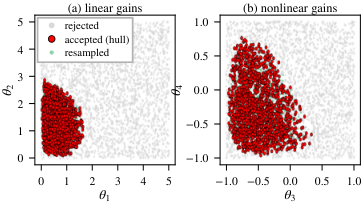
The paper proposes a policy-conditioned Koopman representation framework in which a single learned model predicts closed-loop trajectories for a family of feedback controllers without retraining, capturing how controller parameters affect both latent dynamics and observable coordinates. It stays below a 15% error threshold on four nonlinear prediction benchmarks where each baseline exceeds it at least once, and as an application enables one-shot feedback-parameter selection, stabilizing nonlinear control benchmarks including MuJoCo systems with 3-97x less online computation than nonlinear MPC.
中文摘要: 本文提出策略条件化的Koopman表示框架,用以解决在非线性系统上预测不同反馈控制器闭环响应的问题:在有限维Koopman模型中,控制器参数的变化可能同时影响潜动力学与用于表示该动力学的可观坐标。该框架使单一学习模型无需针对每个控制器重新训练即可预测一族闭环轨迹。作者在四个非线性预测基准上测试,模型在每个系统上误差均低于15%阈值,而各基线至少在一个系统上超过该阈值。作为示例应用,所得代理模型支持一次性反馈参数选择:在初始状态进行一次优化即可选定控制器,随后以固定参数和持续状态反馈运行。在包括MuJoCo在内的非线性控制基准上,所选控制器能稳定所有系统,且在线计算量比非线性MPC低3至97倍。这表明策略相关坐标可同时支持跨闭环系统的预测与无需重复在线轨迹优化的控制器选择。
💬 A neat surrogate-modeling idea that makes controller selection a one-shot offline optimization instead of repeated online MPC solves.
💬 一个简洁的代理建模思路,使控制器选择成为一次性离线优化,而非反复在线求解MPC。
Why read it / 推荐理由: Provides a computationally cheap alternative to online NMPC for selecting gait or feedback parameters, attractive for resource-constrained modular legged platforms. 为选择步态或反馈参数提供了替代在线NMPC的低计算成本方案,对资源受限的模块化足式平台颇具吸引力。