Robotics Digest
Robotics Paper Digest — 2026-11-15
🤖 Scanned 60 papers from the last 7 days of arXiv announcements (cs.RO / eess.SY / cs.LG), picked 5 for modular & legged robotics — summarized by DeepSeek.
🤖 从近 7 天的 arXiv 新论文(cs.RO / eess.SY / cs.LG)中扫描 60 篇,围绕模块化与足式机器人精选 5 篇 — 由 DeepSeek 生成双语摘要。
1. Grasp-TAGS: Task-Aware Grasp Selection via Critic Distillation for Prehensile Loco-Manipulation
Grasp-TAGS:通过评论家蒸馏进行任务感知抓取选择以用于抓取式移动操作
Authors / 作者: Xun Tu, Minghao Zou, Karthik Desingh
arXiv: 2611.09864 · PDF
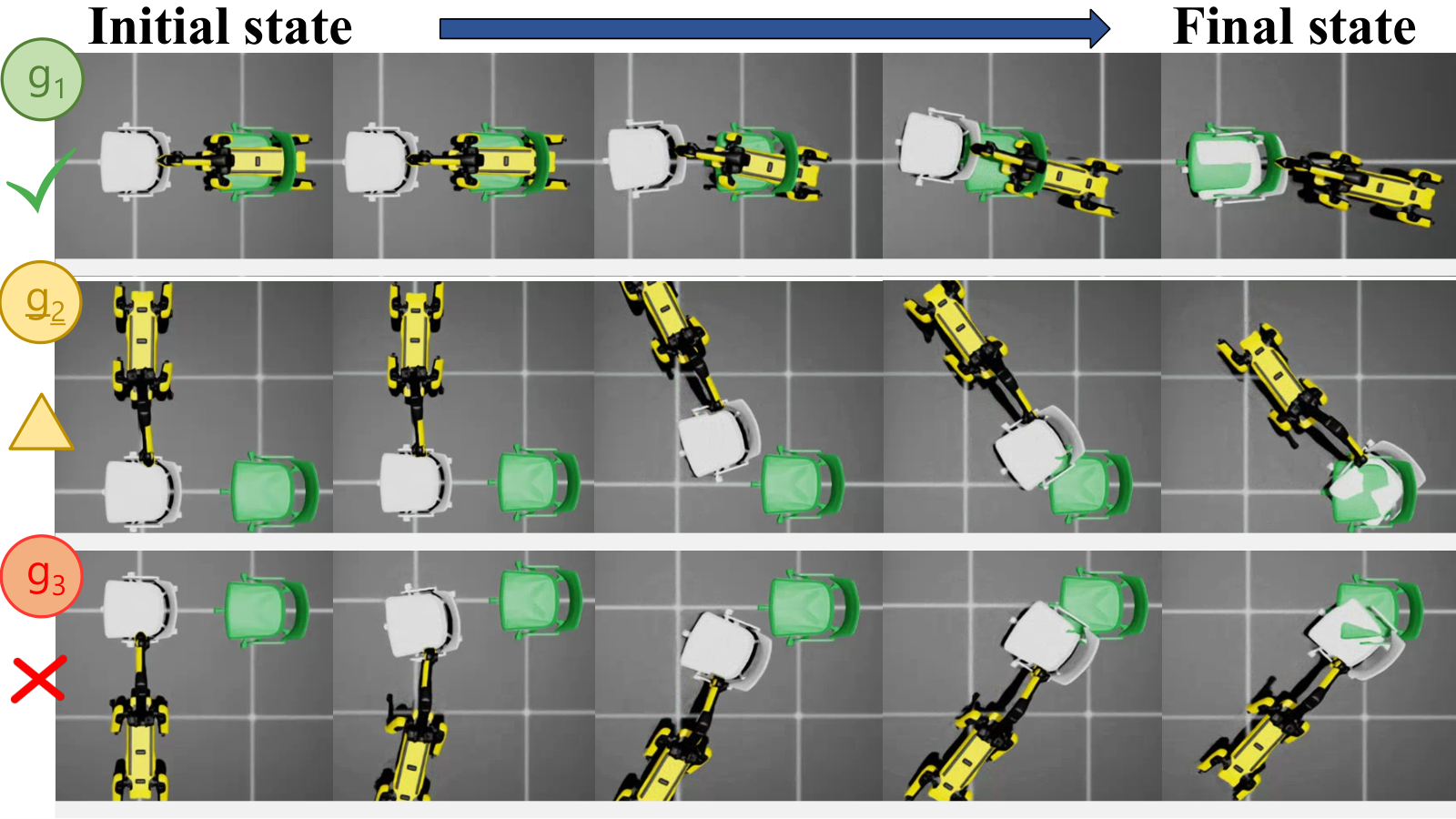
The authors train a unified PPO reinforcement-learning policy for goal-conditioned large-object rearrangement across multiple initial grasp configurations, then distill the learned critic into a lightweight grasp utility network. At inference, the system ranks candidate grasps using only grasp configuration and goal information, selecting the most promising grasp before contact to improve downstream loco-manipulation success.
中文摘要: 本文针对移动操作机器人进行大物体重排时的抓取选择问题,提出Grasp-TAGS框架。作者首先在多种初始抓取构型下训练一个统一的PPO强化学习策略,完成目标条件化的移动操作任务;随后将学习到的评论家网络蒸馏为一个轻量级抓取效用网络,该网络仅依赖候选抓取构型与目标信息即可预测下游任务性能。推理阶段,机器人无需接触物体即可对候选抓取进行排序并选取预测效用最高的抓取,从而提升后续重排任务的成功率。该方法将critic蒸馏与任务感知抓取规划结合,兼顾了学习策略的泛化性与推理效率。
💬 Nice demonstration that critic distillation can encode task-level grasp utility for loco-manipulation; the multi-grasp training and pre-contact selection idea is transferable to legged platforms carrying manipulators.
💬 该工作很好地展示了评论家蒸馏能够编码面向移动操作的任务级抓取效用,多抓取训练与接触前选择思路可迁移到搭载机械臂的足式平台。
Why read it / 推荐理由: Although manipulator-focused, its task-aware, pre-contact grasp selection pipeline offers a useful template for coordinating locomotion and end-effector decisions on legged robots. 尽管以机械臂为主,其任务感知、接触前抓取选择流程为足式机器人协调运动与末端执行器决策提供了可借鉴的范式。
2. Polarization calibration of fisheye cameras using skylight in the wild
利用野外天空光的鱼眼相机偏振标定
Authors / 作者: Shuo Wang, Shiqi Che, Dianze Dong, Wenxin Liu
arXiv: 2611.08911 · PDF
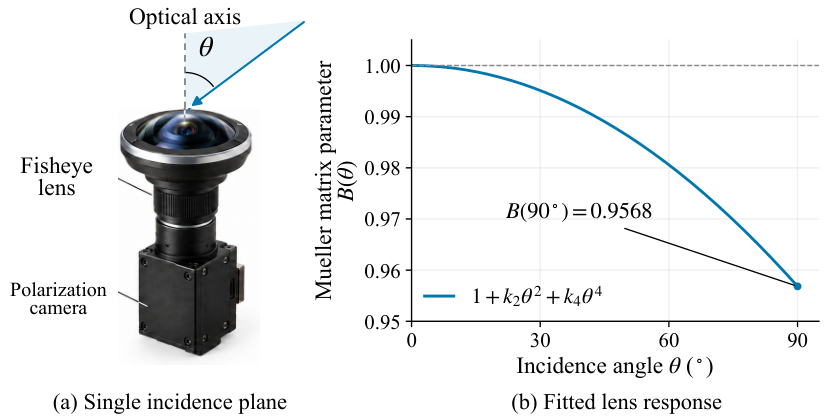
The paper presents a joint lens-analyzer calibration that models incidence-dependent lens transmission together with analyzer gains and angular offsets in an eight-parameter formulation, requiring only a short handheld outdoor skylight sequence. On real outdoor data it achieves weighted cross-frame AoLP error below 0.5 degrees and generalizes without refitting, with preliminary quadruped-mounted solar-azimuth experiments showing improved heading alignment.
中文摘要: 本文提出一种联合镜头-分析器偏振标定方法,用统一的八参数模型同时刻画随入射角变化的镜头透射特性以及分析器的增益和角度偏差。方法仅需一段手持户外天空光序列,无需专用偏振标定设备或预定义天空偏振模型,利用帧间旋转估计与偏振方向一致性完成标定。在真实户外序列上,加权跨帧线偏振角平均绝对误差低于0.5度,对80至90度入射角区域误差降低73.4%,且在独立序列上无需重拟合即可泛化。初步的足式机器人太阳方位实验显示标定后的偏振测量与可见太阳中心对齐更好,为相对航向估计提供了支持。
💬 A practical, low-equipment polarization calibration pipeline for fisheye cameras, with an early quadruped-mounted heading experiment that hints at field-deployable terrain-relative navigation.
💬 该工作提出了低设备依赖的鱼眼相机偏振标定流程,其早期足式机器人航向实验暗示了野外可部署的地形相对导航潜力。
Why read it / 推荐理由: Polarization-based heading is a promising complement to leg odometry and IMU for legged robots operating in GNSS-denied outdoor terrain, and this calibration lowers the barrier to trying it. 基于偏振的航向估计可作为足式机器人在无GNSS野外环境中腿式里程计与IMU的有力补充,而该标定方法降低了尝试门槛。
3. Building World Models from Intrinsic Motivation
通过内在动机构建世界模型
Authors / 作者: Reece Keller, Declan Kutscher, Xaq Pitkow, Aran Nayebi
arXiv: 2611.13113 · PDF
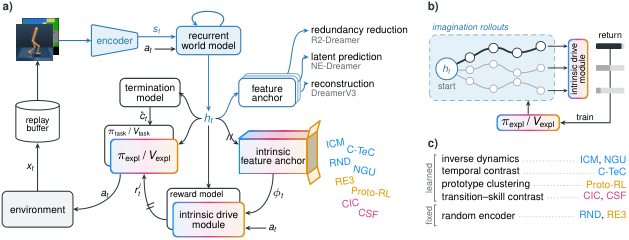
The authors integrate 24 intrinsic objectives into a common model-based RL framework and evaluate the resulting world models via zero-shot, few-shot and multi-task control in locomotion, manipulation and open-ended games, comparing observation reconstruction, latent prediction and redundancy reduction. Curiosity-driven exploration with observation reconstruction gives the strongest aggregate profile, though the best pairing is experiment-dependent, and episodic plus lifelong novelty signals are complementary in compositional vision tasks.
中文摘要: 本文在统一的基于模型的强化学习框架中集成24种内在动机目标,涵盖好奇心、熵与胜任力等经典方法及其显式变体,并比较观测重建、隐空间预测与冗余缩减三种表征学习策略。作者在运动控制、操作与开放式游戏环境中通过零样本、少样本与多任务控制评估所构建的世界模型。结果表明,好奇心驱动探索结合观测重建在总体上表现最强,但最佳组合因实验而异;在组合式视觉任务中,来自情节性与终身新颖性的内在动机信号具有互补性,有助于构建可复用的世界模型。
💬 A broad systematic study of how intrinsic objectives shape world-model representations, relevant to sample-efficient locomotion learning but more of a benchmark-style analysis than a new controller.
💬 该文系统研究了内在动机目标如何塑造世界模型表征,对样本高效的运动学习有参考价值,但更偏向基准式分析而非新控制器设计。
Why read it / 推荐理由: It offers evidence for which self-supervised exploration signals yield reusable dynamics models, informing sim-to-real RL pipeline choices for legged locomotion. 它为哪些自监督探索信号能产生可复用的动力学模型提供了证据,可指导足式运动RL流程中的sim-to-real设计选择。
4. SIGMO: Sigmoid Gated Interaction-Aware Motion Planning
SIGMO:Sigmoid门控的交互感知运动规划
Authors / 作者: Avinash Singh, Manish Saroya, Fatemeh Cheraghi Pouria, Faizan Tariq, Jovin D’sa, David Isele et al.
arXiv: 2611.14414 · PDF
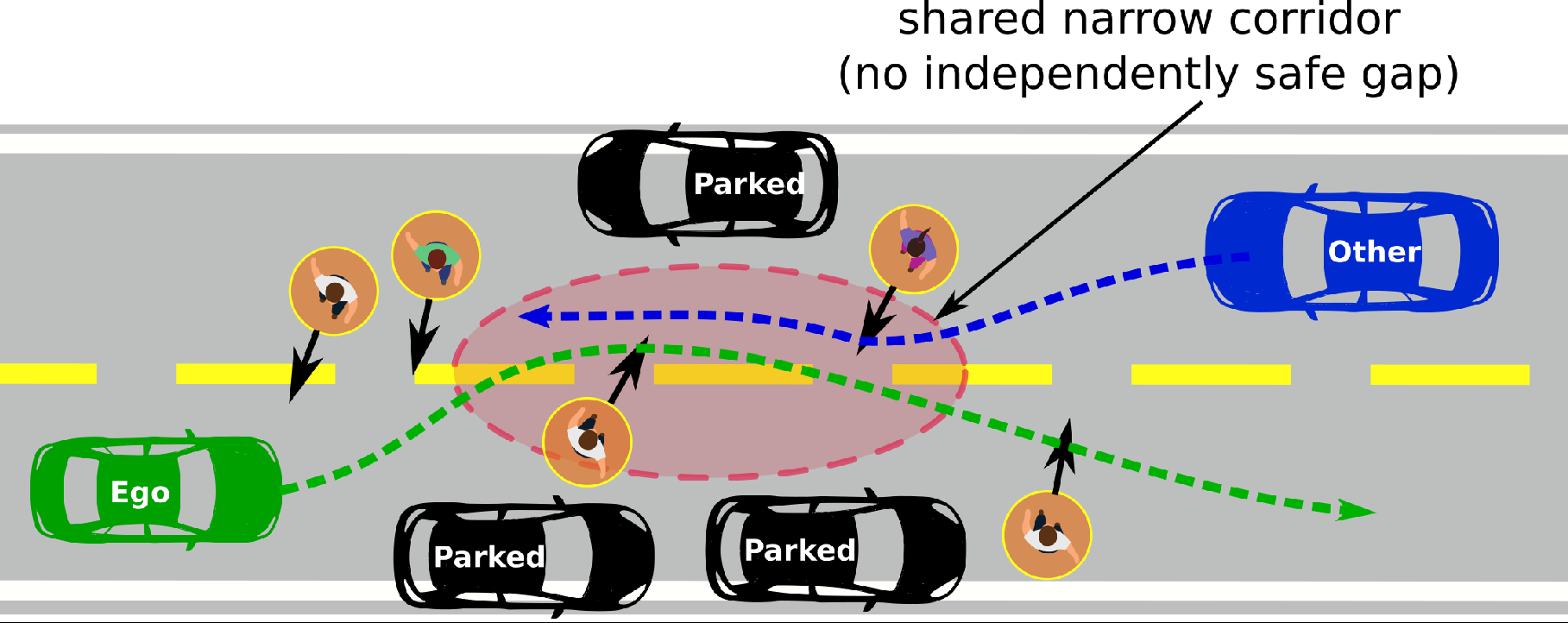
SIGMO formulates polynomial sigmoid functions that analytically estimate the yield scores of surrounding agents from physics-grounded interaction features, and integrates them into a receding-horizon planner to enable interaction-aware planning with arbitrary trajectory predictions. Simulations and hardware experiments show it balances proactive and defensive behavior while remaining computationally lightweight.
中文摘要: 本文提出SIGMO,一种sigmoid门控的交互感知运动规划器。作者用多项式sigmoid函数基于物理意义上的交互特征解析地估计周围智能体的让行得分,并将其集成到滚动时域规划框架中,从而在任意轨迹预测下实现交互感知规划。该策略具备对多智能体的可扩展性、对其他智能体行为变化的适应性,并与周围交通保持协调而不过度保守或僵死。交互密集的仿真与硬件实验表明,SIGMO在保持计算轻量的同时取得了主动性与防御性行为的平衡,可作为实时规划组件。
💬 The yield-score gating idea is compact and interpretable; while aimed at autonomous driving, it maps naturally onto receding-horizon whole-body planners that must reason about other agents.
💬 让行得分门控思路简洁且可解释,虽面向自动驾驶,但可自然映射到需推理其他智能体的滚动时域全身规划器中。
Why read it / 推荐理由: Its lightweight, interpretable interaction modeling inside a receding-horizon planner is directly transferable to MPC-style local planning for mobile and legged platforms in cluttered spaces. 其在滚动时域规划器内轻量且可解释的交互建模,可直接迁移到移动与足式平台在杂乱空间中的MPC式局部规划。
5. Q-OIL: Optimistic Exploration in Learning from Human Interventions
Q-OIL:人类干预学习中的乐观探索
Authors / 作者: Pranav Teegavarapu, Sriyash Poddar, Rico Qi, Cleah Winston, Krisha Khandelwal, Aykut Onyol et al.
arXiv: 2611.08576 · PDF
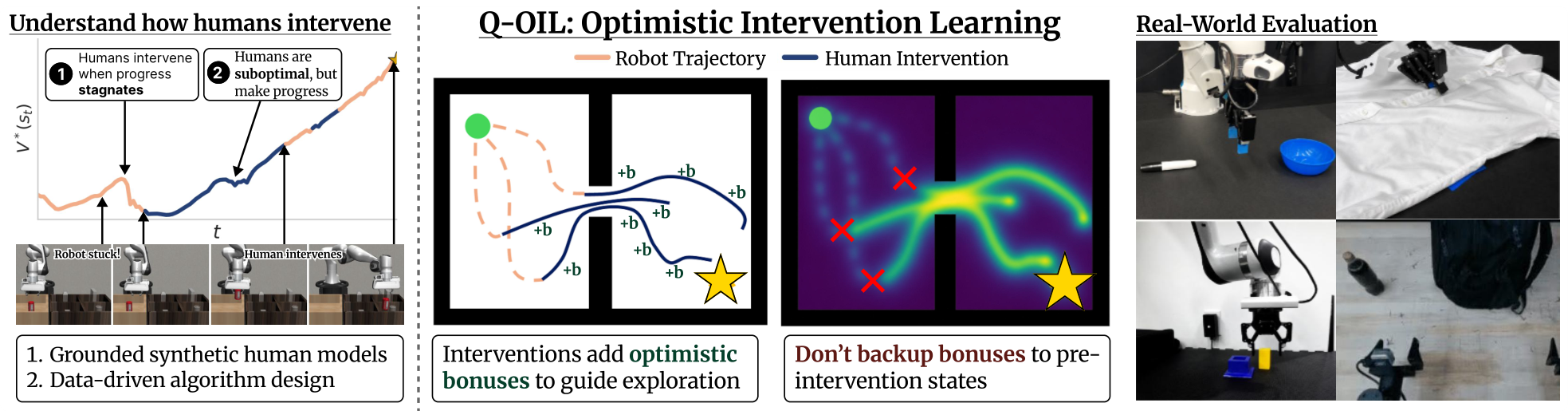
Analyzing real human interventions, the authors find people intervene when progress stalls and their corrections are often suboptimal, and they propose a progress-based intervention model that better matches real-user algorithm rankings. Q-OIL adds optimistic bonuses to intervention transitions with decoupled critics for stability, yielding 10-50% higher success in simulation and on real robots and improving pretrained VLAs.
中文摘要: 本文通过分析真实人类干预数据发现,人类往往在智能体进展停滞时介入,且其纠正动作常常并非最优。据此作者提出基于进展的干预模型,使仿真中的算法排序与真实用户排序具有更高秩相关,从而支持更真实的基准评测。Q-OIL方法在干预转移上加入乐观奖励并柔性地引导探索朝人类纠正方向进行,同时采用解耦评论家以避免乐观奖励回传到干预前状态、保证训练稳定。实验表明,Q-OIL在仿真与真实机器人上取得比竞争基线高10至50%的成功率,并能改进预训练的视觉-语言-动作模型。
💬 Interesting real-robot evidence that intervention models must reflect stall-triggered suboptimal human corrections; the decoupled critic trick is a neat fix for stability.
💬 该文提供了真实机器人证据,说明干预建模需反映由停滞触发的次优人类纠正;解耦评论家技巧是提升稳定性的巧妙修正。
Why read it / 推荐理由: Human-in-the-loop RL is valuable for bootstrapping legged policies in the real world, and the sim-human model mismatch findings are worth heeding. 人在回路RL对在真实世界中引导足式策略很有价值,其关于仿真人类模型失配的发现值得重视。